Imagine standing in your newly built home in Meerut or a luxury apartment in Noida, ready to apply that perfect “Moonlit Silk” finish. You’ve budgeted for the paint, but suddenly you’re hit with a dilemma: did you buy too much, leading to environmental waste, or too little, causing a “patchy” disaster where the second batch doesn’t quite match the first? In 2026, where sustainability and “Quiet Luxury” define Indian home improvement, knowing how to calculate paint quantity is no longer a luxury—it is a critical financial skill that separates a professional renovation from a costly headache.
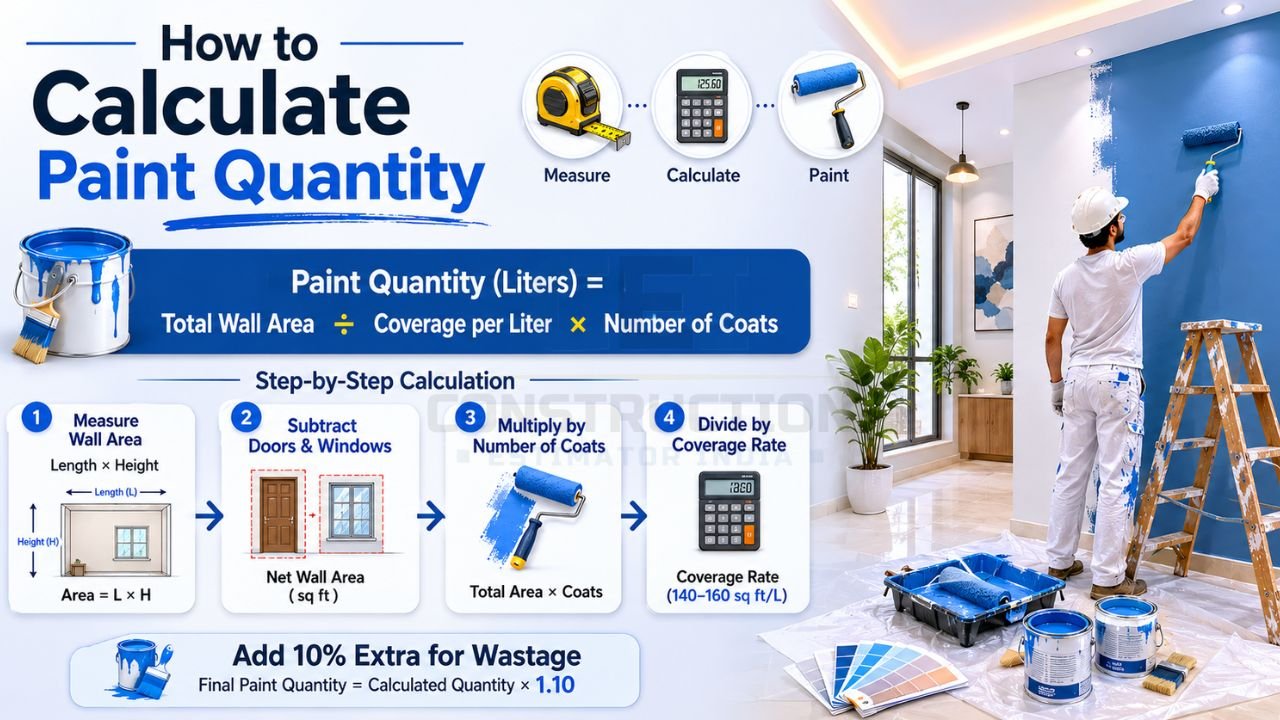
The direct answer to how to calculate paint quantity for your project is a simple formula: Total Surface Area (sq. ft.) ÷ Paint Coverage Rate (sq. ft. per Litre). However, achieving a professional-grade Bill of Quantities (BOQ) requires adjusting for surface porosity, the number of coats required for specific pigments, and India’s unique humidity factors.
👉 Get Accurate Paint Estimates & Professional Wall Finishes with Expert Painting Services.
At Construction Estimator India, we have seen how a minor error in quantity calculation can swing a project budget by 15–20%. Using our 10+ years of construction estimating expertise, we have developed this definitive guide to help you calculate paint like a pro.
For accurate paint quantity calculation or full BOQ for your painting project in India, WhatsApp or call us today at +91 8630676890.
2026 Paint Quantity Quick Reference
| Surface / Paint Type | Standard Formula | 2026 Avg. Coverage (2 Coats) | Expert Tip |
|---|---|---|---|
| Interior Walls (Emulsion) | (L × H) – Deductions | 130–160 sq. ft. / Litre | Royale Glitz covers more |
| Ceiling | Length × Width | 120–140 sq. ft. / Litre | Use matte to hide defects |
| Exterior Walls | Total Area × 1.2* | 50–70 sq. ft. / Litre | Factor in surface texture |
| New Drywall | Area ÷ Coverage | 110–130 sq. ft. / Litre | Thirsty! Needs high-build primer |
*Multiplication factor for exterior textures and undulations.
👉 Avoid Paint Wastage & Get Smooth, Long-Lasting Wall Finishes with Professional Painters.
Why Accurate Paint Quantity Calculation Matters for Your BOQ
In the world of professional interior painting estimation services, precision is everything. Most contractors provide a “rough estimate,” but a detailed BOQ ensures you aren’t overcharged for material that ends up in a landfill.
- Material Wastage Reduction: Accurate calculations typically save our clients 10–15% on wasted material costs.
- Labor Efficiency: A third coat adds 33% more labor time. Knowing if you need that coat beforehand allows for better scheduling.
- Color Consistency: Buying all your paint in one “batch” ensures there is no “Metamerism” (color shift) between different production runs.
- Budget Integrity: Paint can account for a significant portion of the interior painting cost per sq ft in India 2026.
Step-by-Step Guide: How to Calculate Paint Quantity for Walls
To determine how to calculate paint quantity for walls, follow this technical sequence used by the experts at Construction Estimator India:
Step 1: Measure Gross Wall Area
Measure the length and height of every wall in the room.
- Formula: Length × Height = Area (per wall).
- Add the areas of all four walls together to get the Total Gross Area.
Step 2: Calculate Deductions
You don’t paint doors, windows, or wardrobes.
- Standard Door Deduction: 21 sq. ft. (7ft × 3ft).
- Standard Window Deduction: 12 sq. ft. (4ft × 3ft).
- Subtract these from your Gross Area to get the Net Paintable Area.
Step 3: Account for Primer
For new walls or significant color changes, 1 coat of primer is non-negotiable. Primer coverage is generally higher (180–200 sq. ft. / Litre) than finish paint.
Step 4: Division by Coverage Rate
Divide your Net Paintable Area by the spreading rate of your chosen paint brand. Always refer to the official 2026 paint coverage standards in India for technical accuracy.
Calculating Paint for Ceilings, Doors, and Trims {#ceiling-doors}
Calculating paint for ceilings and wood surfaces requires a different approach than masonry walls.
The Ceiling Strategy
Ceilings are often porous and face no physical contact, meaning two coats of a budget-friendly distemper are usually sufficient.
- Formula: Room Length × Room Width = Ceiling Area.
- Expert Insight: Since ceilings often hide minor masonry defects, we recommend matte finishes which require about 10% more paint than high-gloss options due to their absorption rates.
Doors and Wooden Trims
Wooden doors are “high-touch” statements.
- PU vs. Enamel: Polyurethane (PU) finishes are luxury standards for 2026, but they are thinner and require more coats.
- Quantity Rule: For a standard 7×3 door, 1 Litre is typically sufficient for 2 coats on both sides.
For accurate paint quantity calculation or full BOQ for your painting project in India, WhatsApp or call us today at +91 8630676890.
👉 Transform Your Home with Accurate Paint Planning, Elegant Colours & Expert Craftsmanship.
2026 Coverage Rates: Asian Paints, Berger, and Nerolac
One of the biggest variables in how to calculate paint quantity is the brand performance. High-solids paints cover more area with less volume.
| Brand & Product | 2026 Avg. Coverage (2 Coats) | Best Use Case |
|---|---|---|
| Asian Paints Royale Glitz | 145–165 sq. ft. / L | Luxury Living Rooms |
| Berger Silk Breathe Easy | 135–155 sq. ft. / L | Health-conscious Bedrooms |
| Nerolac Impressions Ideo | 130–150 sq. ft. / L | Modern High-Rise Flats |
| Dulux Velvet Touch | 125–145 sq. ft. / L | High-Traffic Corridors |
For technical specifications, always review the Asian Paints 2026 paint coverage rates or the latest 2026 paint coverage guidelines by Berger and Nerolac.
The Dark Pigment Factor: When 2 Coats Aren’t Enough
The 2026 trend toward “Desert Terracotta” and “Deep Navy” has a significant impact on quantity. These organic pigments have lower “hiding power.”
- The 3rd Coat Rule: If you are opting for a deep accent wall, budget for at least 3 coats to avoid “streaking” and ensure the velvety depth seen in luxury catalogs.
- Quantity Increase: A 3rd coat increases your material purchase by exactly 50% for that specific wall.
- BOQ Tip: We use our 10+ years of expertise to include a 5–10% wastage buffer in every BOQ to account for deep-base saturation.
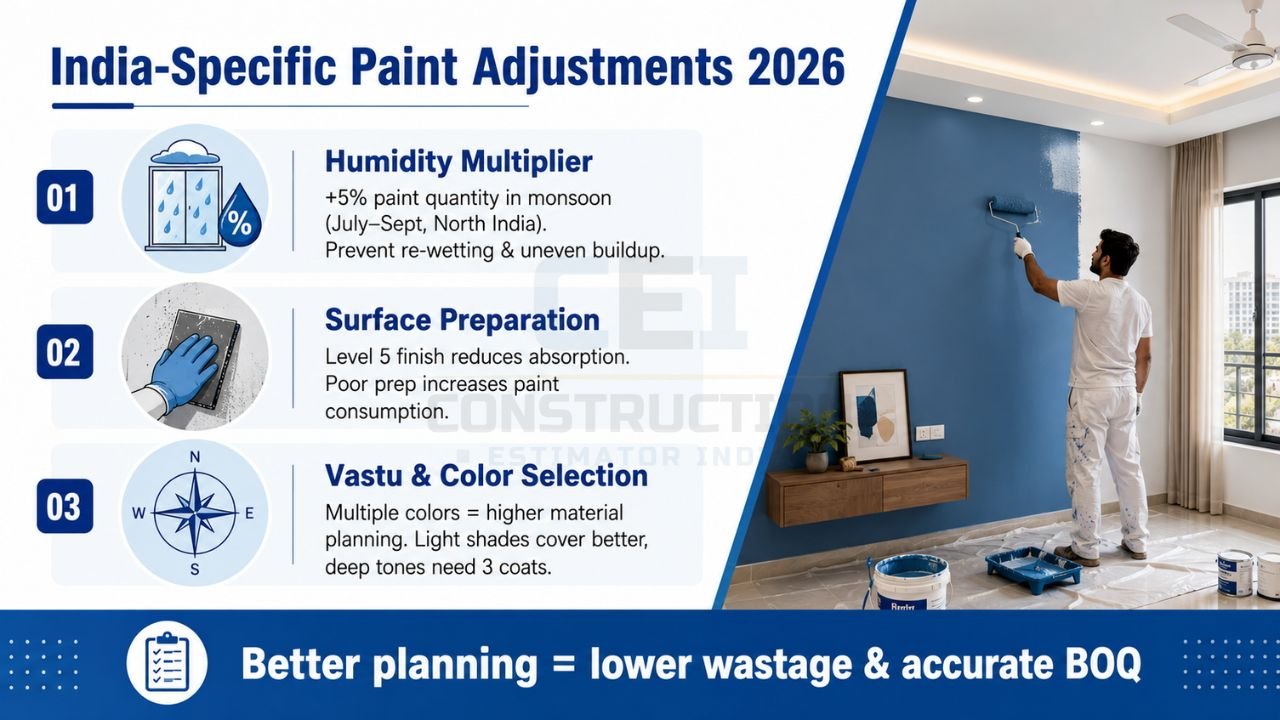
India-Specific Adjustments: Humidity, Monsoon, and Vastu
At Construction Estimator India, based in Meerut, we know that the North Indian climate dictates technical choices.
The Humidity Multiplier
In high-humidity regions or during the monsoon, paint takes longer to cure. If you apply a second coat too early, the first coat may “re-wet,” leading to higher consumption as the paint builds up unevenly. We recommend increasing your quantity estimate by 5% if painting between July and September in Uttar Pradesh or Delhi.
Surface Preparation (The Silent Quantity Killer)
If your wall hasn’t been sanded to a “Level 5 finish,” the paint will be absorbed into micro-pores rather than sitting on the surface. Refer to the CPWD guidelines for paint quantity calculation for standards on surface prep and its impact on material takeoff.
Vastu and Color Selection
Vastu Shastra often dictates different colors for different directions, which can lead to multiple small paint purchases rather than one large drum.
- North-East: Light Blue/White (High coverage).
- South-East: Pink/Orange (May require 3 coats for vibrancy).
Common Calculation Mistakes to Avoid
- Skipping Deductions: Assuming “Area = Length × Height” without subtracting doors can lead to buying 20% more paint than needed.
- Ignoring the Ceiling: Many homeowners focus on walls but forget the ceiling, which often requires a different, flatter paint type.
- Primer Neglect: Trying to use expensive emulsion as a primer is a financial disaster. Primer is 1/3 the cost and seals the wall so the paint doesn’t soak in.
- Incorrect Spreading Rates: Using the “theoretical coverage” from the back of the tin without adjusting for the “real-world” porosity of Indian masonry.
👉 Save Time, Reduce Paint Waste & Get Beautiful Wall Finishes with Professional Painting Solutions.
Professional Case Study: Calculating a 12×10 Master Bedroom
Let’s apply the principles of how to calculate paint quantity to a standard Indian bedroom.
- Room Size: 12 ft (L) × 10 ft (W) × 10 ft (H).
- Gross Wall Area: (12+10+12+10) × 10 = 440 sq. ft.
- Deductions: 1 Door (21 sq. ft.) + 1 Window (12 sq. ft.) = 33 sq. ft.
- Net Wall Area: 407 sq. ft.
- Ceiling Area: 12 × 10 = 120 sq. ft.
Material Requirement (2 Coats of Asian Paints Royale Glitz):
- Walls: 407 ÷ 150 (Avg. Coverage) = 2.71 Litres.
- Ceiling: 120 ÷ 130 = 0.92 Litres.
- Total Purchase: 4 Litres for walls (standard bucket sizes) and 1 Litre for the ceiling.
This precision is what we provide in our house construction cost estimation services.
FAQ: Real Answers for Indian Homeowners
- How do I calculate paint for a room with textured walls?
Texture paints have a higher resin content and aggregate (sand/quartz), reducing coverage by 15–20%. Divide your net area by a lower coverage rate (approx. 120 sq. ft. / L). - Does the brand of paint change the quantity needed?
Yes. Premium brands like Royale Glitz or Berger Silk have higher solids and cover more area in 2 coats compared to budget distempers which might need 4 coats for the same opacity. - How much paint is needed for 1000 sq ft in India 2026?
Assuming a 2-coat application of standard emulsion, you would need approximately 35–45 Litres of paint, depending on the number of rooms and deductions for doors and windows. - Can I use a paint quantity calculator online for India?
While online tools provide a baseline, they often miss India-specific factors like masonry porosity and monsoon humidity adjustments. For a precise BOQ, consult professional interior painting estimation services. - Does the number of coats change the quantity significantly?
Absolutely. A 3-coat specification increases your paint purchase by exactly 50% compared to a 2-coat job. - How do I calculate paint for new drywall?
Drywall is a “paint sponge”. You must use a high-quality primer first. Expect coverage to be at the lower end of the spectrum (110–120 sq. ft. / L) for the first coat. - Is it better to buy paint in 1L, 4L, 10L, or 20L containers?
Buying in bulk (20L) is generally 15–20% cheaper per Litre, but only do this if your calculation is accurate to avoid having expensive leftovers. - How much does an extra coat of paint cost per sq ft?
In 2026, an extra coat typically adds ₹5 to ₹8 per sq. ft. for labor and ₹10 to ₹15 for premium materials.
Conclusion and Expert Advice
Mastering how to calculate paint quantity is the first step toward a successful, budget-friendly home transformation. By following the 2026 standards for coverage, accounting for India’s unique climate, and subtracting the right deductions, you can ensure a flawless finish with zero waste.
However, a single calculation doesn’t exist in a vacuum. It is part of a larger financial roadmap for your home. At Construction Estimator India, we believe that the most expensive paint is the one you have to redo because of a poor initial estimate. Don’t leave your project to guesswork.
For accurate paint quantity calculation or full BOQ for your painting project in India, WhatsApp or call us today at +91 8630676890.