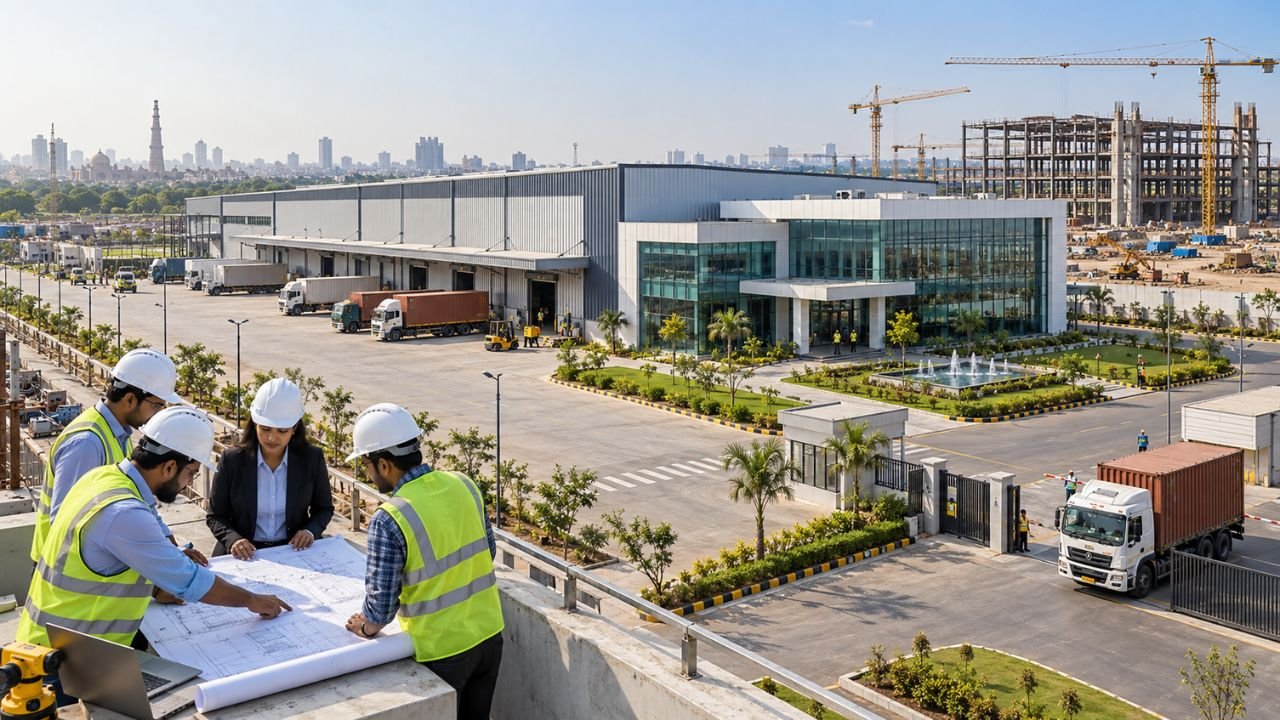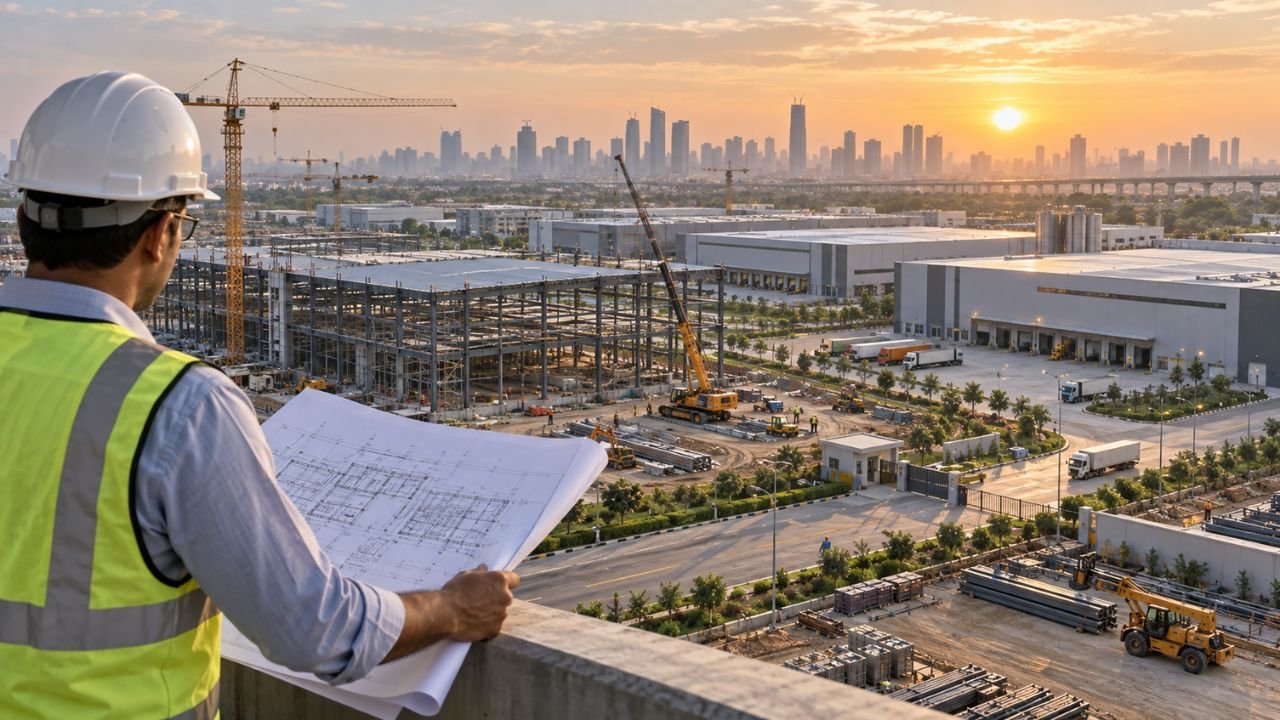
Building approval, frequently referred to as a building plan sanction or building permit, is the official legal permission granted by a local authority—such as a municipal corporation, panchayat, or development authority—to commence construction on a specific piece of land. For any homeowner learning how to plan home construction in India, the journey toward a dream home does not begin with the procurement of bricks, steel, or cement; it begins with the meticulous processing of legal paperwork. Before a single excavator touches the soil, a series of complex legal checks must be cleared to ensure the structure complies with local building bylaws and urban planning standards.
👉 Avoid Delays and Approval Issues with Professional Construction Support.
The risks of bypassing these approvals are severe. Illegal construction can lead to immediate demolition orders from municipal bodies, the refusal of bank loans, and a permanent inability to secure essential utility connections like electricity and water. Furthermore, without a valid Occupancy Certificate (OC), the building remains legally uninhabitable, significantly depleting its resale value and making it ineligible for future financial leveraging.
Conversely, securing proper approval ensures that your home is legally recognized, structurally safe, and fully compliant with seismic and fire safety norms. It facilitates easy access to home loans and guarantees that the property holds its market value. While timelines vary by region, a standard individual house approval typically takes 15–30 days, provided all documentation is accurate. Construction Estimator India offers a free approval consultation at +91 8630676890 to help you navigate this bureaucratic maze. While specific procedures might differ slightly between Delhi, Mumbai, or Bangalore, the broad path—verifying land, preparing designs, securing permits, and obtaining completion documents—remains the standard for legal residential construction services in India.
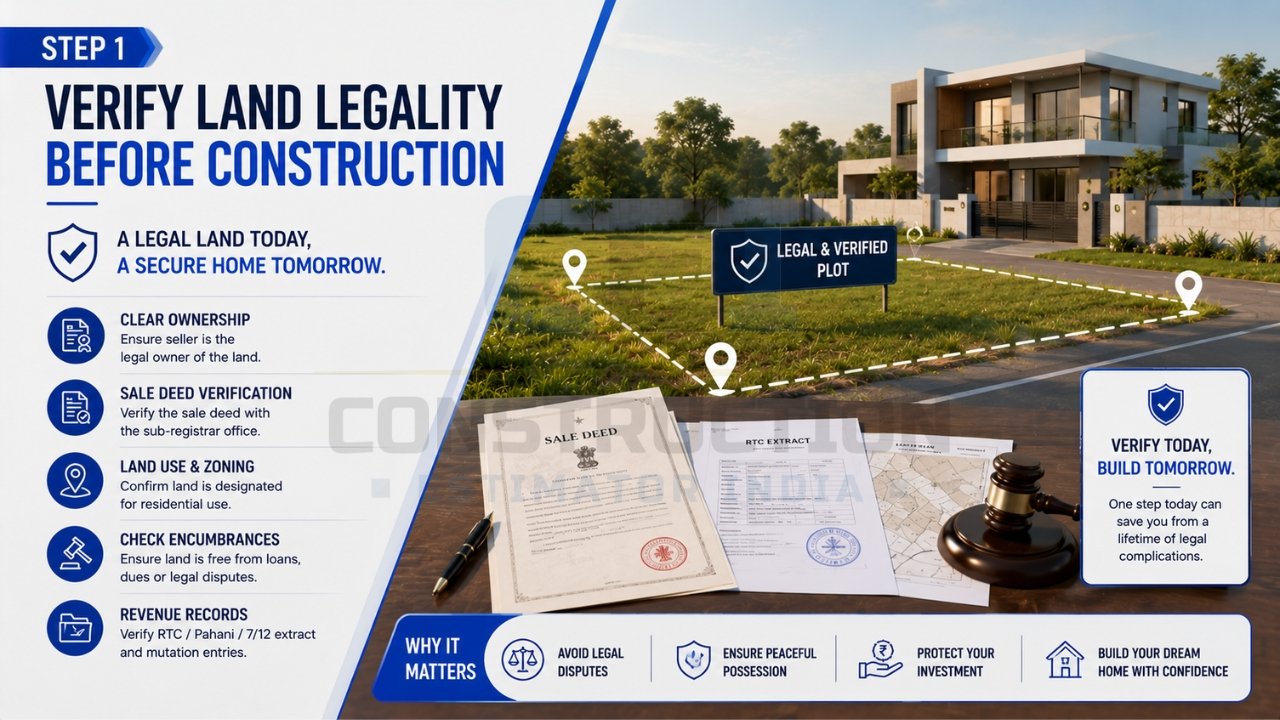
Step 1: Verify Land Legality Before Construction
The foundation of a legal home is the legality of the land itself. Before engaging an architect or applying for permits, you must ensure you have absolute, unencumbered ownership of the plot. Verification at this stage prevents catastrophic legal disputes later.
Required Document: Sale Deed / Title Deed
The Sale Deed or Title Deed is the primary document proving ownership. It records the transfer of property from the seller to you and must be registered at the Sub-Registrar’s office. Legally, this document is the “root” of your claim to the land. Verifying its authenticity takes 1–2 days, and while the cost is part of your initial purchase, ensuring you have the original or a certified copy is critical for approval applications.
👉 Build with Confidence by Understanding Every Approval Requirement.
Required Document: Patta/Chitta or Land Record
Depending on your state, land records are known by different names—Patta or Chitta in Tamil Nadu, Registry in Karnataka, or Khata in Kerala. This document is a government record proving that the land is registered in your name in the revenue department’s books. It is essential for proving the land’s dimensions and type. Obtaining an updated copy typically costs ₹500–₹2,000 and takes 3–7 days.
Required Document: Encumbrance Certificate (EC)
An Encumbrance Certificate proves that the land is free from any legal disputes, active mortgages, or unpaid loans. For construction approval, authorities usually require an EC for a minimum period of 13 years, though some states request records dating back 30 years. This protects you and the municipal body from future third-party claims. The cost is approximately ₹500–₹1,500, with a timeline of 7–15 days.
Required Document: Mutation & Property Records
Mutation involves updating the local municipal records to reflect the change in ownership. Without a mutation entry, you cannot apply for a building sanction as the municipal records would still show the previous owner’s name. This process is legally critical for tax purposes and utility applications. It typically costs ₹500–₹2,000 and can take 15–30 days to process.
Land Use Classification: Residential vs Agricultural
One of the most common pitfalls is attempting to build on agricultural land without a Non-Agricultural (NA) conversion. Construction is only legal on land classified as “Residential” in the city’s master plan. If your land is agricultural, you must apply for a change of land use. This is a complex legal process costing between ₹10,000 and ₹1,00,000, taking anywhere from 30 to 90 days. Construction Estimator India (+91 8630676890) can help verify your land use classification during a free consultation.
Property Tax Records & Latest Tax Receipt
Municipalities will not approve a new building plan if there are outstanding taxes on the land. You must provide the latest property tax receipt to prove all dues are clear. If taxes are unpaid, you may face significant penalties before your application is even reviewed. Updating these records takes 1–3 days.
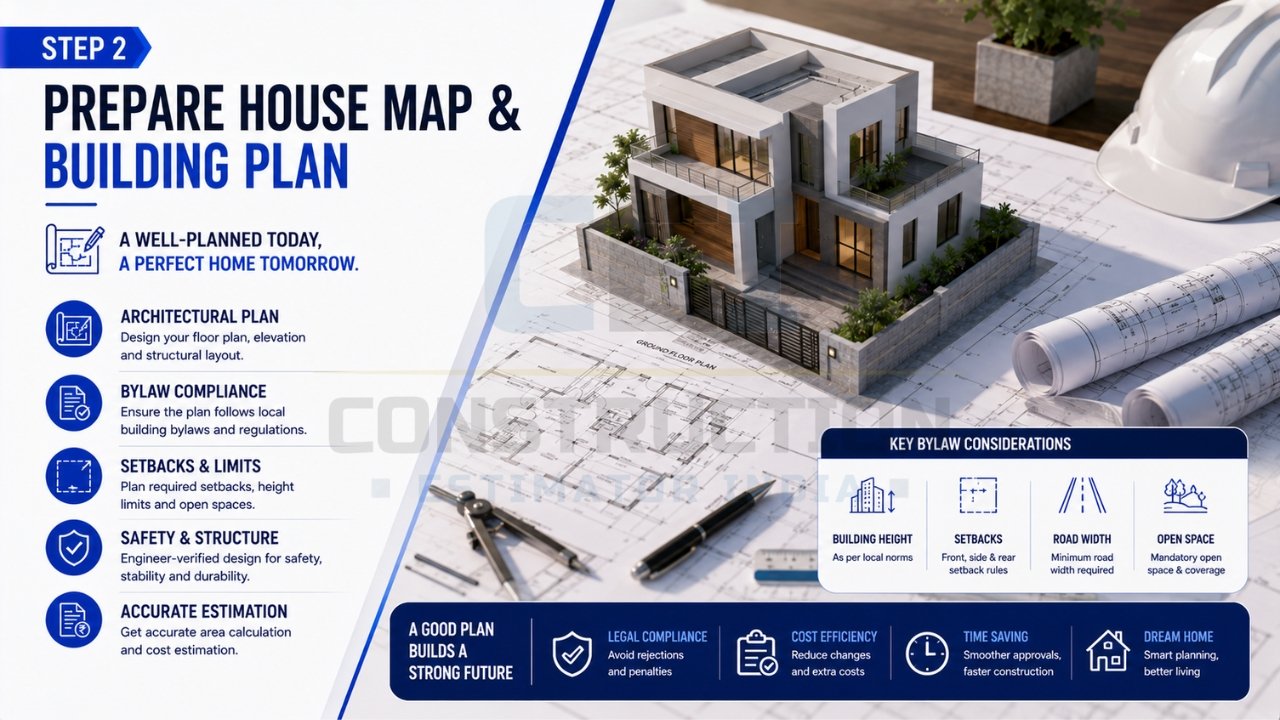
Step 2: Prepare House Map & Building Plan
Once land legality is established, the next step is translating your vision into a technical plan that complies with local building bylaws. These bylaws govern everything from the height of the building to the distance you must leave from your neighbor’s wall (setbacks).
Hire Licensed Architect or Engineer
In India, only professionals registered with the Council of Architecture (CoA) or engineers licensed by the local municipal body can sign and seal approval drawings. Engaging reputable architects and architecture firms ensures that your design doesn’t just look good but is legally “buildable” according to the Floor Space Index (FSI) and Floor Area Ratio (FAR) norms. Fees for plan design range from ₹15,000 to ₹75,000, and the process takes about 7–15 days.
Required Drawing: Site Plan
The site plan is a birds-eye view of your plot. It shows the exact boundaries, the position of the proposed house, the width of the adjacent road, and the location of neighboring structures. It is critical for the authority to verify that you are not encroaching on public land or violating setback rules. This drawing is typically scaled at 1:500 or 1:1000.
👉 Need Help with Construction Approvals? Consult Our Experts Today.
Required Drawing: Floor Plans
Floor plans provide the internal layout for each level of the house. They specify room dimensions, the placement of stairs, windows, and doors, and the thickness of walls. These must adhere to minimum room size requirements specified in the National Building Code (NBC). These are usually drawn at a 1:100 scale.
Required Drawing: Elevation & Section Drawings
Elevation drawings show the external appearance of the house from all sides, while section drawings provide a “cut-through” view to show ceiling heights, slab thickness, and foundation depth. These are necessary for the authority to verify the total height of the building and its structural logic.
Required Drawing: Structural Drawings
Structural drawings are the “bones” of your house, detailing the reinforcement steel, column placement, and beam dimensions. These must be certified by a licensed structural engineer to ensure the building can withstand its own weight and seismic forces (earthquakes). Professional structural design fees range from ₹10,000 to ₹40,000.
Required Calculation: Area Statement & FSI Calculations
Every city has a specific Floor Space Index (FSI) or Floor Area Ratio (FAR) that dictates how much you can build on a plot of a certain size. For example, in Delhi, FAR might range from 1.5 to 2.5, while in Mumbai, it can go up to 3.0 depending on the road width. Your architect must provide a detailed area statement proving compliance with these limits.
Step 3: Get Soil Test Report (Mandatory for Large Buildings)
The safety of your structure depends entirely on the soil it sits on. A soil test report, or geotechnical report, identifies the Safe Bearing Capacity (SBC) of the earth, which determines how deep and wide your foundation must be.
When Soil Test Is Mandatory
While smaller G+1 homes on small plots may sometimes skip this, a soil test is generally mandatory in India for plots exceeding 200 sq yd or for buildings planned with G+2 floors and above. In regions with “black cotton soil” (common in Delhi NCR and parts of MP), skipping this test is a major risk that leads to foundation failure and wall cracks.
Soil Test Process & Cost
A certified lab will drill bores on your site to collect soil samples from various depths for analysis. This process costs between ₹5,000 and ₹25,000 and takes about 7–15 days to generate a report. The resulting data is used by your structural engineer to design safe foundation types for house construction in India. For help finding certified labs, contact Construction Estimator India at +91 8630676890.
Step 4: Submit Building Plan Application (Online/Offline)
Most major Indian cities have transitioned to the Online Building Plan Approval System (OBPAS) to reduce corruption and speed up the approval process.
Online Portals by City
If you are building in a metro, you will likely use portals such as:
- Delhi: OBPAS.
- Bangalore: BBMP One.
- Mumbai: MCGM Portal.
- Chennai: Tamil Nadu Single Window Portal.
Online portal fees are nominal, usually between ₹500 and ₹2,000.
Upload Required Documents
You will be required to upload digital copies of your Sale Deed, Patta, EC, Tax Receipts, and all architectural and structural drawings. Additionally, you must provide an affidavit confirming the truthfulness of the information and a copy of the architect’s registration certificate. Scanning and preparing these documents professionally is key to avoiding rejection.
| Document Category | Key Items | Timeline to Prepare |
|---|---|---|
| Land Ownership | Sale Deed, Patta, EC, Mutation | 15-30 Days |
| Technical Drawings | Site Plan, Floor Plan, Structural | 7-15 Days |
| Certifications | Soil Report, Architect License | 7-10 Days |
| Tax/Legal | Tax Receipt, Affidavit, Photos | 1-3 Days |
Step 5: Pay Scrutiny Fees & Development Charges
The “Approval Fee” is actually a combination of several charges levied by the municipality for checking your plan and funding city infrastructure. Budgeting for these approvals should be factored directly into your house construction per sq ft rate.
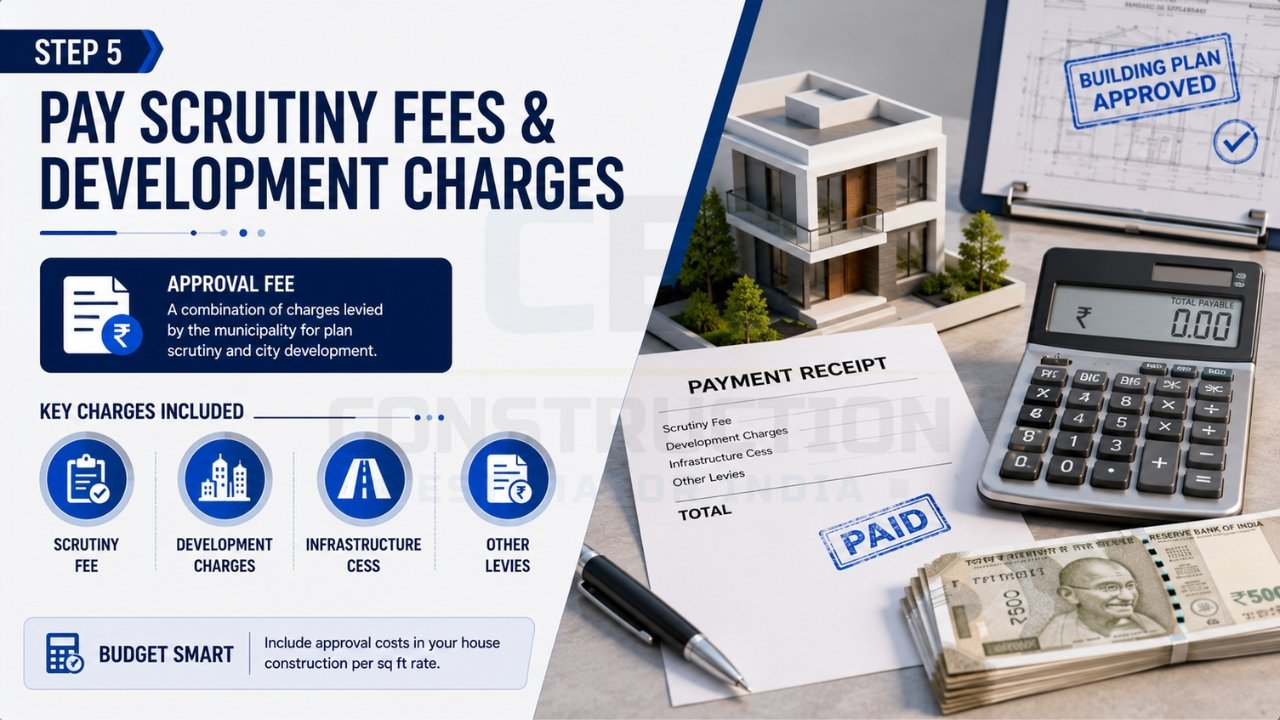
Scrutiny Fee
This is the basic fee for the authority to technically review your plan against the bylaws. It is based on your plot area and the number of floors planned. For a standard individual house, this ranges from ₹5,000 to ₹50,000.
Betterment and Development Charges
Betterment charges are collected to improve the local infrastructure around your plot, while development charges contribute to larger city-wide projects. These can be significant, ranging from ₹10,000 to ₹2,00,000 depending on the location and premium nature of the area.
👉 Stay Compliant and Keep Your Project Moving Forward with Professional Guidance.
Labour Welfare Fees & Shelter Fund
A portion of your approval cost (usually 1%) goes toward the Labour Welfare Cess, which supports construction workers. In some cities, you may also have to contribute to a “Shelter Fund” for affordable housing. Total approval fees for a luxury individual house can range from ₹50,000 to ₹5,00,000.
Step 6: Obtain NOCs from Relevant Departments
No-Objection Certificates (NOCs) prove that your proposed building does not pose a threat to public safety, aviation, or the environment.
Fire Department NOC
This is mandatory for buildings taller than 15 meters (roughly G+4 floors). It ensures that the building has adequate fire exits, extinguishers, and water storage. The process takes 15–30 days and costs between ₹10,000 and ₹1,00,000.
Airport Authority of India (AAI) NOC
If your plot is within a 10–15 km radius of an airport, you must get a height clearance NOC from the Airport Authority of India (AAI). This ensures your building doesn’t interfere with radar or flight paths. It takes 15–45 days to process.
Environmental and Utility NOCs
If you are building near a forest, river, or coastline, an Environmental NOC is mandatory, often taking 30–90 days. Additionally, you need clearances from the Electricity and Water Supply boards to ensure the city can support your new connections. These typically take 7–15 days.
Step 7: Technical Scrutiny & Site Inspection
After you pay the fees, the municipal engineers begin the technical review of your application.
Technical Scrutiny Process
Engineers check your plans for FAR/FSI compliance, ensuring you haven’t exceeded the allowed built-up area. They also verify “setbacks”—the open spaces required around your building for light and air—and parking norms. This stage can take 15–90 days depending on the city’s efficiency.
Site Inspection Process
A municipal inspector will visit your plot to verify that the boundaries match the documents and that the road width is sufficient for emergency vehicles. Any discrepancy between your “on-paper” submission and the physical site will lead to immediate rejection.
Step 8: Receive Building Plan Approval & Commencement Certificate
If everything is in order, the authority will issue the Building Plan Approval, often accompanied by a permit number.
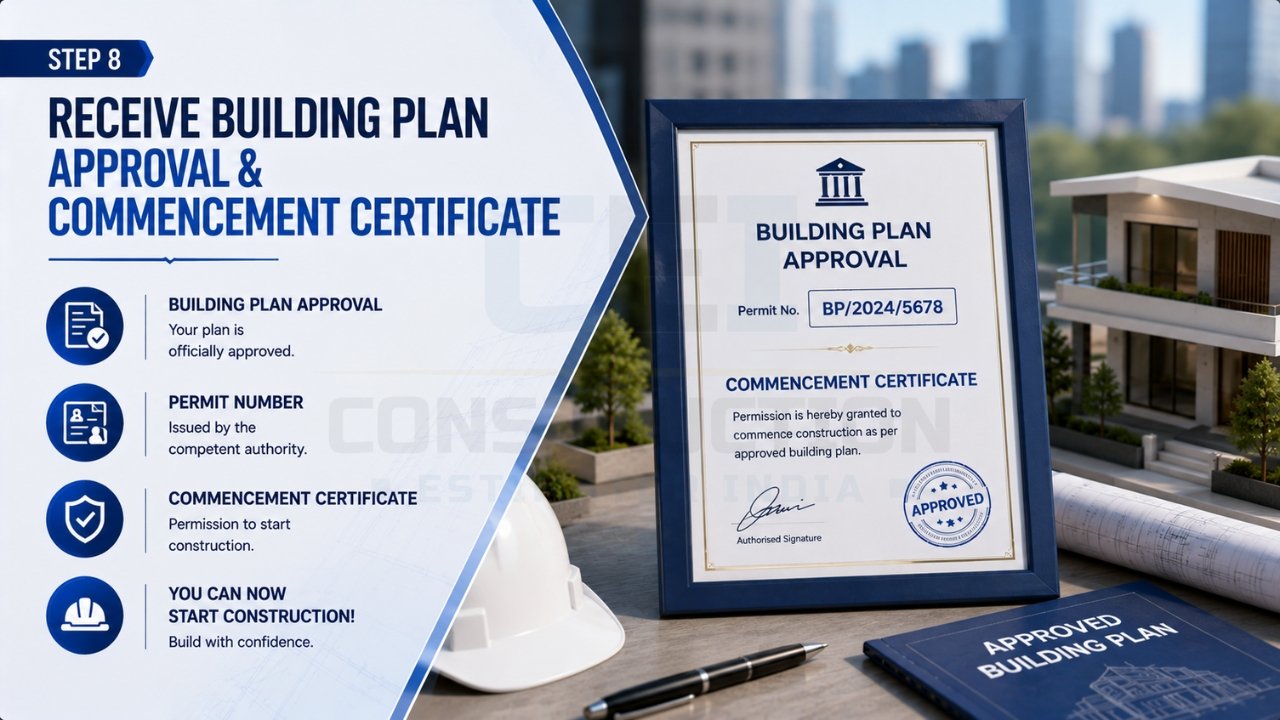
Approved Building Plan
This is your official permission to build. The approved drawings will be stamped and signed. It is usually valid for 3–5 years; if construction doesn’t reach a certain stage by then, you must apply for a renewal.
Commencement Certificate (CC)
In states like Maharashtra or Delhi, simply having an approved plan isn’t enough; you must apply for a separate Commencement Certificate (CC) before breaking ground. This is the “green light” confirming that you have met all pre-start conditions. The CC costs between ₹5,000 and ₹30,000 and takes about 7–15 days.
👉 Get Expert Assistance for a Smooth and Hassle-Free Approval Process.
Step 9: Construct as Per Sanctioned Plan
The most critical rule during construction is zero deviation. If you decide to add an extra room or balcony that wasn’t in the approved plan, your building becomes “unauthorized”.
Key Compliance Rules
You must maintain the approved setbacks and not exceed the permitted height. Deviations can lead to heavy fines or the refusal of an Occupancy Certificate later. It is highly recommended to hire reputable building contractors and have Construction Estimator India (+91 8630676890) supervise critical stages to ensure total compliance.
Inspection During Construction
Authorities may conduct inspections at the “Plinth” level (after the foundation is laid) and at the “Last Storey” level to ensure the building is coming up exactly as per the sanctioned plan. Each inspection carries a nominal fee and takes 2–3 days.
Step 10: Apply for Building Completion Certificate (CC)
Once the construction is finished, you must inform the authority and apply for a Completion Certificate (CC).
Completion Certificate Process
This document proves that the house was built strictly according to the approved drawings and structural designs. You will need to submit “as-built” photos and a structural stability certificate signed by expert civil engineers general contractors. The process takes 15–30 days and costs between ₹10,000 and ₹50,000.
Final Inspection
A municipal engineer will conduct a final walk-through to check if the height, setbacks, and FAR match the permit. If they find illegal extensions, you may be forced to demolish them before a CC is issued.
Step 11: Obtain Occupancy Certificate (OC)
The Occupancy Certificate is the most important legal document for a completed building. It is the legal permission to occupy and live in the building.
Occupancy Certificate Importance
Without an OC, you cannot legally live in your own house. It is required for permanent electricity and water connections, for securing a home loan, and for the future sale of the property. For large-scale projects registered under boards like RERA, OC issuance marks the legal handover point. Living in a building without an OC can lead to eviction and heavy municipal penalties.
OC vs CC Difference
- Completion Certificate (CC): Confirms the building is finished according to the plan.
- Occupancy Certificate (OC): Confirms the building is safe and fit for human habitation.
You must apply for the CC first, and once it is granted, apply for the OC.
👉 Start Your Construction Project on the Right Foundation with Expert Support.
When to Contact Construction Estimator India for Approval Help
Navigating the 11 steps of the Indian house approval process can be daunting for first-time homeowners. Construction Estimator India acts as your personal representative to ensure your paperwork is flawless and your approvals are fast-tracked.
You should contact us if:
- You are unsure about the legality of your land title or land-use classification.
- You need a comprehensive document checklist tailored to your specific city.
- You want professional help in coordinating with architects and structural engineers.
- You need a project timeline to understand when you can realistically break ground.
Construction Estimator India offers:
- Free Approval Consultation: Understand the legal landscape before you spend a rupee.
- Free Document Checklist: A personalized list of everything you need for your local authority.
- Free Approval Timeline Planning: A month-wise roadmap from land verification to OC.
- Contact: WhatsApp/Call +91 8630676890 to speak with an approval specialist today.
FAQs
Q1: How long does building approval take in India?
For an individual residential house, the process typically takes 15–30 days if all documents are accurate and the application is submitted through the online portal. However, complex projects or those requiring multiple NOCs (like those near airports or forests) can take 3–6 months.
Q2: What is the total cost for house construction approval?
The total cost, including scrutiny fees, development charges, and professional architect fees, usually ranges from ₹50,000 to ₹5,00,000 for a standard individual house. This varies significantly based on the city, plot size, and total built-up area.
Q3: Is building approval mandatory for individual houses?
Yes, it is strictly mandatory for all constructions, whether in a major city or a rural panchayat. Building without approval makes your home “unauthorized,” leading to potential demolition and lack of utility services.
Q4: Can I start construction before getting approval?
Absolutely not. You must wait for the Building Plan Approval and, in some states, the Commencement Certificate (CC) before breaking ground. Starting early can result in heavy fines and immediate work-stop notices from the municipality.
Q5: What happens if I construct without approval?
The local authority has the legal right to demolish the structure. Additionally, you will not receive an Occupancy Certificate, making the building legally uninhabitable and ineligible for bank loans or resale.
Q6: How long is building plan approval valid?
It is generally valid for 3 to 5 years. If construction is not completed within this timeframe, you must apply for a revalidation or extension of the permit.
Q7: What is the difference between CC and OC?
The Completion Certificate (CC) confirms that the building is constructed as per the sanctioned plan. The Occupancy Certificate (OC) confirms that the building is safe for people to live in and meets all utility and safety standards.
Q8: Do I need NOCs for small houses (G+1)?
Generally, small G+1 houses do not need NOCs from the Fire Department or AAI unless they are in restricted zones (near airports or heritage sites). However, utility NOCs for water and electricity are usually still required.
Q9: Can I modify an approved plan after approval?
Minor changes may be allowed through a “Revised Plan” application, but major changes to the building’s footprint or height require a completely new approval process. Always consult your architect before making changes.
Q10: How do I apply for approval online?
You must visit your city’s specific OBPAS portal (e.g., Delhi OBPAS or BBMP One), create an account, upload the required digital documents, and pay the scrutiny fees online.
Q11: What if my approval is rejected?
Rejections usually happen due to document errors or bylaw violations. You will receive a “Reason for Rejection” notice. You can then modify your plan to comply with the rules and resubmit the application.
Q12: How do I contact Construction Estimator India for approval help?
You can reach us via WhatsApp or Call at +91 8630676890 for a free consultation. Our experts will guide you through the document checklist and timeline planning for your specific city.
Contact Construction Estimator India for Construction Approval Services
Don’t let bureaucracy stand in the way of your dream home. Construction Estimator India provides expert legal and technical oversight to ensure your construction journey is 100% compliant from day one. We bridge the gap between complex municipal bylaws and your vision for a perfect home.
Our Core Approval Services:
- Land Legality Audits: Thorough verification of Sale Deeds, ECs, and land-use records.
- Building Plan Liaison: Working with licensed architects to ensure FSI/FAR compliance.
- NOC Coordination: Managing applications for Fire, AAI, and Environmental clearances.
- OC & CC Assistance: Ensuring you get the final legal papers to occupy your home safely.
Company: Construction Estimator India
WhatsApp/Call: +91 8630676890
Email: info@constructionestimatorindia.com
Conclusion: Get Legal Approval for Safe, Compliant House Construction
Building approval is more than just a permit; it is the official legal acknowledgment that your home is safe, compliant, and structurally sound. As we have explored, the journey toward a legal home begins with paperwork, not bricks. By following this 11-step guide—from land verification to the final Occupancy Certificate—you protect your family’s future, your financial investment, and your peace of mind.
The path is clear: verify your land, design according to bylaws, secure your NOCs, and never deviate from the sanctioned plan. While the cost for an individual house approval can range from ₹50,000 to ₹5,00,000, it is a small price to pay compared to the risk of demolition or total loss of property value. Remember, Construction Estimator India is here to help with a free approval consultation at +91 8630676890. Build smart, build legal, and build a home that lasts for generations.