Planning your next home, villa, apartment, or commercial project in 2026? Getting the electrical cost per point right is crucial if you want to avoid last‑minute budget shocks and disputes with contractors. At Construction Estimator India, we specialize in accurate electrical estimation, detailed BOQ, and complete project costing for clients across India—helping you plan with confidence and verify every quote line by line. For a, project-specific electrical estimate, message us now on WhatsApp at +918630676890
Whether you are a homeowner, builder, or contractor, this guide gives you the latest 2026 per‑point electrical rates, city-wise variations, point-wise breakdowns, quality-wise comparison, and practical calculation examples you can directly use on site. Throughout this article, you’ll also see how Construction Estimator India can prepare a professional BOQ tailored to your drawings and specifications so you always stay one step ahead of cost escalations.
Why Calculating Electrical Cost Per Point Is Important?
Most cost overruns in residential and commercial projects happen in finishing stages—electrical, plumbing, and interiors—because they were never broken down clearly at planning stage. When you calculate electrical cost per point upfront, you gain:
- Clear budget visibility: You know exactly what each light, fan, plug, DB, and MCB will cost, so you can scale up or down depending on your budget.
- Accurate BOQ for tenders: Contractors must quote against a well-defined BOQ, reducing disputes over “extra points” and hidden charges.
- Better comparison of quotations: Instead of comparing lump-sum rates, you compare contractor quotes point-wise, quality-wise, and floor-wise.
- Compliance and safety: Proper load calculation and DB design reduces overloading, tripping, and fire risks while meeting IS/IEC and NBC recommendations.
- Smart future planning: When you know the cost per additional point, you can easily add provisions for EV chargers, extra plugs, or smart automation today instead of expensive retrofits later.
For most clients, a clear per‑point BOQ from Construction Estimator India becomes the core reference document for the entire project—from site execution to final bills. To get your custom electrical BOQ, share your plans with us on WhatsApp at +91 8630676890.
👉Buy Electrical Estimate Template Bundle at ₹199 Only
Electrical Cost Per Point in India 2026 (City-wise & Point Type)
In 2026, electrical wiring and point rates have increased across India due to higher copper prices, better fire‑retardant cable demand, and rising skilled labour costs. Tier‑1 cities like Delhi NCR, Mumbai, Bangalore, and Hyderabad command higher labour and overheads, while Tier‑2 cities like Jaipur and Lucknow remain slightly cheaper but follow similar patterns.
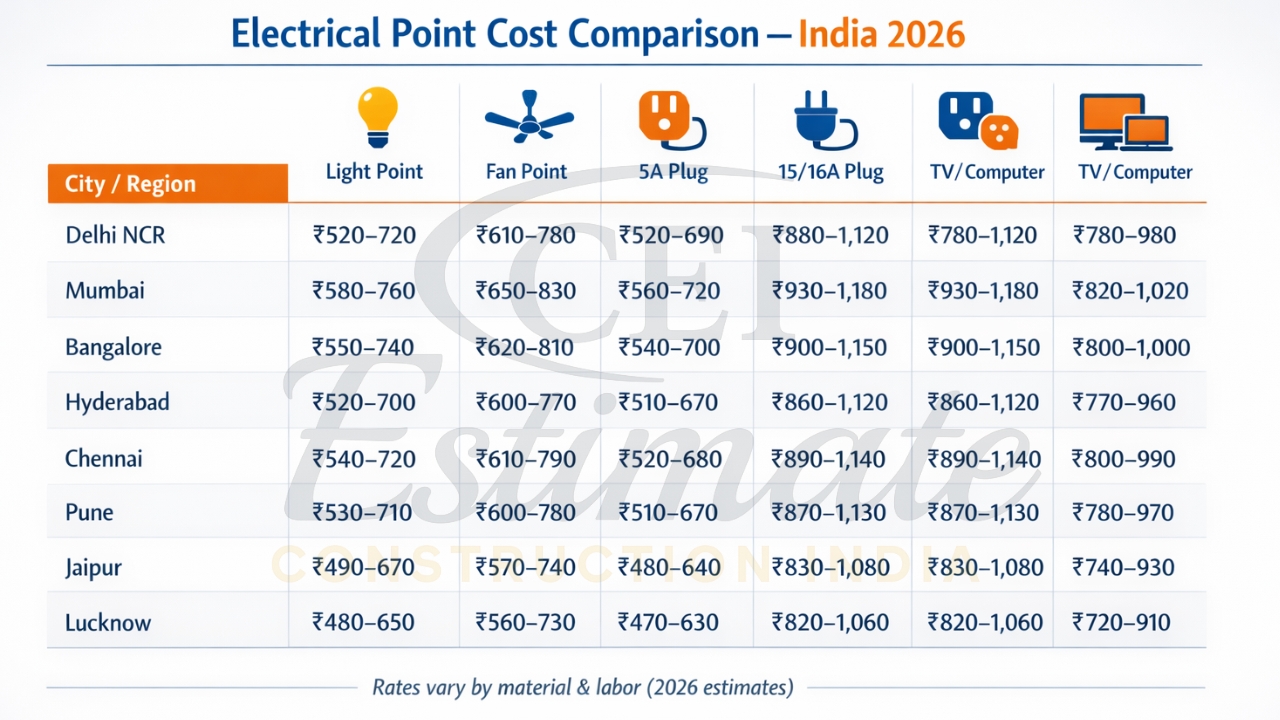
Below are realistic all‑inclusive per‑point ranges (material + labour + standard concealed wiring accessories) for residential work with mid‑range modular switches and branded FRLS copper wires.
2026 Per‑Point Electrical Cost – Major Cities (Residential, Mid-Range Quality)
| City / Region | Light Point (₹) | Fan Point (₹) | 5A Plug (₹) | 15/16A Plug (₹) | TV / Computer (₹) |
| Delhi NCR | ₹520 – 720 | ₹610 – 780 | ₹520 – 690 | ₹880 – 1,120 | ₹780 – 980 |
| Mumbai | ₹580 – 760 | ₹650 – 830 | ₹560 – 720 | ₹930 – 1,180 | ₹820 – 1,020 |
| Bangalore | ₹550 – 740 | ₹620 – 810 | ₹540 – 700 | ₹900 – 1,150 | ₹800 – 1,000 |
| Hyderabad | ₹520 – 700 | ₹600 – 770 | ₹510 – 670 | ₹860 – 1,120 | ₹770 – 960 |
| Chennai | ₹540 – 720 | ₹610 – 790 | ₹520 – 680 | ₹890 – 1,140 | ₹800 – 990 |
| Pune | ₹530 – 710 | ₹600 – 780 | ₹510 – 670 | ₹870 – 1,130 | ₹780 – 970 |
| Jaipur | ₹490 – 670 | ₹570 – 740 | ₹480 – 640 | ₹830 – 1,080 | ₹740 – 930 |
| Lucknow | ₹480 – 650 | ₹560 – 730 | ₹470 – 630 | ₹820 – 1,060 | ₹720 – 910 |
- Villas and independent houses usually work at the upper end of these ranges because of longer wiring runs and more vertical drops per point.
- High‑rise apartments with repetitive layouts may negotiate closer to the lower or mid‑range when executed in bulk.
- Commercial offices, retail, and hospitality typically run 20–35% higher per point due to higher load density, more DBs, and stricter safety requirements.
👉Buy Electrical Estimate Template Bundle at ₹199 Only
For a city‑specific per‑point sheet tailored to your building type, reach out to Construction Estimator India on WhatsApp at +91 8630676890 and get a BOQ you can share immediately with your electrical contractor.
Detailed Point-wise Electrical Cost Breakup 2026
A good electrical BOQ does not just list “light point = X”; it breaks every point into materials, wiring length, conduit, switch gear, and labour, so that you can negotiate and verify every item.
Typical Per‑Point Cost Structure (Residential, Mid-Range Materials)
| Point Type | Materials (₹) | Labour (₹) | Total Per Point (₹) | What’s Included |
| Light Point | 220 – 320 | 280 – 360 | ₹500 – 680 | 1 switch, 1 point box, 2–3 m FRLS wire, conduit, accessories. |
| Fan Point | 260 – 360 | 320 – 420 | ₹580 – 780 | 1 switch + regulator, ceiling drop box, wiring to fan point. |
| 5A Plug Point | 210 – 310 | 270 – 360 | ₹480 – 670 | 5A socket + switch, 2–3 m wire, concealed box, conduit. |
| 15/16A Plug Point | 360 – 470 | 440 – 580 | ₹900 – 1,050 | 16A socket + switch, heavier gauge wire, separate circuit where needed. |
| TV / Computer Point | 310 – 420 | 410 – 540 | ₹820 – 960 | Power point + TV/data outlet provision, extra box, conduit. |
| Exhaust Fan / Bell | 240 – 340 | 310 – 420 | ₹550 – 760 | Switch + point box, wiring to exhaust or bell, accessories. |
DB, MCB, RCCB and Earthing Cost Components (2026)
| Item | Materials (₹) | Labour (₹) | Typical Total (₹) | Notes |
| 8–12 Way DB (Single Phase) | 6,500 – 9,000 | 2,300 – 3,500 | ₹8,800 – 12,500 | Includes enclosure, busbar, basic MCB set, accessories. |
| 16–24 Way DB (Single/Three Phase) | 9,500 – 14,500 | 3,000 – 4,500 | ₹12,500 – 19,000 | For larger 3BHKs/villas, extra outgoing circuits. |
| MCB (per unit, 6–32A) | 260 – 420 | 120 – 180 | ₹380 – 600 | Branded SP/DP MCBs. |
| RCCB / RCBO (30/40A) | 1,560 – 2,700 | 460 – 700 | ₹2,020 – 3,400 | Recommended for leakage protection. |
| Earthing Set (per pit) | 4,000 – 7,000 | 1,500 – 2,500 | ₹5,500 – 9,500 | GI/CI plate or chemical earthing, salt/charcoal, testing. |
These values are realistic for 2026 and align with current material and labour trends seen across mid‑range residential projects. For premium projects and commercial schemes, the DB and protection components are often upsized, pushing these ranges higher.
Electrical Cost by Quality Level (Basic, Standard, Premium)
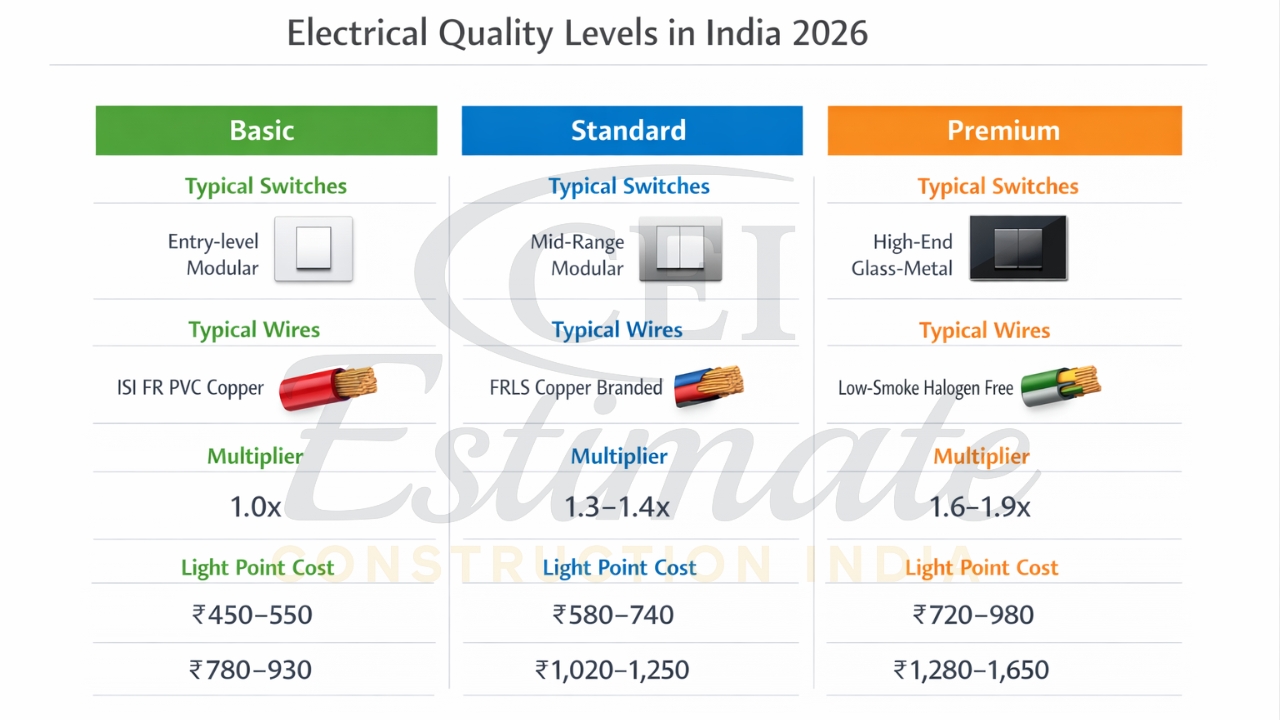
The same number of points can produce dramatically different total costs depending on the brand and grade of switches, sockets, wires, and protection devices you choose. We generally classify residential wiring into three practical bands:
Quality-wise Cost Multipliers (Indicative)
| Quality Level | Typical Switches (Examples) | Typical Wires (Examples) | Approx. Multiplier vs Basic | Light Point (₹) | 16A Point (₹) |
| Basic | Entry-level modular ranges | ISI FR PVC copper | 1.0x | ₹450 – 550 | ₹780 – 930 |
| Standard | Mid-range modular | FRLS copper, known brands | 1.3x – 1.4x | ₹580 – 740 | ₹1,020 – 1,250 |
| Premium | High-end / designer, glass / metal plates | Low-smoke halogen free, higher ratings | 1.6x – 1.9x | ₹720 – 980 | ₹1,280 – 1,650 |
- Basic is suitable for budget flats, rental properties, and small builder floors where cost is highly sensitive.
- Standard is ideal for most owner‑occupied apartments and typical individual houses.
- Premium is preferred in high‑end villas, luxury apartments, and commercial interiors where aesthetics and lifespan matter more than lowest upfront cost.
Smart switches and automation modules can add another ₹350 – 900 per controlled point depending on features (Wi‑Fi, app control, voice integration, dimming etc.).
For your drawings, Construction Estimator India can prepare three side‑by‑side BOQs (Basic vs Standard vs Premium) so that you and your client can instantly see the cost difference per point and per flat. To request this comparison, just send us your plan on WhatsApp at +91 8630676890.
👉Buy Electrical Estimate Template Bundle at ₹199 Only
👉Buy Electrical Estimate Template Bundle at ₹199 Only
Factors Affecting Electrical Cost Per Point in India
Even within the same city and quality band, two projects can end up with very different per‑point costs because of the following factors.
Building type and layout:
Compact apartments with straight shafts have shorter cable runs, whereas sprawling villas and commercial spaces have longer circuits, increasing wire and conduit quantities per point.
Number of floors and height:
With each additional floor, distribution becomes more complex—more sub‑DBs, longer vertical risers—which slightly raises per‑point cost.
Design density:
A minimalist design with fewer plug points per room costs less than a design with multiple dedicated circuits for every appliance and gadget.
Smart home and networking:
Smart switches, automation controllers, structured LAN cabling, and AV wiring significantly add to material cost per point.
Local labour rates and contractor margins:
Tier‑1 cities and organized contractors generally quote higher labour, but often provide better workmanship and warranty.
Safety and compliance level:
More RCCBs/RCBOs, surge protection, and separate earthing arrangements improve safety but increase DB and protection costs per point.
This is exactly why blindly using “standard per‑point rates” can mislead you. Construction Estimator India analyses your drawings, load schedule, and specification notes to produce a project‑specific per‑point sheet that reflects your real conditions. Share your requirements with us on WhatsApp at +91 8630676890 to get started.
Expert Tips to Reduce Electrical Cost Per Point
You do not always need to compromise on safety or aesthetics to save on electrical costs; intelligent design and procurement decisions can reduce effective per‑point cost by 15–25%.
Optimize point placement and grouping
Plan primary switching and socket clusters logically so that cable paths are shorter and fewer conduit routes are needed.
Avoid unnecessary duplication
Many layouts show “habitual” points—extra 5A points or redundant TV sockets that never get used. Rationalizing them saves both material and labour.
Standardize switch and plate sizes
Using a limited range of gang configurations and plate sizes across the project cuts wastage and simplifies installation.
Freeze specifications early
Late changes in brand or quality level can cause wastage of already‑procured material and additional labour.
Buy major materials directly, install through contractor
Many builders procure wires, switches, and DBs directly at better rates, while contractors charge primarily for labour and small consumables.
Use proper load diversity and circuit planning
A well‑engineered DB design avoids oversizing cables and breakers unnecessarily, keeping costs under control without compromising safety.
👉Buy Electrical Estimate Template Bundle at ₹199 Only
Sample Cost Calculation – 2BHK Apartment (Approx. 80–90 Points)
Assume a typical 2BHK flat in a metro with mid‑range materials:
- 30 light points × ₹580 – 700
- 10 fan points × ₹650 – 800
- 25 nos 5A plug points × ₹520 – 650
- 8 nos 16A points (AC, geyser, microwave) × ₹1,000 – 1,200
- 6 TV/computer/extra points × ₹820 – 960
- 1 main DB with RCCB + earthing: ₹16,000 – 22,000 (lump sum)
Total ballpark electrical cost (material + labour) for this 2BHK will generally fall around ₹1.7 – 2.4 lakh depending on city and fine specification.
If you’d like us to run this calculation for your actual layout, Construction Estimator India can send you a fully itemized Excel sheet with all points, lengths, and totals clearly shown. Message your floor plan and requirements to +91 8630676890 for a free, no‑obligation estimate.
How Construction Estimator India Helps You Get Accurate Electrical Estimates?
Construction Estimator India is dedicated to helping homeowners, builders, and contractors eliminate guesswork from electrical costing. Our services are structured to support you from pre‑tender stage right up to final billing:
Project-specific electrical BOQ:
We prepare a detailed BOQ for each flat, villa, or commercial floor—listing light, fan, plug, 16A, TV, data, exhaust, bell, DB items, earthing, and accessories with quantities and rates
City-wise rate alignment:
Our database is continuously updated with 2026 city-wise labour and material trends, so the rates we propose match what contractors are actually charging in your area
Quality-level scenarios:
We provide separate BOQs for Basic, Standard, and Premium options so you or your client can choose the right combination of cost and quality
Integration with civil and interior estimates:
Because we also handle civil and finishing estimates, your electrical BOQ is perfectly integrated into the overall project cost plan
Support during negotiation and execution:
Many clients ask us to review contractor quotes and change orders; we help you verify whether per‑point rates and variations are justified
If you are planning any project—new home, renovation, or commercial fit‑out—start with a professional electrical BOQ from Construction Estimator India so you know exactly what you are committing to. For a quick start, ping us on WhatsApp at +91 8630676890 and share your basic details.
Frequently Asked Questions (FAQ)
- What is the average electrical cost per sq ft in India in 2026?
For residential projects in 2026, a realistic all‑inclusive electrical cost per sq ft ranges roughly between ₹30 – 80 per sq ft, depending mainly on material quality, number of points, and city. Simple budget flats will be closer to the lower band, while premium interiors and high‑load layouts trend towards the higher side.
- How many electrical points are typically required for a 2BHK or 3BHK flat?
A standard 2BHK (800–1,000 sq ft) usually ends up with about 70–100 electrical points, while a 3BHK (1,100–1,400 sq ft) can have 100–140 points depending on design density. This includes lights, fans, plug points, 16A points, TV, data, and special purpose points like bell and exhaust.
- Are the per‑point rates the same for villas and apartments?
No. Villas and independent houses often have slightly higher per‑point rates because wiring runs are longer and more vertical drops and sub‑DBs are needed. Apartments with repetitive layouts and centralized shafts often enjoy marginally lower effective per‑point costs.
- How much extra does premium quality add to total electrical cost?
Shifting from basic to premium switches, wires, and protection can increase the electrical budget by 60–90% for the same number of points. However, many clients opt for a hybrid approach—standard quality for most areas and premium for living rooms, kitchens, and visible zones.
- What about smart switches and home automation—how do they impact cost?
Smart switches, dimmers, and automation controllers typically add ₹350 – 900 per controlled point, depending on brand and features. When applied selectively (for example only in living room and master bedroom), they can deliver convenience without inflating the entire project budget.
- Are the rates you’ve shared inclusive of GST?
Yes, unless specifically stated otherwise, the per‑point and lump‑sum ranges above are considered inclusive of GST at prevailing rates, reflecting what end users are generally paying in the market in 2026.
- How do I estimate total electrical cost for my home using per‑point rates?
You can start by counting approximate points from your floor plan, multiply each type by an appropriate per‑point rate for your city and quality, and then add DBs, earthing, and contingencies. If this feels complex, Construction Estimator India can do it for you and share a ready‑to‑use BOQ—just message us on +91 8630676890.
- Are these rates suitable for tendering and signing contracts?
These are realistic planning ranges based on current 2026 trends and should be refined into a project‑specific BOQ before you issue tender documents or sign contracts. Our team can transform these benchmarks into a formal BOQ with item codes, quantities, and rates aligned to your location and scope.
- How often do electrical material prices change?
Electrical material prices (especially cables and copper-based items) can fluctuate every few months because of commodity prices and demand cycles. For critical orders, it is advisable to reconfirm rates with your supplier just before finalizing and lock in major purchases early.
- Can you help me verify a quotation I received from my contractor?
Yes. Many clients share their contractor’s quotation with Construction Estimator India to compare it against a neutral BOQ prepared by us. This helps identify over‑pricing, missing items, or risky assumptions before you sign.
- Do you also estimate electrical cost for commercial buildings?
Absolutely. We regularly prepare detailed electrical BOQs for offices, showrooms, small industries, and institutional buildings with load schedules, DB structures, and per‑point costing tailored to commercial requirements. Commercial projects involve more complex power distribution and safety, so professional estimation adds significant value.
- How can I get a customised electrical cost estimate for my project?
Simply share your location, building type (flat/villa/commercial), and basic drawings with us on WhatsApp. Construction Estimator India will revert with a custom per‑point sheet and full BOQ, and you can continue refining it with our team—start now at +91 8630676890.
Conclusion – Plan Your Electrical Budget with Confidence
Understanding electrical cost per point in India 2026—city-wise rates, point-wise breakup, and quality-wise options—equips you to plan realistically and negotiate confidently with contractors. From individual 2BHK apartments to large villas and commercial interiors, a clear per‑point BOQ prevents cost overruns, ensures safety, and keeps everyone aligned on scope.
Construction Estimator India is your trusted partner for accurate electrical estimation, detailed BOQ, and integrated project costing across India. If you want a tailored, ready‑to‑use electrical BOQ for your project, message us right now on WhatsApp at +91 8630676890 and get expert guidance before you finalize your contractor, material, or budget.