The documents required for house construction India encompass a wide range of legal, technical, and regulatory paperwork that ensures your building is safe and compliant with local laws. Navigating the maze of house construction documents India is the first and most critical step for any homeowner or builder. Generally, these requirements are categorized into land ownership proofs, engineering designs, municipal permissions, and utility permits. While specific rules vary between states like Uttar Pradesh, Maharashtra, or Karnataka, having a core set of building construction paperwork India is non-negotiable for obtaining bank loans or avoiding government penalties. At Construction Estimator India, we provide professional support for all your documentation needs, including DPR and BOQ preparation. Contact us at +91 8630676890 for expert guidance.
What Are the Documents Required for House Construction in India? (Quick Answer)?
To ensure a seamless building process in 2026, you must organize your paperwork into five primary categories. Having these documents required for house construction India ready before you dig the first foundation pit will save you from “trial and error” financial losses.
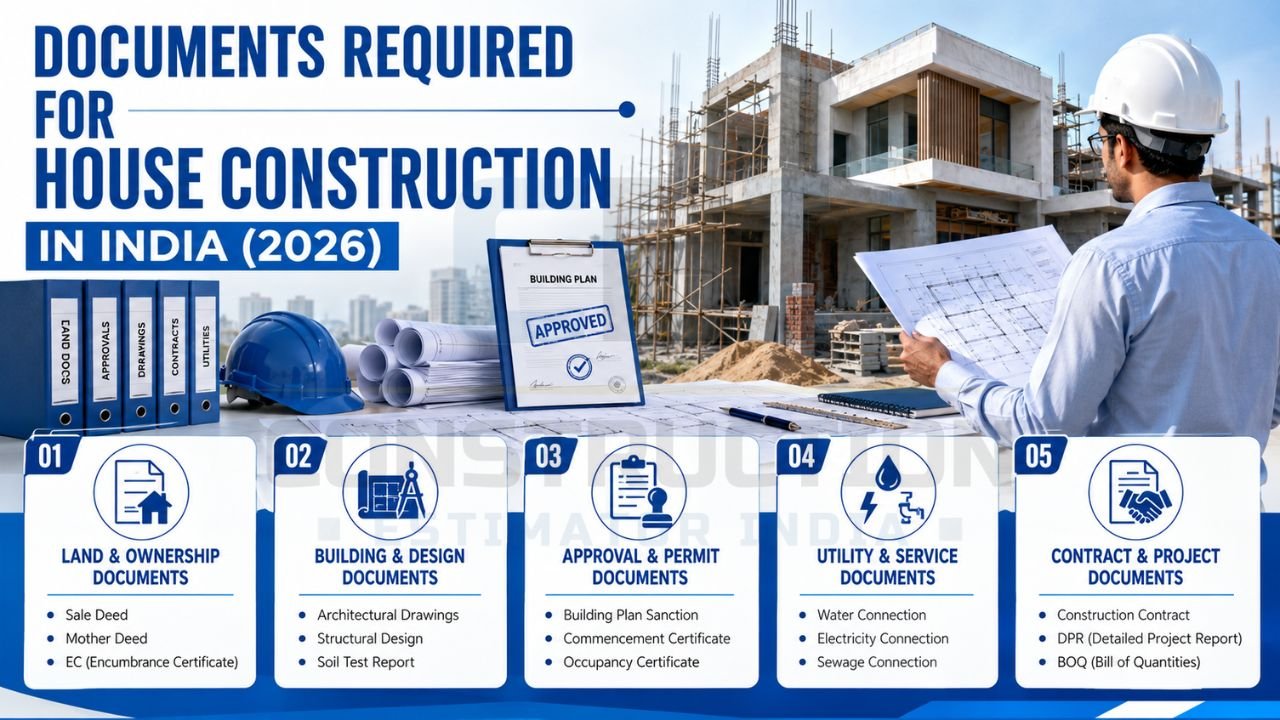
Land & Ownership Documents
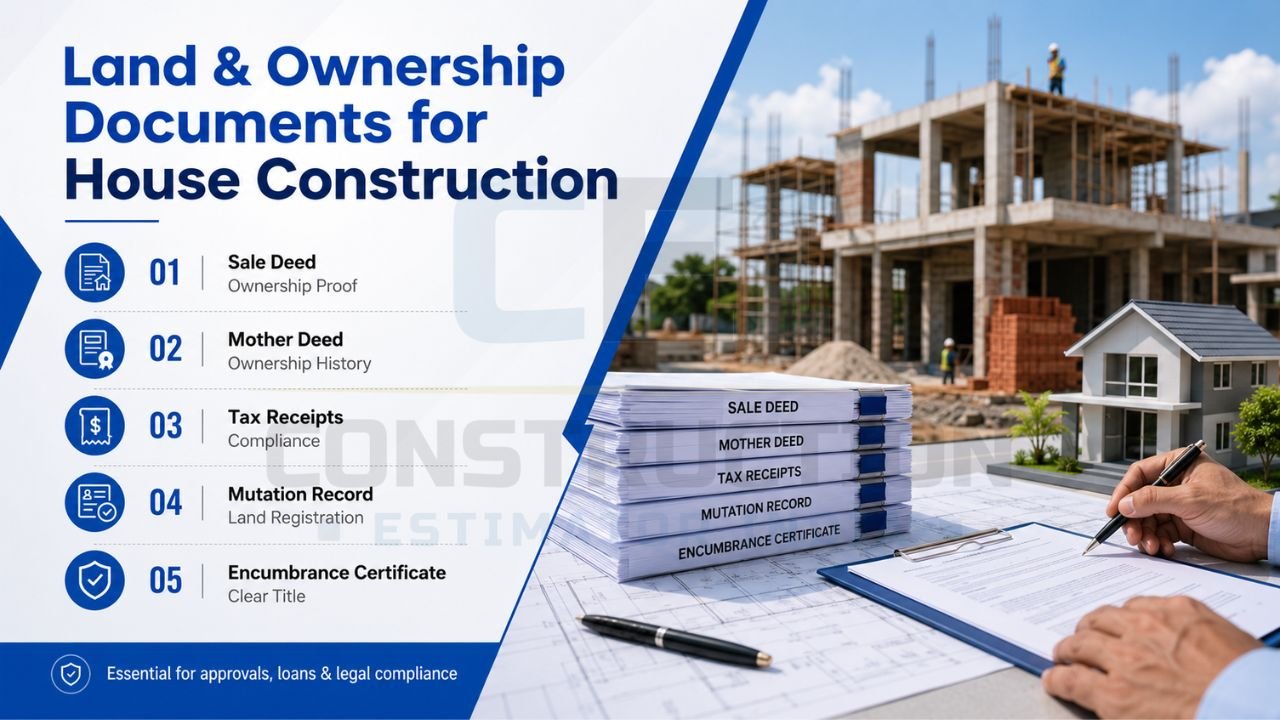
These are the legal foundations of your project. You need a Sale Deed or Title Deed to prove ownership, a Mother Deed to trace history, and an Encumbrance Certificate (EC) to ensure the land is free of liabilities. In specific states, a Mutation Document or Form I & XIV is essential for land record clarity.
Building & Design Documents
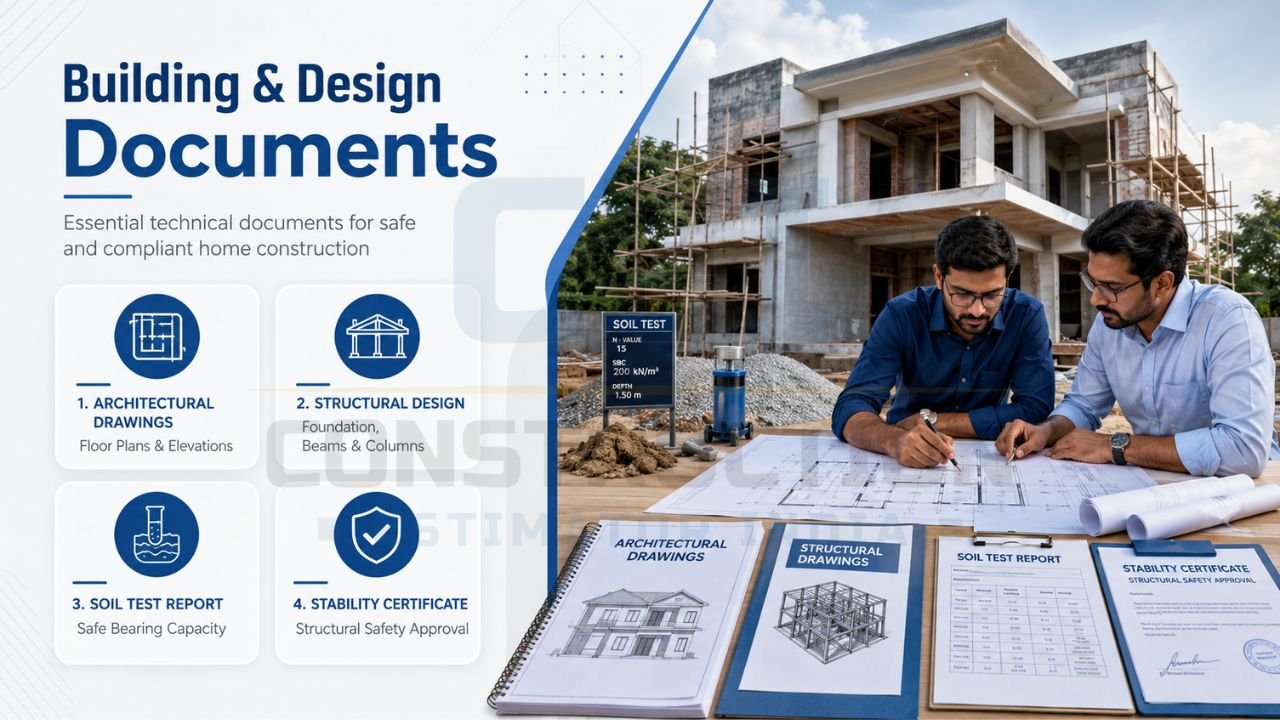
Technical accuracy is vital for safety. This includes Architectural Drawings (floor plans and elevations), Structural Design (beams and columns), and a mandatory Soil Test Report to determine foundation depth. Larger structures may also require a Structural Stability Certificate.
Approval & Permit Documents
Before starting, you need the “green light” from local authorities. This includes the Building Plan Sanction and the Commencement Certificate. After construction, you must obtain an Occupancy Certificate to legally live in the building.
Utility & Service Documents
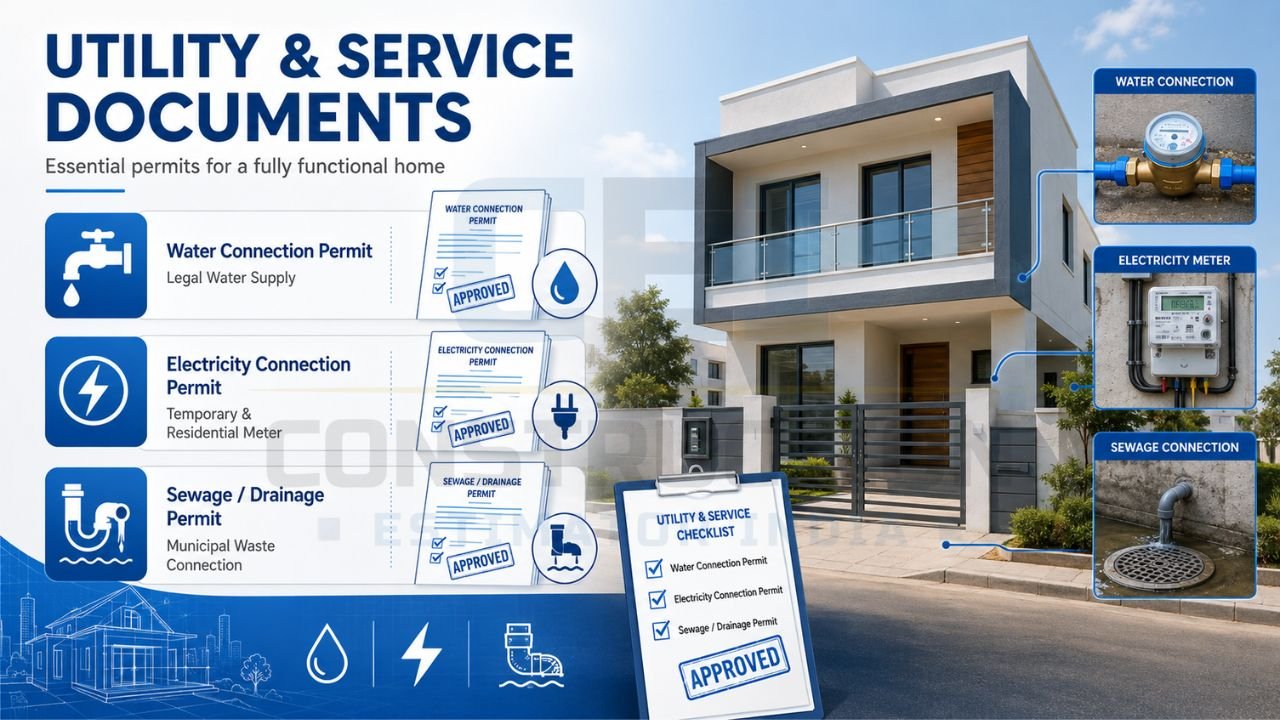
To make the house livable, you need legal permits for Water, Electricity, and Sewage/Drainage connections from municipal boards.
Contract & Project Documents
For professional execution, a written Construction Contract Agreement, a Detailed Project Report (DPR), and a Bill of Quantities (BOQ) are required to manage costs and timelines.
Land & Ownership Documents for House Construction
The foundation of a successful home starts with the land it stands on. Before you hire an architect, you must complete a thorough house construction checklist India for your plot documents.
Sale Deed / Title Deed
The Sale Deed is the most important legal document. It serves as the primary proof of ownership and records the transfer of property from the seller to the buyer. It must be properly registered with the local sub-registrar to be legally valid.
Mother Deed
The Mother Deed is used to trace the ownership history of the property. If the land has changed hands multiple times, the Mother Deed helps verify that the title is clear and that there are no gaps in ownership that could lead to future legal disputes.
Property Tax Receipts
You must ensure that all property taxes are paid up to date. Municipal authorities often require the latest tax receipts as proof of current ownership and compliance before they process any building plan approvals.
Mutation Document / Form I & XIV
A Mutation Document shows that the property is registered in your name in the government’s land records. In some regions like Goa or parts of Maharashtra, this is referred to as Form I & XIV. It is a critical document for proving you are the “owner of record” for utility and tax purposes.
Encumbrance Certificate
An Encumbrance Certificate (EC) proves that the land is free from any legal or monetary liabilities, such as unpaid mortgages or court cases. It is essential for ensuring a clear title and is a primary requirement for any bank loan.
Without proper land ownership documents, your construction can be deemed illegal, leading to demolition or heavy fines.
Building & Design Documents
Once the land is verified, you must focus on the technical house construction documents India that define how your home will be built.
Architectural Drawings
Your architect will turn your requirements into functional floor plans, elevations, and sections. These drawings must detail setbacks, building height, and area calculations to comply with local building bye-laws.
Structural Design & Drawings
Prepared by a qualified structural engineer, these drawings are the “bones” of your house. They show the exact placement and reinforcement for the foundation, columns, beams, and slabs to ensure the building can withstand earthquakes and heavy loads.
Soil Test Report
Many homeowners skip soil testing, but it is mandatory in many regions to determine the “safe bearing capacity” of your land. The report helps engineers decide the type and depth of foundation required (e.g., pile or raft), preventing future wall cracks.
Structural Stability Certificate
Issued by a certified structural engineer, this certificate attests that the building is safe for long-term use. This is particularly important for multi-story buildings (G+2 and above) where load-bearing capacity is critical for public safety.
According to a detailed checklist, having the right construction approval documents ensures compliance with building codes.
Approval & Permit Documents
Obtaining the “green light” from the government is a complex but necessary part of the process.
Building Plan Sanction
The Building Plan Sanction is the official approval of your design by the municipal corporation or development authority. Starting work without a sanctioned plan is illegal and can lead to immediate stoppage orders.
Commencement Certificate
After your plans are approved, the municipal council verifies the site details and issues a Commencement Certificate. This is your legal permission to start the physical digging and construction.
No-Objection Certificates (NOCs)
Depending on your location and building height, you may need NOCs from the fire department, airport authority (for height restrictions), or the pollution control board.
Occupancy Certificate
Once construction is finished and inspected, the authority issues an Occupancy Certificate. This confirms the building is safe to live in and is required to convert temporary utility connections into permanent ones.
Failure to secure these approvals can lead to project delays or even demolition of the structure.
Utility & Service Documents
Your house is not complete until it is connected to essential services.
Water Connection Permit
You must apply for a legal water supply connection from your local water board. This requires your sanctioned plan and proof of ownership.
Electricity Connection Permit
A separate permit is needed for an electrical connection. You will initially get a temporary “construction” meter, which must be converted to a residential meter after receiving your Occupancy Certificate.
Sewage / Drainage Permit
Legal disposal of waste is a requirement in urban areas. You need a permit to connect your internal plumbing to the municipal sewage line.
Without these permits, you may face significant hurdles and extra costs when trying to get utilities after construction.
Contract & Project Documents
Professional documentation during the execution phase ensures your budget stays under control.
Construction Contract Agreement
A written contract between the owner and contractor is your only defense against over-billing and delays. It should clearly define the scope of work, payment milestones, and penalties for delays.
DPR (Detailed Project Report)
A what is DPR in construction is a comprehensive document outlining every aspect of the build, from site analysis to timelines. It is often mandatory for bank loan approvals.
BOQ (Bill of Quantities)
A what is BOQ in construction lists every single item needed for the project—from cement bags to steel tonnage. It prevents contractors from over-charging and helps in transparent bidding.
Estimation & Cost Breakdown
Understanding what is estimation in construction allows you to predict total costs before work begins. This prevents financial shocks mid-way through the project.
Construction Estimator India specializes in preparing professional DPRs, BOQs, and cost estimates. Reach out at +91 8630676890 for help.
Additional Documents for House Construction Loan
If you are financing your dream home through a bank, they will require a specific set of home construction loan documents to assess risk.
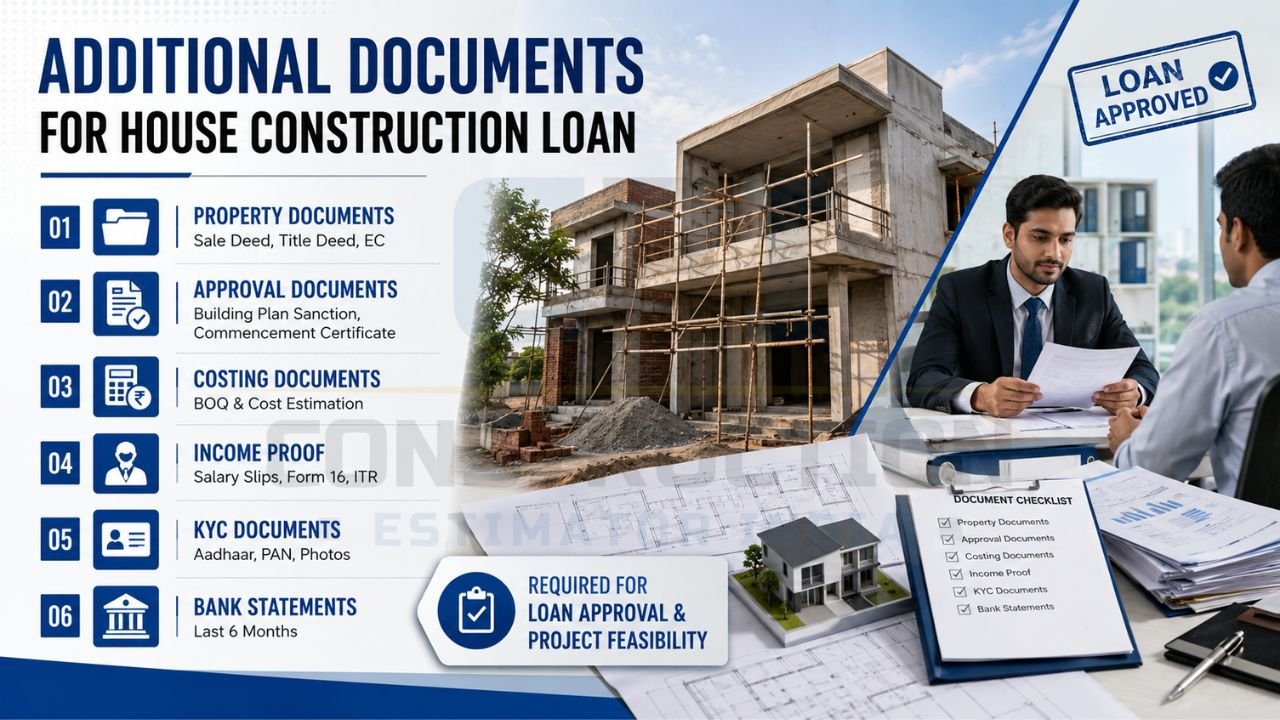
- Property Documents: Registered Sale Deed, Title Deed, and EC.
- Approval Documents: Building Plan Sanction and Commencement Certificate.
- Costing Documents: Detailed Cost Estimation or BOQ prepared by a professional.
- Income Proof: Last 3 months’ salary slips, Form 16, or IT returns for the last 2 years.
- KYC: Aadhaar card, PAN card, and passport-size photographs.
- Bank Statements: Usually for the last 6 months to track financial stability.
Banks use these documents to verify project feasibility and your ability to repay the loan.
Common Mistakes When Handling Construction Documents
Poor documentation is one of the 7 common expensive mistakes in house construction in India. Here are pitfalls to avoid:
- Starting without Sanction: Many owners begin digging before getting a building plan sanction, leading to immediate fines.
- Incomplete Soil Testing: Skipping a soil test can lead to foundation failure, which is a major source of hidden costs in house construction in India.
- Verbal Contracts: Relying on a handshake instead of a written construction contract leads to payment disputes and quality issues.
- Ignoring Utility Permits: Getting an illegal connection can result in heavy penalties from municipal boards.
Checklist: Documents Required Before Starting House Construction
Use this checklist to ensure you have all the necessary documents required for house construction India:
- Sale Deed / Title Deed (Registered)
- Mother Deed (Historical Link)
- Property Tax Receipts (Latest)
- Mutation Document / Form I & XIV
- Encumbrance Certificate (Current)
- Architectural Drawings (Floor Plans)
- Structural Design & Drawings
- Soil Test Report (From Lab)
- Structural Stability Certificate
- Building Plan Sanction (From Municipality)
- Commencement Certificate
- NOCs (Fire, Airport, etc., if applicable)
- Utility Permits (Water, Electricity, Sewage)
- Construction Contract Agreement (Written)
- Professional DPR & BOQ
- Detailed Cost Estimation
Following this checklist ensures your project is legally sound and structurally safe.
Conclusion
Planning your dream home in India requires more than just bricks and cement—it requires flawless documentation. To ensure you have every documents required for house construction India in order, partner with Construction Estimator India.
We provide end-to-end support for:
- Documentation Guidance for homeowners and NRIs.
- Professional DPR (Detailed Project Report) for bank loans.
- Detailed BOQ (Bill of Quantities) to prevent contractor over-billing.
- Accurate Cost Estimation to manage your budget from day one.
Don’t let legal or financial surprises stall your project. WhatsApp / Call us today at +91 8630676890 for a consultation!
FAQ — Documents Required for House Construction India
What are the main documents required for house construction in India?
The main documents include the Title Deed, Building Plan Sanction, Commencement Certificate, and Soil Test Report.
Is building plan sanction mandatory for house construction?
Yes. Constructing without a sanctioned plan is illegal and can lead to demolition or heavy fines.
What is a commencement certificate and why is it needed?
It is a permit issued after plan approval that legally allows you to start construction on the site.
Do I need a soil test report before construction?
Yes. It determines the foundation type and depth, preventing structural cracks in the future.
What ownership documents are required for house construction?
You need a Sale Deed, Mother Deed, latest Property Tax receipts, and an Encumbrance Certificate.
What documents are needed for a house construction loan?
Banks require the Title Deed, sanctioned plans, professional cost estimates, income proof, and KYC documents.
What happens if I start construction without proper documents?
You may face legal action, stop-work orders, disconnection of utilities, or total demolition of the structure.
Who prepares architectural and structural drawings?
Registered Architects prepare architectural layouts, while certified Structural Engineers prepare the structural designs.
How do I contact Construction Estimator India for support?
You can reach us via WhatsApp or Call at +91 8630676890 for DPR, BOQ, and estimation services.