
- Homepage
- Cement Calculator for RCC
Cement Calculator for RCC in India 2026 – Calculate Cement Bags & Concrete Volume for Reinforced Cement Concrete (RCC)
Highly Accurate Cement and Other Material Estimation
Cement Calculator for RCC
📊 Material Estimation Results
| Item | Quantity |
|---|---|
| Total Concrete Volume | |
| Cement Required | |
| Sand Required | |
| Aggregate Required |
Enter Details to Download
Reinforced Cement Concrete (RCC) is the backbone of modern construction in India, used for columns, beams, slabs, footings, lintels, and shear walls to provide tensile strength and structural integrity. Precise material estimation is critical to achieve the required concrete strength, prevent cracking, control project costs, and minimize wastage.
A Cement Calculator for RCC is a powerful construction estimation tool that helps engineers, contractors, builders, and homeowners in India quickly calculate the concrete volume, number of cement bags, sand, and aggregate required for RCC elements. Enter dimensions, concrete grade, and wastage to get accurate quantities based on standard Indian mix design practices.
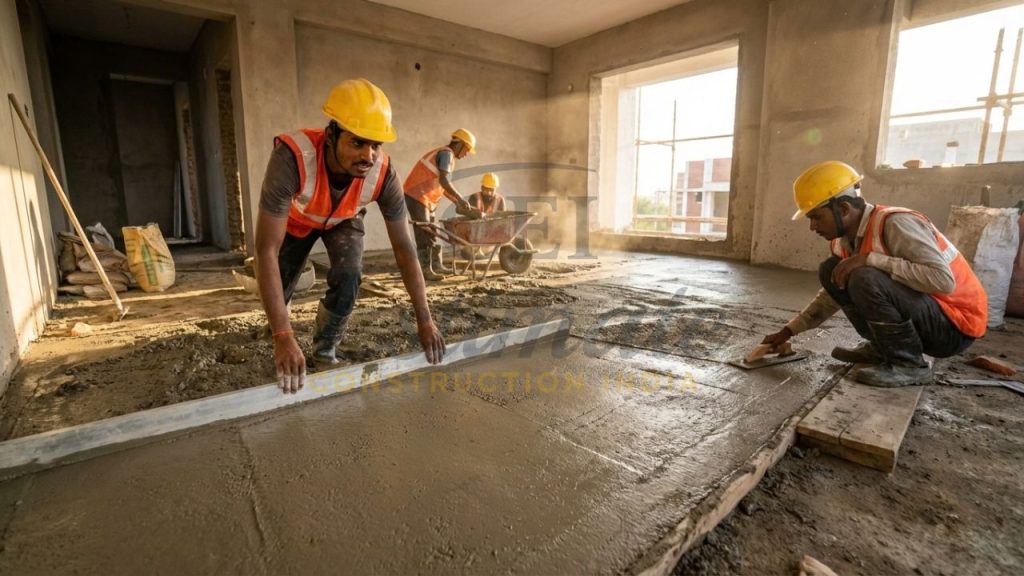
RCC is commonly used in:
- RCC columns and beams
- Roof slabs and floor slabs
- Isolated and combined footings
- Shear walls and retaining walls
- Staircases and lintels
- Water tanks and overhead service reservoirs
Manual RCC calculations are time-consuming and prone to errors. An RCC Concrete Calculator automates volume computation and material breakdown for reliable planning.
What is a Cement Calculator for RCC?
This tool estimates material quantities specifically for Reinforced Cement Concrete (with steel reinforcement). It first calculates the gross concrete volume, then applies design mix ratios or nominal mixes commonly used in India to determine cement (50 kg bags), sand, coarse aggregates, and helps forecast steel needs indirectly.
It supports accurate BOQ preparation, material procurement, budgeting, and reduces over/under-ordering during RCC pouring.
RCC Concrete Volume Formula Used in Construction
For most RCC elements (slabs, beams, columns, footings), volume is calculated as:
V = Length × Width × Depth (for slabs/footings)
or
V = π × r² × Height (for circular columns)
or sectional area × length (for beams)
Typical Thickness/Depth for RCC in India
- Roof/floor slabs: 4–6 inches (100–150 mm)
- Columns: 9×9″ to 18×18″ (230–450 mm)
- Footings: 12–24 inches (300–600 mm)
- Beams: 9–18 inches depth Always follow structural drawings and IS 456:2000 guidelines.
Understanding Each Variable
Dimensions — Accurate measurement from drawings is essential.
Concrete Grade — Higher grades require more cement for strength.
Importance of Concrete Volume Calculation
Accurate RCC volume calculation ensures:
- Exact cement bag requirement
- Proper sand & aggregate proportions
- Cost-effective steel & formwork planning
- M20/M25 strength achievement
- Prevention of honeycombing or weak spots
Inputs Required for the Calculator
Key inputs:
- Element Type (slab, column, beam, footing, etc.)
- Dimensions (length, width, depth/diameter, height)
- Concrete Grade — Common: M20, M25, M30
- Wastage Percentage — Usually 5–10% for RCC
Concrete Mix Ratios Used in India for RCC
RCC typically uses nominal or design mixes:
Grade | Nominal Mix Ratio (Cement : Sand : Aggregate) | Typical Application |
M20 | 1 : 1.5 : 3 | Residential columns, beams, slabs |
M25 | 1 : 1 : 2 or design mix | Commercial/high-rise elements |
M30 | Design mix | Heavy-load structures, water tanks |
M20 (1:1.5:3) remains the most common for residential RCC in India.
Cement Bags in India
Cement in 50 kg bags; one bag ≈ 1.25 cubic feet (dry volume).
Step-by-Step Example Calculation (RCC Roof Slab)
- Length = 35 ft
- Width = 25 ft
- Thickness = 5 inches = 0.417 ft
- Grade = M20 (1:1.5:3)
- Wastage = 8%
Step 1: Wet Volume
V = 35 × 25 × 0.417 ≈ 364.875 cubic feet
Step 2: Dry Volume
Dry Volume = 364.875 × 1.54 ≈ 562 cubic feet
Step 3: Add Wastage
562 × 1.08 ≈ 607 cubic feet
Step 4: Cement
Total parts = 5.5
Cement = 607 ÷ 5.5 ≈ 110.36 cubic feet
Bags = 110.36 ÷ 1.25 ≈ 88 bags (round up to 90–92 bags)
Step 5: Sand ≈ (1.5/5.5) × 607 ≈ 165 cubic feet
Step 6: Aggregate ≈ (3/5.5) × 607 ≈ 331 cubic feet
Final Material Estimate (approx.)
Material | Quantity |
Cement | ~90–92 bags |
Sand | ~165 cubic ft |
Aggregate | ~331 cubic ft |
Average Cement Cost in India (2026)
As of March 2026, cement prices range ₹340–₹430 per 50 kg bag (average ₹360–₹410; Agra/Uttar Pradesh often ₹350–₹400).
Example: 100 bags ≈ ₹35,000–₹43,000
Always choose from India’s top cement brands in 2026 for RCC works to ensure high compressive strength, low heat of hydration, better workability, and long-term durability:
- UltraTech Cement — India’s No.1 brand, trusted for consistent M20/M25 quality in residential RCC.
- Ambuja Cement — Excellent fineness and strength, widely used in structural elements.
- ACC Cement — Reliable legacy brand, great for columns and slabs.
- Shree Cement — Cost-effective, low-heat, ideal for large RCC pours.
- JK Cement — Strong performance, popular in northern India including Agra.
- Birla Cement (MP Birla / Birla Gold) — Superior crack resistance for RCC.
- Dalmia Bharat Cement — High-quality PPC blends for durable structures.
- Ramco Cement — Excellent compressive strength, especially in southern projects.
PPC (Portland Pozzolana Cement) variants from these brands are strongly recommended for RCC to improve workability, reduce thermal cracking, and enhance resistance to weathering.
Applications of RCC Concrete Calculations
- Residential & commercial building frames
- Multi-storey RCC structures
- Foundation systems
- Water-retaining RCC structures
- Bridge girders and small culverts
Benefits of Using a Cement Calculator for RCC
- Fast and accurate material estimates
- Minimized wastage
- Better budgeting & procurement
- Supports structural engineers & contractors
- Ideal for BOQ and tender preparation
Get a Professional Construction Estimate & BOQ
For precise RCC quantity takeoffs, detailed Bills of Quantities (BOQ), full structural cost estimation, or complete house/building planning in Agra, Uttar Pradesh, or anywhere in India, contact Construction Estimator India – experts in accurate construction cost estimating services.
Call: 📞 8630676890
Available across India.
Frequently Asked Questions
How do you calculate RCC volume?
Depends on element: slab = L × W × D; column = πr²h; beam = cross-section area × length.
Which grade is most common for residential RCC in India?
M20 (1:1.5:3) for columns, beams, and slabs.
How many cement bags for a 1000 sq ft RCC slab at 5 inches?
Approximately 80–100 bags (M20 with wastage; exact depends on dimensions).
Average cement price in Agra 2026?
Usually ₹350–₹420 per bag (confirm with local dealers).
Why prefer PPC cement for RCC?
Better long-term strength gain, reduced heat, and superior durability.
Use a Cement Calculator for RCC to plan your structural elements accurately and build a strong, safe, and long-lasting building.