
Are you a contractor in Delhi-NCR or a builder in Gujarat still losing hours—or worse, entire tenders—due to manual calculation errors in your Bill of Quantities? In the hyper-competitive Indian construction market of 2026, a single formula mistake can cost you lakhs. Whether you are managing a 2BHK interior project in Mumbai or a large-scale commercial site in Uttar Pradesh, your bid needs to be as professional as your build.
📊 Get a professional BOQ Template in Excel for just ₹249.
At Construction Estimator India, we’ve seen thousands of contractors struggle with outdated manual sheets. That is why our team of experts, with our 10+ years of construction estimating expertise, has developed the most powerful, automated BOQ Template in Excel specifically for Indian standards. This tender-ready, GST-compliant tool is now available for an unbeatable ₹249, helping you deliver precise quotes in minutes instead of days.
Stop wasting time on manual math. Our ₹249 BOQ Template in Excel offers fully automated quantity calculations, 2026 GST slabs, and a professional format that wins bids. Get instant access and start bidding like a pro today.
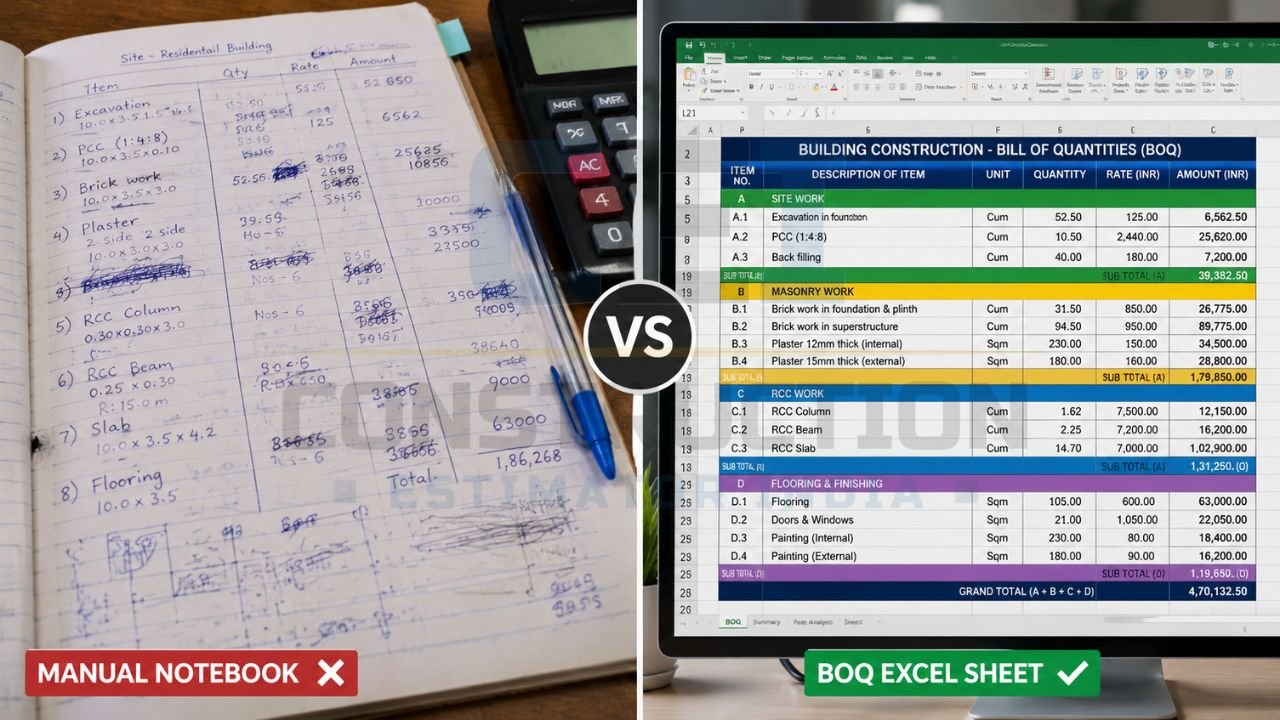
What is a BOQ Template in Excel and Why Every Contractor Needs It
A Bill of Quantities (BOQ) is the structural backbone of any construction project. It provides a detailed list of materials, labor, and equipment needed, complete with units, quantities, and rates. In 2026, with the rise of digital tender platforms like eProcure, having a standardized BOQ format Excel download is no longer a luxury—it is a mandatory requirement for government and private projects alike.
A construction BOQ template India needs to align with specific standards such as CPWD DSR 2026 or state PWD formats. Manual preparation often leads to disjointed data and broken formulas. A professional template ensures that your “Quantity × Rate” always equals a correct “Amount,” with subtotals and taxes flowing seamlessly into the final quote.
Key Features of Our ₹249 BOQ Template
Our template is not just a spreadsheet; it is a smart estimation system tailored for the Indian landscape.
- Fully Automated Calculations: Input your quantity and rate, and watch the totals, subtotals, and grand totals update live.
- 2026 GST Compliance: Built-in formulas automatically apply the latest GST slabs (typically 12-18% for civil works) to ensure your tax compliance is audit-proof.
- Tender-Ready Structure: Matches the standard Sl. No., Description, Unit, Qty, Rate, and Amount format required by PWD/CPWD evaluators.
- 500+ Pre-Loaded Items: Includes common civil works like M20 concrete, reinforcement TMT bars, and brickwork, based on current market rates and latest 2026 GST and construction cost trends affecting BOQ preparation.
- Multi-Trade Support: Integrated tabs for civil, electrical, plumbing, and interiors, allowing you to manage full-house projects in one file.
- Wastage & Profit Analysis: Automatically factors in material wastage (5-10%) and allows you to set custom profit margins (10-25%) to protect your bottom line.
Get your ready-to-use BOQ Template in Excel for just ₹249. For custom BOQ, professional estimation or 3D plans across India, WhatsApp or call us today at +91 8630676890.
Who Should Buy This BOQ Template?
We designed this tool to be versatile enough for everyone involved in the Indian building sector:
- Civil Contractors: Whether you are doing earthwork in Agra or RCC in Ahmedabad, this template ensures your bids are professional and accurate.
- Interior Designers: Managing a luxury fit-out in Noida? Our interior BOQ format handles custom woodwork, false ceilings, and premium finishes with ease.
- Site Engineers & Quantity Surveyors: Save 20–30 hours per project by using a pre-formatted tool that adheres to best practices for accurate BOQ preparation in Indian construction projects.
- Small Builders: Standardize your quotations across your team to build client trust and project a “pro” image.
- Home Owners: Planning your own home? Use our template for house construction cost estimation services to double-check contractor quotes and prevent overcharging.
How This BOQ Template in Excel Saves Time and Money
Efficiency is the currency of the construction industry. Manual BOQ preparation can take 4–6 hours for a single project. For a busy contractor, that is time stolen from site supervision or new business development.
By switching to a professional template, you reduce that time to just 30 minutes. Furthermore, it eliminates the “human error factor.” A mistake of even ₹50 in a rate for 10,000 units can result in a ₹5 lakh loss. Our automated system acts as your digital quantity surveyor, ensuring every paisa is accounted for.
⚡ Instant download—start using your BOQ template in minutes.
What is Included in the ₹249 BOQ Template?
When you invest ₹249 in our system, you aren’t just getting a file; you’re getting a complete toolkit for professional house construction estimation services:
| Component | Description | Benefit |
|---|---|---|
| Main BOQ Sheet | Standard columns (Sl. No, Desc, Unit, Qty, Rate, Amount) | Tender-ready output instantly |
| GST Dashboard | Automatic tax calculation (CGST/SGST/IGST) | 100% tax compliance for 2026 |
| Summary Abstract | One-page project total view | Quick review for clients & architects |
| Rate Analysis Tab | Breakdown of material vs. labor costs | Deep insight into your project margins |
| Trade Sections | Civil, Electrical, Plumbing, and Finishing | Full-site management in one file |
| Material Takeoff | Link measurements to quantities | Zero measurement errors |
Step-by-Step: How to Use the BOQ Template
Using our BOQ Template Excel download is incredibly straightforward:
- Download & Open: Instant access post-payment. Compatible with Microsoft Excel and Google Sheets.
- Input Project Details: Enter the client name, site location (e.g., “Rana Villa, Gurgaon”), and date in the header.
- Fill Quantities: Enter your site measurements (Qty) into the designated columns.
- Set Your Rates: Use our suggested 2026 rates based on latest 2026 GST and construction cost trends affecting BOQ preparation or enter your local supplier quotes.
- Review Auto-Calcs: Watch as the sheet computes amounts, applies GST, and adds your set profit margin.
- Export to PDF: Save a professional, branded copy to share with clients or upload to tender portals.
Comparison: Manual BOQ vs. Ready Excel BOQ Template
| Feature | Manual Excel Sheet | Construction Estimator India Template |
|---|---|---|
| Setup Time | 4–8 Hours | 0 Minutes (Ready-to-use) |
| Calculation Accuracy | Risk of formula breaks | 100% Error-free automation |
| GST Compliance | Manual entry (prone to errors) | Fully automated 2026 slabs |
| Professionalism | Basic, often inconsistent | Designer-quality, tender-ready |
| Rate Analysis | Difficult to calculate | One-click breakdown |
| Total Cost | Hours of stress | Only ₹249 |
📞 Download your BOQ Excel Template today for just ₹249 and simplify your estimating process.
Common Mistakes in BOQ Preparation That This Template Prevents
Through our years of helping over 500+ clients across India, we have identified critical errors that our template solves:
- Forgetting Wastage: Many contractors quote for the exact area, forgetting that tiles break and pipes are cut. Our template includes adjustable wastage factors.
- Incorrect Units: Using ‘running feet’ instead of ‘square meters’ can confuse labor and material counts. Our template provides dropdowns for standard BOQ format and quantity takeoff practices in India 2026.
- Missing Hidden Costs: Items like shuttering oil, curing water, or small hardware often go missing. Our pre-loaded 500+ items list ensures you don’t miss the small things that add up.
- Static Rates: Material prices in India are volatile. Our template allows you to update one master rate cell that reflects across the entire document instantly.
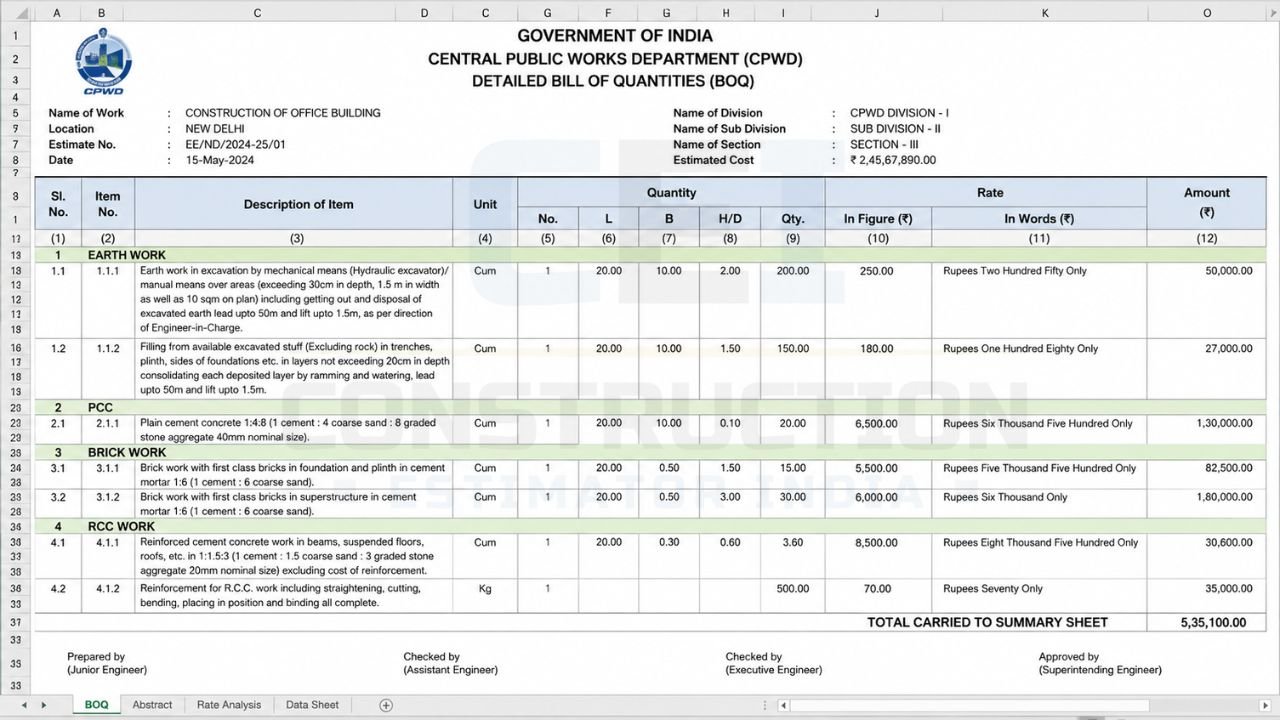
How to Get the ₹249 BOQ Template Instantly
We believe in speed. Getting your tender ready BOQ Excel is as easy as:
- Click the “Buy Now” button on our secure payment gateway.
- Complete the payment via UPI, Card, or Net Banking.
- Instant Download: You will receive the Excel file and Google Sheets link immediately in your browser and via email.
- Lifetime Access: No subscriptions. Own the template forever and use it for unlimited projects.
Why Construction Estimator India’s BOQ Template is Trusted
We are not just a software company; we are construction veterans. Construction Estimator India serves a Pan-India clientele—from the hills of Uttarakhand to the industrial hubs of Gujarat.
Our template is built on the foundation of our 10+ years of construction estimating expertise, ensuring it meets the rigorous demands of Indian site conditions. When you use our template, you aren’t just using a sheet; you’re using a workflow used by 500+ happy clients to close multi-crore deals.
Frequently Asked Questions (FAQ)
- Is this BOQ Template compliant with CPWD DSR 2026?
Yes, our template follows the structure and measurement standards defined in standard BOQ format and quantity takeoff practices in India 2026, making it ideal for government and private tenders. - Can I use this on my smartphone?
Absolutely. The template is fully compatible with the Google Sheets app and Microsoft Excel for Mobile, allowing site engineers to update quantities on the go. - Does it include GST calculations?
Yes. It features an automated GST dashboard that calculates CGST/SGST or IGST based on your project location and the latest 2026 GST and construction cost trends affecting BOQ preparation. - Can I customize the items for interior work?
Yes. While it comes with 500+ pre-loaded items, it is 100% editable. You can easily add items for modular kitchens, false ceilings, or specialized lighting. - How do I receive the template after paying ₹249?
The download link is generated instantly on the success page and also sent to your registered email address. - Do you offer support if I get stuck?
Yes. You can WhatsApp our support team at +91 8630676890 for any technical queries regarding the template.
Conclusion: Take Your Bidding to the Next Level Today
In 2026, the gap between a successful contractor and one who struggles is often just the tools they use. For less than the price of a site lunch, you can own a professional BOQ Template in Excel that saves you dozens of hours and protects your profit margins.
Don’t let manual errors or unprofessional formatting hold your business back. Join the 500+ professionals who trust Construction Estimator India for their project needs.
Download your ₹249 BOQ Template now and secure your next big contract.
Get your ready-to-use BOQ Template in Excel for just ₹249. For custom BOQ, professional estimation or 3D plans across India, WhatsApp or call us today at +91 8630676890.