
I still remember a site visit to a beautiful bungalow in Jaipur three years ago. The owner had spent a fortune on Italian marble and premium paints, but within just two monsoons, the ceiling was covered in ugly damp patches and hairline cracks began to snake across the master bedroom roof. The root cause? Poor execution during the roof slab casting procedure in India. They had used a local “chalta hai” approach—adding too much water to the concrete and skipping mechanical vibration.
As a civil engineer, I can tell you that your roof is the most critical structural shield of your home. If the casting goes wrong, you are looking at a lifetime of maintenance headaches, leakage, and even structural risks. Following best practices for roof concrete and slab casting isn’t just a technical requirement; it is an investment in your family’s peace of mind. In this guide, I will share the exact on-site protocols we use at constructionestimatorindia.com to ensure a rock-solid, leak-proof roof that stands the test of time.
Understanding Roof Slab Casting
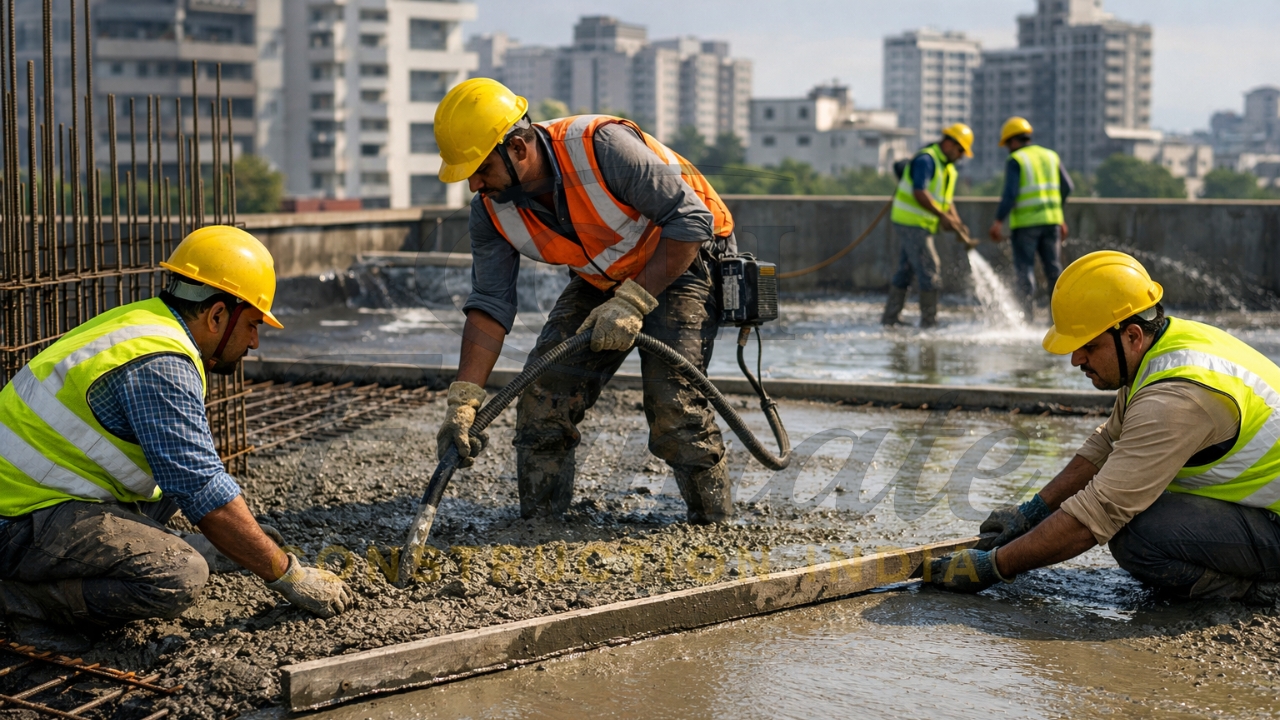
Roof slab casting is the process of pouring a mixture of cement, sand, stone aggregates, and water into a pre-arranged mold of steel reinforcement and wooden or steel formwork. It is a defining stage in house construction because, unlike brickwork or flooring, you cannot “fix” a poorly cast slab later without massive expense.
A roof slab does more than just provide shade; it ties the entire structure together. It transfers the loads from the roof to the beams and columns, and finally to the foundation. Because it is exposed to the harshest elements—scorching Indian summers and heavy monsoons—the concrete must be dense, impermeable, and structurally sound. This is why understanding how to cast roof slab properly is the difference between a house that lasts 20 years and one that lasts 80 years.
Best Cement Selection for Roof Slab Casting
Selecting the right “glue” for your concrete is the first step toward excellence. In India, we primarily deal with three types of cement: OPC (Ordinary Portland Cement), PPC (Portland Pozzolana Cement), and PSC (Portland Slag Cement).
For most residential projects, choosing the best cement for roof concrete in India typically leads us to OPC 53 Grade. It provides high early strength, which is vital for faster construction and quicker removal of formwork. However, if you are building in coastal areas or regions with high groundwater, I often recommend PSC or PPC because they offer superior resistance to sulfate attacks and have lower heat of hydration, which reduces the risk of thermal cracks.
When you are planning the top finish of your terrace, you must also consider the best cement for roof flooring to ensure the surface remains durable against foot traffic and weather. For the core structural work, finding the best cement for roofing in India requires looking at brands with consistent fineness and quality control, such as UltraTech, ACC, or Ambuja. Ultimately, the best cement for roof slab in India is one that is fresh (less than 3 months old) and stored properly away from moisture.
Correct Mix Ratio and Material Proportion for Roof Concrete
The strength of your roof depends on the “recipe.” For residential slabs, we never go below an M20 grade, though M25 or higher is strongly recommended for better durability and safety.
Standard Mix Ratios for Roof Slabs
| Concrete Grade | Mix Ratio (Cement:Sand:Aggregate) | Common Usage |
|---|---|---|
| M20 | 1 : 1.5 : 3 | Standard residential slabs & beams |
| M25 | 1 : 1 : 2 | High-strength/Heavy-load structures |
| M15 | 1 : 2 : 4 | Non-structural leveling or P.C.C. |
Key Material Best Practices
- Water-Cement Ratio: Keep this between 0.40 and 0.48. I’ve seen laborers add extra water to make the concrete “soupy” and easier to spread, but this is a disaster. Every extra liter of water beyond the design limit creates microscopic voids in the concrete once it evaporates, leading to a porous, leaky roof.
- Aggregates: Use a mix of 10mm and 20mm crushed stone. Ensure they are clean and washed; dusty or muddy stones will not bond properly with the cement paste, weakening the entire slab.
- Admixtures: In 2026, using a high-quality waterproofing admixture and a superplasticizer is a standard best practice. Superplasticizers allow you to maintain high workability (flow) without adding excess water.
Step-by-Step Best Practices for Roof Slab Casting
Following a disciplined roof slab construction tips checklist is essential for a successful pour.
1. Formwork (Shuttering) Preparation
Before a single drop of concrete is poured, the formwork must be rigid and watertight.
- Material: Use high-quality plywood or steel plates. Ensure the props (supports) are on firm ground.
- Sealing: Seal all joints with foam tape or masking tape. If cement slurry leaks through gaps, you will end up with “honeycombing” (voids) that expose your steel reinforcement to rust.
- Cleaning: Use a mold-release oil on the plates to ensure the concrete doesn’t stick when you remove the shuttering.
2. Reinforcement Placement
The steel bars are the “bones” of your slab.
- Cover Blocks: This is the most ignored step on Indian sites. You must use 20–25mm concrete cover blocks to lift the steel bars off the shuttering. Without these, the steel sits at the bottom of the slab, gets exposed to the air, and starts rusting within years.
- Chair Bars: Ensure that the top and bottom reinforcement meshes are separated using “chairs” to maintain the structural thickness.
3. Concrete Pouring Sequence
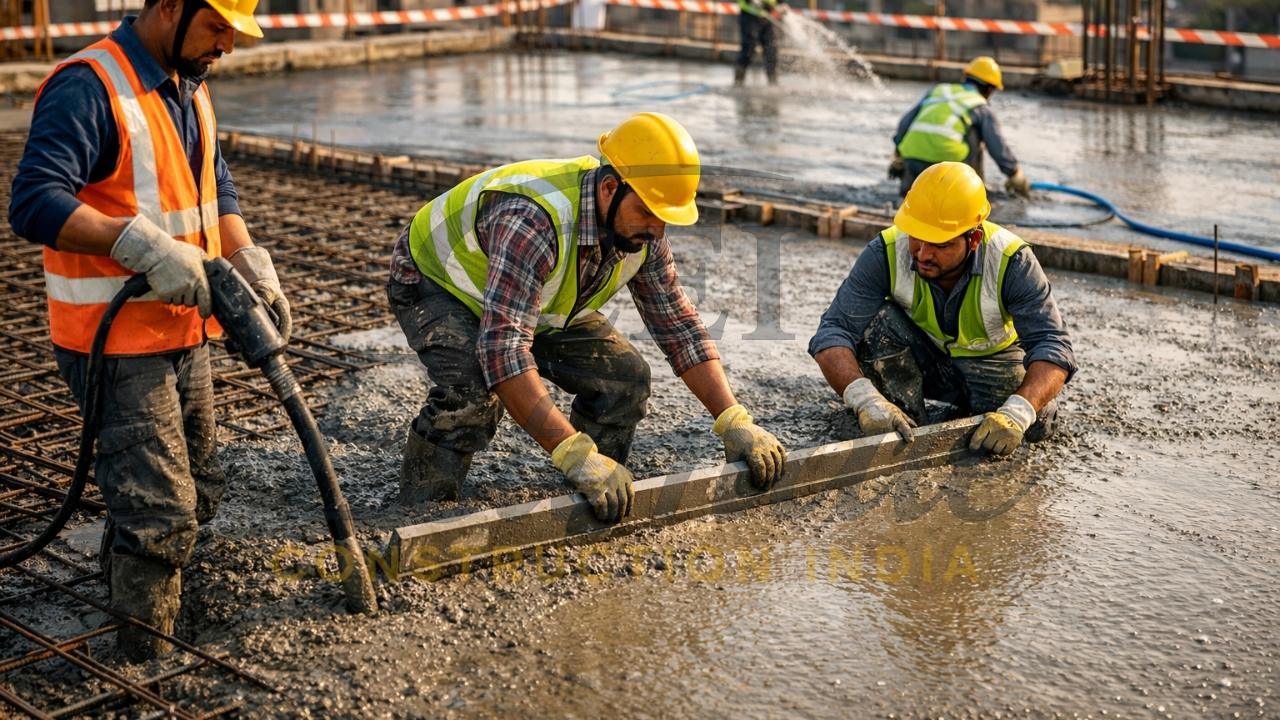
- Continuous Pour: Always aim to complete the slab in one single operation. Avoid “cold joints” (where fresh concrete meets already hardened concrete), as these are the primary spots for future leaks.
- Pouring Height: Never drop concrete from a height of more than 1.5 meters. High drops cause “segregation,” where the heavy stones sink to the bottom and the cement paste stays on top.
4. Vibration and Compaction
Best practices for roof concrete pouring mandate the use of a mechanical needle vibrator.
- Insertion: Insert the needle vertically, spacing points about 30–45 cm apart.
- Timing: Hold for 5–15 seconds until the surface glistens and air bubbles stop rising. Do not “over-vibrate” (more than 30 seconds), or you will cause the stones to separate from the mix.
5. Finishing and Waterproofing
Once the concrete is leveled, the surface should be finished with a wooden float. For waterproofing during roof slab casting, ensure the slab has a slight slope (1:100) toward the rainwater pipes to prevent water stagnation.
Proper Curing Methods for Roof Concrete
Curing is the process of keeping the concrete moist to allow the chemical reaction (hydration) to complete. If the concrete dries too fast, it will shrink and crack.
- Duration: For Indian weather, curing methods for roof concrete must be maintained for 14 to 21 days.
- Ponding Method: This is the most effective method for slabs. Create small bunds (clay or mortar walls) across the roof and fill the “ponds” with 2-3 inches of water.
- Early Curing: Start curing as soon as the concrete surface is hard enough to walk on without leaving footprints. In peak summers, cover the fresh slab with wet gunny bags (jute) to prevent rapid evaporation.
Common Mistakes in Roof Slab Casting and How to Avoid Them
Even with the best materials, simple on-site errors can ruin your project. Here are the common mistakes in roof slab casting and their solutions.
Troubleshooting Site Mistakes
| Common Mistake | Consequence | Practical Solution |
|---|---|---|
| Adding extra water | Weak concrete & high leakage risk | Use superplasticizers for workability. |
| Skipping cover blocks | Rebar corrosion & structural failure | Use 20-25mm PVC or concrete cover blocks. |
| Poor vibration | Honeycombing (voids in concrete) | Use mechanical needle vibrators at 30-45cm intervals. |
| Removing props too early | Slab sagging or collapse | Follow IS codes: 7-10 days for slabs, 14 days for beams. |
| Casting in heavy rain | Cement wash-out | Keep tarpaulins ready; stop pouring if rain is heavy. |
Frequently Asked Questions (FAQs)
- Which concrete grade is best for a residential roof slab?
Minimum M20 (1:1.5:3) is required, but M25 (1:1:2) is highly recommended for better long-term durability and resistance to Indian monsoons. - Can I use OPC 53 for my roof slab?
Yes, OPC 53 is excellent for high early strength. However, it requires very disciplined curing for at least 14 days to prevent shrinkage cracks. - Why is my roof leaking even after using the best cement?
Leakage is often due to a high water-cement ratio, poor compaction (lack of vibration), or the absence of cover blocks, rather than the cement itself. - How long should I cure my roof slab?
In India, you should cure the slab for a minimum of 14 days, and ideally 21 days during hot or dry weather. - When can the shuttering (formwork) be removed?
For typical residential spans, slab shuttering can be removed after 7–10 days, but props under beams should remain for 14–21 days. - Is a needle vibrator necessary for a 5-inch slab?
Absolutely. Hand tamping cannot remove the trapped air pockets effectively. A needle vibrator is mandatory for all RCC work to prevent honeycombing. - Can I cast the roof during the summer?
Yes, but you must take precautions. Pour concrete in the early morning or evening, use chilled water, and cover the fresh concrete with wet burlap immediately. - Should I add waterproofing liquid to the concrete?
Yes, adding an ISI-marked integral waterproofing compound during the mixing stage is a best practice to reduce the permeability of the slab. - How do I prevent cracks in my roof?
Maintain a low water-cement ratio (0.45), ensure proper vibration, and never skip the 14-day curing period. - What is the standard thickness of a residential roof slab?
Usually, it ranges between 4.5 inches to 6 inches (115mm to 150mm), depending on the span and structural design.
Conclusion
Your roof is more than just a horizontal surface; it is the structural crown of your home. By following the best practices for roof concrete and slab casting—from selecting the right cement to ensuring a 21-day curing period—you are guaranteeing the longevity of your investment. Remember, a small saving today on labor or “cover blocks” could lead to lakhs of rupees in waterproofing repairs five years down the line.
Always hire a skilled supervisor, use a mechanical vibrator, and stick to a strict water-cement ratio. If you build it right the first time, your roof will stay strong and leak-proof for generations. For more expert guidance and accurate material estimates, keep following constructionestimatorindia.com. Build it once, build it strong!