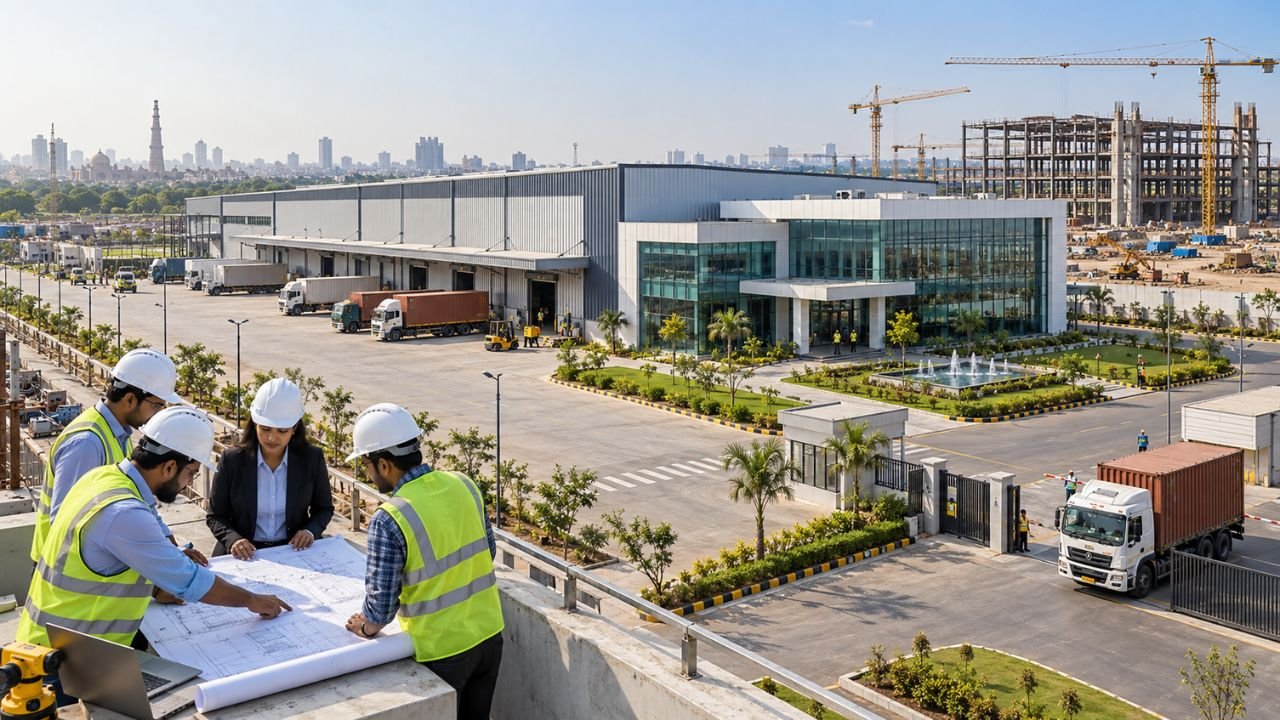
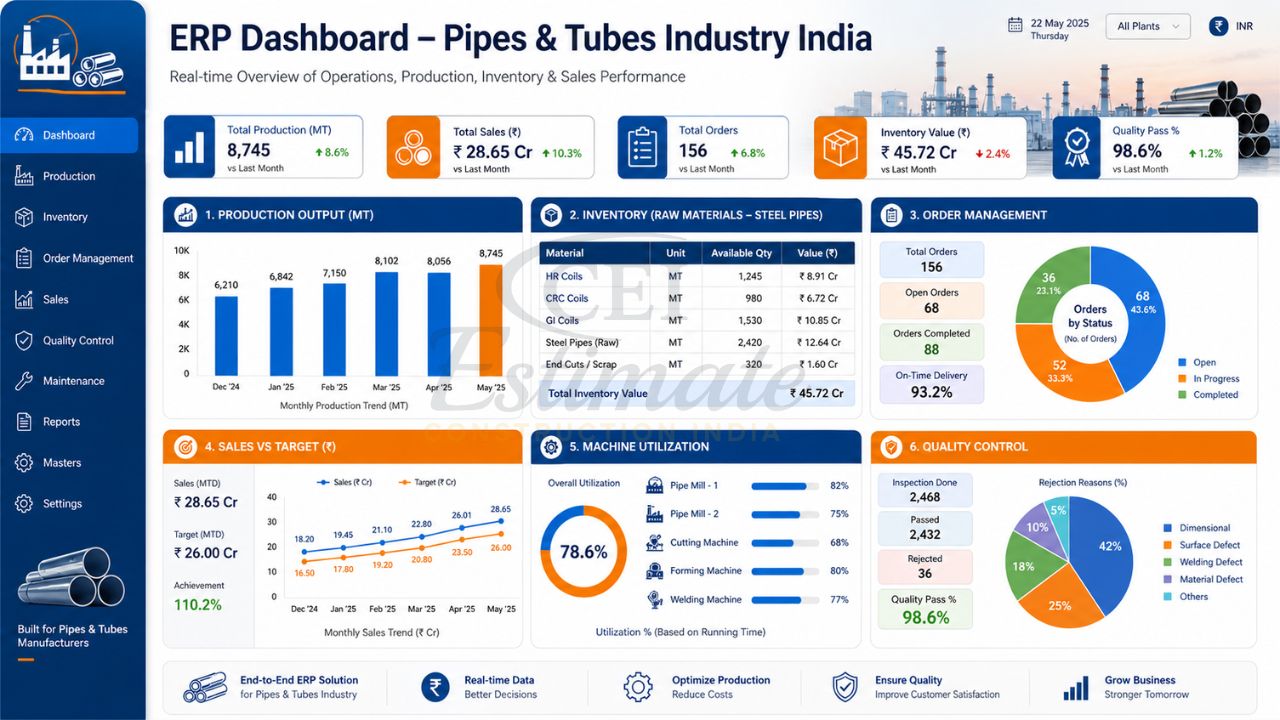
India’s pipes and tubes industry is one of the most dynamic segments of the country’s broader manufacturing ecosystem. From steel ERW and seamless pipes used in oil & gas and infrastructure projects, to PVC, HDPE, and PPR pipes serving agriculture, construction, and municipal water networks — the diversity of products, specifications, and customer demands is enormous. Add to this the complexities of volatile raw material pricing (steel coils, PVC resin, HDPE granules), strict quality standards like IS, ASTM, and BIS certifications, fluctuating export demand, and ever-tightening GST compliance requirements, and it quickly becomes clear why managing a pipes and tubes business on spreadsheets or disconnected legacy systems is no longer sustainable.
In 2026, the right ERP (Enterprise Resource Planning) software is not just a tool for automation — it is a genuine competitive advantage. The best ERP for pipes and tubes manufacturers gives you real-time visibility across procurement, production, inventory, quality control, sales, and finance, all from one integrated platform. It eliminates data silos, reduces production waste, ensures timely delivery, and helps your business scale confidently.
👉 Need Help Choosing Manufacturing ERP? 📞 Call/WhatsApp: +91 86306 76890
At Construction Estimator India, we have guided dozens of manufacturing companies — including some of India’s leading pipe producers — through the process of selecting and implementing the ERP systems that actually work for their unique operational realities. In this comprehensive guide, we break down the best ERP software for the pipes and tubes industry in India so you can make an informed, confident decision in 2026.
Top 8 Best ERP Software for Pipes & Tubes Industry in India (2026 Rankings)
1. SAP S/4HANA — Best for Large-Scale Pipe & Tube Manufacturers
SAP S/4HANA consistently ranks as one of the world’s most powerful enterprise ERP platforms, and for large Indian pipe and tube manufacturers — especially those with integrated steel operations, multi-plant setups, or significant export volumes — it remains the gold standard. SAP’s real strength for this industry lies in its depth: it can handle everything from raw material procurement and coil-to-pipe traceability to finished goods dispatch, export documentation, and multi-currency financial reporting, all within a single, audit-ready system.
For pipes and tubes companies, SAP S/4HANA excels in production planning with variant configuration (handling the hundreds of combinations of OD, wall thickness, grade, and length), materials requirements planning (MRP), and shop floor execution. Its quality management module supports end-to-end inspection workflows, from incoming coil testing to hydrostatic pressure testing of finished pipes, complete with non-conformance reports and corrective action tracking.
Key Features for Pipes & Tubes:
- Variant configuration for complex pipe specifications (grade, OD, WT, length, coating)
- Real-time production scheduling with shop floor control
- Quality Management with inspection plans and batch traceability
- Integrated export management with LC tracking and shipping documentation
- Advanced analytics and live dashboards for production and financial KPIs
- GST, TDS, and Indian statutory compliance built-in
Best Suited For:
Large pipe manufacturers with revenues above ₹100 Crore, multi-plant operations, and significant domestic and export sales.
Pricing Overview:
Enterprise licensing starts at approximately ₹25 lakh per year and can go above ₹1 crore for large implementations, excluding implementation partner costs.
Pros:
- Unmatched depth of functionality across all business processes
- Strong global network of certified implementation partners in India
- Proven scalability for complex, high-volume pipe manufacturing environments
Cons:
- High total cost of ownership — not suitable for SMEs
- Long implementation timelines (typically 12–18 months for complex setups)
- Requires dedicated IT resources and skilled SAP consultants
2. Oracle NetSuite — Best for Growing Pipe Exporters & Multi-Site Operations
Oracle NetSuite has established itself as a leading cloud ERP for mid-to-large manufacturing companies in India, and its appeal for pipes and tubes exporters is particularly strong. The platform’s native multi-currency, multi-language, and multi-subsidiary capabilities make it an excellent fit for pipe manufacturers supplying to the Middle East, Africa, Southeast Asia, and beyond — markets that Indian pipe exporters increasingly serve.
NetSuite’s manufacturing module supports discrete and process manufacturing workflows, making it relevant across different pipe types. Its inventory management goes well beyond basic stock tracking — you can manage inventory by weight, length, bundle, or piece, with full lot and serial traceability. For quality-conscious exporters needing to generate material test certificates (MTCs) and comply with ASTM or DIN standards, NetSuite offers robust quality management capabilities that can be configured to match your specific requirements.
Key Features for Pipes & Tubes:
- Cloud-native architecture — access from anywhere, zero server maintenance
- Multi-currency billing and LC tracking for export-focused manufacturers
- Lot and serial number traceability for heat-wise pipe production
- Advanced demand planning and supply chain management
- Built-in CRM for managing domestic and international client relationships
- Real-time financial dashboards with profitability analysis by product line
Best Suited For:
Mid-to-large pipe and tube exporters with revenues of ₹50 Crore and above, multiple sales offices or warehouses, and a need for strong financial consolidation.
Pricing Overview:
Typically ₹15 lakh to ₹60 lakh per year depending on user count and modules.
Pros:
- True cloud ERP — ideal for companies with remote teams or multi-location operations
- Strong export and international trade management capabilities
- Excellent reporting and business intelligence tools
Cons:
- Can be expensive for smaller manufacturers
- Deep pipe-specific customisation may require additional development effort
- Less known among Indian SME pipe manufacturers
👉 Get Expert Advice for ERP Implementation – 📞 WhatsApp: +91 86306 76890
3. Lighthouse ERP — Best Industry-Specific ERP for ERW, Seamless & Spiral Pipes
If you are looking for an ERP built from the ground up for the pipe manufacturing industry — particularly steel pipe mills producing ERW, seamless, or spiral pipes — Lighthouse ERP deserves serious attention. With a history in the pipes and tubes segment going back decades, Lighthouse brings a level of domain specificity that generic ERP platforms simply cannot match out of the box.
What truly sets Lighthouse apart is how it handles the core complexities of a pipe mill. The system manages coil receiving by actual or theoretical weight, generates internal coil numbers, tracks heat numbers and coil numbers through every production stage, and manages pipe and tube inventory by length, bundle, or weight. For sales teams, Lighthouse allows orders to be confirmed by matching available stock to ASTM, ASME, or MIL standards after importing chemical and mechanical test results — a workflow that would require significant customisation in a generic ERP.
Key Features for Pipes & Tubes:
- Coil receiving by actual/theoretical weight with internal coil number generation
- Heat number and tag-based traceability through the entire production cycle
- OD, ID, and wall thickness-based stock search and order matching
- ASTM, ASME, and MIL standard compliance verification with chemical/mechanical test import
- Managing 50–60 pipe varieties and 250–300 fitting types in one system
- Production planning, in-house and outsourced process tracking
Best Suited For:
Steel pipe mills (ERW, seamless, spiral), precision tube manufacturers, and companies dealing with ASTM/ASME/BIS-certified products for infrastructure, oil & gas, or industrial applications.
Pricing Overview:
Approximately ₹3 lakh to ₹15 lakh per year depending on plant size and modules selected.
Pros:
- Deepest industry-specific functionality for steel pipe mills in this price range
- Strong production traceability from raw coil to finished pipe dispatch
- Practical, shop-floor-friendly interface built around real pipe mill workflows
Cons:
- Less suitable for polymer pipe (PVC, HDPE) manufacturers
- Smaller ecosystem compared to SAP or Oracle
4. DataNote ERP — Best for Multi-Process Pipe Manufacturers (Steel, PVC, HDPE)
DataNote ERP, developed in India (Ahmedabad), has carved out a strong reputation in the pipes and tubes sector by supporting a wide range of manufacturing processes — from extrusion and compounding for polymer pipes to welded and seamless processes for metal pipes. Its versatility makes it an excellent choice for manufacturers producing multiple pipe types under one roof, or for those looking for a genuinely Indian ERP solution that understands local compliance and business practices.
DataNote’s approach to quality control is particularly noteworthy — the system assesses quality at every manufacturing stage, creating a continuous audit trail from raw material procurement to finished goods dispatch. Its automated order entry, real-time inventory monitoring, and integration of financial and operational data from multiple departments make it a robust, practical choice for pipe manufacturers scaling from mid-size to enterprise.
Key Features for Pipes & Tubes:
- Supports extrusion, compounding, thermoforming, injection moulding (polymer pipes)
- CS/SS/MS tube and pipe manufacturing — welded, seamless, and ERW
- Multi-stage quality inspection with real-time defect tracking
- Automated order entry with real-time inventory and production linkage
- Comprehensive financial and operational reporting across departments
- BIS and IS standard compliance management
Best Suited For:
Manufacturers producing steel, stainless steel, and polymer pipes; mid-sized companies seeking a comprehensive, India-focused ERP solution.
Pricing Overview:
Approximately ₹2 lakh to ₹10 lakh per year depending on company size and configuration.
Pros:
- Covers both metal and polymer pipe manufacturing in one platform
- Strong quality management module tailored for pipe production
- Indian company with deep understanding of GST, statutory compliance, and local business needs
Cons:
- Less globally recognised compared to SAP or Oracle
- May require more customisation for niche tube manufacturing processes
👉 Upgrade Your Manufacturing System Today – 📲 Contact: +91 86306 76890
5. Sage X3 — Best for Multi-Country & Multi-Currency Pipe Manufacturing Groups
Sage X3 is an enterprise-grade ERP platform that strikes a compelling balance between power and usability, making it a strong contender for pipe and tube manufacturers who operate across multiple geographies or deal with complex international supply chains. Its native support for multi-currency, multi-language, and multi-country operations makes it particularly well-suited for Indian pipe manufacturers with operations or significant export sales in the Gulf, Africa, or Europe.
For the pipes and tubes industry specifically, Sage X3 provides solid production planning, precise inventory management, and advanced quality control capabilities. It handles product configurations including pipe dimensions, materials, and coatings, and its extended warehouse management module tracks the movement of pipes from the production plant all the way to the warehouse and dispatch yard. The system’s strong BI and reporting tools help management teams track profitability by product line, region, and customer segment with ease.
Key Features for Pipes & Tubes:
- Multi-currency, multi-language, multi-country ERP platform
- Product configuration management for complex pipe specifications
- Extended warehouse management with pipe movement tracking
- Advanced production planning with resource and capacity scheduling
- Strong BI and analytics for management decision-making
- Flexible deployment: cloud, on-premise, or hybrid
Best Suited For:
Mid-to-large pipe manufacturing groups with international operations, multi-plant setups, or complex supply chain requirements.
Pricing Overview:
Typically ₹10 lakh to ₹40 lakh per year, varying with user count and modules.
Pros:
- Excellent for international trade and multi-country pipe manufacturers
- Strong balance between enterprise functionality and ease of use
- Flexible deployment options
Cons:
- May be over-engineered for smaller, single-plant pipe manufacturers
- Implementation requires experienced Sage partners for optimal results
6. Tally Prime with Manufacturing Add-On — Best for Small & Medium Pipe Manufacturers
Tally has been the trusted accounting backbone for tens of thousands of Indian SMEs for decades, and Tally Prime — its latest iteration — combined with manufacturing-specific add-ons or modules from certified Tally partners, represents a genuinely practical and affordable ERP option for smaller pipes and tubes manufacturers. While it is not a fully integrated manufacturing ERP out of the box, the right configuration of Tally Prime with add-ons for BOM management, production orders, job work tracking, and inventory management can handle the core operational needs of many small and medium pipe producers efficiently.
Tally Prime’s real strengths for Indian pipe manufacturers lie in its flawless GST compliance, ease of use, strong banking and payment reconciliation, and the massive ecosystem of local Tally partners who understand Indian business practices. For companies managing multiple pipe sizes, grades, and customer-specific pricing, Tally’s inventory configuration capabilities are surprisingly robust.
Best Suited For:
Small pipe manufacturers with up to ₹25 Crore turnover, those needing strong accounting and GST compliance first, and companies looking for a low-cost, quick-to-implement starting point before scaling to a fuller ERP.
Pricing Overview:
₹50,000 to ₹2 lakh per year for Tally Prime with manufacturing add-ons.
Pros:
- Very affordable and widely supported across India
- Best-in-class GST compliance and statutory reporting
- Quick to implement, easy to train staff
Cons:
- Limited native manufacturing functionality without add-ons
- Not suitable for complex, large-scale pipe manufacturing operations
- Advanced shop-floor control and quality traceability are limited
👉 Manage Production, Inventory & Sales in One System – 📞 Call Now: +91 86306 76890
7. eresource ERP — Best Web-Based ERP for Indian SME Pipe Manufacturers
eresource ERP is a web-based, India-developed ERP solution that has gained a strong following among manufacturing SMEs across sectors, including the pipes and tubes industry. Its browser-based architecture means no heavy client installation is needed, making it accessible from the factory floor, office, or on the road — a practical advantage for pipe manufacturers with multiple production shifts or remote sales teams.
The platform covers all core manufacturing ERP functions — production planning, inventory management, procurement, sales, finance, and HR — with good Indian statutory compliance. For the piping industry segment, eresource ERP supports project-based operations, making it relevant not just for pipe manufacturers but also for industrial piping installation contractors who need to track material consumption, labour costs, and project progress.
Best Suited For:
SME pipe manufacturers and piping contractors with revenues of ₹5 Crore to ₹100 Crore looking for an affordable, web-based, comprehensive ERP solution.
Pricing Overview:
Approximately ₹1.5 lakh to ₹8 lakh per year based on user count and modules.
Pros:
- Web-based — accessible from anywhere without complex IT infrastructure
- Strong Indian statutory compliance including GST, TDS, and payroll
- Good balance of features and affordability for Indian SMEs
Cons:
- Less depth in pipe-specific production traceability versus specialist solutions
- May need customisation for very niche pipe manufacturing processes
8. BizSol ERP — Best for Integrated Steel Pipe Plants & Rolling Mills
BizSol ERP has been purpose-built for the Indian steel manufacturing ecosystem, with specific capabilities for pipe and tube manufacturers, rolling mills, and integrated steel plants. If your business produces ERW pipes, hollow sections, or operates a rolling mill alongside pipe fabrication, BizSol’s steel-specific ERP framework offers a level of relevance that generic ERPs cannot easily replicate.
BizSol handles heat-wise production tracking, actual versus planned yield analysis, machine utilisation monitoring, scrap generation management, and grade-wise inventory — all in real time. Its 2026 roadmap includes AI-powered demand forecasting and IoT integration for live machine data feeds, positioning it as a forward-looking choice for pipe manufacturers investing in Industry 4.0 capabilities.
Best Suited For:
Integrated steel pipe plants, rolling mills with pipe fabrication, and companies wanting a steel-sector-focused ERP with a strong 2026 technology roadmap.
Pricing Overview:
Approximately ₹2 lakh to ₹12 lakh per year based on plant complexity.
Pros:
- Deep steel and pipe manufacturing domain expertise
- Strong production traceability and yield management for steel pipe mills
- Future-ready with AI and IoT integration on the roadmap
Cons:
- Smaller market presence compared to international ERP vendors
- Less suitable for polymer pipe (PVC/HDPE) manufacturers
👉 Replace Excel with Smart Manufacturing ERP – 📲 WhatsApp: +91 86306 76890
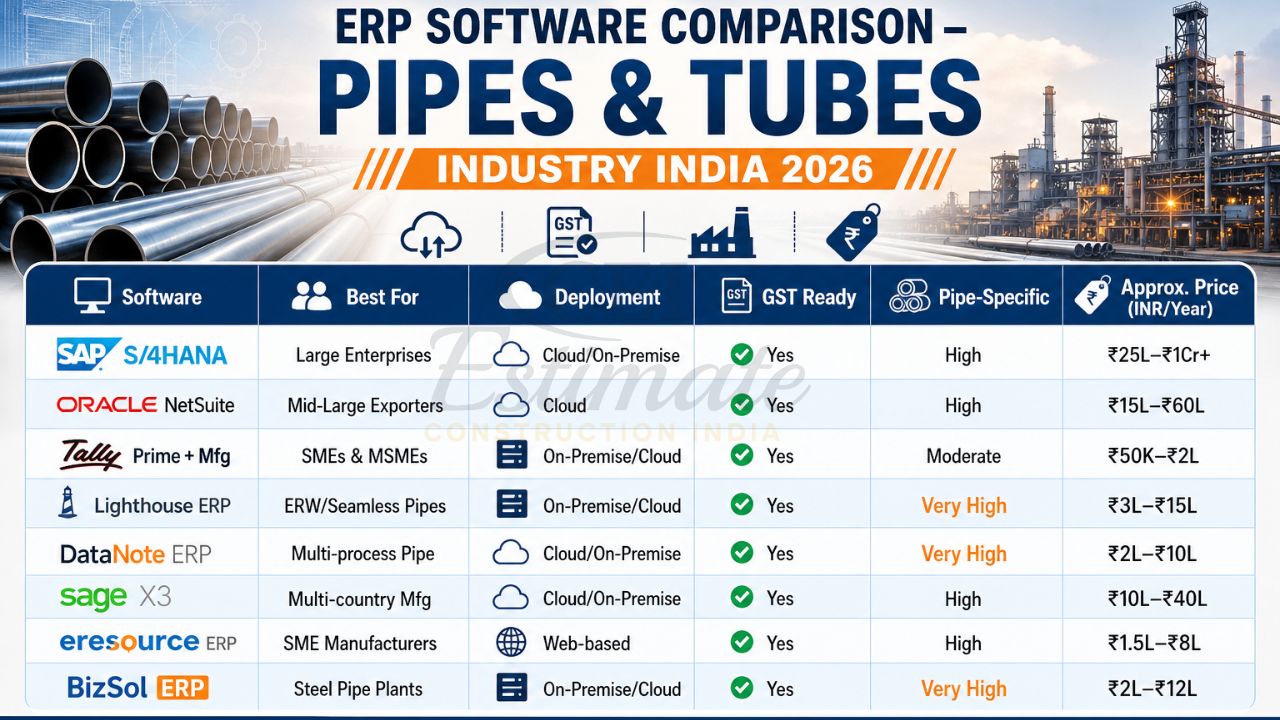
ERP Software Comparison Table for Pipes & Tubes Industry — India 2026
| Software | Best For | Deployment | GST Ready | Pipe-Specific | Approx. Price (INR/Year) |
| SAP S/4HANA | Large Enterprises | Cloud/On-Premise | Yes | High | ₹25L–₹1Cr+ |
| Oracle NetSuite | Mid-Large Exporters | Cloud | Yes | High | ₹15L–₹60L |
| Tally Prime + Mfg | SMEs & MSMEs | On-Premise/Cloud | Yes | Moderate | ₹50K–₹2L |
| Lighthouse ERP | ERW/Seamless Pipes | On-Premise/Cloud | Yes | Very High | ₹3L–₹15L |
| DataNote ERP | Multi-process Pipe | Cloud/On-Premise | Yes | Very High | ₹2L–₹10L |
| Sage X3 | Multi-country Mfg | Cloud/On-Premise | Yes | High | ₹10L–₹40L |
| eresource ERP | SME Manufacturers | Web-based | Yes | High | ₹1.5L–₹8L |
| BizSol ERP | Steel Pipe Plants | On-Premise/Cloud | Yes | Very High | ₹2L–₹12L |
Key ERP Trends in Pipes & Tubes Manufacturing in India for 2026
The ERP landscape for Indian pipe and tube manufacturers is evolving rapidly, driven by both technology advancement and changing market demands. Understanding these trends will help you make a more future-proof technology investment.
AI-Powered Demand Forecasting
Leading ERP platforms are integrating machine learning algorithms that analyse historical sales data, seasonal demand patterns, raw material price trends, and construction sector activity to help pipe manufacturers forecast demand more accurately. This reduces overproduction, minimises inventory carrying costs, and ensures you have the right pipe grades and sizes ready when customers need them.
IoT-Enabled Shop Floor Integration
Pipe mills are increasingly connecting production equipment — pipe mills, hydraulic presses, testing machines, weighbridges — directly to ERP systems via IoT sensors. This enables real-time capture of production data like pipe output per shift, machine downtime, defect rates, and actual vs planned yield — completely eliminating manual data entry and the errors it introduces.
Cloud-First Adoption Among Indian Pipe SMEs
Cloud ERP adoption among Indian pipe manufacturers is accelerating. The combination of lower upfront investment, automatic software updates, remote access, and the ability to scale user licences as the business grows is making cloud ERP the preferred model for most new implementations in 2026, particularly for companies with revenues below ₹200 Crore.
Export Compliance and Documentation Automation
With Indian pipe exports growing to markets in the Middle East, Africa, and Southeast Asia, ERP systems are increasingly incorporating export compliance modules that automate the generation of shipping documents, material test certificates, certificates of origin, and customs declarations — reducing documentation turnaround time from days to hours.
Mobile ERP for Shop Floor and Field Sales
Sales representatives visiting project sites and pipe distributors now expect mobile access to customer order history, available stock, pricing, and delivery schedules. Similarly, shift supervisors need mobile dashboards to monitor production output and quality alerts without being tied to a desktop. Mobile-ready ERP interfaces are no longer optional — they are a baseline expectation.
👉 Automate Your Pipe Manufacturing Business Today – 📞 Contact: +91 86306 76890
How to Choose the Right ERP System for Your Pipes & Tubes Business?
Choosing an ERP system is one of the most significant technology decisions your business will make. The wrong choice can cost you time, money, and operational disruption. Here is a practical framework we use at Construction Estimator India to guide pipe and tube manufacturers through this decision:
Start with Your Biggest Pain Points
Before evaluating ERP systems, list the top five operational problems costing you the most money or time. Is it raw material wastage due to poor production planning? Inventory inaccuracies causing stock-outs or excess holding? Quality rejections from customers due to missed inspection steps? GST compliance headaches? The right ERP will directly address your most critical pain points.
Match ERP to Your Pipe Type and Process
A steel ERW pipe mill has fundamentally different ERP requirements from a PVC pipe extrusion plant or an HDPE pipe manufacturer. Ensure the ERP you choose has demonstrable, working functionality for your specific manufacturing process — not just generic manufacturing capability.
Evaluate Indian Statutory Compliance Depth
GST, TDS, EPF, ESI, and state-specific levies are non-negotiable requirements for Indian pipe manufacturers. Verify that the ERP handles GST for manufacturing specifically — including job work transactions, reverse charge mechanism, and e-invoicing — not just basic GST billing.
Consider Total Cost of Ownership, Not Just License Cost
The software license is just one component of ERP cost. Factor in implementation fees, data migration, staff training, annual maintenance, and the cost of internal IT resources needed to manage the system. Some mid-market ERP solutions appear affordable upfront but carry significant hidden costs.
Insist on Reference Checks from Pipe Manufacturers
Ask every ERP vendor for references from pipe and tube manufacturers — not generic manufacturing companies. Speak to those reference customers about their implementation experience, ongoing support quality, and whether the ERP has genuinely improved their operations. This single step will save you from many poor decisions.
You might also find it helpful to explore our related guides on the best ERP software for manufacturing industry in India and our curated list of the top ERP software companies in India to broaden your research.
👉 Limited Demo Slots Available – 📲 Call: +91 86306 76890
Why Construction Estimator India’s ERP Solutions Deliver the Best Results for Pipes & Tubes Companies?
At Construction Estimator India, we do not just sell ERP software — we deliver end-to-end ERP transformation for manufacturing companies, with a deep focus on the pipes, tubes, and building materials sectors. Here is what sets us apart:
Deep Industry-Specific Knowledge
We understand the operational realities of pipe manufacturing — raw material price volatility, the challenge of managing hundreds of SKUs across pipe sizes and grades, the complexity of quality certification for export markets, and the pressure to reduce cutting losses and improve yield. This domain knowledge means we configure ERP systems to solve real problems, not generic business challenges.
Vendor-Neutral Recommendation
We work with a portfolio of leading ERP solutions — from enterprise platforms like SAP and Oracle to highly specialised pipe industry ERPs like Lighthouse and DataNote — which means our recommendations are genuinely aligned with your needs, not with any single vendor’s commission structure.
Phased Implementation for Minimum Disruption
We implement ERP in well-planned phases, starting with the modules that deliver the fastest ROI — typically inventory management and production planning — before expanding to quality control, finance, and HR. This approach ensures your operations continue running smoothly through the transition.
Ongoing Support and Optimisation
Our relationship does not end at go-live. We provide continuous post-implementation support, user training refreshes, and system optimisation to ensure your ERP continues delivering value as your business grows and evolves.
We also bring complementary expertise in ERP for the plumbing industry and ERP for construction companies — making us the go-to partner for the entire building materials and infrastructure supply chain in India.
Frequently Asked Questions (FAQs)
Q1: What is ERP software and why do pipes and tubes manufacturers in India need it?
ERP (Enterprise Resource Planning) software is an integrated business management platform that connects all your departments — production, inventory, procurement, finance, HR, and sales — into one unified system. For pipes and tubes manufacturers in India, ERP is especially critical because the industry deals with complex production variables like multiple pipe grades, sizes, wall thicknesses, and material specifications. Managing all of this manually or through disconnected systems leads to errors, delays, and cost overruns. A good ERP brings real-time visibility, automated workflows, GST-compliant billing, and accurate production planning that help manufacturers stay competitive, meet delivery deadlines, and maintain quality standards — all from a single dashboard.
Q2: Which is the best ERP software for steel pipes manufacturers in India?
For steel pipe manufacturers — whether producing ERW, seamless, or spiral pipes — Lighthouse ERP and SAP S/4HANA are among the strongest choices, alongside BizSol ERP for integrated steel plants. Lighthouse ERP is built specifically for the pipe mill environment, handling coil-to-pipe traceability, heat number tracking, weight-based inventory, and grade-wise dispatches. SAP S/4HANA, while enterprise-focused, offers unmatched depth for large steel pipe manufacturers with export operations. At Construction Estimator India, we assess your plant size, production complexity, and budget to recommend the right fit from our curated portfolio of ERP solutions.
Q3: Can ERP software handle PVC and HDPE pipe manufacturing processes?
Absolutely. Leading ERP solutions like DataNote ERP and Sage X3 have proven capabilities in polymer-based pipe manufacturing, including processes like extrusion, compounding, thermoforming, and quality testing. These systems track raw material (resin, additives, colour masterbatch) consumption, manage recipe-based production, handle batch traceability, and ensure quality parameters like pressure rating, wall thickness, and colour consistency are maintained. They also support IS and BIS certification compliance, which is mandatory for PVC and HDPE pipes sold in the Indian market.
Q4: How much does ERP software cost for a pipes and tubes manufacturing company in India?
ERP pricing in India varies significantly based on business size, number of users, modules needed, and deployment model. For small and medium pipe manufacturers, costs typically range from ₹50,000 to ₹5 lakh per year for solutions like Tally Prime with manufacturing modules or eresource ERP. Mid-sized manufacturers can expect to invest between ₹3 lakh to ₹15 lakh annually for industry-specific solutions like Lighthouse ERP or DataNote ERP. Enterprise-level systems like SAP S/4HANA or Oracle NetSuite can cost ₹25 lakh to ₹1 crore or more. At Construction Estimator India, we help you find the right solution that delivers maximum ROI for your specific budget and scale.
Q5: Is cloud-based ERP better than on-premise ERP for pipes manufacturers?
Both have merits depending on your business situation. Cloud-based ERP offers lower upfront costs, easy scalability, automatic updates, and remote access — ideal for multi-plant pipe manufacturers or companies with field sales teams. On-premise ERP gives you full data control, better customisation for complex shop-floor processes, and works even with poor internet connectivity — which can be a real concern in industrial zones. Many modern ERPs like Sage X3 and SAP S/4HANA offer hybrid models. Our recommendation at Construction Estimator India is to consider cloud-first if you are a growing mid-sized manufacturer, and on-premise or hybrid if you run a large, complex pipe mill with significant IT infrastructure.
Q6: Does ERP help with export compliance and documentation for pipes and tubes?
Yes, and this is one of the most valuable capabilities of a good ERP for Indian pipe exporters. Export-ready ERP systems generate key shipping documents like packing lists, commercial invoices, certificates of origin, and material test certificates (MTCs) in the format required by international buyers. They also handle multi-currency transactions, letter of credit (LC) tracking, customs duty calculations, and compliance with export standards such as ASTM, ASME, DIN, and EN. Oracle NetSuite and SAP S/4HANA are particularly strong in this area, while Lighthouse ERP also offers solid export documentation capabilities for pipe mills serving global markets.
Q7: How long does ERP implementation take for a pipe manufacturing company?
Implementation timelines vary based on the complexity of your operations and the ERP solution chosen. For smaller manufacturers using solutions like Tally Prime or eresource ERP, basic implementation can be completed in 4–8 weeks. Mid-sized pipe companies implementing Lighthouse ERP or DataNote ERP typically take 3–6 months including configuration, data migration, and staff training. Enterprise ERP implementations like SAP S/4HANA can take 6–18 months for large, multi-plant pipe manufacturers. At Construction Estimator India, we structure the implementation in well-defined phases — starting with the most critical modules like inventory and production planning — so you see early results without disrupting ongoing operations.
Q8: Can ERP integrate with quality testing and lab management systems in pipe factories?
Modern ERP systems can integrate with laboratory information management systems (LIMS) and quality control instruments on the shop floor. For pipe manufacturers, this means that test results for hydrostatic pressure testing, dimensional checks, tensile strength, and chemical composition can flow directly into the ERP from testing equipment. This eliminates manual data entry errors, creates an auditable quality trail, and automatically blocks non-conforming material from moving to the next stage or dispatch. Lighthouse ERP, for example, supports ASTM, ASME, and MIL standard compliance verification, while DataNote ERP’s quality module covers multi-stage inspection for complex pipe manufacturing setups.
Q9: What modules should a pipe and tube manufacturer look for in an ERP system?
A comprehensive ERP for the pipes and tubes industry should include: Production Planning and Scheduling (with support for job orders, routing, and BOM for multiple pipe sizes); Inventory Management (weight-based, length-based, and bundle-based tracking); Quality Control and Inspection (with heat number and batch traceability); Procurement and Vendor Management; Sales Order Management and Dispatch Planning; Finance and Accounts (including GST, TDS, and export billing); Costing and Profitability Analysis (grade-wise and size-wise margins); and Reporting and Business Intelligence. For exporters, modules for multi-currency accounting and export documentation are also essential. At Construction Estimator India, we help you prioritise which modules to go live with first based on your immediate pain points.
Q10: How can Construction Estimator India help my pipes and tubes business find the right ERP?
Construction Estimator India brings deep, hands-on expertise in helping manufacturing companies — particularly in the pipes, tubes, and building materials sectors — evaluate, select, and implement the right ERP solution. We start with a detailed needs assessment of your operations, understanding your production processes, inventory challenges, quality requirements, and compliance needs. Based on this, we shortlist the ERP systems that genuinely fit your business — not generic recommendations. We then manage the entire implementation journey, from data migration and configuration to staff training and go-live support. Our goal is to ensure you extract maximum value from your ERP investment, with measurable improvements in production efficiency, inventory accuracy, and financial control. Reach out to us on WhatsApp at +91 86306 76890 or email us at info@constructionestimatorindia.com for a free consultation.
Conclusion: Make Your ERP Decision Count in 2026
The pipes and tubes industry in India is at an inflection point. Growing infrastructure spending under government schemes, rising export demand, and increasing quality consciousness among buyers are all creating tremendous opportunity — but also raising the bar for operational excellence. The manufacturers who will lead in 2026 and beyond are those who invest in the right digital infrastructure today.
Choosing the best ERP software for your pipes and tubes business is not about picking the most popular brand or the cheapest option. It is about finding the platform that genuinely fits your production processes, your team’s capabilities, your compliance requirements, and your growth aspirations — and then implementing it with the right expertise and support.
At Construction Estimator India, we have the industry knowledge, the ERP portfolio, and the implementation experience to help you make the right choice and get the most from your investment. Whether you are a small pipe manufacturer taking your first steps into ERP, or a large pipe group looking to replace a legacy system with something more powerful and modern, we are ready to help.
You may also find it useful to explore our broader guides on best ERP for the construction industry and best construction ERP software in India for additional context on the ERP ecosystem we operate in.
Ready to find the perfect ERP for your pipes and tubes business?
Contact Construction Estimator India today for a free, no-obligation consultation:
WhatsApp / Phone: +91 86306 76890