Look, I’ve seen it happen more times than I care to admit. You spend your life savings building your dream home, only to wake up three years later during a heavy monsoon to find damp patches on the ceiling or, worse, water dripping onto your furniture. Just last year, I visited a site in Agra where a beautiful G+1 villa had developed massive structural cracks in the roof slab. The culprit? The owner had saved a few thousand rupees by choosing a low-grade, unknown cement for the casting. Selecting the best cement for roof construction in India is not just about strength; it is about protecting your family and your biggest investment from the elements for the next 50 years.
Why Cement Choice Matters for Roof and Slab Casting?
The roof slab is arguably the most vulnerable part of any structure. Unlike walls, it is constantly exposed to direct sunlight, heavy rainfall, and thermal expansion. In 2026, with the extreme weather patterns we are seeing across India, you need a cement that does more than just hold things together.
First, we have the load-bearing capacity. The roof must support its own weight, the weight of water tanks, solar panels, and people. If the cement isn’t up to the task, the slab starts sagging or develops honeycombs. Second is waterproofing. A roof slab that isn’t dense enough will have micro-pores that allow water to reach the steel reinforcement, causing it to rust and expand.
Third, we must consider the heat of hydration. When you cast a large slab, the chemical reaction of cement produces heat. If this heat isn’t managed—common with high-grade Ordinary Portland Cement (OPC) without proper curing—it leads to thermal cracks. Lastly, long-term durability is the goal. You want a roof that doesn’t just survive the first five years, but stays leak-proof for decades.
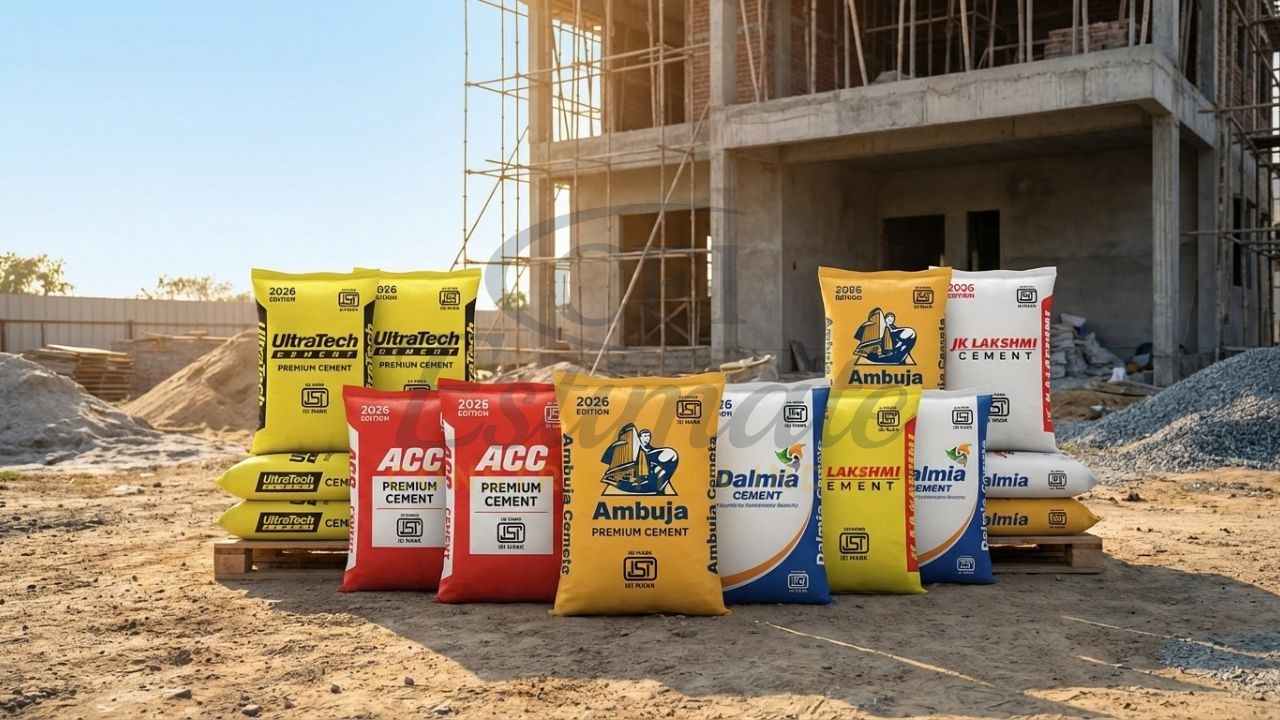
OPC vs PPC Cement for Roof Slab – Which One is Better?
This is the number one question homeowners ask me on-site: OPC vs PPC for roof slab? Let’s break it down technically but simply.
Ordinary Portland Cement (OPC), especially the 53 grade, is the “fast” cement. It reaches its design strength very quickly. This is great if you are building a commercial high-rise and need to remove the shuttering (de-shuttering) in just 7 days. However, the downside is that it generates a lot of heat during setting, which can cause hairline cracks in thin slabs if curing isn’t aggressive.
Portland Pozzolana Cement (PPC), on the other hand, is the “durability” cement. It uses fly ash, which reacts slowly but creates a much denser concrete matrix. This density is what makes it a crack resistant cement for terrace use. It has a lower heat of hydration and provides better resistance against chemical attacks from groundwater or air pollution.
| Feature | OPC 53 Grade | PPC (Portland Pozzolana Cement) |
|---|---|---|
| Initial Setting Time | Fast (30–60 mins) | Moderate (60–90 mins) |
| Early Strength (3-7 days) | Very High | Moderate |
| Heat of Hydration | High (High crack risk) | Low (Reduced crack risk) |
| Waterproofing Ability | Good | Superior (Denser matrix) |
| Curing Requirement | Mandatory (14-21 days) | Essential (14-21 days) |
| Long-term Durability | High | Very High (Better corrosion resistance) |
| Best Used For | Fast-track high-rise RCC | Residential slabs, damp areas |
In my experience, unless you are in a massive hurry to remove the props, PPC is often the better choice for residential roof slabs because it offers built-in waterproof cement for roof properties through its finer particles.
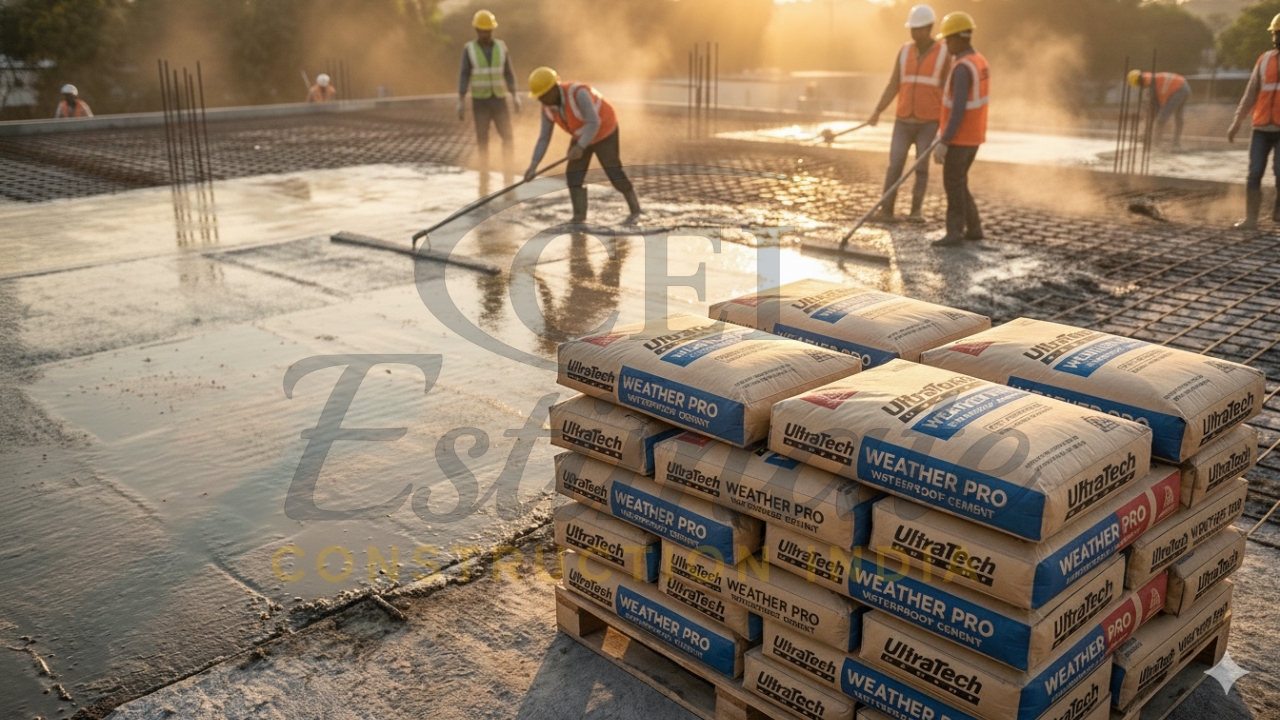
Best Cement for Roof Construction and Slab Casting in 2026
When we look at the cement for roof construction 2026 market, several top-tier brands have developed specific products for RCC (Reinforced Cement Concrete) work. Whether you are doing best cement for concrete slab casting in a seismic zone or a standard G+1 house, brand consistency matters.
Roof Slab Casting Recommendations
For the main slab casting, you want a brand that offers high consistency. UltraTech Cement remains a top choice for its reliable OPC 53 and PPC variants. Their “Weather Plus” range is specifically engineered to be a best cement for roof choice for most homeowners. If you are looking for the best cement for roof construction in India, UltraTech and ACC Gold are often the first names contractors mention.
Terrace and Roof Waterproofing
If your terrace will be exposed to heavy monsoons (like in Kerala or the Northeast), you should look at Ambuja Plus Roof Special or ACC Gold Water Shield. These cements have water-repellent properties that make them the best cement for roof slab casting in wet climates. While these are great for the slab, remember that for the final finish, you might also need the best PPC cement for plastering to ensure a smooth, leak-proof surface.
High-Rise vs Low-Rise Buildings
For high-rise buildings where speed is money, OPC 53 from brands like Dalmia or JK Lakshmi is preferred for columns and beams to allow faster construction cycles. For a standard low-rise house, a high-quality PPC or PSC (Portland Slag Cement) is usually sufficient and more cost-effective.
Seismic Zones
In earthquake-prone areas like North India, the bond between the steel and concrete is vital. Brands like JK Super and Shree Cement have shown excellent performance in providing that tight grip on reinforcement bars.
Recommended Mix Ratio and Best Practices for Roof Slab Casting
Choosing the best cement for terrace and roof in India is only half the battle. If your mix ratio is wrong, even the most expensive cement will fail.
The Ideal Concrete Mix
For residential slabs, we generally use M20 or M25 grade concrete.
| Concrete Grade | Cement : Sand : Aggregate Ratio | Typical Use |
|---|---|---|
| M20 | 1 : 1.5 : 3 | Standard residential slabs |
| M25 | 1 : 1 : 2 | Heavy-duty or long-span slabs |
Technical Tips for a Strong Slab
- Water-Cement Ratio: Keep this between 0.40 and 0.45. Too much water makes the concrete easy to pour but creates “capillary pores” when it evaporates, leading to future leakages.
- Use Admixtures: For a leak-proof roof, I always recommend adding a liquid waterproofing compound (like Dr. Fixit) directly into the concrete mixer.
- Vibration: Never skip the use of a mechanical needle vibrator. It removes air bubbles and ensures the concrete settles perfectly around the steel.
- Curing: This is the most ignored step. You must cure the slab for at least 14 to 21 days. For slabs, “ponding” (creating small water pools on top) is the gold standard.
Factors to Consider When Choosing Cement for Roof in India
Before you place your order with the local dealer, consider these four factors:
- Climate Conditions: If you are casting in the peak of the UP summer, avoid OPC 53 unless you have a massive curing team. Use PPC to manage the heat.
- Slab Thickness: A standard slab is 4 to 5 inches (100–125 mm) thick. Thicker slabs require more attention to the heat of hydration.
- Load Requirements: If you plan to add more floors in the future (G+2 or G+3), prioritize high early strength cements like OPC 53 for your columns and beams to handle the vertical load.
- Budget and Availability: While UltraTech and ACC are premium brands, regional players like Wonder Cement or Birla Corporation offer excellent quality at a more competitive price point in certain states.
Frequently Asked Questions (FAQs)
- Which is better for roof: OPC or PPC?
For residential roofs, PPC is generally better because it is more resistant to cracks and provides better waterproofing over time. - Can I use OPC 43 for slab casting?
It is acceptable for low-rise buildings, but OPC 53 or high-quality PPC is preferred for better safety margins in 2026 construction. - How many bags of cement are needed for a 1000 sq ft roof slab?
Typically, a 100-square-meter (roughly 1076 sq ft) roof with a 5-inch thickness requires 35 to 40 bags of cement for an M20 mix. - Is “waterproof cement” a real thing?
Yes, variants like ACC Gold Water Shield contain hydrophobic additives that resist water penetration more effectively than standard cement. - How long should I wait before removing the shuttering?
For OPC 53, it can be 7-10 days for small spans; for PPC, it is safer to wait 14 to 21 days depending on the temperature. - Does the age of cement matter?
Absolutely. Never use cement that is more than 3 months old from the date of manufacture, as it loses strength significantly. - Can I mix different brands of cement in one slab?
No. Stick to one brand and one batch if possible to ensure uniform setting and strength across the entire slab. - What is the best concrete grade for a terrace?
M20 is the minimum, but M25 is recommended for better durability and crack resistance.
Conclusion
Choosing the best cement for roof construction in India is a decision that will live with you as long as you live in your house. Don’t let a small saving today lead to a massive repair bill five years down the line. For most residential projects in 2026, I strongly recommend using a premium PPC from brands like UltraTech, ACC, or Ambuja to ensure a crack resistant cement for terrace finish.
Combine the right cement with a strict 1:1.5:3 mix ratio, use a mechanical vibrator, and commit to 21 days of water curing. If you do these things right, your roof won’t just be a cover over your head—it will be a permanent shield for your home. Build strong, build once!