
If you’re investing in premium marble like Makrana White, Wonder White, Statuario, Calacatta, or Italian Botticino, the wrong cement can destroy the look in just a few months – yellow patches, hairline cracks, hollow sound, and ugly stains start appearing even before you’ve shifted in. In 2026, marble contractors and luxury homeowners across India are shifting from ordinary grey cement to specialized marble adhesives and white cement systems to get stain-free, crack-free, long-lasting marble floors.
Why Ordinary Grey Cement Should Never Be Used for Marble Flooring?
Ordinary grey OPC/PPC cement is designed for concrete and brickwork, not for sensitive natural stone like white or imported marble. Its high alkalinity and soluble salts react with minerals and iron content in marble, leading to yellowing, rust-like stains and efflorescence (white salt deposits) that show through from the back to the polished surface over time.
Key problems with using normal grey cement directly under marble:
- High alkalinity and salts cause yellowing and brown stains, especially on Makrana, Wonder White, Statuario, Calacatta and other light/imported marble.
- Shrinkage during curing leads to hairline cracks and hollow spots under large slabs.
- Poor workability and inconsistent mixing cause voids, resulting in the typical “hollow sound” when you tap the floor.
- Water absorption and microcracks allow dampness to rise, creating efflorescence and patchy discoloration.
- Lack of polymer modification means low flexibility, so slabs debond or crack under temperature changes and light structural movements.
If you are doing high-value villas, farmhouses, luxury apartments, boutique hotels or offices, using ordinary grey cement directly under marble is a costly mistake that usually shows up 3–18 months after handover.
Which Type of Cement/Adhesive Is Best for Marble Flooring?
For premium marble flooring in 2026, the industry has clearly moved towards engineered marble/stone adhesives and polymer-modified white cement systems. The right choice depends on marble type, area (dry/wet), and budget.
Recommended types
- White cement-based marble adhesive
Best overall choice for light and imported marble. Gives bright background, avoids yellowing, has controlled shrinkage and high bond strength when used as a ready-mix adhesive or with proper polymers. - Polymer-modified white cement mortar / adhesive
Premium option with very high bond strength, flexibility and water resistance, perfect for large-format slabs, Italian/Imported stones and high-traffic luxury areas. - Epoxy-based marble adhesive
Zero water absorption, chemical resistance, very high bonding and flexibility, ideal for wet areas (bathrooms, spas, decks, pool sides, commercial lobbies, hotel kitchens). - Grey + white cement mix (only for dark marble)
Can be used as a budget option under dark marbles where staining is not visible; still better to improve it with polymer additives. - Avoid direct use of ordinary grey OPC/PPC cement under white/imported marble
Even if the workmanship is good, risks of staining and efflorescence remain high.
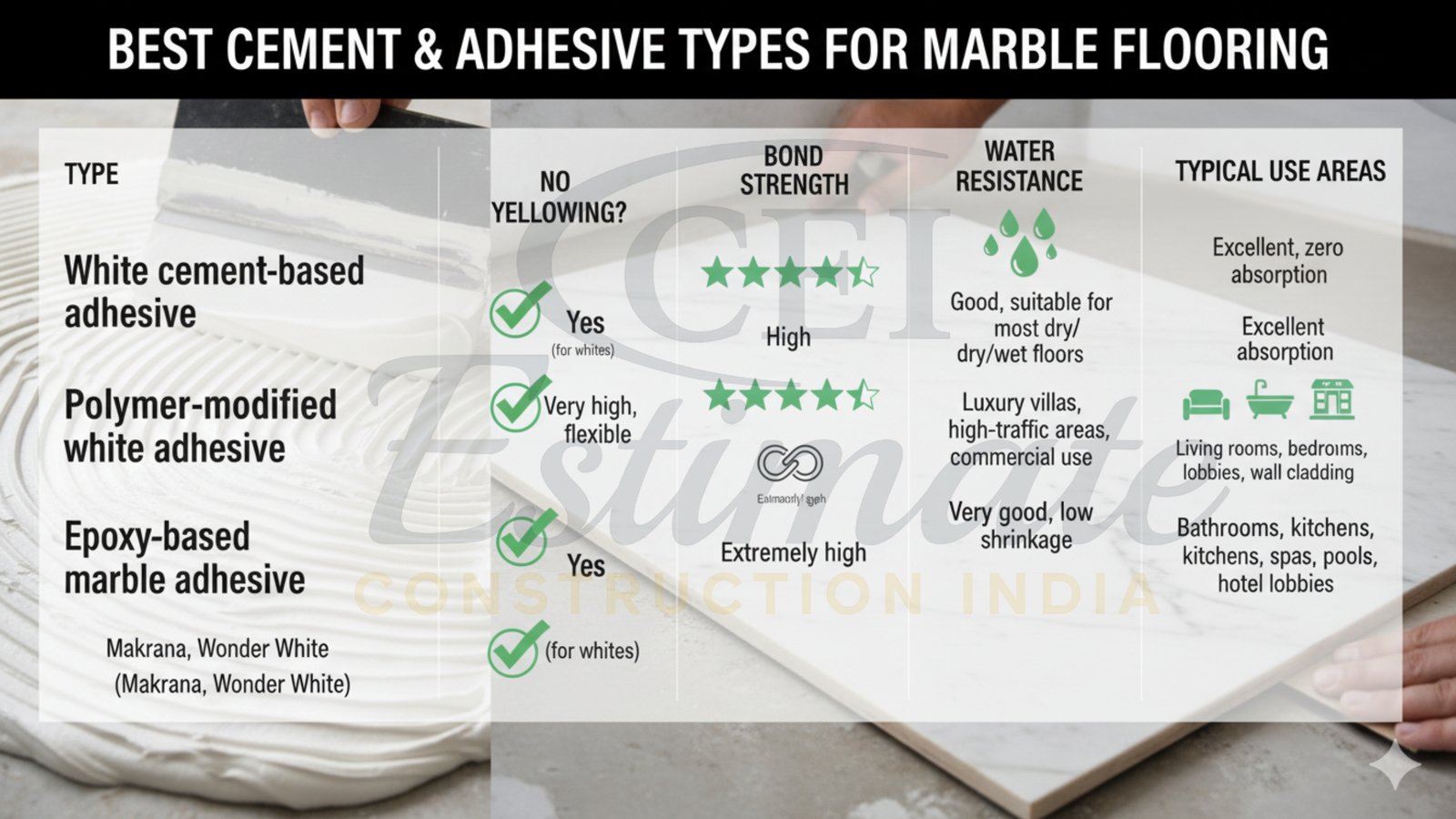
White vs Polymer-Modified vs Epoxy – Quick Comparison
| Type | Best For Marble | No Yellowing? | Bond Strength | Water Resistance | Typical Use Areas |
| White cement-based adhesive | Makrana, Wonder White, imported white stones | Yes (for whites) | High | Good, suitable for most dry/wet floors | Living rooms, bedrooms, lobbies, wall cladding |
| Polymer-modified white adhesive | Large slabs, Italian, Statuario/Calacatta | Yes | Very high, flexible | Very good, low shrinkage | Luxury villas, high-traffic areas, commercial use |
| Epoxy-based marble adhesive | All marbles in wet/heavy-load areas | Yes | Extremely high | Excellent, zero absorption | Bathrooms, kitchens, spas, pools, hotel lobbies |
Top 10 Best Cement & Adhesive Brands/Products for Marble Flooring in India 2026
Note: Prices vary by city, dealer discount and packaging; below are typical 2025–26 contractor market ranges for 20–25 kg/40 kg bags or epoxy kits in major metros.
1. Birla White Cement / Birla White Marble Adhesive
- Type: White cement and white marble/stone adhesive.
- Best for: Makrana, Wonder White, imported white marbles, light beige stones.
- No yellowing: Yes, when used with proper sand and mixing; very safe for white marble backs.
- Typical price (2026): ₹550–₹750 per 25 kg for premium marble adhesive; white cement itself around ₹35–₹40 per kg retail.
- Coverage: Around 1.3–1.6 kg/m²/mm thickness for adhesive; roughly 3–4 m² per 20–25 kg at 3–4 mm bed with notched trowel.
- Key advantage: High whiteness, trusted brand, good bond, compatible with latex/polymer additives for flexible marble bedding.
2. JK White Cement + Latex Additive
- Type: White cement with polymer/latex modifier for marble bedding mortar.
- Best for: White and light marbles in living rooms, bedrooms and lobbies.
- No yellowing: Yes, high-purity white cement reduces discoloration risks when used with clean sand and proper curing.
- Typical price (2026): ₹500–₹700 per 25 kg equivalent system (cement + additive).
- Coverage: Approximately 3–4 m² per 25 kg at 3–4 mm bed; higher consumption for back-buttering.
- Key advantage: Customizable mix, good for contractors who prefer site-batched white mortar but want better bonding and flexibility with latex.
3. UltraTech White Cement / UltraTech Marble Adhesive
- Type: White cement, tile & stone adhesives for marble and granite.
- Best for: Both Indian and imported marble in residential and commercial spaces.
- No yellowing: Yes for white-based adhesives on light stones; avoid grey-based for whites.
- Typical price (2026): ₹650–₹900 per 20–25 kg bag of marble/stone adhesive.
- Coverage: Around 3–4 m² per bag at 3–4 mm thickness with notched trowel.
- Key advantage: Consistent quality, easy availability, suitable for large projects with predictable performance.
4. ACC White Cement
- Type: White cement for marble bedding, jointing and underlays.
- Best for: White and light marble when used with well-graded sand and admixtures.
- No yellowing: Yes, provided aggregates are clean and low in iron content.
- Typical price (2026): Around ₹500–₹650 per 25 kg in metros.
- Coverage: Similar to other white cements – 3–4 m² per 25 kg at 3–4 mm thickness.
- Key advantage: High whiteness, smooth finish, good base for site-made polymer-modified marble mortar.
5. MYK Laticrete – Laticrete 111 + 73 Latex / Laticrete 255
- Type: Polymer-modified cementitious thin-set and latex system for stone; high-performance S1/S2 class adhesives.
- Best for: Imported marbles, large-format slabs, cladding, high-traffic commercial floors.
- No yellowing: Yes, white versions are suitable for sensitive marble; check product shade.
- Typical price (2026): ₹900–₹1,500 per 20–25 kg bag (or bag + latex combo) depending on product.
- Coverage: Around 3–5 m² per 20–25 kg at standard 3–4 mm thickness.
- Key advantage: Very high bond, flexibility and water resistance, widely used by professional tile/marble contractors in metros.
6. Ardex Endura – White Star / X 77 / X 90
- Type: High-polymer, white cement-based stone adhesives conforming to IS 15477 & EN 12004.
- Best for: White and imported marble, vitrified tiles and dense stones; suitable for wet areas and pools.
- No yellowing: Yes, specifically designed to prevent discoloration and stains in marble and light stones.
- Typical price (2026): ₹900–₹1,400 per 20 kg bag in major cities.
- Coverage: Approximately 1.35–1.40 kg/m²/mm, i.e., 3–4.5 m² per 20 kg at 3–4 mm bed.
- Key advantage: High bond strength, water resistance and workability, proven performance with marble flooring and cladding.
7. Kerakoll – Keraflex Maxi / H40 No Limits (White)
- Type: Premium polymer-modified, deformable white adhesives for natural stone and large-format tiles.
- Best for: Imported Italian marble, Statuario, Calacatta, large slabs in luxury residential and commercial spaces.
- No yellowing: Yes, white base with controlled chemistry suits sensitive stones.
- Typical price (2026): Typically ₹1,400–₹2,000 per 25 kg (imported premium range).
- Coverage: Roughly 4–6 m² per bag depending on trowel size and bed thickness.
- Key advantage: Top-end performance – high deformability, long open time, excellent wetting of large, heavy slabs.
8. Roff – Marble Adhesive / Roff Tuffix White
- Type: White tile & stone adhesives and marble fix systems.
- Best for: Indian marble, imported marble and granite in premium homes and commercial projects.
- No yellowing: Yes for white-based marble adhesives on light stones.
- Typical price (2026): ₹700–₹1,000 per 20–25 kg bag.
- Coverage: Around 3–4 m² per bag at 3–4 mm thickness.
- Key advantage: Excellent availability via retail tile shops, good balance of performance and price.
9. Weber – Webercol Flex White / Weberfix Pro White
- Type: Flexible, polymer-modified white cement-based adhesive for stone and tiles.
- Best for: Light marble, porcelain and vitrified combinations, wall cladding and floors.
- No yellowing: Yes, formulated for natural stones including white marble.
- Typical price (2026): ₹850–₹1,200 per 20–25 kg bag in metros.
- Coverage: Typically 3–5 m² per bag depending on bed thickness and tile back.
- Key advantage: Flexible and deformable, good for projects with minor structural movement or thermal expansion.
10. Fosroc – Nitobond White / Epoxy & Hybrid Systems
- Type: Epoxy-based and epoxy-hybrid bonding agents and adhesives for stone and tiles.
- Best for: Wet areas, podiums, balconies, commercial kitchens, industrial floors, or where zero water absorption and chemical resistance are critical.
- No yellowing: Yes, white/neutral epoxy systems with no grey-cement staining.
- Typical price (2026): Usually ₹3,500–₹5,000 per kit depending on pack size and type.
- Coverage: Lower coverage than cement adhesives; typically 1–2 m² per kit for full-bed marble fixing, depends strongly on kit size.
- Key advantage: Extreme bond, zero shrinkage and high chemical/water resistance, perfect for critical luxury/wet applications.
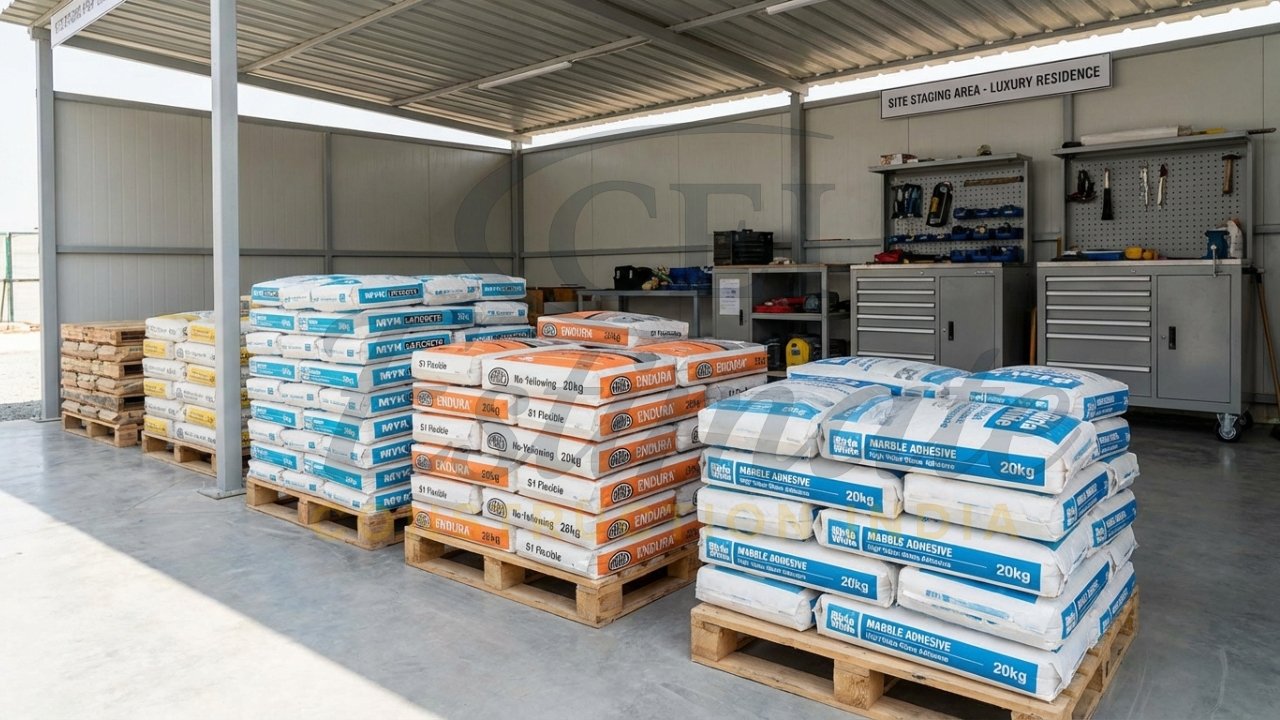
Simple Brand Comparison Snapshot
| Product/Brand | Type | Best For Marble | No Yellowing? | Bond Strength | Approx Price 2026 (25/40 kg or kit) | Coverage (approx) |
| Birla White Marble Adhesive | White cement adhesive | White/imported marble | Yes | High | ₹550–₹750 per 25 kg | 3–4 m² per 20–25 kg |
| JK White + Latex | White cement + polymer | White/light marble | Yes | High, flexible | ₹500–₹700 per 25 kg eq. | 3–4 m² per 25 kg |
| UltraTech Marble Adhesive | White/stone adhesive | Indian & imported marble | Yes (white grade) | High | ₹650–₹900 per 20–25 kg | 3–4 m² per bag |
| ACC White Cement | White cement | White/light marble | Yes | Medium–High | ₹500–₹650 per 25 kg | 3–4 m² per 25 kg |
| MYK Laticrete 111/255 | Polymer-modified adhesive | Imported/large slabs | Yes (white) | Very high | ₹900–₹1,500 per 20–25 kg | 3–5 m² per bag |
| Ardex Endura White Star/X77 | High-polymer white adhesive | White/imported marble, wet areas | Yes | Very high | ₹900–₹1,400 per 20 kg | 3–4.5 m² per 20 kg |
| Kerakoll H40 (White) | Premium polymer-modified adhesive | Italian/Calacatta/Statuario | Yes | Very high | ₹1,400–₹2,000 per 25 kg | 4–6 m² per bag |
| Roff Marble Adhesive | White stone adhesive | Indian & imported marble | Yes | High | ₹700–₹1,000 per 20–25 kg | 3–4 m² per bag |
| Webercol Flex White | Polymer-modified white adhesive | Light marble & porcelain combinations | Yes | High–Very high | ₹850–₹1,200 per 20–25 kg | 3–5 m² per bag |
| Fosroc Nitobond Epoxy | Epoxy/hybrid adhesive | Any marble in wet/critical areas | Yes | Extremely high | ₹3,500–₹5,000 per kit | 1–2 m² per kit (approx) |
How Much Cement/Adhesive Do You Need for Marble Flooring?
For marble flooring, typical consumption of cementitious adhesive is around 4–6 kg/m², depending on tile size, bed thickness and whether you are doing full back-buttering. Large-format slabs and uneven substrates may consume more because you need a thicker, continuous bed to eliminate hollows.
Typical Consumption Table (Indicative)
Assumption: 16 mm average overall thickness (bed + back-butter), medium/large marble slabs, good substrate.
| Floor Area (sq ft) | Floor Area (m²) | Adhesive Type | Average Consumption (kg/m²) | Total Adhesive (kg) | Approx Bags (25 kg) |
| 200 sq ft | ~18.6 m² | White/polymer-modified adhesive | 4.5–5.0 | 85–95 | 4 bags |
| 500 sq ft | ~46.5 m² | White/polymer-modified adhesive | 4.5–5.5 | 210–255 | 9–11 bags |
| 1,000 sq ft | ~93 m² | White/polymer-modified adhesive | 4.5–6.0 | 420–560 | 17–23 bags |
| 2,000 sq ft | ~186 m² | White/polymer-modified adhesive | 4.5–6.0 | 840–1,120 | 34–45 bags |
For epoxy systems, volume-based calculation is needed, and consumption is usually significantly lower in thickness but higher in cost per m².
Want exact cement/adhesive quantity and brand mix for your villa or commercial project? WhatsApp us on +91 8630676890 and we’ll send you a project-specific marble flooring BOQ with brand suggestions.
Practical Tips for Perfect Marble Flooring Installation
Even the best adhesive fails if the application is wrong. Follow these on-site practices for a premium, crack-free, stain-free marble floor.
- Prepare the concrete surface properly
- Roughen the surface mechanically or by hacking to ensure mechanical key, remove loose particles, laitance, paint or curing compounds.
- Check and correct levels before starting
- Use a leveling screed or self-leveling compound where needed; do not use marble adhesive just to correct large undulations.
- Clean and slightly dampen the substrate
- Remove dust with vacuum/air blower, lightly dampen (SSD condition) so that the surface does not absorb water from the adhesive too quickly.
- Soak and dry marble slabs correctly
- Many contractors pre-soak marble to reduce water absorption; ensure stones are surface-dry before fixing to avoid weakening the adhesive.
- Use the right mixing ratio and clean water
- Always follow manufacturer’s powder-to-water ratio (or resin:hardener for epoxy), use a mechanical mixer for lump-free, creamy consistency.
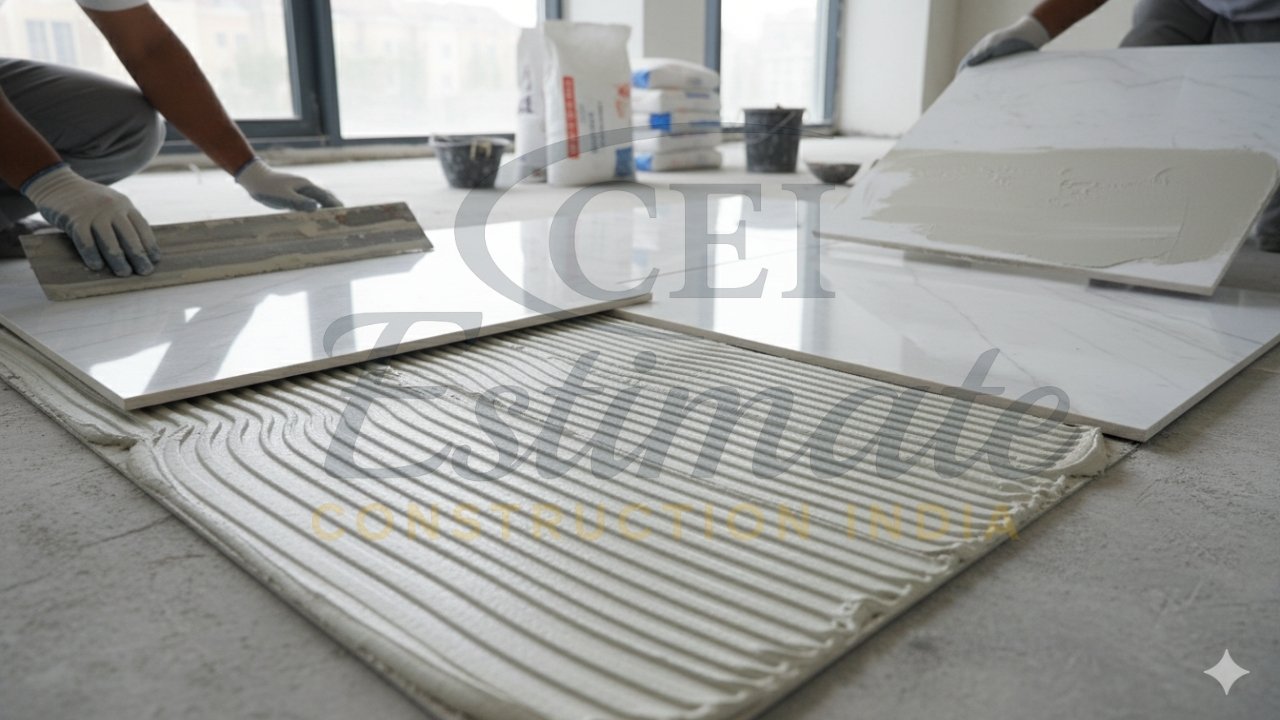
- Apply adhesive with a notched trowel (6–10 mm)
- First spread a thin bonding coat, then comb with suitable notch size so you get uniform thickness and avoid air pockets under the slab.
- Back-butter large marble slabs
- For big sizes and imported marble, apply a thin layer of adhesive on the back of the stone as well to achieve near 100% contact and eliminate hollow sounds.
- Do not exceed open time and adjustability time
- Lay marble within the specified open time; if skin forms on the adhesive, discard and reapply fresh material.
- Use spacers for joints and straight lines
- Leave appropriate joint widths (even 1–2 mm) instead of butt-jointing; this allows for movement and cleaner grouting.
- Cure properly for 7–14 days
- Protect from heavy load or traffic in the initial 3–5 days, keep surfaces moist (where recommended) and avoid rapid drying due to direct hot sun or strong breeze.
- Grout joints with white or epoxy grout
- Use white cement-based or epoxy grout compatible with marble to avoid staining and ensure stain-resistant joints, especially in kitchens and bathrooms.
- Seal marble after 28 days
- Once complete curing is over and polishing is done, apply a good quality marble/stone sealer to reduce staining from spills of tea, coffee, wine, oil, etc.
Need Accurate Marble Flooring Material BOQ & Full Budget?
Most homeowners and even many contractors underestimate the quantity and cost of adhesives, grouts, sealers and edge treatments in premium marble flooring. We help you avoid surprises by preparing a complete, project-specific BOQ and budget.
Here’s how our process works for you:
- You WhatsApp your floor plan (PDF, AutoCAD screenshot, or hand sketch) and marble details to +91 8630676890.
- We discuss your project location (Delhi NCR, Gurgaon, Noida, Jaipur, Mumbai, Bangalore, Hyderabad, Dehradun, Lucknow, etc.), usage (villa, flat, office, hotel, showroom) and marble type (Makrana, Wonder White, Statuario, Botticino, etc.).
- We suggest the ideal cement/adhesive system brand-wise – separate recommendations for bedrooms, living, bathrooms, balconies, kitchens and heavy-traffic areas.
- You get a clear BOQ: marble quantities, adhesive bags, grout, sealer, bedding material, edge profiles – with approximate 2026 cost.
- Optionally, we help you compare 2–3 brand options (budget vs premium) so you can decide where to save and where to upgrade.
- Your contractor/installers get written technical notes for mixing, application, curing and protection so execution matches the design value.
If you are planning a luxury marble flooring project in any Tier-1 or Tier-2 city, simply WhatsApp “Marble BOQ” to +91 8630676890 and we’ll take it from there.
Get Your Marble Flooring BOQ & Cement Brand Recommendation
✅ Want crack-free, stain-free marble flooring for your villa or apartment?
✅ Confused between white cement, adhesive brands and epoxy systems?
✅ Need an accurate material quantity and budget before finalizing contractor?
WhatsApp us now on +91 8630676890 for:
- Marble flooring material estimate & quantity calculation
- Room-wise cement/adhesive brand recommendation
- Full house marble flooring & cladding BOQ
- Approx total budget for flooring + adhesives + grouts + sealers
FAQ – Best Cement & Adhesive for Marble Flooring in India 2026
- Which cement is best for white marble flooring in India?
For white marble (Makrana, Wonder White, Statuario, Calacatta), a white cement-based marble adhesive or polymer-modified white adhesive from brands like Birla White, Ardex Endura, MYK Laticrete, Roff or Weber is best because it avoids yellowing and offers high bond strength. - Can I use normal grey cement for marble flooring if my budget is low?
You can use a grey + white cement mix for dark marbles, but for white/imported marble it is strongly discouraged due to staining, efflorescence and poor aesthetics; it often becomes more expensive later due to repairs. - Is epoxy adhesive necessary for all marble floors?
No, epoxy is mainly needed for wet, chemical or heavy-duty areas like bathrooms, commercial kitchens, pool decks and industrial spaces; for normal dry interior floors, a high-quality polymer-modified white adhesive is usually sufficient. - What is the average cost difference between grey cement and marble adhesive?
Grey cement mortar is cheaper per bag, but specialized marble adhesives typically cost ₹550–₹1,500 per 20–25 kg, and offer higher performance, less wastage and dramatically lower risk of failures on expensive marble. - How long should we wait before polishing marble after laying with adhesive?
Generally, you should wait 7–14 days for the adhesive bed to gain sufficient strength and moisture to reduce, then proceed with grinding and polishing; always follow the adhesive manufacturer’s recommendations. - How do I avoid hollow sound under marble tiles?
Use a proper notched trowel, maintain the right adhesive thickness, fully back-butter large slabs, avoid dry patches and press/beat the marble into position to achieve near 100% contact. - Do I still need curing when I use tile/stone adhesive?
Yes, even with polymer-modified adhesives, protect the fresh installation from early traffic, direct sun and rapid drying; light misting or controlled curing is often recommended by manufacturers. - Which adhesive is best for marble wall cladding?
For external or high-rise cladding, use high-performance, deformable polymer-modified white adhesives (Ardex Endura, MYK Laticrete, Kerakoll, Weber, Roff) and follow anchor/clip details as per structural design. - Do I need a separate grout for marble joints?
Yes, use a white cement-based or epoxy grout specifically designed for tiles/stone; avoid filling joints with plain cement-sand as it cracks and stains easily. - Can you help me choose between two brands I already have a quote for?
Yes, share your quotes and project details on WhatsApp +91 8630676890 and we’ll help you compare performance, suitability for your marble type and lifecycle cost.
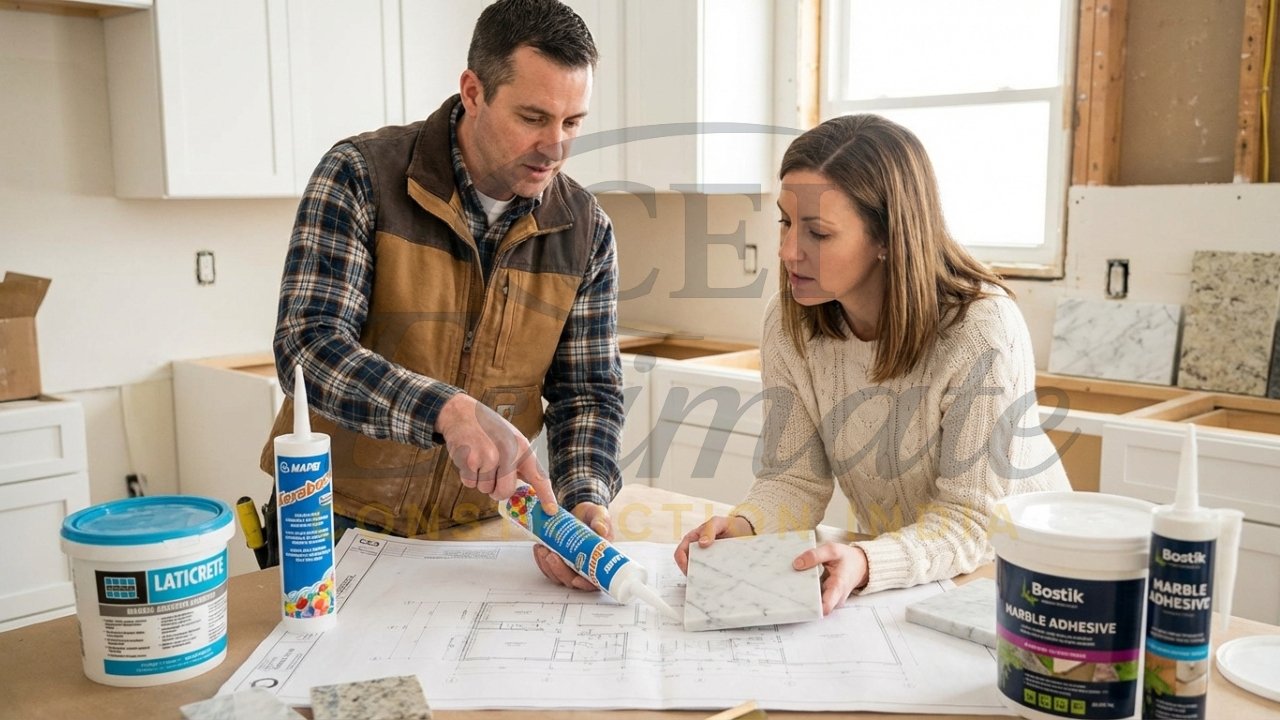
Conclusion – Get Crack-Free, Stain-Free Marble Flooring with the Right Cement System
Premium marble flooring deserves more than ordinary grey cement – it needs the right white cement, polymer-modified adhesive or epoxy system matched to your marble type, area of use and project budget. Whether you’re building a luxury villa in Gurgaon, a farmhouse near Dehradun, a high-end flat in Mumbai or a boutique hotel in Jaipur, the right combination of brand, adhesive type and site practice will decide whether your marble looks pristine for 20 years or starts cracking and yellowing in 12 months.
If you want an expert to do the thinking for you – quantities, brand selection, and complete marble flooring BOQ – WhatsApp us now on +91 8630676890 for a marble flooring material quantity calculation, BOQ and full house construction budget estimate.