Imagine you are a contractor in Meerut, Uttar Pradesh, successfully bidding for a high-rise residential project in the heart of the Delhi-NCR region. As you review the tender documents, you notice the client mandates a “Construction All Risk” policy. However, when you approach your insurance broker or a digital platform like HDFC ERGO or ICICI Lombard, they provide quotes for “Contractor All Risk.” You might find yourself caught in a loop of confusion, debating construction all risk insurance vs contractor all risk insurance and wondering if you are purchasing the correct legal protection. In the Indian market, this confusion is incredibly common because these terms are used with frustrating fluidity by insurers, banks, and legal departments.
To be perfectly honest, in most professional contexts within India, Construction All Risk Insurance and Contractor All Risk Insurance refer to the exact same insurance product, widely known by its acronym, CAR Insurance. Whether you are a small builder in a tier-2 city or a large-scale developer, these names represent the “gold standard” of protection for civil engineering works. However, subtle differences do exist in how the terms are utilized in contracts, who the primary buyer is, and whose interests the policy aims to safeguard. Understanding these nuances is critical for proper policy selection, ensuring tender compliance, and maintaining accurate project costing. This comprehensive guide will dissect the similarities, explore the technical differences, and provide practical insights for construction estimators to treat CAR insurance effectively in their Bill of Quantities (BOQ). By the end, you will have the clarity needed to secure your project against the unpredictable risks of 2026.
Are Construction All Risk and Contractor All Risk Insurance the Same?
The short and practical answer is: Yes, in the Indian insurance industry, they are essentially the same policy. The terminology used often depends more on the source of the document than the nature of the coverage. The name “Contractor All Risk Insurance” typically originates from the perspective of the contractor who is performing the work and is legally responsible for the site. On the other hand, the term “Construction All Risk Insurance” is often favored by project owners, developers, or government bodies who view the policy as a comprehensive shield for the entire “construction” project, rather than just a liability tool for the contractor.
In the 2026 market, many insurers have begun to standardize their language under the “CAR” banner to reduce confusion. However, if you are looking at the difference between CAR and construction all risk insurance, you may find that some insurers use the “Construction” label for larger, multi-party infrastructure projects where the policy is purchased as a “Principal-Controlled” program. Conversely, “Contractor” naming is more prevalent for smaller residential or commercial builds where the builder is the one expected to manage and pay for the insurance. Despite these linguistic choices, the core policy wording remains fundamentally tied to the “All Risk” philosophy—covering all physical loss or damage unless specifically excluded.
What is Contractor All Risk (CAR) Insurance?
A contractors all risk policy India is a specialized insurance product designed specifically for civil engineering projects. Its primary function is to protect the project’s physical works, construction materials on-site, and the legal liabilities of the contractor toward third parties. What makes this policy unique is its “comprehensive” nature. It doesn’t just cover one specific risk; it covers almost every physical hazard that could strike a construction site—from fires and floods to earthquakes and theft.
The policy typically protects several parties under one umbrella: the main contractor, all subcontractors, and the principal (project owner). This “Joint Name” approach is a requirement for most bank-financed projects in North India. The coverage period is also specialized, generally starting from the moment materials are unloaded at the site and continuing until the project is handed over or the final completion certificate is issued. Most importantly, a standard CAR policy includes a “Maintenance Period” (usually 12 months), which covers the contractor if a defect is discovered or damage occurs while they are back on-site performing rectification work post-completion.
What is Construction All Risk Insurance?
While we have established that the terms are interchangeable, the specific phrase “Construction All Risk Insurance” is sometimes used more broadly to emphasize the protection of the project assets regardless of who is working on them. In certain high-value government tenders or RERA-registered projects in cities like Noida and Lucknow, the term is used to signify that the insurance must cover the entire scope of the construction—including temporary structures, scaffolding, and even site offices.
In some instances, “Construction All Risk” is used as an umbrella term that might even include aspects of construction all risk vs erection all risk. While CAR is for civil works like building houses or bridges, Erection All Risk (EAR) is for the installation of heavy machinery or electrical systems. When a project owner says they need “Construction All Risk,” they are often asking for a policy that manages the totality of the site’s physical existence. For you as a builder, it represents the financial certainty that if a monsoon-induced landslide destroys your foundation in a hilly region of UP, the project can be rebuilt without bankrupting your firm.
Key Differences Between Construction All Risk vs Contractor All Risk Insurance
To help you navigate these terms in 2026, the following table provides a side-by-side comparison of how these terms are practically perceived and applied in the Indian construction sector.
| Feature | Contractor All Risk (CAR) | Construction All Risk |
|---|---|---|
| Primary Focus | The liability and physical risks of the contractor. | The overall safety and continuity of the project. |
| Typical Buyer | Usually the main contractor or builder. | Often the project owner or principal developer. |
| Common Usage | Residential builds, small commercial projects. | Infrastructure, industrial plants, large housing. |
| Sum Insured Basis | Total contract value of the builder’s scope. | Full reinstatement value of the entire project. |
| Interchangeability | High (95% same policy wording in India). | High (95% same policy wording in India). |
| Common Add-ons | Third-party liability, debris removal. | Escalation, professional fees, cross liability. |
| Legal Context | Mandated by individual contracts. | Often mandated by lenders (SBI/HDFC) or RERA. |
What is Covered Under CAR Insurance (Common to Both Terms)
Regardless of the name on the policy document, the coverage provided by CAR insurance India 2026 is exhaustive. In a volatile environment where climate change is causing unseasonal heavy rains in West UP and seismic activity in Delhi-NCR is a constant concern, these covers are non-negotiable.
- Material Damage to Works: This covers the permanent and temporary structures being built. If a fire breaks out at a site in Ghaziabad due to a short circuit, the policy pays for the reconstruction.
- Materials on Site: Raw materials like TMT bars, cement, and premium tiles are covered against theft or damage from the moment they are unloaded.
- Natural Perils: Coverage for floods, inundation, earthquakes, landslides, and storms. This is vital for projects in Meerut during the monsoon season.
- Third-Party Liability (TPL): If a piece of scaffolding falls and damages a neighbor’s car or injures a passerby, the policy covers the legal costs and compensation.
- Maintenance Period Cover: Protects against damage occurring while the contractor is fulfilling obligations during the defects liability period.
- Popular Add-ons:
- Escalation: Increases the sum insured to match rising material costs (crucial in 2026).
- Debris Removal: Covers the cost of clearing the site after an accident.
- Surrounding Property: Covers damage to the owner’s existing property that isn’t part of the construction.
Major Exclusions in CAR Insurance
It is equally important to know what the policy won’t pay for. Many contractors in India face claim rejections because they assume “All Risk” means “everything.” The standard exclusions for both terms include:
- Faulty Design: Damage caused by a structural engineer’s error is usually excluded (this requires Professional Indemnity insurance).
- Poor Workmanship: If your mason builds a crooked wall, the insurance won’t pay to fix it.
- Willful Negligence: Intentional violation of safety norms.
- Normal Wear and Tear: Rusting of steel left in the rain or gradual erosion of soil.
- Inventory Shortages: Materials that go missing without proof of theft or burglary.
- Cessation of Work: If the project is abandoned for a certain period, the cover may lapse.
Cost of Construction All Risk / Contractor All Risk Insurance in India
In 2026, the premium for construction all risk insurance vs contractor all risk insurance remains relatively affordable, yet it is a significant “soft cost” in any estimate. Typically, you can expect the premium to range between 0.5% and 1.5% of the total project value.
For a residential project in Meerut worth ₹1 Crore, your insurance premium might be around ₹60,000 to ₹1,20,000 for a 12-month period, depending on factors like:
- Location Risk: Sites in high-density urban areas or flood-prone zones attract higher rates.
- Contractor Track Record: Firms with zero past claims often get discounts.
- Policy Duration: Longer projects naturally cost more to insure.
- Selected Add-ons: Each extra rider (like escalation or earthquake cover) adds to the base premium.
How to Choose and Buy the Right CAR Insurance?
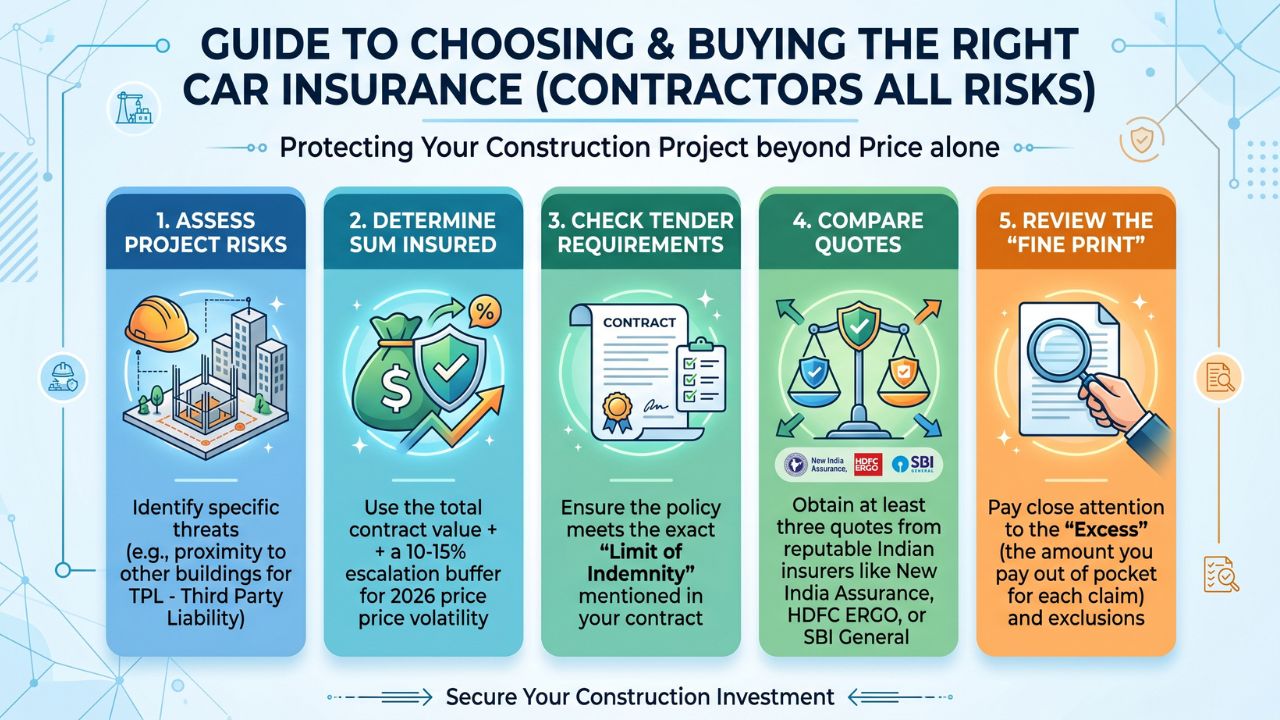
Buying the right policy isn’t just about the lowest price; it’s about the widest protection. Follow these steps:
- Assess Project Risks: Identify specific threats (e.g., proximity to other buildings for TPL).
- Determine Sum Insured: Use the total contract value + a 10-15% escalation buffer for 2026 price volatility.
- Check Tender Requirements: Ensure the policy meets the exact “Limit of Indemnity” mentioned in your contract.
- Compare Quotes: Obtain at least three quotes from reputable Indian insurers like New India Assurance, HDFC ERGO, or SBI General.
- Review the “Fine Print”: Pay close attention to the “Excess” (the amount you pay out of pocket for each claim) and exclusions.
How Estimators Should Include CAR Insurance in BOQ?
As an expert estimator, you should never hide insurance costs within your profit margin. It must be a distinct line item in your Bill of Quantities (BOQ), usually placed under “Preliminaries” or “General Requirements.”
When you include a specific amount for CAR insurance, you demonstrate professionalism to the client and protect your cash flow. If you are bidding for a project in Delhi-NCR, where third-party risks are high, itemizing the insurance ensures that the client understands the cost of their own protection. Always base this number on a realistic 1% of the estimated project value if a firm quote isn’t yet available.
Conclusion
To conclude, the debate of construction all risk insurance vs contractor all risk insurance is largely one of terminology rather than technicality. In the practical world of Indian construction, both refer to the same essential CAR policy that shields your project from ruin. Whether you call it “Contractor All Risk” to emphasize your responsibility or “Construction All Risk” to highlight the project’s safety, the result is the same: peace of mind for everyone involved.
Don’t let an unforeseen accident or a sudden monsoon flood derail years of hard work. Secure your project with the right CAR coverage today. At Construction Estimator India, we specialize in providing professional BOQ and construction cost estimation services that accurately factor in all necessary insurance premiums, ensuring your bids are as safe as they are competitive.
FAQ Section
What is the difference between construction all risk insurance and contractor all risk insurance?
In India, they are usually the same policy. “Contractor” focuses on the builder’s liability, while “Construction” focuses on the project assets.
Are CAR insurance and construction all risk insurance the same?
Yes, CAR is the acronym for both, and the policy wording is virtually identical across major Indian insurers.
What is covered under CAR insurance in India?
It covers fire, theft, natural disasters (flood/earthquake), damage to works/materials, and third-party liability for injury or property damage.
How much does CAR insurance cost for a construction project?
In 2026, premiums typically range from 0.5% to 1.5% of the total contract value.
Is CAR insurance mandatory?
While not always legally mandated by the state, it is almost always required by banks for loans and by clients for government and private tenders.
What is the difference between CAR and EAR insurance?
CAR is for civil works (buildings), while EAR (Erection All Risk) is for installing machinery and electrical equipment.
Who should buy CAR insurance — contractor or project owner?
Either can buy it, but it should always be in the “Joint Names” of both the contractor and the owner.
How is sum insured calculated for CAR policy?
It is based on the full contract value, including materials, labor, and professional fees, often with an escalation add-on.
Can small contractors buy CAR insurance?
Absolutely. Many insurers offer “Small Project” packages for residential builds in tier-2 and tier-3 cities at very affordable rates.How do I include CAR insurance cost in my BOQ?
List it as a separate line item under “General Requirements” or “Preliminaries” using a percentage of the total project cost.