
I still remember visiting a site in Agra just last year where a beautiful G+1 villa had developed massive structural cracks in the roof slab only three years after completion. The owner, a hardworking professional, had spent his life savings on his dream home, but during a heavy monsoon, water began dripping onto his expensive furniture. The culprit? He had saved a few thousand rupees by choosing a low-grade, unknown cement for the casting. This is a heartbreaking but common story across India.
Common roof problems caused by wrong cement selection are not just cosmetic issues; they are structural warnings. The roof is the most vulnerable part of your building, constantly facing the brunt of extreme Indian heat, UV rays, and torrential rains. Many homeowners believe that any “strong” cement will do, but as an engineer, I can tell you that using the wrong grade or type—such as a “hot” cement where a “cool” one was needed—can lead to permanent damage. Choosing the right material is about protecting your biggest investment for the next 50 years.
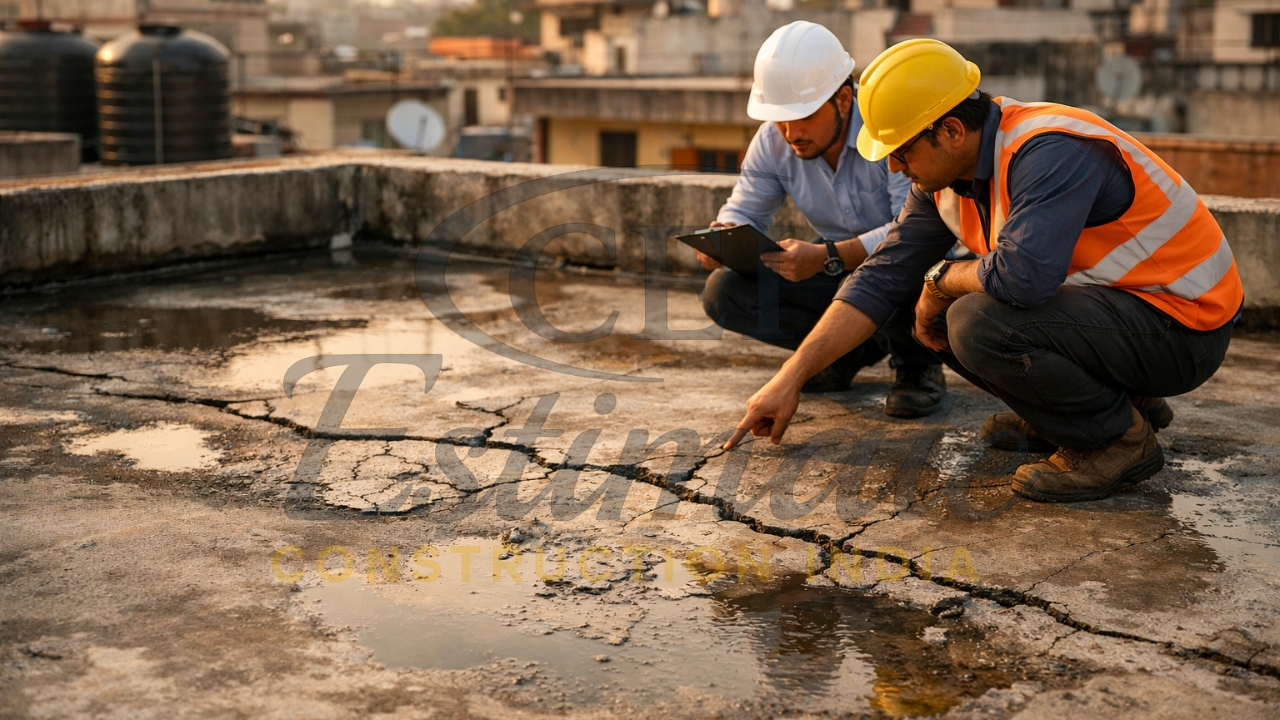
How Wrong Cement Selection Affects Roof Performance?
In Reinforced Cement Concrete (RCC) construction, cement acts as the “glue” that binds aggregates and sand together while tightly gripping the steel reinforcement bars. If this glue is mismatched for the specific application of a roof slab, the entire structural integrity is compromised.
The technical role of cement extends beyond simple bonding. It must create a dense matrix to block water, sulfates, and chlorides from reaching the steel rebar. When the wrong cement is selected, it can lead to high permeability, allowing moisture to seep through micro-pores. Furthermore, the chemical reaction of cement with water, known as hydration, produces heat. If the cement choice is too aggressive for the slab’s thickness, this heat leads to thermal expansion and subsequent contraction, creating roof slab problems due to wrong cement even before the house is occupied.
Top 8 Common Roof Problems Caused by Wrong Cement
1. Hairline and Structural Cracks in Roof Slab
One of the most frequent cracks in roof slab due to cement is the appearance of hairline fractures, often referred to as map cracking or crazing. This happens when a cement with high heat of hydration, like OPC 53, is used in a thin slab. The surface dries faster than the underlying layer, causing the material to shrink and crack. Over time, these hairline cracks can widen into structural cracks, especially if the cement lacks the bonding strength to handle thermal stresses.
2. Roof Leakage and Seepage
Cement related roof leaks in India often stem from the porosity of the concrete. If the cement particles are not fine enough to create a dense matrix, or if the cement type has high shrinkage, it creates “capillary pores” as water evaporates. These pores act as tiny straws that suck in rainwater. Once the water penetrates the slab, it causes damp patches on the ceiling, ruining your interior paint and false ceilings.
3. Weak Bonding and Delamination
For a roof to be strong, the cement must bond perfectly with the reinforcement steel and the coarse aggregates. Using the wrong cement for roof dhalai can lead to poor adhesion. If the cement is too coarse or lacks the necessary chemical properties for masonry bonding, the concrete may start to delaminate, meaning layers of the slab physically separate from each other or from the steel cages.
4. Excessive Heat of Hydration Leading to Thermal Cracks
High-strength cements like OPC 53 are ground very fine to achieve fast setting times. However, this “fast” chemistry releases immense heat. In a large horizontal surface like a roof, this heat must escape. If the cement is too “hot,” the rapid temperature change between the core and the surface leads to thermal cracks. This is a major cause of roof concrete failure causes in the hot and dry climates of North and Central India.
5. Poor Waterproofing and Dampness
A roof slab should ideally be its own waterproofing layer. Roof slab leakage problems arise when the chosen cement does not have low permeability. While traditional OPC provides strength, it may not offer the superior water-repellent properties found in specialized Portland Pozzolana Cement (PPC) or Portland Slag Cement (PSC) variants. Without a dense, water-resistant cement matrix, dampness becomes a permanent guest in your home.
6. Reduced Load-Bearing Capacity
A roof must support the weight of water tanks, solar panels, and furniture. If the cement selection is incorrect—for instance, using an under-grade cement or a stale batch—the concrete may develop honeycombing or internal voids. This reduces the compressive strength of the slab, leading to sagging over long spans or, in extreme cases, partial structural failure.
7. Premature Aging of Roof Concrete
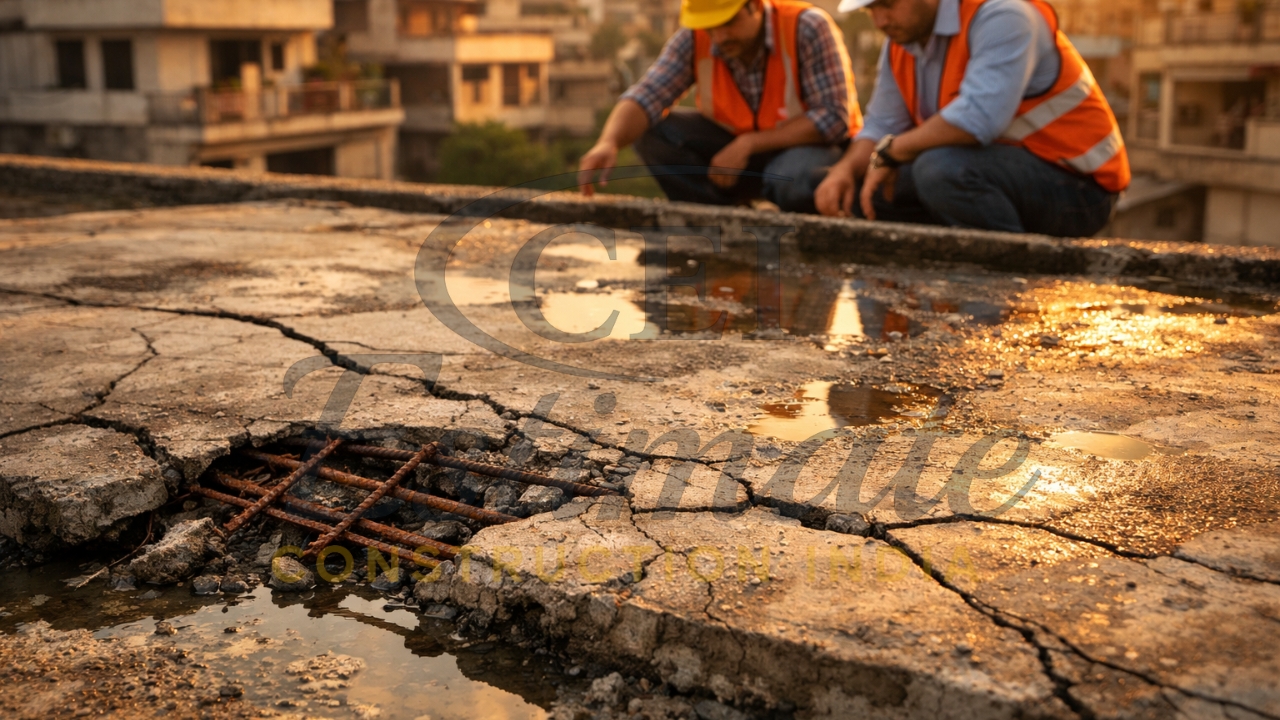
When the cement is highly permeable, it allows chlorides and sulfates to reach the rebars. The steel then begins to rust and expand. This internal expansion puts outward pressure on the concrete, causing it to spall or flake off. This cycle significantly reduces the lifespan of the roof, necessitating expensive repairs just a few years after construction.
8. Efflorescence and Surface Damage
Have you ever seen white, powdery deposits on your roof or ceiling? This is efflorescence. It happens when soluble salts in the cement are carried to the surface by moisture. Wrong cement selection, especially those with high alkali content or unburnt lime, exacerbates this problem. It not only looks ugly but also indicates that the cement is physically breaking down.
Table 1: Common Roof Problems & Their Primary Cement-Related Causes
| Roof Problem | Primary Cement-Related Cause | Typical Symptom |
|---|---|---|
| Hairline Cracks | High heat of hydration/Shrinkage | Spider-web like lines on the surface |
| Structural Cracks | Inadequate bonding/Fast drying | Deep cracks extending through the slab |
| Pore Seepage | High permeability/Coarse particles | Damp patches and water droplets on ceiling |
| Spalling | Rebar corrosion due to porous matrix | Flaking concrete and exposed rusty steel |
| Efflorescence | High salt/alkali content in cement | White powdery deposits on the finish |
OPC vs PPC Cement – How Wrong Choice Creates Problems
The OPC vs PPC roof problems debate is central to Indian construction. Ordinary Portland Cement (OPC), particularly the 53 grade, is often marketed as “stronger”. While it reaches design strength quickly—ideal for high-rise commercial projects—it is often the wrong choice for a residential roof slab. Its high heat release and rapid setting make it extremely prone to cracking in thin layers if curing is not aggressive and perfect.
Portland Pozzolana Cement (PPC), on the other hand, is considered the “durability” cement. It uses fly ash to create a much denser concrete matrix with lower heat of hydration. This makes it a naturally best cement to avoid roof cracks because it shrinks less and resists water penetration more effectively. Using OPC 53 in a residential house just to save a few days of shuttering time is a common mistake that leads to long-term leakage.
Table 2: OPC 53 vs PPC for Residential Roof Slabs
| Feature | OPC 53 Grade | PPC (Portland Pozzolana) |
|---|---|---|
| Heat Release | Very High (High crack risk) | Low (Reduced crack risk) |
| Waterproofing | Moderate | Superior (Denser matrix) |
| Setting Time | Fast (Hard to finish large slabs) | Moderate (Easier to level) |
| Durability | High (Strength focused) | Very High (Corrosion resistant) |
| Curing | Aggressive & Constant | Mandatory & Regular |
Real Case Studies from Indian Homes
Case Study 1: The Jaipur Bungalow
In Jaipur, a homeowner used OPC 53 for his terrace slab during the peak of summer. Despite watering the slab, the intense heat combined with the cement’s own high heat of hydration caused deep thermal cracks within 48 hours. He eventually had to spend lakhs on external waterproofing membranes to fix a problem that could have been avoided with PPC.
Case Study 2: The Coastal Odisha Project
A builder in coastal Odisha used standard OPC for a roof slab near the sea. Within five years, the high permeability of the cement allowed saline air to corrode the reinforcement. The roof developed massive spalling, with chunks of concrete falling from the ceiling. A switch to PSC (Portland Slag Cement) or a high-quality PPC would have protected the structure against sulfate and chloride attacks.
How to Avoid These Roof Problems?
To ensure your roof remains a permanent shield for your family, follow these professional best practices:
- Select the Right Type: For most residential projects, use a premium PPC. It is often the best cement for roof dhalai because of its crack resistance and long-term durability.
- Trust Reputed Brands: Consistency matters. Choose a best cement brand for roof like UltraTech, ACC, or Ambuja, which offer specific “Weather Plus” or “Water Shield” variants.
- Ensure Proper Concrete Grade: Use at least M20 (1:1.5:3) or M25 (1:1:2) for your slab. For the internal finish, knowing which cement is best for ceiling in India 2026 will help you achieve a smooth, crack-free surface.
- Control Water-Cement Ratio: Keep the ratio between 0.40 and 0.45. Avoid adding extra water to the mixer just to make it “easy to pour,” as this creates future leakage points.
- Use Admixtures for Specialized Roofs: If you are using modern materials, ensure you use the best roof cement for asphalt shingles or compatible mastics to prevent wind uplift and leaks.
- Curing is Non-Negotiable: Cure the slab for 14 to 21 days. Use “ponding” (creating water pools) on the roof to ensure the cement hydrates fully without cracking.
Frequently Asked Questions (FAQs)
- Is OPC 53 better than PPC for a home roof?
No. While OPC 53 is stronger initially, it is prone to thermal cracking in residential slabs. PPC is generally better for roofs due to its low heat and waterproofing properties. - Why is my new roof already leaking?
The most likely causes are high permeability in the cement, micro-cracks from rapid drying, or a poor water-cement ratio during casting. - How many bags of cement do I need for a 1000 sq ft slab?
Typically, a 100-square-meter (approx. 1076 sq ft) slab with 5-inch thickness requires about 35 to 40 bags of cement for an M20 mix. - Can I use “waterproof cement” for the roof?
Yes, brands like ACC Gold Water Shield contain additives that significantly reduce water penetration and are excellent for roof slabs. - Does the age of cement affect roof strength?
Yes. Never use cement older than 3 months from the manufacturing date, as it loses strength and may lead to a weak slab. - What is the best concrete grade for a residential terrace?
M20 is the minimum, but M25 is highly recommended for better durability and crack resistance in 2026. - Why are there spider-web cracks on my roof?
These are hairline cracks (crazing) usually caused by the surface of the “hot” cement drying too quickly. - Is mechanical vibration necessary for roof casting?
Absolutely. You must use a mechanical needle vibrator to remove air bubbles and ensure the concrete is dense around the steel.
Conclusion
Choosing the right cement for your roof is a decision that stays with you as long as you live in your home. Common roof problems caused by wrong cement selection—from hairline cracks to structural seepage—can turn a dream house into a maintenance nightmare. In 2026, with shifting weather patterns and extreme temperatures, you cannot afford to compromise on quality.
For most Indian residential projects, a premium PPC or PSC cement is the smartest choice for a crack-resistant, leak-proof terrace. Combine the right brand with professional site practices like proper curing and mix control, and you will have a roof that stands the test of time. Don’t let a small saving today lead to a massive repair bill tomorrow. Build strong, build once!