If you are building or renovating a home in India in 2026, the question of wall finishing is no longer a simple choice between “sand and cement.” As homeowners in cities like Agra, Lucknow, and Bangalore seek faster construction timelines and superior aesthetics, gypsum plastering has emerged as the clear winner. But for a budget-conscious builder, the ultimate question remains: What Are the Costs of Gypsum Plastering?
In 2026, the total applied costs of gypsum plastering in India sit between ₹32 and ₹55 per sq. ft. Compared to the multi-step process of cement plastering followed by POP punning and wall putty—which can easily touch ₹50–₹85 per sq. ft.—gypsum offers a “one-and-done” solution. To see how these finishing costs fit into your overall building budget, start by checking the latest construction cost per sq ft in India for 2026.
What is Gypsum Plastering?
Gypsum plaster is a white cementing material made by dehydrating mineral gypsum. Unlike traditional sand-cement plaster, it is applied in a single coat directly onto brick, AAC block, or concrete surfaces. In the Indian market of 2026, top brands like Gyproc (Saint-Gobain), Europlast, and JK Lakshmi dominate the sector.
The Gypsum Advantage in 2026:
- No Water Curing: Unlike cement, which requires 7-10 days of constant watering, gypsum sets naturally without a drop of water.
- Crack Resistant: Gypsum is a “low-shrinkage” material, meaning those annoying hairline cracks common in cement walls are virtually non-existent.
- Quick Drying: Walls are ready for painting in just 3-4 days, significantly shortening the project timeline.
- Glass-Like Finish: It provides a perfectly leveled, smooth white finish that eliminates the need for wall putty.
Key Factors Affecting Gypsum Plastering Costs in 2026
When asking What Are the Costs of Gypsum Plastering?, you must consider these eight variables that influence the final quote:
- Thickness of Application: The standard is 11-13mm. If your brickwork is uneven, a thicker coat (15mm+) will consume more bags, raising the cost.
- Internal vs. External: Gypsum is strictly for internal walls. It cannot be used externally as it dissolves in heavy rain.
- Geographic Location: Rates in Tier-2 cities like Agra or Jaipur are more affordable (₹32–₹48/sq. ft.) compared to metros like Mumbai (₹45–₹65/sq. ft.).
- Substrate Type: Applying gypsum on smooth AAC blocks requires less material than rough, uneven traditional red bricks.
- Contractor Expertise: Specialized gypsum applicators charge a premium but ensure zero wastage.
- Wastage Factor: Standard wastage is 5-10%. Poor handling can push this higher, inflating the gypsum plaster cost in India.
- Height & Scaffolding: Plastering high ceilings or double-height lobbies involves scaffolding rentals, adding ₹3-₹7 per sq. ft.
- Brand Quality: Premium “lightweight” gypsum variants are easier to apply and offer better coverage but have a higher bag price.
For large structural elements like roofs, you’ll still need to know how to calculate cement sand and aggregate for slab work, as gypsum is only a finishing material for walls and ceilings.
Choose Your Construction Services
Connect with verified experts for your project. We provide professional
General Contractors, Sub-contractors, Builders, and Material Suppliers.
Our network also includes specialized 3D Rendering Developers and Interior Experts.
Average Costs of Gypsum Plastering in India 2026
To help you budget, here is the baseline gypsum plaster rate per square foot 2026 for a standard residential project.
2026 Cost Summary Table
| Component | Rate Range (Per Sq. Ft.) |
| Material Only | ₹18 – ₹28 |
| Labour Only | ₹12 – ₹20 |
| Total Applied Cost (Standard) | ₹32 – ₹55 |
| Premium / Metro Applied Cost | ₹45 – ₹65 |
| Gypsum Bag (25kg) | ₹500 – ₹750 |
Cost Comparison: Gypsum vs. Traditional
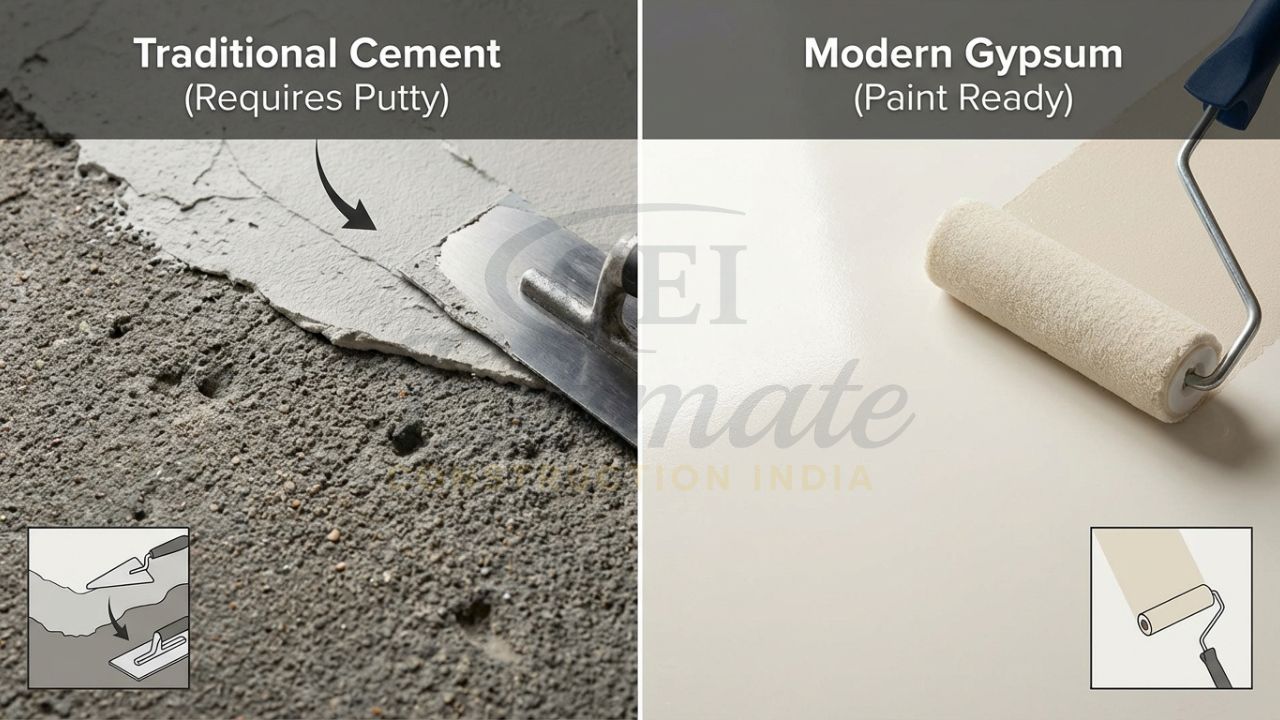
When evaluating the costs of gypsum plastering, it is essential to compare it to the traditional plaster cost per square foot with material in India.
| Method | Process Steps | Total Estimated Cost (2026) |
| Gypsum Plastering | Single Coat → Paint | ₹32 – ₹55 / sq. ft. |
| Cement + POP + Putty | Plaster → Curing → POP → Putty | ₹50 – ₹85 / sq. ft. |
Detailed Cost Breakdown (1,000 Sq. Ft. Wall Area)
If you are plastering a standard 2BHK with roughly 3,000 sq. ft. of wall and ceiling area, here is a detailed breakdown for 1,000 sq. ft. units:
| Item | Quantity / Rate | Total Cost (Standard) |
| Gypsum Material | 18 – 20 Bags (at ₹600) | ₹10,800 – ₹12,000 |
| Labour Charges | ₹15 per sq. ft. | ₹15,000 |
| Consumables / Tools | Lumpsum | ₹2,000 |
| Total for 1,000 Sq. Ft. | ₹27,800 – ₹29,000 |
City-Wise Comparison Table (2026)
| City | Applied Rate (Material + Labour) |
| Delhi NCR | ₹40 – ₹60 per sq. ft. |
| Mumbai / Bangalore | ₹45 – ₹65 per sq. ft. |
| Hyderabad / Chennai | ₹35 – ₹55 per sq. ft. |
| Agra / Lucknow / Jaipur | ₹32 – ₹48 per sq. ft. |
Gypsum Plaster vs Cement Sand Plaster: Long-Term Savings
When evaluating What Are the Costs of Gypsum Plastering?, don’t just look at the upfront labor rate. The “hidden” savings are substantial:
- Elimination of Putty: Gypsum is so smooth you can paint directly over it after a primer coat. This saves ₹8–₹15 per sq. ft. on wall putty.
- Zero Water Cost: No need to hire water tankers or pay labor for 10 days of curing.
- Time is Money: A project that takes 30 days with cement can be finished in 10 days with gypsum, saving on security and site overheads.
- Thermal Insulation: Gypsum has lower thermal conductivity, potentially reducing your AC bills in the hot Indian summer.

Material Quality and Brand Selection
In 2026, using high-quality bags (25kg) is non-negotiable for a crack-free finish. Brands like Gyproc (Saint-Gobain) and JK Lakshmi dominate the market.
Just as you might compare UltraTech Cement vs ACC Cement for your foundation, choosing the right gypsum brand affects the “whiteness” and “setting time” of your walls. For premium builds, using top-rated cement for homes in India for the structure and high-grade gypsum for the interiors ensures a luxury finish. If you’re in South India, you might also look at ACC Cement vs Birla Super Cement to find the best structural pairing for your gypsum-finished walls.
10 Tips to Reduce Gypsum Plastering Costs in 2026
- Direct Bulk Purchase: Buy bags directly from distributors in Agra or Delhi to save on retail margins.
- Optimize Wall Surface: Ensure your brickwork is straight. Every extra 2mm of thickness increases material cost by 15%.
- Hire Local Specialists: Specialized “Gypsum Teams” work faster and with less waste than general masons.
- Avoid External Use: Never try to “experiment” with gypsum on balconies; the rework will cost double.
- Use AAC Blocks: Since AAC blocks are very level, you can use a “thin-set” gypsum application (8-10mm) to save material.
- Verify Bag Weight: Ensure you are getting full 25kg bags; underweight bags are a common site fraud.
- Limit Decorative Mouldings: Complex cornices increase labor rates significantly.
- Prime the Surface: Use a bonding agent on concrete ceilings to ensure the gypsum doesn’t peel off, avoiding expensive repairs.
- Monitor Wastage: Don’t let labor mix more than they can apply in 15 minutes; gypsum sets quickly.
- Professional Estimation: Use an expert for the “Takeoff” to ensure you don’t over-order and have 50 bags rotting in the rain.
Why Get Professional Estimation for Gypsum Plastering?
Understanding internal wall plastering cost gypsum requires more than just multiplication. It involves calculating the exact “net area” after deductions for doors and windows and assessing the “plumb” of your walls. In 2026, where every bag of Gyproc costs upwards of ₹600, an error in calculation can lead to thousands of rupees in wasted material. A professional estimate ensures your gypsum plastering cost per sq ft India 2026 stays within the promised bracket.
“Want accurate costs for gypsum plastering on your walls or ceilings in 2026 without any surprises? Construction Estimator India provides detailed, professional gypsum plaster takeoffs and full cost breakdowns (material + labour) starting just at ₹10,000 INR. Our experts tailor estimates to your project size, location, and finish needs—helping you save money and plan confidently.
Contact us today:
Phone/WhatsApp: +91 86306 76890
Email: info@constructionestimatorindia.com
Get your customized gypsum plastering cost estimate in just 24 hours!”
Frequently Asked Questions (FAQs)
What are the costs of gypsum plastering per sq ft in India 2026?
In 2026, the total applied cost of gypsum plastering ranges from ₹32 to ₹55 per sq. ft. for most residential projects. This includes the cost of the gypsum powder (approx. ₹18–₹28/sq. ft.) and the labor charges for application (approx. ₹12–₹20/sq. ft.). In Tier-2 cities like Agra or Lucknow, you can find competitive rates closer to ₹32–₹35, while metros may charge ₹50+.
How much does gypsum plastering cost compared to cement plaster in 2026?
While the base material for gypsum is more expensive than sand, the total finished wall cost is lower. Traditional cement plaster (₹25) + Curing labor (₹5) + POP/Putty (₹25) totals roughly ₹55–₹60 per sq. ft. Gypsum provides the same (or better) finish for ₹35–₹45 per sq. ft., making it a more economical choice in 2026.
Is gypsum plastering more expensive than traditional methods in 2026?
Surprisingly, no. When you consider that gypsum eliminates the need for water curing and two coats of wall putty, it is actually 20% to 30% cheaper than the traditional cement-sand-putty cycle. Additionally, the reduction in project time (ready to paint in 4 days) provides significant indirect savings on labor and rent.
What factors affect the costs of gypsum plastering for home walls?
The primary factors include the thickness of the coat (11mm vs 15mm), the type of wall (Brick vs AAC block), and the height of the ceiling. Furthermore, the gypsum vs cement plaster cost is influenced by your location; metros have higher labor costs, while being near a manufacturing hub in North India can reduce bag prices.
How can I get a precise estimate for gypsum plastering costs in 2026?
To get a precise estimate, you should have a professional perform a “Quantity Takeoff” from your floor plans. This accounts for the exact wall surface area, deducts for openings, and includes a 5% wastage buffer. Relying on a professional service like Construction Estimator India ensures your gypsum plaster rate per square foot 2026 is accurate to the last rupee.