
Accurate material estimation is critical when you are casting an RCC roof or floor slab. How to calculate cement sand and aggregate for slab correctly helps you avoid shortages on the day of concreting, prevent costly over-ordering, and stay within budget amid 2026 material price fluctuations.
In residential projects across Agra, Delhi NCR, or Lucknow, most homeowners and contractors use M20 or M25 grade concrete. However, before calculating individual materials, it is essential to understand the broader construction cost per sq ft in India for 2026 to ensure your overall project remains financially viable.
You will learn the exact mix ratios, formulas, per-cubic-metre quantities, thumb rules, and a full worked example for a 1000 sq ft slab. Whether you are a site engineer, contractor, or first-time homeowner building a 2000 sq ft house, these steps will give you precise quantities and save money.
Understanding Concrete Mix Ratios for RCC Slabs in India 2026
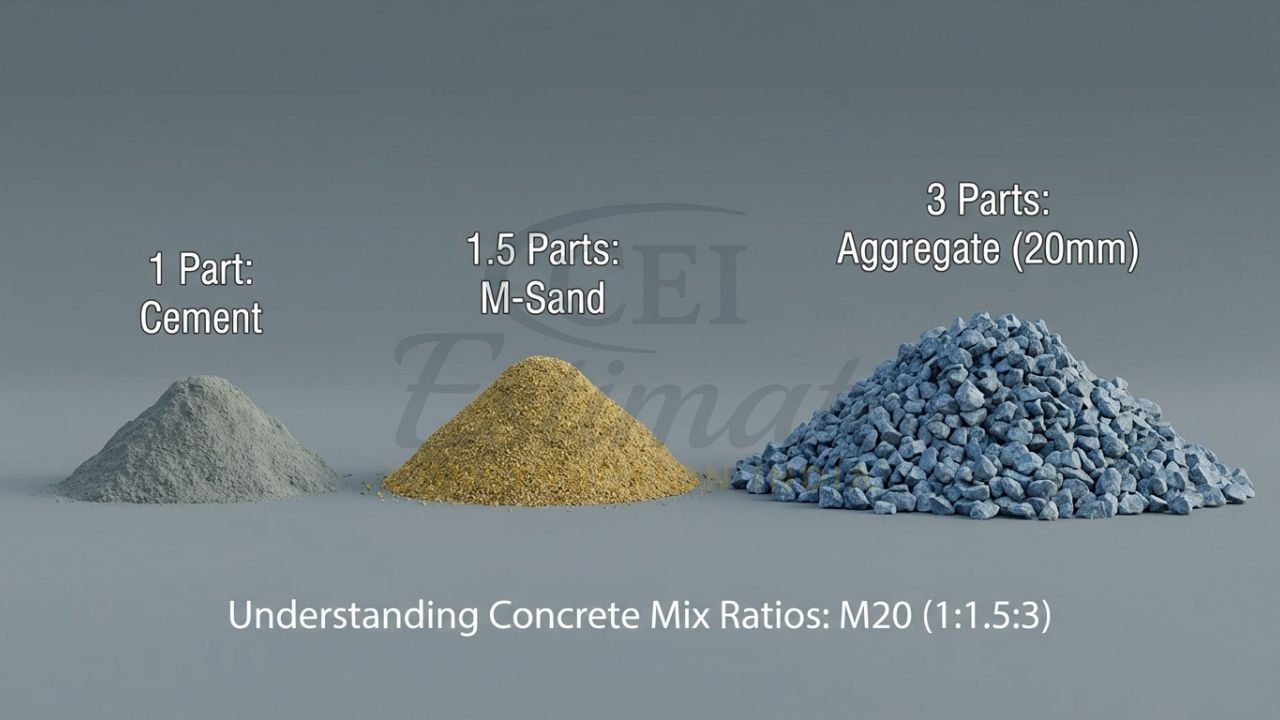
Nominal mixes are still widely used for residential slabs because they are simple and reliable. IS 456:2000 recommends the following for RCC slabs:
| Grade | Mix Ratio (Cement : Sand : Aggregate) | 28-day Strength | Typical Use in India |
| M20 | 1 : 1.5 : 3 | 20 N/mm² | Most home roof & floor slabs |
| M25 | 1 : 1 : 2 | 25 N/mm² | Heavier loads or seismic zones |
Selecting the right grade is only half the battle; using high-quality materials is equally important. For long-term durability, ensure you choose the best cement for RCC in India to prevent cracks and structural fatigue.
Key Steps to Calculate Cement Sand and Aggregate for Slab
Follow these 6 steps every time:
- Measure slab dimensions Length × Width × Thickness (convert everything to metres or feet consistently).
- Calculate wet volumeWet Volume=L×W×T \text{Wet Volume} = L \times W \times T Wet Volume=L×W×T
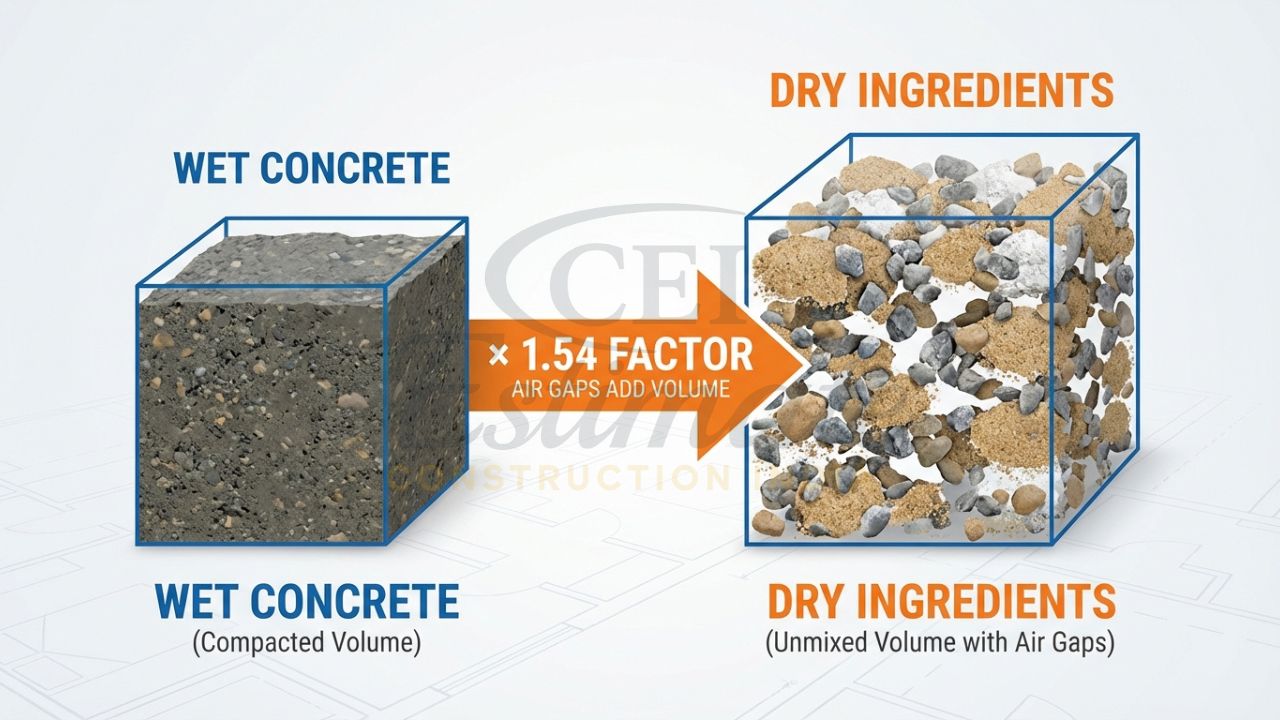
- Convert to dry volume Dry volume accounts for 54% voids and shrinkage: Dry Volume=1.54×Wet Volume \text{Dry Volume} = 1.54 \times \text{Wet Volume} Dry Volume=1.54×Wet Volume
- Add wastage Add 5–10% for spillage and uneven pouring.
- Apply mix ratio Divide dry volume by total parts and multiply by each ingredient’s share.
- Convert to practical units
- Cement: divide volume by 0.035 m³ (1 bag = 50 kg)
- Sand & Aggregate: keep in m³ or convert to cft (1 m³ = 35.3147 cft)
Choose Your Construction Services
Connect with verified experts for your project. We provide professional
General Contractors, Sub-contractors, Builders, and Material Suppliers.
Our network also includes specialized 3D Rendering Developers and Interior Experts.
Choosing the Right Cement Brand
While the quantity is mathematical, the brand choice is strategic. In the Indian market of 2026, the debate often comes down to industry giants. You can read our detailed comparison of UltraTech Cement vs ACC Cement or see how they stack up in the ACC Cement vs Amuja Cement analysis to find the best fit for your slab’s specific requirements.
While you focus on the slab, don’t forget the envelope of the building; choosing the best cement for exterior walls in India is just as vital for waterproofing and finish.
Standard Quantities per Cubic Meter for Slab Concrete
These are field-proven quantities for nominal mixes (2026 practice):
M20 Concrete (1:1.5:3) per m³
- Cement: 8 bags (400 kg)
- Sand: 0.45–0.48 m³ (16–17 cft)
- Aggregate (20 mm): 0.90–0.92 m³ (32–33 cft)
- Water: 180–200 litres
M25 Concrete (1:1:2) per m³
- Cement: 9 bags (450 kg)
- Sand: 0.42 m³ (15 cft)
- Aggregate: 0.84 m³ (30 cft)
- Water: 170–190 litres
These values already include the 1.54 dry volume factor.
Practical Example: Calculate for a 1000 Sq Ft RCC Slab (5-Inch Thick)
Let’s take a real example: 1000 sq ft roof slab, 5-inch thick, M20 grade (most common in Agra homes).
Step 1: Thickness = 5 inch = 0.127 m
Area = 1000 sq ft = 92.9 m²
Step 2: Wet volume
=92.9×0.127=11.8 m3 = 92.9 \times 0.127 = 11.8 \, \text{m}^3 =92.9×0.127=11.8m3
Step 3: Dry volume
=11.8×1.54=18.17 m3 = 11.8 \times 1.54 = 18.17 \, \text{m}^3 =11.8×1.54=18.17m3
Step 4: Add 7% wastage
18.17×1.07=19.44 m3 18.17 \times 1.07 = 19.44 \, \text{m}^3 18.17×1.07=19.44m3
Step 5: M20 ratio total parts = 5.5
- Cement volume = (1/5.5) × 19.44 = 3.53 m³ Cement bags = 3.53 ÷ 0.035 = 101 bags (round up to 105–110 with site wastage)
- Sand volume = (1.5/5.5) × 19.44 = 5.30 m³ ≈ 187 cft (add 10% = 205–220 cft)
- Aggregate volume = (3/5.5) × 19.44 = 10.60 m³ ≈ 374 cft (add 10% = 410–430 cft)
Final practical quantities for 1000 sq ft 5-inch M20 slab
- Cement: 320–340 bags (standard thumb rule matches)
- Sand: 1000–1200 cft
- Aggregate: 2000–2400 cft
This matches real site data from Agra and Lucknow projects in 2026.
Managing these numbers across multiple sites can be daunting. Many modern contractors are now switching to specialized construction software for small builders in India to automate these calculations and track inventory in real-time.
Thumb Rules & Quick Estimates for Slabs in India 2026
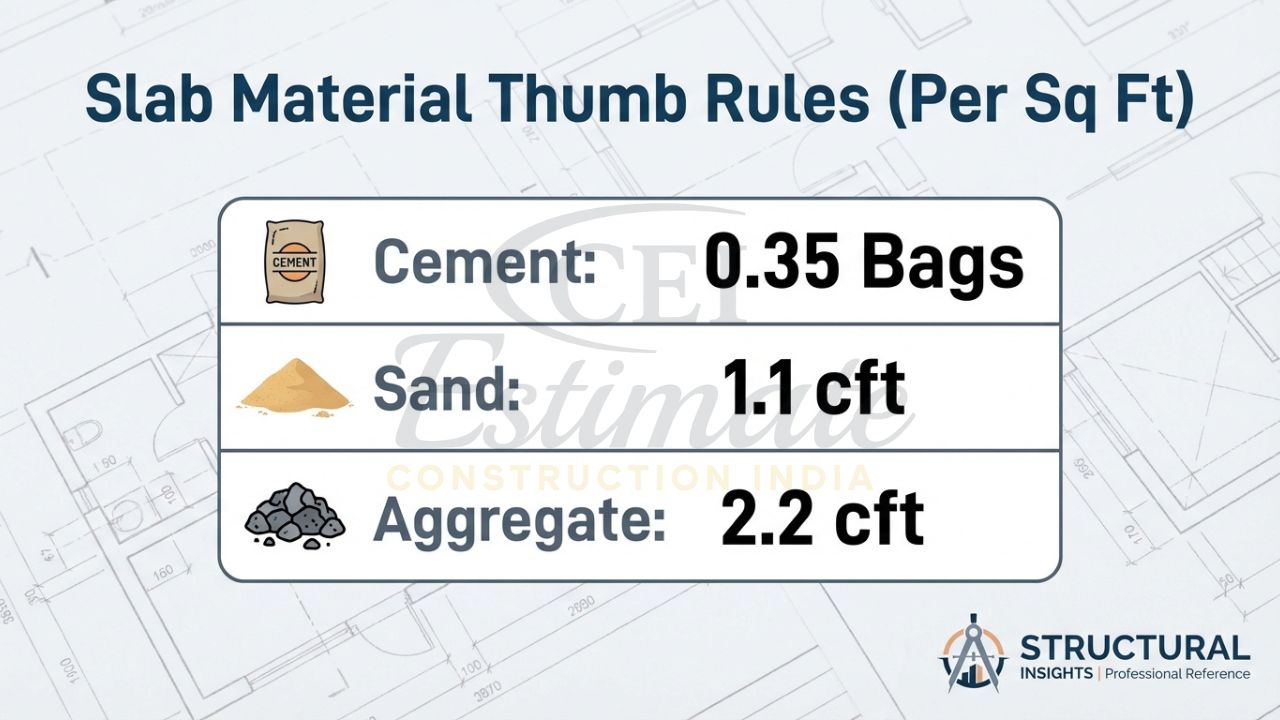
Use these quick thumb rules when you need fast estimates:
- Cement per sq ft: 0.32–0.38 bags (5-inch slab), 0.40–0.45 bags (6-inch)
- Sand per sq ft: 1.0–1.2 cft
- Aggregate per sq ft: 2.0–2.4 cft
For a 2000 sq ft house slab:
- 5-inch M20 → 640–760 bags cement
- 6-inch M20 → 760–900 bags cement
Always verify with exact calculation for final ordering.
Factors Affecting Calculation & Common Mistakes to Avoid
Common mistakes that inflate costs or cause shortages:
- Using wet volume directly (forget 1.54 factor)
- Wrong thickness measurement (5 inch = 0.127 m, not 0.15 m)
- No wastage allowance (add minimum 7–10%)
- Using river sand rates but ordering M-sand
- Ignoring water-cement ratio (0.45–0.50 for M20)
- Mixing M20 and M25 quantities by mistake
Always double-check dimensions on-site and use the dry volume factor 1.54.
Tools & Tips for Accurate Slab Material Estimation in 2026
- Excel sheet with built-in formulas (link to [Link: BOQ Format in Excel for Construction])
- Mobile apps like “Concrete Calculator” or “Civil Quantity Estimator”
- Cross-check with DSR/PWD rates updated for 2026
- For large or complex slabs, get a professional BOQ from a quantity surveyor
Conclusion
Knowing how to calculate cement sand and aggregate for slab is a basic but powerful skill that every homeowner, site supervisor, and contractor in India must master in 2026. By following the wet-to-dry volume conversion (×1.54), applying the correct M20 or M25 ratio, adding wastage, and converting to bags and cft, you will get precise quantities every time.
Whether you are building a 1000 sq ft roof slab in Agra or a 2000 sq ft house, these steps save money, reduce wastage, and ensure strong, crack-free slabs. For bigger projects or when you want zero errors, professional estimation services give you a complete BOQ in hours.
Start calculating today — your next slab will be accurate, on-budget, and built to last.
Ready to get an accurate, customised construction estimate for your project in 2026?
At Construction Estimator India our professional estimating team delivers detailed BOQ and cost reports in just 48 hours.
Construction cost estimation services start at just ₹10,000 INR only.
Contact us today:
📞 Phone / WhatsApp: +91 86306 76890
✉️ Email: info@constructionestimatorindia.com
Don’t overpay or underbid — get your precise 2026 construction cost per sq ft estimate now and win more projects with confidence!
Frequently Asked Questions (FAQs) – How to Calculate Cement Sand and Aggregate for Slab
What is the standard mix ratio for RCC slab concrete in India 2026?
For most residential slabs the standard mix is M20 (1:1.5:3) as per IS 456. This gives 20 N/mm² strength after 28 days and is economical. M25 (1:1:2) is used for longer spans or seismic zones. The ratio is applied after converting wet volume to dry volume (×1.54), making how to calculate cement sand and aggregate for slab simple and reliable.
How many cement bags are required per sq ft for a 5-inch thick slab?
For a 5-inch thick RCC slab using M20 mix, you need approximately 0.32–0.38 bags per sq ft. For 1000 sq ft this totals 320–380 bags (including 7–10% wastage). This is the most common cement bags per sq ft slab India thumb rule used by contractors in Uttar Pradesh and other states in 2026.
Why do we multiply wet volume by 1.54 for dry volume in slab calculation?
Fresh concrete has voids and bulking in sand and aggregate. The dry volume factor 1.54 accounts for approximately 54% extra volume needed to produce the final wet concrete after compaction and shrinkage. Without this factor your quantities will fall short on the day of pouring.
How to calculate cement sand aggregate for a 2000 sq ft house slab?
First find wet volume = 2000 sq ft × thickness (e.g., 5 inch = 0.127 m) = 23.6 m³. Dry volume = 23.6 × 1.54 = 36.34 m³. For M20 mix divide by 5.5 parts. Cement ≈ 6.6 m³ (188–200 bags), sand ≈ 9.9 m³ (350–380 cft), aggregate ≈ 19.8 m³ (700–760 cft). Add 7–10% wastage for final ordering.
What wastage percentage should I add when calculating materials for RCC slab?
Add 7–10% wastage for spillage, uneven pouring, and transportation losses. In 2026 projects with rising cement prices, 8% is a safe and commonly used figure. This small addition prevents last-minute shortages and keeps your RCC slab material quantity calculation accurate.