
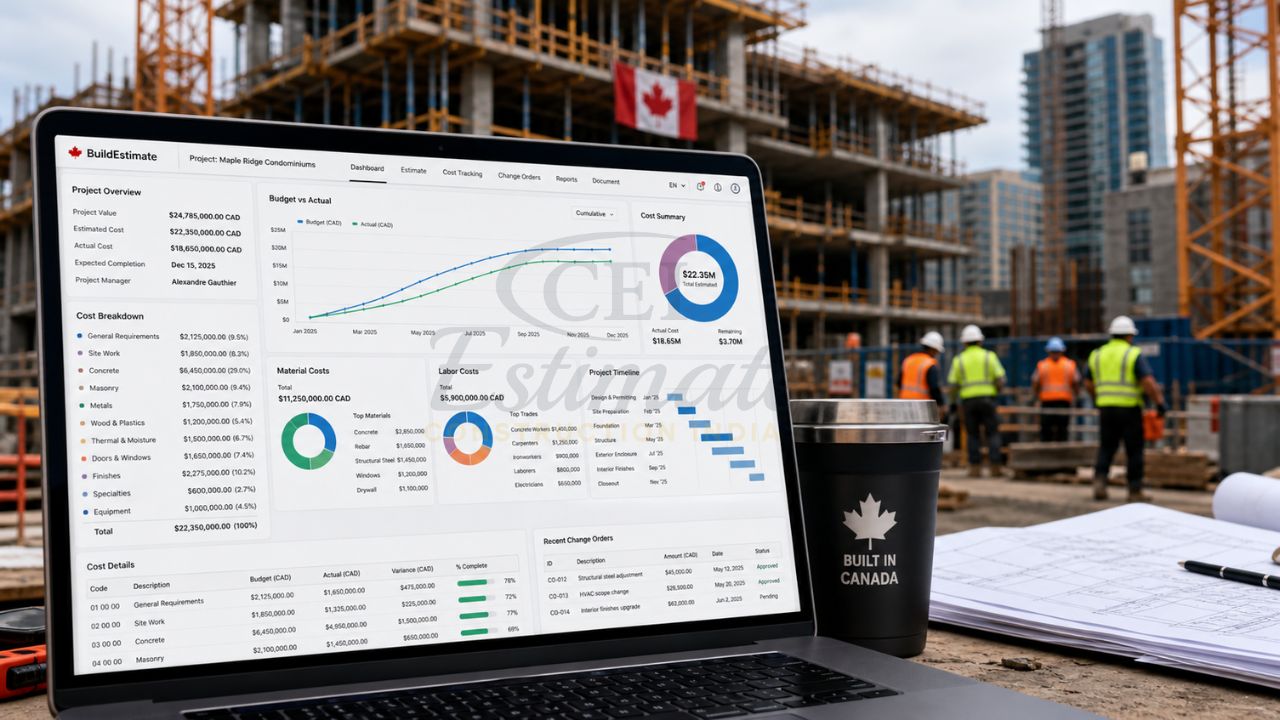
If you’re a contractor working in Canada right now, you already know that estimating a construction project is never simple. Between fluctuating lumber costs, unpredictable winters that shut down job sites for weeks, stringent provincial building codes, and some of the most complex labour regulations in North America, getting your numbers right the first time is absolutely critical. Underbid a project in Toronto or Calgary, and you’re eating losses before the second floor is framed. Overbid it, and you’ve handed the contract to a competitor who took the time to build a tighter, smarter estimate.
👉 Need Help Choosing the Right Estimating Tool? 📞 Call/WhatsApp: +91 86306 76890
That’s exactly why choosing the right Canadian construction estimating software has never mattered more. The market has matured significantly heading into 2026 — tools are smarter, more integrated with Canadian-specific cost databases, and increasingly mobile-friendly for site supervisors working in challenging conditions. At Construction Estimator India, we work with contractors and builders across international markets, and we’ve spent considerable time evaluating which platforms genuinely serve the unique demands of Canadian construction businesses. Here’s our comprehensive, no-fluff guide to the best options available today.
Best Canadian Construction Estimating Software 2026: Full Breakdown
1. Procore — Best All-in-One Platform for Large Canadian Contractors
Procore has cemented its place as one of the most recognized names in construction technology worldwide, and it’s particularly well-adopted among mid-to-large general contractors across Ontario, British Columbia, and Alberta. What makes Procore stand out isn’t just estimating — it’s the depth of integration across the entire project lifecycle. Your estimate flows into budgets, change orders, RFIs, and invoicing without the need for manual re-entry.
Key Features for Canadian Contractors: Procore connects natively with RSMeans cost data, which is commonly used for benchmarking Canadian construction costs. The platform offers multi-currency support (critical for contractors working on US-Canadian cross-border projects), French-language interface options useful for Quebec-based firms, and robust document management that simplifies compliance with provincial environmental and safety regulations.
Best Suited For: General contractors, commercial builders, and large residential developers managing projects above $5 million.
Pricing Overview: Procore operates on a custom, annual contract model. Expect to invest anywhere from CAD $15,000 to $60,000+ per year depending on the modules you activate and your company size. There’s no free plan, and the onboarding investment is real.
Pros: Deep feature set, strong third-party integrations, excellent support infrastructure, and widely recognized across Canadian sub-trades.
Cons: Expensive for smaller contractors, steep learning curve, and can feel over-engineered for residential builds or smaller commercial projects.
Real-User Insights: General contractors in Vancouver frequently cite Procore’s document management as a lifesaver on multi-trade commercial projects, though smaller operations in Saskatchewan and Manitoba sometimes find the pricing difficult to justify relative to their project volumes.
2. Sage Estimating (Sage 300 CRE) — Best for Mid-Size Canadian Construction Firms
Sage has long been a staple of Canadian construction accounting and ERP, and their Sage Estimating product — particularly when integrated with Sage 300 Construction and Real Estate — remains one of the most powerful purpose-built estimating platforms available for the Canadian market. If your firm already runs Sage 300 for accounting, integrating Sage Estimating is a no-brainer.
Key Features for Canadian Contractors: Sage Estimating supports Canadian-specific database pricing and integrates seamlessly with provincial tax structures. The platform handles complex assemblies well, making it popular among ICI (Industrial, Commercial, Institutional) contractors in Ontario who need to model everything from structural steel to mechanical systems within a single estimate.
Best Suited For: Mid-size ICI and commercial contractors, firms already using Sage accounting software, and companies with dedicated estimating departments.
Pricing Overview: Sage Estimating starts at approximately CAD $3,500–$8,000 for a standalone license, with enterprise and subscription pricing available. Sage 300 CRE integration adds additional licensing costs.
Pros: Deep accounting integration, strong assembly-based estimating, Canadian-market familiarity, and solid customer support through a network of Canadian Sage partners.
Cons: The interface feels dated compared to newer SaaS platforms. Cloud functionality, while improving, still lags behind native cloud tools.
Real-User Insights: Electrical and mechanical subcontractors in Alberta consistently praise Sage Estimating’s assembly libraries, though newer users often note that the initial setup and configuration require professional assistance.
3. STACK Estimating — Best Cloud-Based Option for Canadian Subcontractors
STACK has rapidly gained traction among Canadian subcontractors who need a fast, accessible, purely cloud-based estimating solution. The platform’s takeoff and estimating tools are designed for speed — you can import digital plans, perform quantity takeoffs, and build estimates without ever touching a CD or installing desktop software.
Key Features for Canadian Contractors: STACK offers unlimited cloud storage for plan sets, real-time collaboration that’s invaluable when your estimator is working remotely during a cold snap, and a growing library of pre-built templates tailored for various trade types. The platform works well on tablets, which is particularly useful for Canadian site supervisors reviewing estimates from job site trailers.
Best Suited For: Subcontractors (drywall, flooring, roofing, insulation), smaller GCs, and estimating teams that need fast, collaborative digital takeoff.
Pricing Overview: STACK starts at approximately USD $2,999/year (roughly CAD $4,000+) for the Pro plan. A free version with limited takeoff capabilities is available.
Pros: Genuinely fast takeoff, great collaboration tools, accessible from any device, good template library.
Cons: Less suited to complex multi-trade estimates or large commercial projects. Pricing for the full-featured plan can feel steep for solo estimators.
Real-User Insights: Roofing contractors in Ontario and insulation specialists in Manitoba cite STACK as significantly faster than their previous PDF-and-spreadsheet workflow, often cutting takeoff time by 40–50%.
👉 Get the Best Canadian Construction Estimating Software – 📲 WhatsApp / Call: +91 86306 76890
4. Buildxact — Best for Canadian Residential Builders and Renovators
Buildxact was purpose-built for residential construction, and it shows. If you’re running a custom home building operation or a renovation contracting business anywhere in Canada, Buildxact solves a very specific problem that most enterprise platforms completely ignore: making professional estimating and job management accessible to small residential operations without requiring a dedicated IT team.
Key Features for Canadian Contractors: Buildxact connects directly with Canadian supplier pricing through its supplier integration feature, supports GST/HST/PST calculations out of the box, and makes it easy to produce polished, professional client proposals from your estimates. The job management features — including scheduling, variation tracking, and client portals — make it an unusually complete package for the price point.
Best Suited For: Custom home builders, renovation contractors, and residential remodelers across Canada working on projects from CAD $50,000 to $2 million.
Pricing Overview: Buildxact starts at approximately CAD $215/month (billed annually) and scales with the volume of active projects.
Pros: Purpose-built for residential, Canadian tax support, excellent client-facing proposal tools, intuitive interface.
Cons: Not designed for commercial or industrial work, limited sub-trade management capabilities.
Real-User Insights: Custom home builders in British Columbia’s Okanagan region and renovation contractors in the Greater Toronto Area consistently rate Buildxact as one of the most practical tools they’ve adopted, particularly for the professional proposals it produces that help close clients.
5. PlanSwift — Best for Fast Digital Takeoffs Across All Trades
PlanSwift remains one of the most established digital takeoff tools on the market and is widely used by Canadian estimators across both GC and trade-specific operations. While newer cloud platforms have challenged its dominance, PlanSwift’s depth of functionality, especially for complex commercial takeoffs, keeps it firmly on every experienced estimator’s radar.
Key Features for Canadian Contractors: PlanSwift integrates with a wide range of Canadian estimating databases and external costing tools. Its click-and-drag takeoff interface is faster than most alternatives for experienced users, and the plugin ecosystem allows integration with Excel — still the backbone of many Canadian estimating workflows, particularly for firms that have built sophisticated in-house templates over the years. (On that note, if you’re still weighing whether to stick with spreadsheets or make the jump to dedicated software, our analysis at Excel vs. Estimating Software for Construction Projects breaks down the real trade-offs in detail.)
Best Suited For: Commercial estimators, mechanical and electrical contractors, and any firm that needs high-speed digital takeoff with integration flexibility.
Pricing Overview: PlanSwift is available starting at approximately USD $1,749 as a one-time perpetual license, which makes it one of the better value propositions for estimators who prefer not to pay ongoing subscription fees.
Pros: Fast and accurate takeoff, perpetual license option, strong Excel integration, plugin flexibility.
Cons: Purely a takeoff/estimating tool — no project management, and the interface hasn’t been modernized significantly in recent years.
Real-User Insights: Senior estimators at mid-size Ontario commercial contractors often keep PlanSwift even after adopting a broader platform like Procore, using it specifically for fast plan-based takeoffs.
6. Bluebeam Revu — Best for Collaborative Document Management and Markup
Bluebeam Revu isn’t a traditional estimating platform, but it has become nearly indispensable in Canadian commercial construction for plan review, quantity markup, and collaborative document management. Many Canadian estimating teams use Bluebeam alongside a dedicated estimating platform — using Revu for the plan review and annotation phase before transferring quantities to their primary estimating tool.
Key Features for Canadian Contractors: Bluebeam Studio enables real-time collaboration on project drawings, which is particularly valuable on large ICI projects with multiple consultants and trade partners. The markup calibration tools make rough quantity takeoffs fast, and the PDF markup audit trail is widely respected by Canadian project owners and consultants.
Best Suited For: Commercial GCs, project managers, and estimating teams working on complex multi-stakeholder projects.
Pricing Overview: Bluebeam Revu starts at approximately USD $349/user/year for the Basics plan.
Pros: Exceptional PDF markup and collaboration, widely adopted by Canadian consultants and owners, strong audit trail.
Cons: Not a standalone estimating solution — requires pairing with a dedicated estimating platform for complete functionality.
👉 Find the Right Software for Your Projects – 📲 Contact: +91 86306 76890
7. Construction Estimator India’s Solutions — Best Value for Cost-Conscious Canadian Builders
We’d be doing a disservice to Canadian contractors if we didn’t share what we at Construction Estimator India bring to the table. While we’re widely recognized for serving contractors in the Indian market, our estimating platforms and ERP solutions are increasingly being adopted by international builders — including Canadian firms — who are looking for powerful, highly customizable software at a fraction of the price of North American enterprise tools.
Our solutions include integrated cost databases that can be localized for Canadian labour and material rates, multi-currency and multi-tax support (including GST/HST/PST frameworks), and estimating workflows that scale from small residential renovations to large ICI projects. We also offer dedicated onboarding and support to help Canadian contractors configure the software for their specific provincial requirements.
For Canadian contractors who are currently paying CAD $15,000–$60,000 annually for platforms that offer far more complexity than they actually need, our solutions deliver a genuinely powerful alternative. You can explore our top-rated construction estimating software and top 5 cost estimation tools for construction projects to see the full range of what we offer.
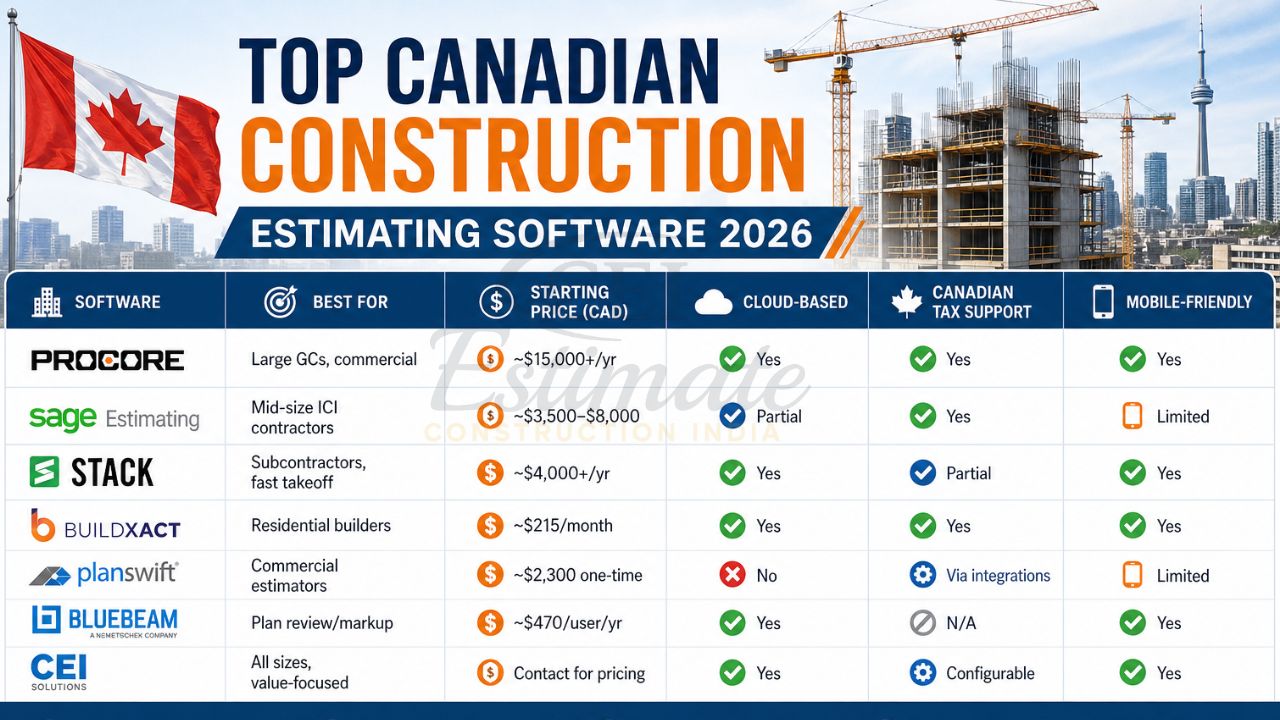
Comparison Table: Top Canadian Construction Estimating Software 2026
| Software | Best For | Starting Price (CAD) | Cloud-Based | Canadian Tax Support | Mobile-Friendly |
| Procore | Large GCs, commercial | ~$15,000+/yr | ✅ Yes | ✅ Yes | ✅ Yes |
| Sage Estimating | Mid-size ICI contractors | ~$3,500–$8,000 | Partial | ✅ Yes | Limited |
| STACK | Subcontractors, fast takeoff | ~$4,000+/yr | ✅ Yes | Partial | ✅ Yes |
| Buildxact | Residential builders | ~$215/month | ✅ Yes | ✅ Yes | ✅ Yes |
| PlanSwift | Commercial estimators | ~$2,300 (one-time) | ❌ No | Via integrations | Limited |
| Bluebeam Revu | Plan review/markup | ~$470/user/yr | ✅ Yes | N/A | ✅ Yes |
| CEI Solutions | All sizes, value-focused | Contact for pricing | ✅ Yes | ✅ Configurable | ✅ Yes |
Key Trends in Construction Estimating Software for the Canadian Market in 2026
- AI-Powered Cost Prediction is Going Mainstream. The biggest shift we’re observing in 2026 is the integration of machine learning into estimating workflows. Platforms are now using historical bid data to flag estimates that seem out of line, predict cost escalation on long-duration projects, and even suggest subcontractor pricing based on regional benchmarks. For Canadian contractors dealing with the ongoing volatility of lumber, concrete, and steel pricing, this is enormously valuable.
- Mobile-First Estimating for Remote and Winter Job Sites. Canada’s geographic reality — remote projects in the North, winter shutdowns across the Prairies, and challenging site access in British Columbia’s interior — has accelerated demand for mobile estimating tools that work reliably with limited connectivity. The best platforms in 2026 now offer robust offline modes so estimators can update figures even when cell service disappears.
- Integration with Canadian Building Information Modelling (BIM) Standards. As NRCan and provincial bodies push BIM adoption across public infrastructure projects, estimating software that can pull quantities directly from BIM models is becoming a competitive advantage — especially for contractors pursuing P3 and government contracts.
- RSMeans and Gordian Data Integration. Canadian contractors are increasingly demanding tight integration with RSMeans Canadian data sets and other localized cost databases, reducing the manual effort of maintaining custom cost libraries and improving estimate accuracy on first pass.
👉 Start Creating Accurate Estimates Today – 📞 Call Now: +91 86306 76890
How to Choose the Right Estimating Software for Your Canadian Construction Business?
Choosing software isn’t about picking the most popular brand — it’s about matching a tool to your specific business reality. Here are the most important considerations for Canadian contractors heading into 2026.
- Define Your Project Type and Scale. A residential renovator in Halifax and a commercial ICI contractor in Mississauga have fundamentally different estimating needs. Residential builders will get far more value from Buildxact or a similarly purpose-built tool than from a heavy enterprise platform designed for $50M+ projects. Be honest about your typical project size and complexity before evaluating tools.
- Consider Canadian-Specific Compliance Requirements. Your software needs to handle provincial sales tax structures (GST, HST, QST, PST), Canadian labour rates that vary dramatically between provinces, and the ability to produce documentation that meets local tender requirements. Don’t assume that a US-built platform automatically handles Canadian tax correctly — verify it before committing.
- Evaluate Total Cost of Ownership. The sticker price is only part of the story. Implementation, training, data migration, and ongoing support can easily double the advertised cost in the first year. Platforms with strong Canadian partner networks — like Sage — or those with excellent self-serve onboarding — like Buildxact — often deliver a better real-world ROI than their prices suggest.
- Test Integrations with Your Existing Stack. If you’re already running QuickBooks for accounting, or using Procore for project management, you want your estimating tool to exchange data cleanly with those systems. Broken integrations are one of the most common sources of frustration in construction technology adoption.
- Prioritize Training Resources for Your Team. The best software in the world delivers zero value if your estimating team can’t or won’t use it. Prioritize platforms with strong video libraries, responsive support, and ideally Canadian user communities where peers share best practices.
For a deeper look at evaluated options across price points, our team has compiled a guide to the best affordable construction estimating software that covers key selection criteria applicable to contractors in any market.
Why Construction Estimator India’s Solutions Deliver Excellent Value for Canadian Contractors?
At Construction Estimator India, we’ve spent years building and refining construction ERP and estimating solutions for some of the most demanding contracting environments in the world. The construction industry in India shares several characteristics with Canada’s — complex regulatory environments, labour-intensive project delivery, wide geographic variation in material costs, and a growing emphasis on digital workflows. That experience translates directly into software that’s genuinely robust.
What Canadian contractors consistently tell us when they evaluate our platform against established North American tools is that they’re surprised by the depth of functionality available at a significantly lower cost point. Our solutions are not “lite” versions of enterprise tools — they include full estimating workflows, subcontractor management, change order tracking, project cost reporting, and Canadian-configurable tax modules.
We also take implementation seriously. Every Canadian client we onboard receives dedicated support from our team to configure the platform for their provincial tax requirements, localize labour rate databases, and ensure the proposal output formats meet the expectations of Canadian clients and project owners.
If you’re evaluating options, we’d encourage you to explore our best construction software solutions and reach out directly to discuss how we can tailor a solution for your Canadian operation.
👉 Win More Bids with Smart Estimation Tools – 📞 Contact: +91 86306 76890
Frequently Asked Questions (FAQs)
What is the best construction estimating software for small Canadian contractors?
For small contractors in Canada — particularly those running residential or renovation businesses — Buildxact is one of the strongest options available in 2026. It’s purpose-built for the scale these businesses operate at, includes Canadian tax support, and produces professional client proposals without requiring a dedicated IT team. STACK is another strong contender for small subcontractors who primarily need fast digital takeoff.
Does Canadian construction estimating software support GST, HST, and PST?
The better platforms do, but you need to verify this before committing. Buildxact and Procore both handle Canadian tax frameworks reliably. Some US-origin platforms require manual configuration to handle the complexity of Canada’s multi-rate provincial tax environment — particularly in provinces like British Columbia that have separate PST, or Quebec with its QST. Always test the tax output against known figures before going live.
Is Procore worth the cost for Canadian contractors?
Procore delivers genuinely powerful functionality, but the cost is significant — typically CAD $15,000 to $60,000+ annually depending on your size and module selection. It’s generally worth it for large general contractors managing complex commercial or industrial projects with multiple subcontractors and stakeholders. For smaller contractors or firms focused on residential work, the investment is hard to justify when purpose-built alternatives exist at a fraction of the price.
What is RSMeans and why does it matter for Canadian estimating?
RSMeans (now Gordian) is one of the most widely used construction cost databases in North America, and it includes Canadian-specific regional cost data. Estimating software that integrates with RSMeans Canadian data allows estimators to benchmark their cost assumptions against localized market pricing, reducing the risk of under- or over-estimating material and labour costs. Procore, Sage Estimating, and several other platforms offer RSMeans integration.
Can Canadian contractors use cloud-based estimating software in remote areas with limited internet access?
This is a real concern for contractors working in northern Ontario, the Prairies, or remote British Columbia sites. The most practical solutions for limited connectivity environments are platforms that offer a robust offline mode — including STACK and PlanSwift (the latter as a desktop application). For site-based work, having a local copy of estimates that syncs when connectivity is restored is an important feature to look for.
How does construction estimating software handle cold weather and seasonal project delays in Canada?
This is more of a scheduling and project management challenge than a pure estimating function, but the better integrated platforms allow estimators to build weather contingency into their cost models and adjust project timelines to account for typical Canadian winter shutdowns. Procore and Sage 300 CRE both offer scheduling tools that can factor in regional weather assumptions when projecting labour costs and project duration.
What’s the difference between takeoff software and full estimating software?
Takeoff software (like PlanSwift and Bluebeam) focuses on measuring quantities from digital plans — lengths, areas, volumes, and counts. Full estimating software goes further, applying unit costs to those quantities to produce complete cost estimates, then often generating proposals, bid packages, and budget reports. Many Canadian contractors use both — a specialized takeoff tool for speed, and a full estimating platform for costing and client deliverables.
Are there any free construction estimating tools for Canadian contractors?
STACK offers a free tier with limited takeoff functionality. Some contractors use Google Sheets or Microsoft Excel with custom templates as a free alternative, though these lack the accuracy checks, database integrations, and collaborative features of dedicated software. For a detailed analysis of when spreadsheets are no longer sufficient for your business, our Excel vs. Estimating Software comparison is a practical starting point.
How do I migrate my existing cost database to a new estimating software?
This is one of the most underestimated challenges in switching platforms. Most modern estimating tools accept CSV or Excel imports for cost libraries, but the data mapping process — ensuring that your existing item codes, units, and descriptions translate correctly — requires careful planning. We recommend running parallel systems for at least one project cycle before fully decommissioning your old tool. Working with a knowledgeable implementation partner, particularly for enterprise platforms like Sage or Procore, can significantly reduce migration risk.
How can Construction Estimator India help Canadian contractors with their estimating software needs?
At Construction Estimator India, we offer estimating and ERP software solutions that are fully configurable for the Canadian market — including provincial tax structures, Canadian labour rate databases, and bilingual (English/French) output options for Quebec-based operations. We work closely with each client to understand their project types, team structure, and existing technology stack before recommending and configuring a solution. Our pricing is significantly more accessible than major North American enterprise platforms, and our implementation support is included rather than billed separately. Reach out to us through WhatsApp at +91 86306 76890 or by email at info@constructionestimatorindia.com to discuss your specific needs.
Conclusion: Make the Right Choice for Your Canadian Construction Business
The Canadian construction market in 2026 rewards contractors who combine field expertise with smart back-office systems. Choosing the right estimating software isn’t just an operational decision — it directly impacts your bid win rate, your project margins, and your ability to scale. Whether you’re a residential renovator in Nova Scotia, an ICI general contractor in Ontario, or a civil contractor working in Alberta’s energy infrastructure, there’s a platform on this list that fits your world.
For contractors looking to explore powerful, cost-effective alternatives to the major North American platforms, Construction Estimator India is ready to help. Our team has deep expertise across the top-rated construction estimating software landscape and can guide you through selecting, configuring, and getting the most from a solution designed for real-world construction businesses.
Get in touch with our team today:
📱 WhatsApp: +91 86306 76890 📧 Email: info@constructionestimatorindia.com