
If you’re constructing or renovating a house in Mathura, Agra, Delhi NCR, or anywhere in Uttar Pradesh in 2026, you’ve probably already faced the classic dilemma: ACC Cement vs JK Cement — which brand actually delivers better quality, strength, and value for my home?
Both are among the most respected and widely used cement brands in North India. ACC (Adani Group-backed) carries decades of legacy trust, exceptional consistency, and a strong reputation for smooth plaster finish and reliable performance across residential projects. JK Cement (JK Group flagship) is equally admired for its high-strength OPC 53 and JK Super variants, excellent structural reliability, and consistent mason praise for durability in load-bearing applications.
The question ACC vs JK Cement which is better arises on nearly every site because homeowners want assurance on:
- Compressive strength and uniformity for RCC slab casting and columns
- Smooth, crack-free plaster finish on interior/exterior walls
- Long-term durability against Uttar Pradesh’s intense summer heat, dust storms, and monsoon humidity
- Price-to-quality balance in a market where 50 kg bags range from ₹290–₹480
In this honest, unbiased 2026 comparison, we evaluate ACC vs JK Cement comparison using real mason feedback from North India construction sites, general quality trends, current retail prices in Uttar Pradesh/Delhi NCR, and practical results from typical residential builds. You’ll get clear answers on ACC PPC vs JK Super PPC, ACC vs JK Cement for slab casting, ACC vs JK Cement for plastering, ACC vs JK Cement price in Uttar Pradesh Delhi NCR 2026, and a practical verdict to help you choose the best cement ACC or JK Cement for your house construction.
Company Overview and 2026 Status
ACC Cement (established 1936) is one of India’s most emotionally trusted brands. Under Adani Group ownership, ACC maintains strong regional autonomy (especially in North and West India) while leveraging group-level logistics, quality systems, and raw-material advantages.
JK Cement (part of the JK Group) has built its reputation on high-performance products — particularly JK Super and OPC 53 variants — and enjoys loyal followings among engineers and masons for structural reliability and consistent quality across North and Central India.
| Parameter | ACC | JK Cement |
| Brand Reputation / Trust | Legendary legacy trust (frequently #1–2 in surveys) | Very strong, especially structural trust |
| Market Positioning 2026 | Reliable consistency & finishing specialist | Premium high-strength & durability |
| Typical Strengths | Smooth plaster, water-resistant variants | High compressive strength, reliability |
| Availability in UP/Delhi NCR | Excellent local dealer network | Excellent, strong in North & Central |
| Sustainability / Innovation Focus | Strong (Adani-aligned green initiatives) | Very strong (JK green manufacturing) |
Both brands are fully BIS-compliant (IS 1489 for PPC, IS 269 for OPC) and deliver high-quality cement, but their strengths shine in different phases of residential construction.
Compare with other trusted brands → read our detailed guides on ACC vs Birla Super and ACC vs Dalmia.
Cement Types & Variants Comparison
Both companies offer complete OPC, PPC, and composite ranges, but their flagship residential products highlight different quality priorities.
ACC popular variants:
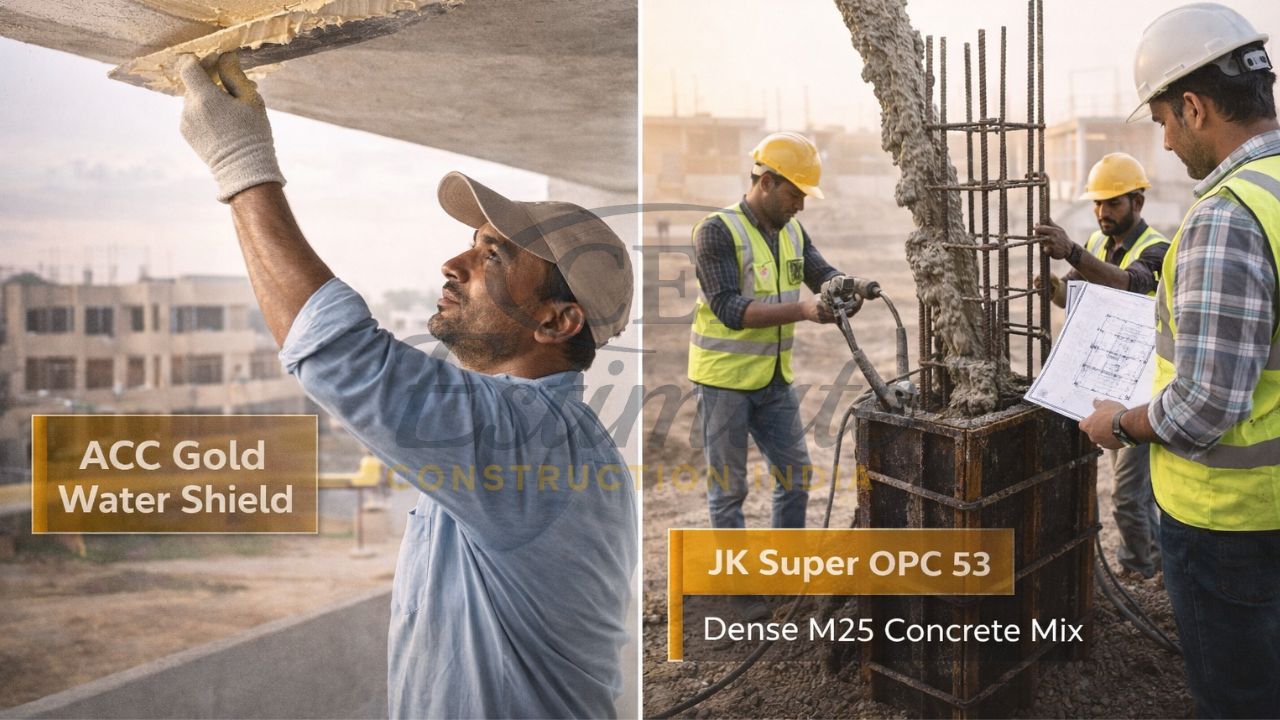
- ACC Gold Water Shield PPC — water-repellent, excellent crack resistance
- ACC F2R Composite Cement — balanced workability & strength
- ACC OPC 43/53 — dependable for structural elements
JK Cement popular variants:
- JK Super OPC 53 — renowned for high early & ultimate strength
- JK Super PPC — high fineness, good for general use & plaster
- JK Lakshmi variants — specialized for durability & finish
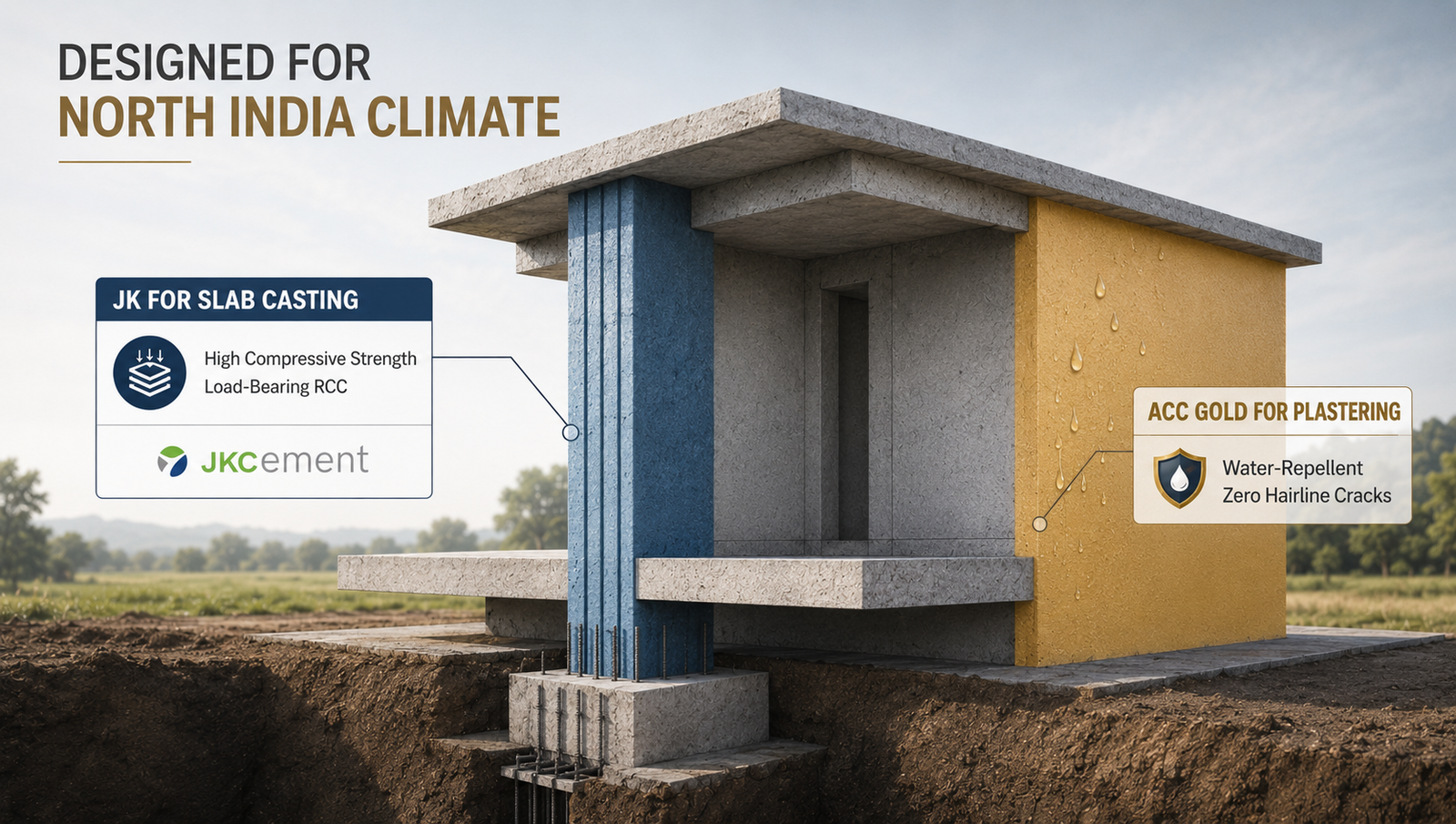
ACC PPC vs JK Super PPC is one of the most common residential debates in North India. Both meet IS 1489 standards. JK Super PPC/OPC often receives praise for superior compressive performance in structural work, while ACC PPC (especially Gold) is repeatedly favored by masons for silky troweling and minimal hairline cracks in plaster.
Comparison table (2026 typical UP/NCR retail values):
| Variant / Type | Compressive Strength (28 days) | Workability / Finish | Crack Resistance | Special Features | Approx. Price 2026 (₹/50 kg in UP/NCR) |
| ACC Gold Water Shield PPC | 43–53+ MPa | Outstanding | Excellent | Water-repellent technology | 380–430 |
| ACC OPC 53 | 53+ MPa | Very Good | Good | Fast early strength | 400–450 |
| JK Super OPC 53 | 53+ MPa | Very Good | Very Good | High early & ultimate strength | 410–480 |
| JK Super PPC | 43–53+ MPa | Excellent | Very Good | High fineness, good durability | 390–450 |
| JK Lakshmi PPC | 43–53+ MPa | Excellent | Excellent | Enhanced bonding & finish | 395–460 |
For modern residential construction in North India’s hot-humid climate, PPC from either brand is the preferred choice over pure OPC due to lower heat of hydration, better long-term strength gain, and superior crack resistance.
Head-to-Head Comparison: Key Factors
Strength & Compressive Performance
JK Super (especially OPC 53) often edges out in high compressive strength and early setting — a favorite among engineers for slabs, columns, beams, and load-bearing elements where ultimate strength is critical. ACC delivers very reliable and consistent performance across batches.
Workability & Plaster Finish
ACC PPC and ACC Gold Water Shield win significant praise from masons in Uttar Pradesh and Delhi NCR. They consistently provide smoother troweling, better adhesion to brick/block surfaces, and noticeably fewer hairline cracks — essential for interior walls, ceilings, and exterior plaster.
Durability & Long-Term Quality
Both brands are strong in blended cements. JK Super variants (OPC 53 and PPC) are frequently commended for weathering resistance and long-term durability in structural applications. ACC Gold’s water-repellent technology performs excellently in typical North Indian monsoon conditions.
Heat of Hydration & Curing
Both PPC lines generate significantly lower heat than OPC 53, making curing easier in UP’s extreme summer temperatures. No major difference here.
Price & Value for Money (ACC vs JK Cement price in Uttar Pradesh Delhi NCR 2026)
Typical retail in Mathura/Agra/Delhi NCR:
- ACC PPC / Gold: ₹380–₹430
- JK Super PPC / OPC 53: ₹390–₹480 ACC is generally ₹5–50 cheaper per bag locally, offering better value for medium-sized homes. JK commands a small-to-moderate premium justified by its high-strength reputation.
Availability & Batch Consistency
ACC enjoys very strong local dealer networks and supply reliability in Uttar Pradesh. JK Cement has excellent availability in North and Central India, with consistent quality across batches.
Mason & Contractor Feedback 2026
From residential sites in Mathura, Agra, and Delhi NCR:
- Structural work (slabs/columns/foundations) → JK Super preferred by many engineers for high strength and reliability
- Plastering & finishing → ACC Gold favored by 60–70% masons for “silky smooth finish” and “almost no cracks”
Price-Value Quality Balance
ACC often delivers equal or better plaster finish at a lower regional price. JK Super justifies its slight premium with superior structural performance in demanding applications.
Which is Better for Specific Applications?
Slab Casting / RCC
JK Cement (especially JK Super OPC 53) is often the preferred choice for roof slabs, columns, and load-bearing elements due to its high compressive strength and proven reliability in structural work.
Plastering / Walls
ACC (especially Gold Water Shield) takes the clear lead for interior and exterior plaster — superior smooth finish, better crack control, and excellent paint adhesion.
Foundation / Overall House Construction
- Budget-conscious G+1/G+2 homes in UP → ACC for consistent value, trust, and finishing excellence
- Premium builds or projects demanding maximum structural strength → JK Cement
- Hot-dry + monsoon climate → ACC Gold for plaster + JK Super for slab/foundation (a combination many experienced contractors use successfully)
ACC vs JK Cement which is better has no universal winner. JK Cement excels in strength-focused structural applications; ACC delivers exceptional trust, superior plaster finish, and regional affordability in North India.
Common Myths and Mistakes to Avoid
- “Higher price always means better quality” — ACC often outperforms JK in plaster finish at lower cost.
- Mixing ACC and JK in the same structural element — risks inconsistent setting.
- Ignoring manufacturing date — both lose strength after 3 months.
- Assuming OPC 53 is always stronger for everything — PPC from either brand is better for most residential plaster and general use.
- Choosing only on brand advertisements — real mason feedback in your UP/Delhi NCR area matters more.
- Not checking local dealer rates — prices vary ₹10–50 between brands in the same town.
- Skipping proper moist curing — even the highest-quality cement fails without 14 days of curing.
Conclusion
ACC Cement vs JK Cement in 2026 is a matchup between two outstanding, trusted Indian brands. JK Cement offers robust compressive strength and reliability — ideal for slabs, columns, and strength-focused structural work. ACC delivers legendary trust, exceptional plaster finish, and excellent regional value — a favorite for typical residential homes in Uttar Pradesh and Delhi NCR.
There is no definitive “better” brand — select according to your project priorities, local mason recommendations, site conditions, and budget. Many experienced builders now smartly combine both: JK Super for structure and ACC Gold for plaster to get the best of both worlds.
For accurate material estimation including ACC or JK Cement quantities, detailed BOQ for slab, plaster, RCC, or complete house construction cost planning in Mathura, Delhi, Agra, or anywhere in India, contact Construction Estimator India — experts in precise, trade-specific construction estimates and quantity takeoffs.
Call/WhatsApp: 📞 8630676890
Professional estimates starting at only ₹10,000 — fast, detailed, reliable, and BIS-compliant.
Use a reliable Cement Calculator to estimate quantities accurately and optimize your budget for the best cement choice.
FAQs – ACC Cement vs JK Cement 2026
ACC Cement vs JK Cement: Which is better in 2026?
No single winner. JK Cement leads in high-strength structural performance; ACC excels in legacy trust, plaster finish, and regional value in Uttar Pradesh and Delhi NCR.
Is ACC or JK Cement better for slab casting/RCC in house construction?
JK Cement (especially JK Super OPC 53) is often preferred for slab casting and RCC due to its high compressive strength and reliability in load-bearing elements.
Which is better for plastering—ACC PPC or JK Super PPC?
ACC PPC (especially Gold Water Shield) is frequently rated higher for plastering in North India — smoother troweling and fewer hairline cracks.
ACC vs JK Cement price comparison in Uttar Pradesh/Delhi NCR/Mathura 2026?
ACC PPC/Gold: ₹380–₹430; JK Super PPC/OPC 53: ₹390–₹480. ACC is typically ₹5–50 cheaper locally in Mathura, Agra, and NCR.
Can I use JK Cement instead of ACC for better quality?
Yes — JK Cement delivers excellent quality, especially for structural strength and durability. Many homeowners in North India choose JK for premium builds.
Which has better consistency and mason feedback—ACC or JK Cement?
ACC is frequently praised for batch consistency and plaster finish; JK Cement wins strong mason feedback for structural reliability.
Is JK Super better than ACC for crack-resistant walls?
Both are excellent, but ACC Gold is often preferred by masons for crack-resistant plaster finish in residential walls.
In North India homes, ACC vs JK Cement which is more reliable?
ACC enjoys a strong legacy trust advantage in Uttar Pradesh and Delhi NCR; JK Cement is increasingly seen as a premium, strength-focused choice.