
If you have ever heard a hollow sound when you tap your tiles, seen hairline cracks, or watched tiles simply pop out from the floor or wall, most of the time the root cause is wrong cement/adhesive choice and poor application – not the tile quality itself. In 2026, with larger vitrified tiles, heavy granite and marble, and wet areas like bathrooms and balconies, using normal cement-sand mortar the old way is almost a guarantee of future complaints, rework and loss.
Why the Right Cement/Adhesive Choice Is Critical for Tiling on Concrete/Plaster?
For today’s tiles and stones, the base is usually RCC slab, screed or plaster – all of which shrink and move with temperature and moisture; if the bonding material cannot handle this movement, tiles debond or crack. A proper tile adhesive is designed to give high bond strength, flexibility, water resistance and controlled thickness, which keeps tiles firmly locked to concrete/plaster even under heavy traffic and thermal movement.
Using the right cement/adhesive also helps:
- Reduce tile breakage and wastage during fixing.
- Avoid stains, efflorescence and color patches on light marble and granite.
- Achieve perfectly level floors and plumb walls, especially with large-format vitrified tiles.
- Save labour time because mixing, application and cleaning are faster and more predictable than loose site-mix mortar.
Traditional Cement vs Modern Tile Adhesives – Which Is Better in 2026?
Traditional cement-sand mortar (1:4 to 1:6) is still seen on many small sites, especially for basic ceramic tiles in rural/low-budget work; it is cheap per bag but needs higher thickness, more labour, soaking tiles, and still gives lower bond strength and more hollow sounds. With large vitrified tiles and dense porcelain, the mortar cannot properly grip the tile back, leading to debonding, curling and uneven surfaces over time.
Modern cement-based tile adhesives are factory-made, polymer-modified powders; you just add water and get a creamy paste that gives excellent adhesion on concrete, screed, plaster and even old tiles. These adhesives are available in different grades (C1, C2, C2TE, etc.) for normal, fast-setting, flexible and heavy-duty applications, and are now the recommended standard for most tiling in India 2026, from residential flats to malls.
Other modern options include:
- Ready-mix / pre-mixed tile adhesives (in buckets): paste form, convenient for wall tiles and small renovation jobs; mostly for internal walls and smaller tiles.
- Epoxy tile adhesives: high chemical resistance and waterproofing; used for industrial kitchens, labs, swimming pools and very heavy-duty areas along with epoxy grout.
- White cement-based adhesives: specially formulated for marble, granite, light and translucent stones where normal grey cement causes stains or shadowing.
In simple language: for 90% of good-quality tiling jobs in 2026, polymer-modified cement-based tile adhesive is better than normal cement mortar in strength, finish, speed and long-term durability.
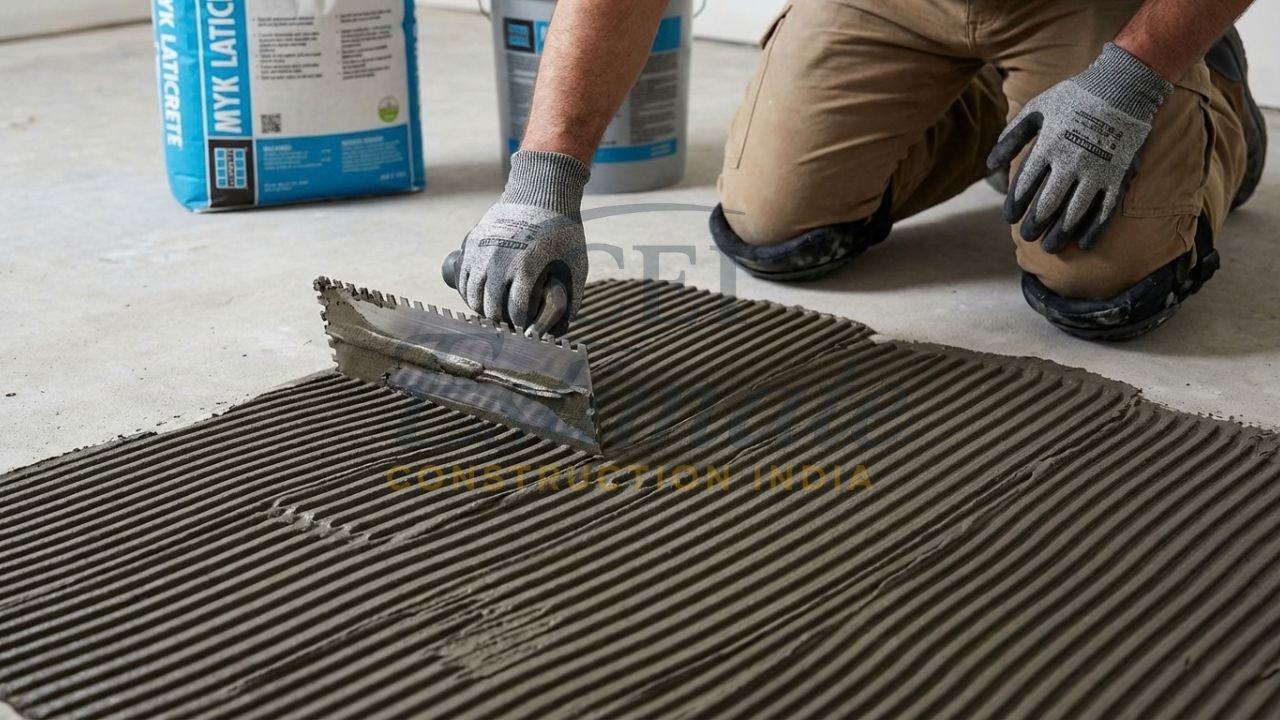
Which Type of Cement/Adhesive Is Best for Different Tile & Surface Types?
Use this practical guide when deciding what to use where:
- Ceramic wall tiles on plastered brick/block walls
- Use: Standard cement-based tile adhesive (C1 or C1T) or a white cement-based adhesive where tile is light/white.
- Why: Better grip on plaster, less slipping on vertical surfaces, neat joints.
- Porcelain/vitrified floor tiles on concrete/RCC screed
- Use: Polymer-modified cement-based adhesive (C2 or C2TE class) with good flexibility.
- Why: Dense tiles need higher bond strength and deform with slab movement; polymer adhesive prevents debonding and hollow spots.
- Vitrified/porcelain wall tiles (bathroom, kitchen, façade)
- Use: Non-slip, polymer-modified adhesive with extended open time (C2TE), sometimes deformable (S1) for external façades.
- Why: Avoid tile slipping on vertical surfaces and handle temperature variations.
- Marble, granite & natural stone on floors and walls
- Use: White cement-based adhesive or premium polymer-modified white tile adhesive, especially for Italian/soft marble and light stones.
- Why: Prevents staining and picture-framing, provides strong but flexible bond for heavy tiles.
- Wet areas – bathrooms, balconies, kitchen backsplash, wash areas
- Use: Waterproof polymer-modified adhesive (C2TE/S1 type) or epoxy adhesive for extreme wet/chemical areas.
- Why: Constant moisture and temperature changes demand water-resistant, flexible bonding.
- Large-format tiles & slabs (>600×600 mm, 800×800, 600×1200, big slabs)
- Use: High-bond strength, deformable adhesive (C2TE/S1 or S2), often labelled as “Large format / Heavy duty / Flex”.
- Why: Big tiles require full bedding support, higher flexibility and better wetting to avoid hollow sound, cracking and edge lifting.
- Heavy-traffic/commercial floors (malls, showrooms, hospitals, schools)
- Use: High-strength cement-based adhesive (C2 or C2TE) or epoxy system where chemical or impact loads are high.
- Why: Repeated impact and point loads can quickly damage tiles fixed with low-grade mortar.
- Tile-over-tile (old tile surface, renovation without breaking)
- Use: Special “tile-on-tile” high-bond adhesive (C2TE/S1), sometimes with primer.
- Why: Old glazed tile surface is smooth and non-absorbent; needs high bond plus surface preparation.
- Cladding on external walls and elevations
- Use: Flexible, weather-resistant polymer-modified adhesive (C2TE/S1), plus proper mechanical support for heavy stones.
- Why: Sun, rain and temperature changes cause high movement; only flexible adhesives can survive long term.
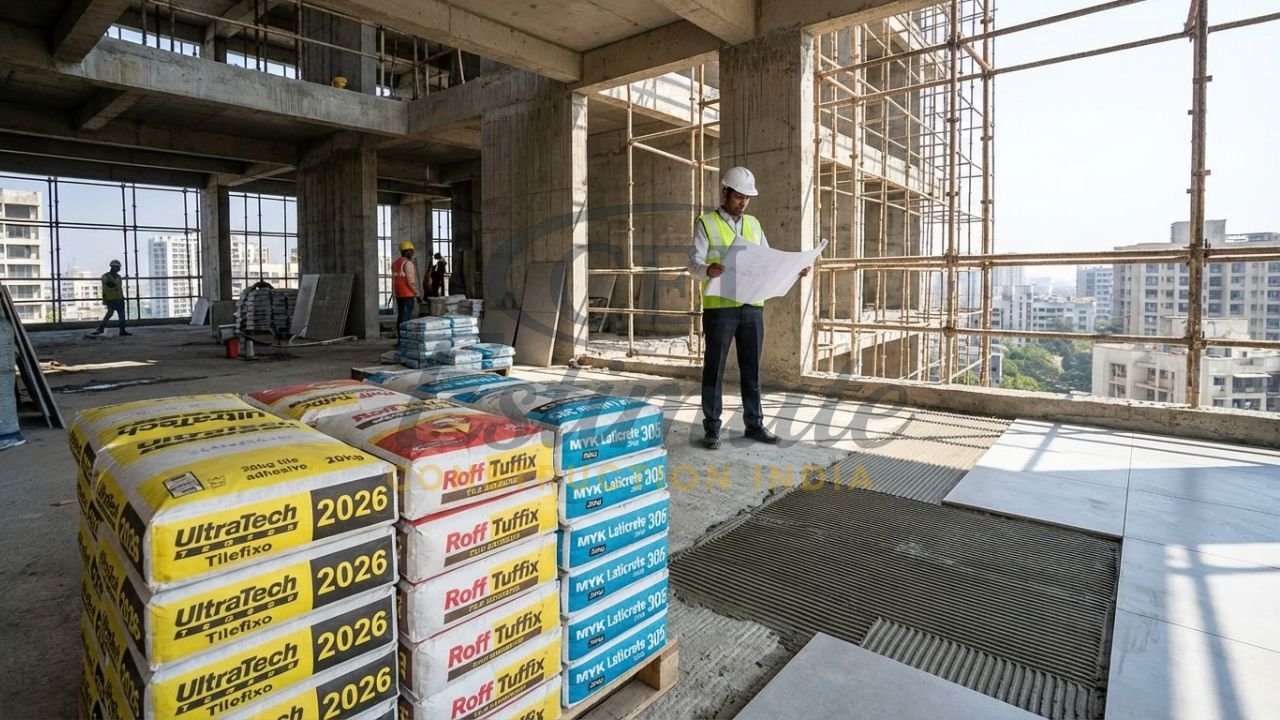
Top 10 Best Cement & Tile Adhesive Brands/Products for Tiling in India 2026
Below are 10 trusted options commonly used by contractors across India; prices are indicative street/retail levels in many Tier‑2/3 cities as of early 2026 and can vary by location, dealer discount and quantity.
1. UltraTech Tilefixo / UltraTech Xtra
- Type: Polymer-modified cement-based tile adhesive range (CT, NT, VT, etc.).
- Best for: Ceramic and vitrified floor/wall tiles on concrete and plaster; different grades for basic tiles, vitrified, large-format and tile-over-tile.
- Approx price (20–25 kg): Around ₹270–₹490 per 20 kg bag in many markets, depending on variant and dealer margin.
- Coverage: Roughly 4–5 kg/m² at 3 mm thickness (around 4–5 m² per 20 kg bag for normal trowel).
- Key advantage: Backed by a major cement brand, consistent quality, easily available in North & Central India, good technical support and data sheets.
2. Ardex Endura (e.g., Ardex X77 / X90 equivalents)
- Type: High-performance polymer-modified cement-based adhesives, including flexible and weather-resistant grades.
- Best for: Premium vitrified, porcelain, tile-on-tile, façades and external cladding where flexibility and strength are critical.
- Approx price: Mid to premium range, usually higher than basic retail brands but justified for demanding work.
- Coverage: Typically 3–6 kg/m² depending on trowel size and tile size (standard for C2TE adhesives).
- Key advantage: Excellent reputation among professional tilers for strong bonding, low slump and wide product range (adhesives + grouts).
3. Kerakoll H40 / Keraflex Range
- Type: High-grip, flexible, polymer-modified cement-based tile adhesives; H40 is a flagship product with high performance.
- Best for: Large-format vitrified, porcelain, natural stone, façades and heavy-duty commercial projects; also for tile-over-tile with suitable grade.
- Approx price: Around ₹1,000–₹1,400 per 25 kg bag for H40 Gel in India, depending on color and seller.
- Coverage: About 1.2–1.3 kg/m² per mm thickness, i.e., roughly 4–6 m² per 25 kg with a typical notched trowel.
- Key advantage: Very strong bond, good deformability, long open time; preferred in high-end residential and commercial sites.
4. Weber (Saint‑Gobain) – Webercol Flex / Weberfix Pro
- Type: Cement-based, polymer-modified flexible tile adhesives; Webercol Flex is a two‑component latex-modified product.
- Best for: Internal and external floors and walls, wet areas, large tiles and places with permanent humidity or temperature variations.
- Approx price: Typically mid to premium range per 20–25 kg set, varying with local distributor.
- Coverage: Approx. 3–7 kg/m² depending on substrate and tile; many Weber specifications list 3–7 kg/m² for their flexible adhesive range.
- Key advantage: High bonding strength, good chemical and water resistance, reliable for balconies, terraces and bathrooms.
5. Roff (Pidilite) – Roff Tufffix / Roff Master
- Type: Polymer-modified cement-based tile adhesives along with specialty products (epoxy grout, waterproofing, etc.).
- Best for: Residential vitrified/ceramic floors and walls, bathrooms, kitchens and balconies where waterproofing and flexibility are important.
- Approx price: Competitive mid-range; often found slightly above local brands but below ultra-premium imports.
- Coverage: Generally 4–6 m² per 20–25 kg bag depending on usage.
- Key advantage: Strong backing of Pidilite, easy availability in paint/adhesive shops, full system (adhesive + grout + waterproofing).
6. Bal Adhesives (Bal Bond / Bal Super)
- Type: Tile adhesives, bonding agents and additives for strengthened cement-based fixing systems.
- Best for: Bathrooms, kitchens and renovation work where enhanced bond and flexibility are required, especially when using admixtures.
- Approx price: Varies by product; typically considered mid-range to premium due to performance.
- Coverage: Depends on whether used as ready adhesive or as additive with site-mix.
- Key advantage: Known internationally; good for contractors who like combining site-mixed mortar with polymer bonding agents.
7. Fosroc – Nitobond / Conbextra Range
- Type: Construction chemicals including bonding agents (Nitobond) and specialized grouts; used along with cement-based adhesives or mortars.
- Best for: Heavy-duty, industrial and infrastructure jobs where strong bonding to old concrete, high impact and load transfer are needed.
- Approx price: Premium industrial-grade; pricing varies widely by region and type (epoxy vs acrylic bonding agents, etc.).
- Coverage: Given per kg or per litre of bonding agent; refer to product data sheets for exact numbers.
- Key advantage: High performance in structural and industrial environments; trusted by engineers for critical applications.
8. MYK Laticrete – Laticrete 252, 305, etc.
- Type: Wide range of polymer-modified cement-based tile adhesives (e.g., 252, 305, 335) and epoxy systems.
- Best for: From basic ceramic wall tiles (305) to high-performance vitrified, stone and external applications (higher numbered products).
- Approx price: Around standard to premium depending on product; typically competitive in professional markets.
- Coverage: Roughly 4–6 m² per 20–25 kg bag for typical 3 mm bed thickness.
- Key advantage: Detailed technical documentation, training support and a complete tiling system (adhesives, grouts, waterproofing).
9. JK White Cement + Polymer Additive
- Type: White Portland cement combined with latex/polymer admixture to create site-made white tile adhesive.
- Best for: Marble, granite and light-coloured natural stones where grey cement may stain; renovation projects where custom mixes are preferred.
- Approx price: White cement around the standard white cement retail price per 25/50 kg bag plus the cost of admixture; often economical vs branded white adhesives.
- Coverage: Varies with mix ratio; roughly similar to other cement-based adhesives at same thickness.
- Key advantage: Very bright white color, flexible to adjust mix on site, easier availability in many Tier‑2/3 markets.
10. Birla White Cement + Latex Additive
- Type: High-whiteness cement used with latex/polymers to make white bonding mortar or adhesive for marble and granite.
- Best for: Italian marble, onyx, light granites and vertical stone cladding where clean white background and strong bonding are critical.
- Approx price: Similar to other white cements; overall system cost depends on additive dosage.
- Coverage: Comparable to JK white-based systems for same thickness.
- Key advantage: Very high whiteness, good brand trust, widely used by marble masons for premium finishes.
Sample Comparison Table – Popular Tile Adhesive Options (Indicative 2026)
| Product / Brand | Type | Best For | Approx Price (bag/bucket) 2026* | Coverage (typical) | Strength Class / Notes |
| UltraTech Tilefixo CT / VT | Cement-based polymer adhesive | Ceramic/vitrified on concrete & plaster | ~₹270–₹490 per 20 kg bag | ~4–5 m² per 20 kg at 3 mm | C1/C2 depending on grade |
| Kerakoll H40 Gel | High-flex cement adhesive | Large-format tiles, façades, heavy-duty | ~₹1,000–₹1,400 per 25 kg | ~4–6 m² per 25 kg | C2TE/S1 type performance |
| Webercol Flex | Flexible cement-based adhesive | Wet areas, external, large tiles | Mid–premium per 20–25 kg | ~3–7 kg/m² (3–6 m² per bag) | C2TE / flexible, waterproof |
| Roff Tufffix | Cement-based adhesive | Residential floors/walls, bathrooms, balconies | Mid-range per 20 kg | ~4–6 m² per 20 kg | C1/C2 depending on version |
| MYK Laticrete 252 / 305 | Polymer-modified adhesive | Ceramic & vitrified tiles, tile-on-tile (higher grade) | Standard–premium per 20–25 kg | ~4–6 m² per bag | C1/C2 as per product |
| JK/Birla White + latex | Site-made white adhesive | Marble, granite, light natural stone | White cement + admixture cost | Similar to other cement adhesives | Depends on mix; good for light stone |
Prices are indicative and vary by city, dealer and quantity; always check local dealer rate before final BOQ.
Practical Tips for Perfect Tiling Using the Best Cement/Adhesive
Follow these field-tested tips to avoid hollow sound, cracks and customer complaints:
- Prepare the base properly
- Roughen smooth concrete or old tiles with mechanical tools or chiselling; remove dust, oil, paint, loose particles and curing compounds.
- Ensure screed or plaster is fully cured and reasonably level before tiling.
- Check surface moisture and priming
- Slightly damp (not flooded) surfaces often help with bonding; avoid standing water.
- On very absorbent or dusty surfaces, use the recommended primer/slurry as per adhesive brand.
- Use the right mixing ratio
- Always follow the water–powder ratio on the bag; over‑watering reduces strength and causes shrinkage and curling.
- Mix with a slow‑speed drill mixer if possible; rest the mix (slake) for a few minutes and remix before use.
- Select correct notched trowel size
- For small wall tiles: 4–6 mm notch.
- For normal floor tiles (600×600): 8–10 mm notch.
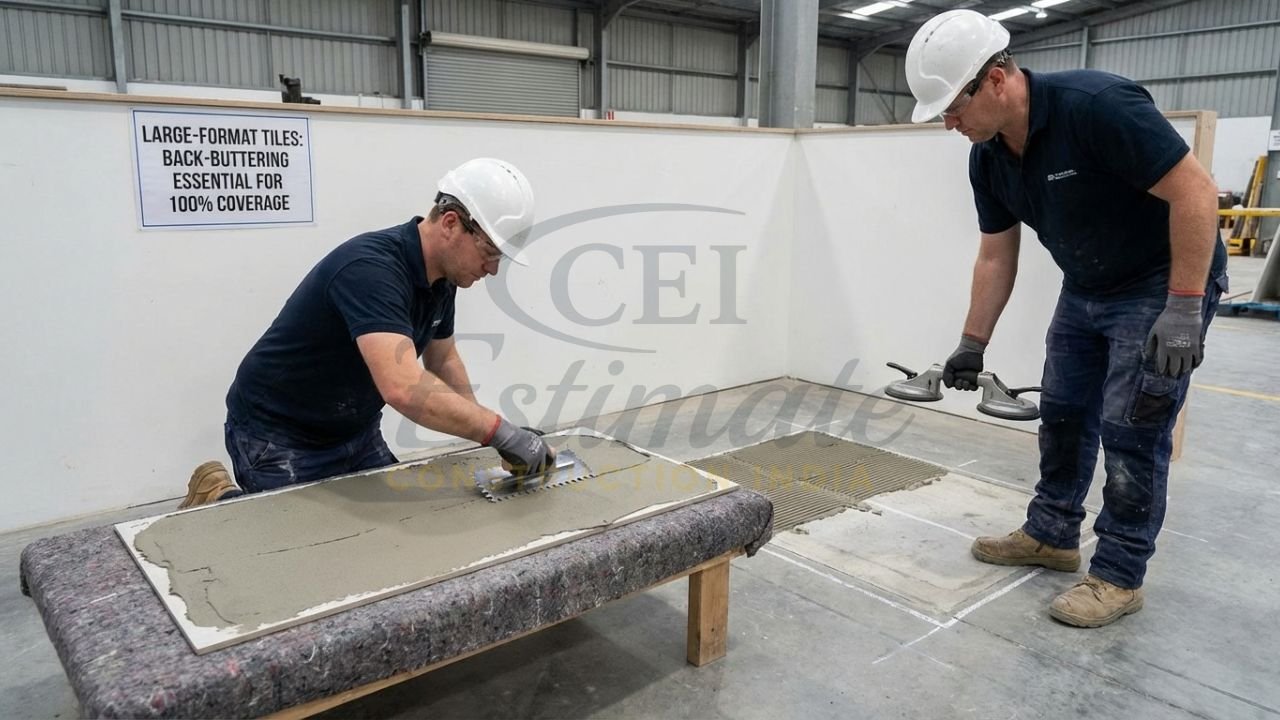
- For large-format and slabs: 10–12 mm notch plus back-buttering of tiles.
- Use back-buttering for large and heavy tiles
- Apply a thin layer of adhesive at the back of big tiles or stones to ensure 100% contact area.
- This dramatically reduces hollow sound and breakage under load.
- Control open time and skinning
- Do not spread adhesive on more area than you can tile within 10–20 minutes (check product open time).
- If adhesive surface forms a skin, re‑comb or discard and apply fresh material.
- Maintain proper joint width and alignment
- Use tile spacers (2–3 mm or as specified) to keep joints consistent and allow for grout and movement.
- Check levels frequently with spirit level/laser and rubber mallet; correct while adhesive is fresh.
- Allow adequate curing before grouting & loading
- Most cement-based adhesives need 24 hours for light foot traffic and grouting; heavy loads may need 48–72 hours.
- Epoxy systems may also specify specific curing times – always follow technical data.
- Use suitable grout and sealants
- For bathrooms, balconies and kitchens, use polymer-modified or epoxy grout as recommended by the adhesive brand.
- Provide movement/expansion joints at periphery, door thresholds, long corridors and around columns; fill these with flexible sealant, not rigid grout.
- Avoid common mistakes
- Do not soak vitrified/porcelain tiles in water; only wipe dust from the back.
- Do not fix tiles directly on green (fresh) screed or plaster without considering curing and shrinkage.
- Do not mix different brands or add extra cement to ready-made adhesive bags.
Need Accurate Tiling Material BOQ & Full Construction Budget?
If you are a house owner, contractor or builder in North India (Delhi NCR, Uttarakhand, Uttar Pradesh, Rajasthan, Madhya Pradesh, Bihar, Punjab, Haryana, etc.), getting the right BOQ (Bill of Quantities) and construction budget can save you lakhs over the project. Instead of guessing bags of cement, adhesive and grout on site, we help you with a clear quantity break-up as per tile type, area and brand preference.
Our simple 5-step process:
- You WhatsApp your floor plan, tile sizes and basic details to +91 8630676890.
- We analyse your drawings and propose suitable adhesive/cement type for each area (living, bedrooms, bathrooms, balconies, parking, cladding).
- We prepare a material BOQ – number of bags of adhesive, grout, primer, waterproofing, etc. with brand options and budget/standard/premium choices.
- If required, we give a full house construction budget including civil, plaster, flooring, cladding, skirting and staircase stone with rate analysis.
- You review, clarify on WhatsApp call, and then order materials from your preferred local dealer based on our guidance.
For a initial tiling material estimate and BOQ suggestion, WhatsApp +91 8630676890 now.
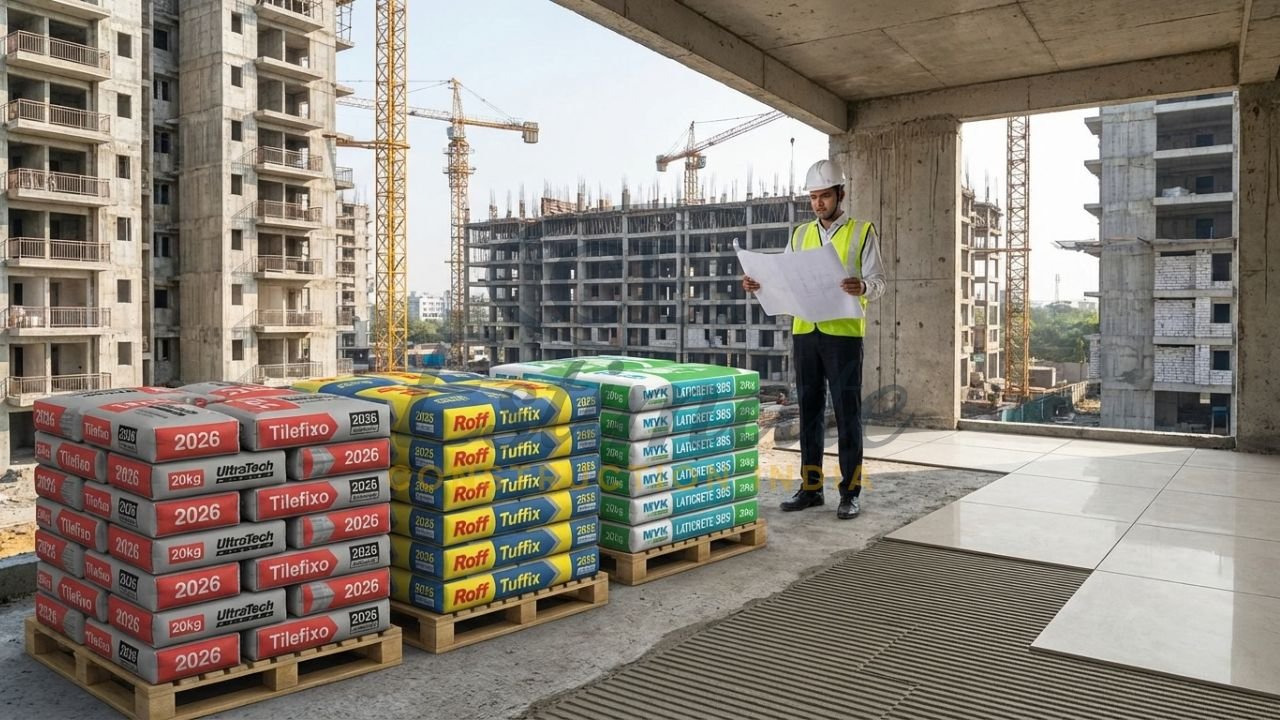
Get Your Tiling BOQ & Budget
Need help choosing the right cement or tile adhesive and calculating exact quantities for your site?
Send your floor plan and tile details on WhatsApp to +91 8630676890 for:
- Tiling material BOQ & estimate
- Brand and grade recommendation as per your city and budget
- Optional full house construction budget with flooring and cladding
WhatsApp now and avoid costly tiling failures later.
FAQ – Best Cement & Tile Adhesives for Tiling in India 2026
- Is normal cement-sand mortar still OK for tiling in 2026?
For small ceramic tiles in low-budget and low-traffic rural work, traditional mortar is still used, but for vitrified, porcelain, large-format and stone tiles it is strongly recommended to use polymer-modified tile adhesive to avoid failures. - Which cement is best for vitrified tiles on RCC slab?
Use a C2 or C2TE grade polymer-modified cement-based tile adhesive from a reputed brand such as UltraTech, MYK Laticrete, Kerakoll, Weber or Roff rather than plain OPC/PPC mortar. - What should I use for Italian marble and light granite?
Prefer white cement-based adhesives or white tile adhesives (from Kerakoll, MYK Laticrete, Weber, Roff etc.) or a combination of JK/Birla White cement with latex additive to avoid stains and shadows. - Can I fix new tiles on top of old tiles without breaking them?
Yes, you can use a special tile-on-tile high-bond adhesive (C2TE/S1 type) after proper cleaning and roughening of the old tile surface, and sometimes applying a primer as recommended by the brand. - How many bags of tile adhesive are needed per 1000 sq ft?
For typical 600×600 vitrified tiles at about 3–4 mm bed thickness, expect roughly 3.5–4.5 kg/m² of adhesive; for 1000 sq ft (about 93 m²), that is roughly 330–420 kg, or around 14–20 bags of 20 kg (or 8–12 bags of 25 kg), depending on trowel size and wastage. - Which adhesive is best for bathroom and kitchen tiles?
Use a water-resistant polymer-modified tile adhesive (C2TE or equivalent) and combine it with proper waterproofing and high-quality grout (polymer-modified or epoxy) to resist moisture and stains. - What is the difference between C1 and C2 tile adhesives?
C1 is a normal cementitious adhesive with standard bond strength, while C2 is an improved adhesive with higher bond strength and often extra properties like reduced slip, extended open time or flexibility; for vitrified, large-format and external work, C2 is generally preferred. - How long should I wait before walking on newly tiled floors?
Most cement-based adhesives allow light foot traffic after 24 hours, but for heavy furniture movement, vehicle parking or industrial loads you should wait 48–72 hours, depending on the product and site conditions. - Is epoxy adhesive necessary for residential homes?
Epoxy adhesive is usually not needed for normal floors and walls; it is reserved for very wet, chemical or heavy-duty conditions like commercial kitchens, labs and industrial floors. For most homes, a good polymer-modified cement adhesive is enough. - Can I mix extra cement or sand into ready-made tile adhesive?
No; adding extra cement or sand disturbs the manufacturer’s design and reduces strength, flexibility and open time. Use the product exactly as instructed and, if needed, shift to a higher grade adhesive instead of modifying the bagged mix.
Conclusion
Choosing the right cement or tile adhesive in 2026 is the difference between a floor that starts sounding hollow within one year and a floor that stays strong, level and crack-free for 15–20 years. When you match the adhesive grade properly to tile type, surface and area usage – and apply it correctly – you save money, avoid rework and deliver professional-quality finishing that impresses every visitor or client.
If you want a clear tiling BOQ, brand recommendation and full construction budget for your house or project in North and Central India, simply WhatsApp your plans and basic details to +91 8630676890. Get your tiling material quantity calculation, BOQ and full house construction budget estimate so you can purchase the right cement and tile adhesive with confidence.