
Picture this: You’re building your house in Aligarh or Patna, used “cheap” cement from a roadside dealer, and just 2 years later – cracks snake across columns, roof leaks like a sieve, and foundation shifts. Repair bill? Lakhs! We’ve seen builders in UP, Bihar, Rajasthan lose everything to fake or expired cement. In 2026, with fakes flooding Tier-2/3 markets, these 12 no-equipment tests save your structure. As experts at Construction Estimator India, we’ll show you how to spot genuine stuff on-site – before it’s cast in your slab.
Why Checking Cement Quality Is Critical in India 2026
Bad cement = weak RCC, cracks in beams/slabs, plaster peeling off, massive leaks. Fake bags (no real clinker, just fillers) give 20-40% less strength. Expired (over 3 months) loses hydration power. Result? Your ₹50 lakh house becomes a liability. Test every bag – it takes 5 minutes, saves crores in repairs.
12 Easy On-Site Tests to Check Cement Quality (No Lab Needed)
Grab a bag, water bucket, glass plate – done. Do these before mixing for foundation, slabs, or plaster.
- Manufacturing Date & Shelf Life Check
Flip bag – fresh date (within 3 months ideal, max 6). Old = weak.
Good: Printed clearly, recent. Red flag: Faded/sticker. - ISI Mark & BIS License Verification
Look for BIS hologram/ISI mark + license no. Scan QR if any.
Good: Clear, matches brand site. Red flag: Missing/fake. - Bag Condition & Stitching
Check stitching – original thread, no cuts/tape.
Good: Intact, branded. Red flag: Repaired/refilled. - Brand Name & Logo Clarity
Sharp printing, no typos (e.g., “ACC” not “AEC”).
Good: Crisp. Red flag: Blurry/spelling errors. - Weight Check
Weigh on scale – 50 kg ±200g.
Good: Full. Red flag: Light (filled with air/stone). - Hand Feel Test
Rub handful between (dry) fingers – silky smooth, no lumps.
Good: Fine powder. Red flag: Gritty/lumps.
- Colour Test
Spread thin layer – uniform grey (OPC greenish, PPC light).
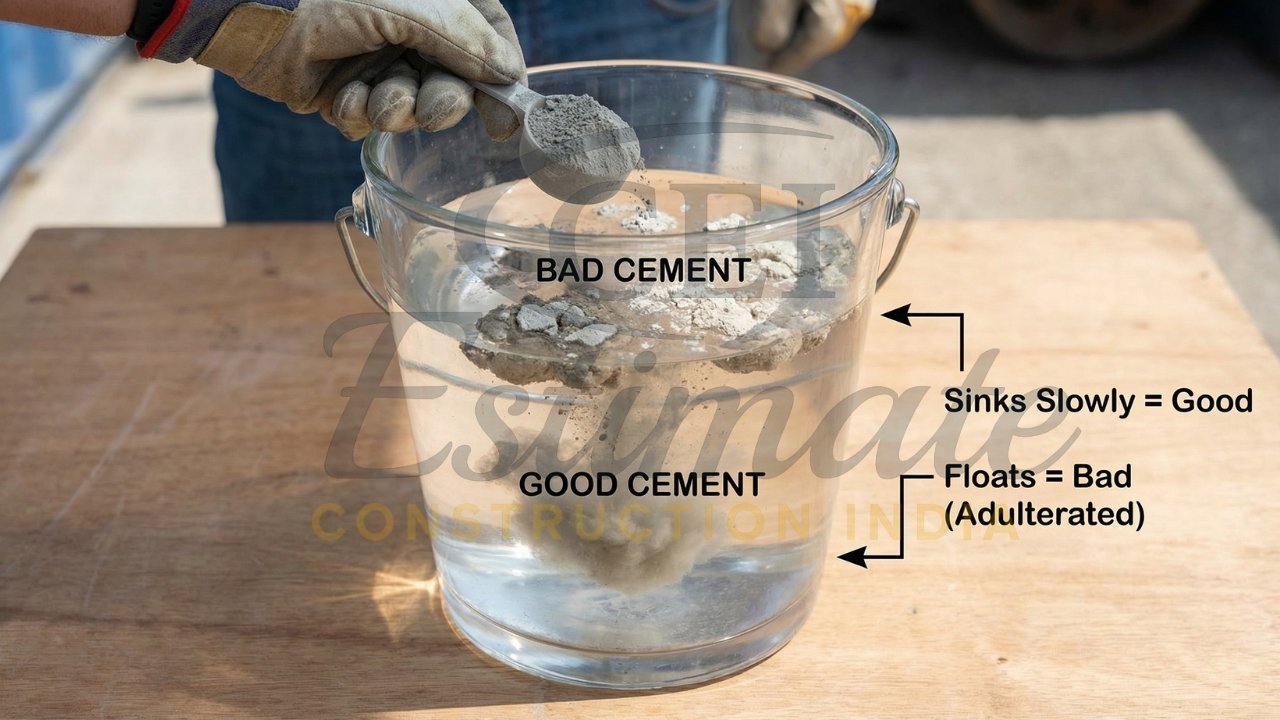
Good: Even. Red flag: Yellowish/white patches. - Float Test
Drop small handful in water bucket – sinks slowly.
Good: Sinks (dense). Red flag: Floats (adulterated). - Glass Plate Test
Mix paste (cement:water 3:1), spread on glass – set hard in 24 hrs, no cracks.
Good: Solid pat. Red flag: Crumbles/soft. - Heat Test
Hold fresh handful – feels cool.
Good: Cool. Red flag: Warm/hot (old/impure). - Setting Time Check
Make patty (cement:water), time initial set – 30-60 min.
Good: Firm quick. Red flag: Too fast/slow. - Strength Test
Form small cube/pat, cure 3-7 days – hammer tap, hard/no cracks.
Good: Rings solid. Red flag: Powdery.
Comparison Table – Cement Quality Tests at a Glance
| Test Name | What Good Cement Does | Red Flag / Bad Sign | Action if Failed |
| Mfg Date | Within 3 months | Expired >6 months | Reject bag |
| ISI Mark | Clear hologram/license | Missing/fake | Return to dealer |
| Bag Stitching | Original, intact | Tampered/cut | Don’t use |
| Weight | 50 kg ±200g | Underweight | Weigh all, complain |
| Hand Feel | Silky smooth | Lumps/gritty | Fake – discard |
| Float | Sinks slowly | Floats | Adulterated, reject |
| Colour | Uniform grey | Patchy/yellow | Poor quality |
| Glass Plate | Sets hard 24 hrs | Cracks/soft | Test more bags |
Red Flags – How to Spot Fake, Expired or Low-Grade Cement Bags
- Lumps or bad smell: Moisture/impurities.
- Wrong colour: Fillers like chalk.
- Low weight/no ISI: Straight fake.
- Expired date/cheap price: Avoid “local brands” mimicking ACC/UltraTech.
- Roadside sellers: No invoice = risk.
Practical Tips for Buying & Storing Genuine Cement in India
- Buy from authorized dealers – demand invoice with batch no.
- Bulk from godowns, not small shops.
- Store dry, elevated, covered – use FIFO (first in, first out).
- For UP/Rajasthan: Check summer stock rotation.
- Verify via brand app/QR.
Need Help with Cement Quantity, BOQ or Full House Budget?
Not sure about your cement bags? Snap a photo – we’ll verify!
- WhatsApp roof/slab area, photos.
- Get exact cement bags, mix, cost in 24 hrs.
- Full BOQ/budget from Construction Estimator India.
WhatsApp +91 8630676890 NOW – “Cement check/photo” or “BOQ estimate”!
FAQ: Cement Quality Checks in India
1. How can I check cement quality at home in India?
You can check cement quality using simple on-site methods like the hand feel test, float test, colour check, and glass plate test. Good cement feels smooth, has uniform grey colour, and sinks slowly when dropped in water.
2. How fresh should cement be for construction work?
For best strength, cement should ideally be used within 3 months of the manufacturing date. Cement older than 6 months may lose a significant amount of its binding strength.
3. What are the common signs of fake cement bags in India?
Fake cement bags often show poor printing, spelling mistakes in brand names, missing ISI marks, damaged stitching, and unusually low prices. Always check the BIS license number and manufacturing date.
4. What is the standard weight of a cement bag in India?
A standard cement bag in India weighs 50 kg. A small variation of ±200 grams is acceptable. If the weight is lower, the bag may have been tampered with or underfilled.
5. Why does cement develop lumps inside the bag?
Cement forms lumps when it absorbs moisture from the air during storage or transportation. Hard lumps usually mean the cement has partially hydrated and lost strength.
6. What colour should good quality cement be?
Good cement generally has a uniform grey colour with a slight greenish shade. Patchy, yellowish, or very light colour may indicate impurities or poor-quality cement.
7. What happens if low-quality cement is used in construction?
Using poor quality cement can cause cracks in walls, weak RCC structures, roof leakage, and reduced building durability, which may lead to costly repairs in the future.
8. How should cement be stored on a construction site?
Cement should be stored in a dry, covered area on raised wooden platforms, away from walls and moisture. Bags should be stacked properly and used using the FIFO (First In, First Out) method.
9. Which cement type is better for house construction in India?
OPC (Ordinary Portland Cement) is commonly used for structural work like beams, columns, and slabs, while PPC (Portland Pozzolana Cement) is preferred for plastering and masonry due to better durability.
10. Where can I verify cement bags or estimate cement quantity for my house?
You can send cement bag photos or construction details to Construction Estimator India on WhatsApp +91 8630676890 to get cement verification, quantity calculation, and BOQ estimates.
Conclusion: Test Your Cement Today – Build Strong Tomorrow
These 12 tests take 10 minutes but prevent disasters. Spot fakes, buy smart, store right – your slabs will thank you.
WhatsApp +91 8630676890 NOW for cement quantity calculation, detailed BOQ, full house construction budget estimate, or quick bag photo verification from Construction Estimator India!