
I still remember a project in Varanasi where a contractor, trying to save costs, used low-grade cement for the plinth beams. Within six months, diagonal shear cracks appeared near the supports, and the beam deflected visibly under its own load. The repair? Jacking up the beam, injecting epoxy, and reinforcing with carbon fiber—costing three times the original beam price and delaying the project by two months.
In the world of Indian construction, the beam is the unsung hero. It carries the floor load and transfers it to the columns. If the cement is wrong, the beam fails in tension (cracking) or shear (catastrophic failure). This guide, from Construction Estimator India, cuts through the marketing fluff. We are talking about real-world performance, 2026 pricing, and the hard science of why your beam might just save your house—or ruin it.
Why Cement Choice Is Make-or-Break for RCC Beams?
Beams are the “muscles” of your structure, subjected to complex bending moments and shear forces. Unlike a slab which is mostly in compression from one direction, a beam under load experiences tension on the bottom and compression on the top.
Why Cement Selection is Critical:
- Tensile Strength & Cracking: Concrete is weak in tension. If the cement paste is brittle or has high shrinkage, the beam cracks under bending stress.
- Bond Strength: The cement paste must grip the steel reinforcement perfectly. Poor cement quality leads to “bond slip,” where the steel slips inside the concrete, causing structural instability.
- Heat of Hydration: Beams are often cast monolithically with columns. High heat can cause thermal cracking, especially in deep beams (plinth beams, transfer beams).
- Early Strength for Formwork Removal: In multi-story buildings, beams need to be stripped quickly to reuse formwork. Slow-setting cements delay the entire project timeline.
- Durability: Beams in plinths or damp areas face moisture. Wrong cement leads to carbonation and rebar corrosion, causing the “concrete cancer.”
Key Insight: A beam doesn’t fail because the steel wasn’t enough; it fails because the concrete matrix (cement) couldn’t transfer the stress to the steel.
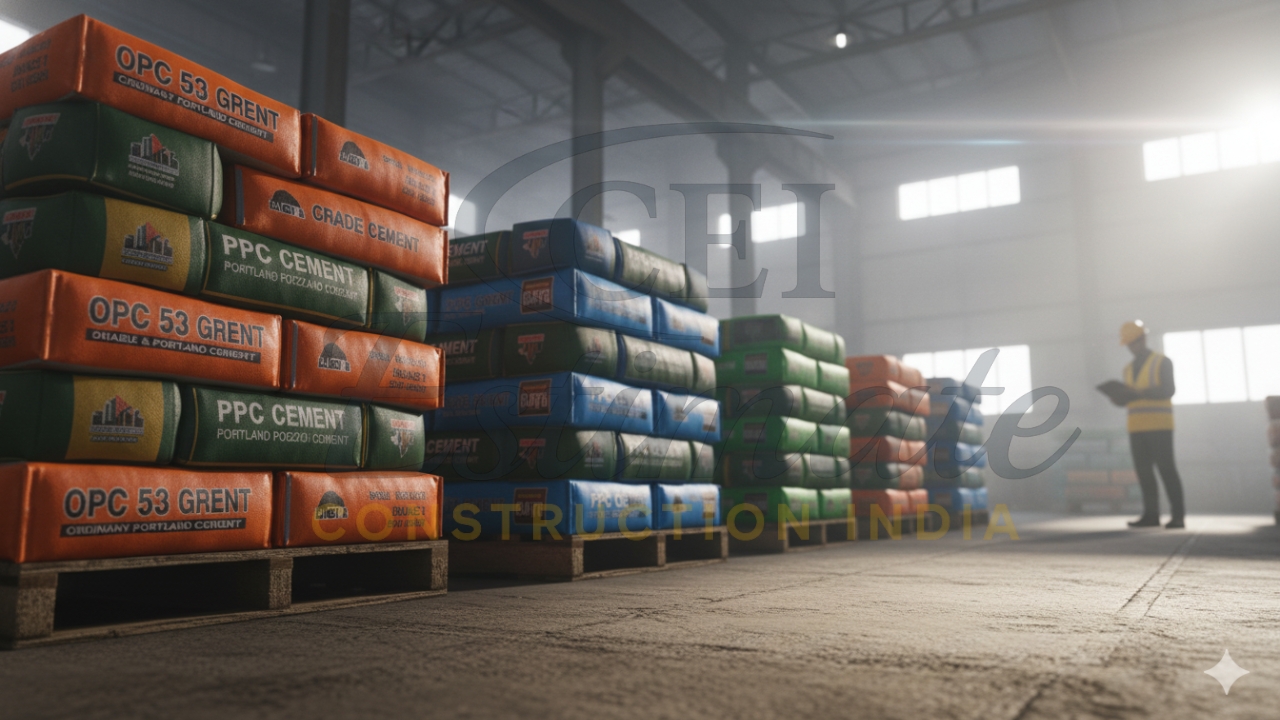
Best Cement Grades for Beam & Lintel Work
Choosing the right grade isn’t just about strength; it’s about when you need that strength and under what conditions.
1. OPC 53 Grade (The Structural King)
- Best For: Main structural beams, lintels in multi-story buildings, and pre-cast elements.
- Why: It achieves high early strength (27 MPa in 7 days, 53 MPa in 28 days). This allows for faster formwork removal (deshuttering), crucial for project timelines.
- Caveat: High heat of hydration. Must be cured rigorously to prevent plastic shrinkage cracks.
2. PPC (Pozzolana Portland Cement)
- Best For: Lintels, non-structural beams, and plinth beams in normal soil conditions.
- Why: The pozzolanic reaction (fly ash) creates a denser matrix, reducing permeability and preventing chloride/sulfate attack. It generates less heat, reducing thermal cracks in mass pours.
- Trade-off: Slower early strength gain. Not ideal if you need to strip formwork in 3-7 days.
3. PSC (PSC – Pozzolana Portland Slag Cement)
- Best For: Coastal regions (high chloride), areas with high water table, or sulfate-rich soil.
- Why: The blast furnace slag provides exceptional sulfate resistance and long-term durability.
4. Composite Cement (IS 16415)
- Best For: General construction where cost and performance must be balanced.
- Why: A blend that offers a middle ground—better workability than pure OPC and better early strength than PPC.
5. OPC 43 Grade (Use with Caution)
- Verdict: Avoid for main structural beams. It is suitable for plastering and masonry but lacks the early strength required for heavy structural beams in multi-story buildings.
Comparison Table: Cement Grades for Beams
| Feature | OPC 53 Grade Cement | PPC (Pozzolana Cement) | PSC (Slag Cement) | Composite Cement (IS 16415) |
|---|---|---|---|---|
| 28-Day Strength | 53 MPa+ | ~33–43 MPa | 43–53 MPa | 33–53 MPa |
| Early Strength | Very High | Low–Medium | Medium | Medium–High |
| Heat of Hydration | High | Low | Very Low | Low–Medium |
| Crack Resistance | Medium (if not cured properly) | High | Very High | High |
| Best Beam Use | Main beams, heavy load structures | Lintels, non-critical beams | Coastal or sulfate-exposed areas | General construction |
| Average Price in India (2026) | ₹400 – ₹520 per bag | ₹360 – ₹450 per bag | ₹370 – ₹480 per bag | ₹350 – ₹460 per bag |
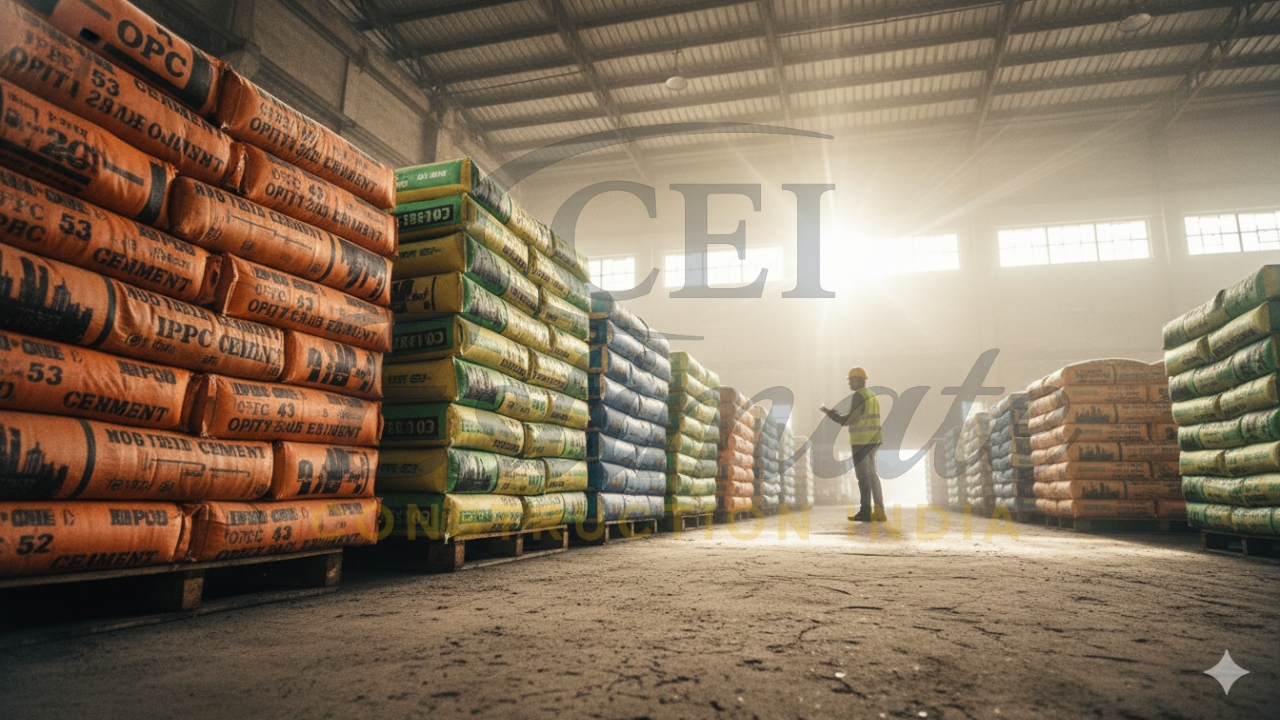
Top 10 Cement Brands for Structural Beams in India 2026
We have analyzed contractor feedback, lab reports, and on-ground performance across India.
- UltraTech OPC 53: The market leader for a reason. Consistent quality, excellent early strength.
- Contractor Feedback: “My go-to for all main beams. Deshuttering at day 7 is safe.”
- Price: ₹450–550/bag.
- Best For: All structural beams in multi-story buildings.
- ACC (Adi Shankar/ACC) OPC 53: Known for superior workability and strong bond with steel.
- Regional: Very strong in North and West.
- Price: ₹440–540/bag.
- Ambuja OPC 53: High workability makes it easy to place in congested beam reinforcement.
- Regional: Popular in North and Central India.
- Price: ₹430–530/bag.
- JK Lakshmi OPC 53: A favorite in North and Central India for its reliability and consistent quality.
- Price: ₹420–520/bag.
- Dalmia OPC 53: Known for high density and low permeability, great for humid climates.
- Price: ₹430–520/bag.
- Wonder Cement OPC 53: Gaining market share for its “non-sag” properties in beams.
- Price: ₹400–500/bag.
- Shree/Bangur OPC 53: Excellent for East and North India, known for smooth finish and strength.
- Price: ₹410–510/bag.
- Heidelberg (Mycem) OPC 53: Reliable performance, good for coastal and high-humidity zones.
- Price: ₹405–500/bag.
- Penna OPC 53: A strong contender in the South, known for durability.
- Price: ₹380–480/bag.
- Birla (MP Birla) OPC 53: Trusted name with consistent quality across India.
- Price: ₹430–520/bag.
Recommended Mix Design & Casting Process for Beams
You can have the best cement, but the mix and execution matter most.
Recommended Mix (M25 Grade for Beams):
- Cement: 400-420 kg/m³ (OPC 53)
- Water-Cement Ratio: 0.40 – 0.45
- Admixture: Superplasticizer (0.5% – 1.5%) to improve workability without adding water.
- Cover: Minimum 25mm for beams (exposed to weather), 20mm for protected beams.
Step-by-Step Casting Best Practices:
- Formwork: Ensure it is rigid. Use 20mm thick planks or steel forms. Apply oil to prevent sticking.
- Reinforcement: Ensure proper cover blocks (25mm for beams).
- Pouring: Pour in layers of 15-20cm. Use a mechanical vibrator for 15-30 seconds per spot to eliminate air voids. Do not over-vibrate or the aggregate will settle and water will rise (segregation).
- Curing: This is non-negotiable.
- Days 1-3:* Keep constantly wet (ponding) or use a curing compound.
- Days 4-14:* Continue moist curing for at least 7 days, ideally 14 days.
- Tip: For beams, curing is harder than slabs. Use wet gunny bags or a continuous misting system.
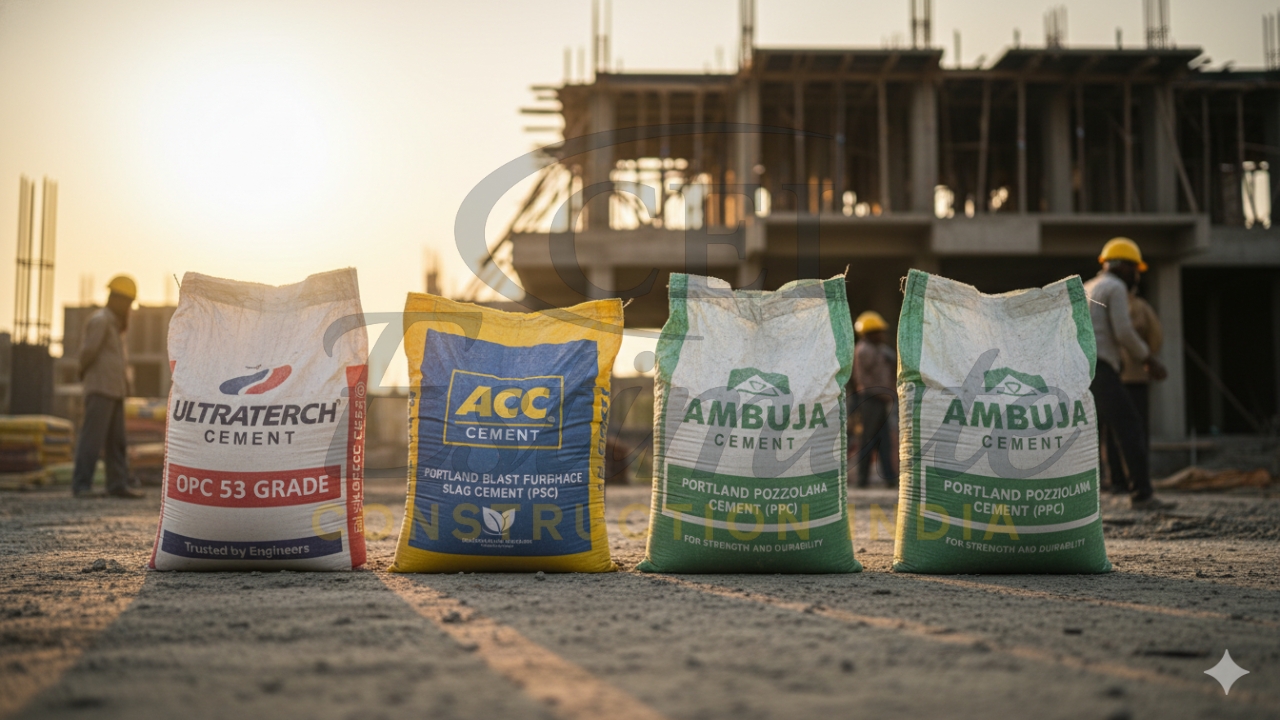
Common Beam Failures & How the Right Cement Prevents Them
| Failure Mode | Cause | Prevention via Cement Choice |
| Shear Cracks | Insufficient tensile strength or poor bond. | Use OPC 53 for high early strength and better steel bond. |
| Thermal Cracks | High heat of hydration in deep beams. | Use PPC or PSC for lower heat generation. |
| Sulfate Attack | Soil moisture attacking the beam (plinth). | Use PSC (Slag) for superior sulfate resistance. |
| Spalling | Corrosion of rebar due to carbonation/chlorides. | Use PSC or PPC for lower permeability and higher durability. |
Cement Consumption Guide for Beams & Lintels
Calculating cement consumption helps in accurate budgeting. The following table assumes an M20-M25 mix.
| Beam Size (Inches) | Length (ft) | Volume (cu.ft) | Cement Bags (50kg) | Notes |
| 9″ x 12″ | 10 | 5.75 | 2.2 | Standard lintel |
| 9″ x 12″ | 20 | 11.5 | 4.5 | Standard lintel |
| 12″ x 15″ | 10 | 12.5 | 4.8 | Heavy beam |
| 12″ x 15″ | 20 | 25.0 | 9.5 | Heavy beam |
| 15″ x 18″ | 10 | 18.75 | 7.0 | Plinth beam |
Note: Approx. 5-6 bags of cement per cubic meter of concrete for M25 mix. This table assumes a standard mix ratio and includes a 5% wastage factor.
Need Free Beam/Lintel BOQ, Mix Design & Material Estimate?
Are you planning to construct a house or renovate? Don’t leave your structural safety to chance. Construction Estimator India offers a Beam & Lintel BOQ (Bill of Quantities), Mix Design, and Material Estimate.
How it works:
- WhatsApp your project details (span, load, location) to +91 8630676890.
- Receive a detailed PDF with exact cement bags, steel weight, and sand/aggregate requirements within 2 hours.
- Get a free 15-minute consultation with a structural engineer to review your beam design.
Don’t let a bad beam ruin your dream home.
FAQ
- Is OPC 53 always the best for beams?
For most structural beams in multi-story buildings, yes, OPC 53 is preferred for its high early strength. However, for lintels or in coastal areas, PPC or PSC might be better for crack resistance and durability. - Can I use PPC for all beams?
For non-critical lintels and plinth beams, yes. For main beams in multi-story buildings, OPC 53 is safer for early strength. - How do I know if my beam is failing?
Look for diagonal cracks near supports (shear), horizontal cracks at the bottom (tension), or rust stains (corrosion). - What is the ideal curing period?
Minimum 7 days, but 14 days is recommended for optimal strength. - Do I need a structural engineer for lintels?
For spans >1.5m or heavy loads, yes. For standard residential lintels, standard detailing usually suffices. - How do I prevent thermal cracks in beams?
Use PPC or PSC, ensure proper curing, and use shrinkage-reducing admixtures. - Can I use the same cement for beams and slabs?
Yes, but ensure the grade matches the structural requirement. Often, OPC 53 is used for both. - How do I check if my cement is good?
Check for the ISI mark, manufacturing date (should be fresh), and ensure it’s free from lumps. - What is the maximum span for a 9″x12″ beam?
For a 9″x12″ beam, a safe span is typically up to 12-15 feet for residential loads, but always consult an engineer. - Is it okay to use PPC for plinth beams?
Yes, PPC is excellent for plinth beams as it offers better durability against ground moisture. - What is the minimum cover for beam reinforcement?
25mm for normal exposure, 40mm for severe exposure. - How long to wait before removing beam formwork?
For beams, typically 21-28 days for full strength, but you can remove side forms in 24-48 hours.
Conclusion
Choosing the right cement for beams and lintels is not just about strength; it’s about safety, durability, and longevity. While OPC 53 remains the gold standard for structural beams, PPC and PSC have their place in specific environments. Always prioritize quality, check for ISI marks, and never compromise on curing.
Ready to build strong and safe?
WhatsApp +91 8630676890 now for your Beam & Lintel BOQ, Mix Design, and Material Estimate. Let Construction Estimator India help you build with confidence and precision.