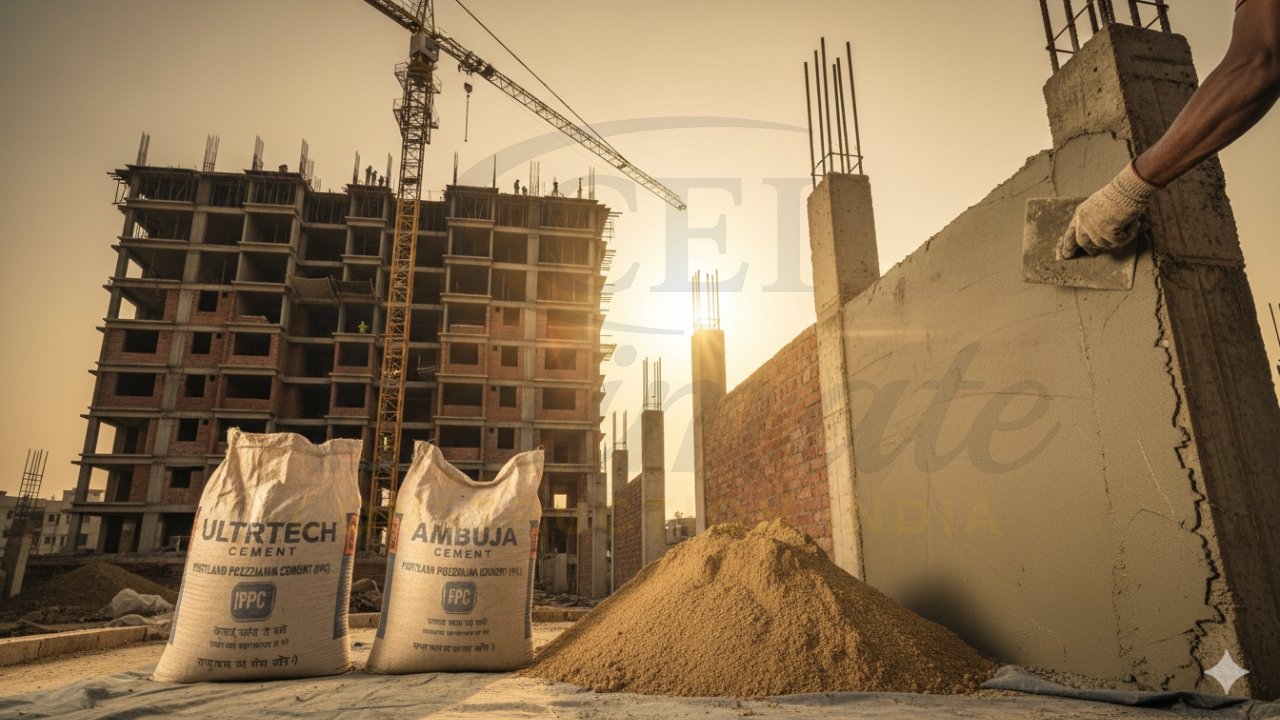
You’ve just completed your RCC structure—strong columns, concrete walls, and slabs—and now you’re ready for plastering. But within months, you notice hairline cracks spreading across the walls, hollow sounds when you tap the surface, and paint peeling off in patches. Sound familiar?
The problem isn’t your mason’s skill—it’s the wrong cement choice for plastering concrete surfaces. Unlike brick walls that absorb water easily, concrete (RCC) is dense and non-porous, demanding a special type of cement that bonds perfectly, shrinks minimally, and delivers that mirror-smooth finish you want. In this complete guide, we’ll reveal the top 10 cement brands specifically proven for crack-free plaster on concrete in 2026, the exact cement type you should use, and how to calculate your material requirement down to the last bag.
Why Cement Choice Is Extra Important for Plaster on Concrete?
Plastering over RCC walls, columns, and concrete blocks is fundamentally different from plastering over brick. Here’s why:
- Low porosity challenge: Concrete has a smooth, dense surface with minimal water absorption. Regular cement plaster struggles to bond properly, leading to delamination (plaster separating from wall) and hollow sounds.
- Shrinkage cracks: Concrete itself shrinks slightly as it cures. If your plaster cement also has high shrinkage, you get a double effect—resulting in those ugly spider-web cracks within 2–3 months.
- Heat generation: Some cements (especially OPC 53 Grade) generate excessive heat during hydration. On concrete surfaces with poor moisture retention, this accelerates drying and causes micro-cracks before the plaster even fully sets.
- Adhesion requirement: You need cement with superior bonding strength to grip the smooth concrete surface. Standard cements often fail this test.
The right cement for concrete plaster must deliver: high adhesion, low shrinkage, excellent workability for smooth trowel finish, good water retention for proper curing, and fine particle size to fill the micro-pores of concrete.
Which Cement Type Is Best for Plastering RCC/Concrete Walls?
Not all cements are created equal. Here’s the definitive breakdown for plaster on concrete surfaces:
| Cement Type | Best For Concrete Plaster? | Key Benefits | Limitations |
| PPC (Portland Pozzolana Cement) | ✅ #1 BEST CHOICE | Finer particles bond excellently to concrete; low heat = minimal shrinkage cracks; pozzolanic reaction fills micro-pores; superior long-term strength; excellent workability; slower setting allows proper finishing | Slightly longer initial setting (not a problem for plaster) |
| PSC (Portland Slag Cement) | ✅ EXCELLENT (especially coastal/humid areas) | Great adhesion; high durability in sulfate soils and high humidity; low shrinkage; smooth finish | Less widely available in some regions |
| Composite Cement (IS 16415) | ✅ GOOD | Balanced properties; decent bonding; economical | Not as fine as PPC; moderate crack resistance |
| OPC 43 Grade | ⚠️ ACCEPTABLE (but not optimal) | Faster setting; good strength | Higher heat & shrinkage than PPC; more prone to hairline cracks on concrete |
| OPC 53 Grade | ❌ AVOID FOR PLASTER | Very high early strength | Too fast setting; generates excessive heat; high shrinkage = maximum crack risk on concrete surfaces |
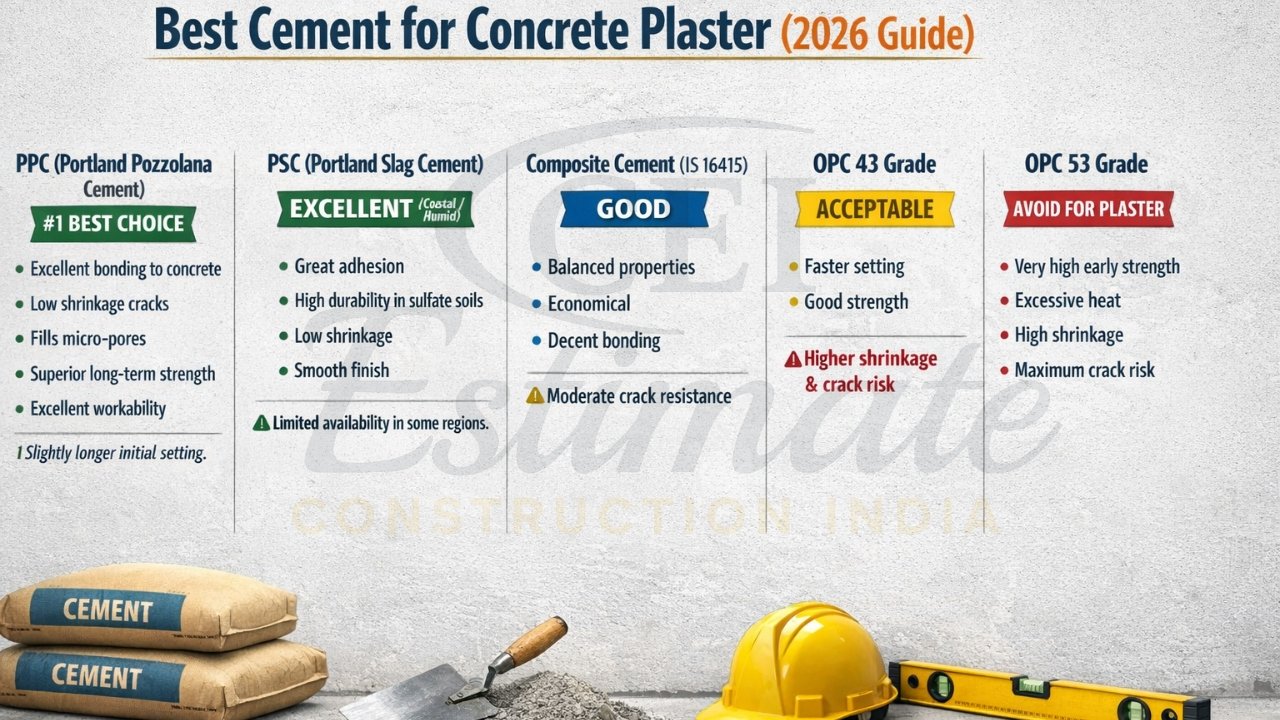
The Clear Winner: PPC Cement
PPC (Portland Pozzolana Cement) is the undisputed champion for plaster on concrete because:
- Finer particle size creates a smoother paste that penetrates concrete’s micro-texture for superior bonding
- Pozzolanic reaction continues over time, filling tiny voids and increasing adhesion strength month after month
- Lower heat of hydration means slower, more controlled curing—the plaster doesn’t dry out too fast, preventing shrinkage cracks
- Better workability gives masons more time to achieve that perfectly smooth trowel finish
- Superior crack resistance due to minimal shrinkage and excellent long-term strength development
💡 Pro Tip: Always ask for PPC cement specifically when purchasing for plaster on RCC walls, columns, or concrete blocks. Don’t let suppliers sell you OPC 53 “because it’s stronger”—strength isn’t what you need here; you need adhesion and crack resistance.
🔥 Need exact cement quantity for your house plaster? Get material estimate + complete BOQ in 10 minutes →
WhatsApp: +91 8630676890
(Send: House area + plastering requirement)
Choose Your Construction Services
Connect with verified experts for your project. We provide professional
General Contractors, Sub-contractors, Builders, and Material Suppliers.
Our network also includes specialized 3D Rendering Developers and Interior Experts.
Top 10 Best Cement Brands for Plaster on Concrete in India 2026
Based on mason feedback across construction sites, laboratory tests, and real-world performance on thousands of RCC projects, here are the most trusted brands:
1. UltraTech PPC / UltraTech Premium Cement
The market leader and first choice of contractors nationwide for concrete plastering.
Why it’s best for concrete plaster:
- Ultra-fine grinding ensures exceptional bonding to smooth concrete surfaces
- Proven track record with minimal shrinkage cracks even in harsh climates
- Excellent workability—masons love the smooth, creamy consistency
- Superior water retention helps proper curing on concrete
Approx Price 2026: ₹420–₹480 per 50 kg bag (varies by region)
Best Regions: Pan-India availability; especially strong in Maharashtra, Karnataka, Gujarat, Rajasthan, Madhya Pradesh
Mason Feedback: “Sets perfectly smooth, no hollow sound, cracks bahut kam” (very few cracks)
2. ACC Gold Water Shield / ACC PPC
Premium quality from the Adani Cement family, specially formulated for superior finish work.
Why it’s best for concrete plaster:
- Water Shield technology provides extra moisture resistance (great for bathroom/kitchen walls)
- Low alkali content reduces efflorescence (white patches) on concrete
- Fine particles give mirror-smooth finish with minimal trowel effort
Approx Price 2026: ₹430–₹490 per 50 kg bag
Best Regions: Strong in South India (Tamil Nadu, Karnataka, Kerala, Andhra Pradesh), Eastern India (Odisha, West Bengal)
Mason Feedback: “Premium feel, paint adhesion ekdum badhiya” (excellent)
3. Ambuja Plus Roof Special / Ambuja PPC
Part of Adani Cement; Roof Special variant is specifically designed for overhead concrete surfaces (slabs, beams).
Why it’s best for concrete plaster:
- Roof Special has enhanced adhesion for overhead plastering of RCC slabs
- Low heat generation prevents thermal cracks on concrete
- Excellent consistency batch after batch
Approx Price 2026: ₹410–₹470 per 50 kg bag
Best Regions: Pan-India; especially popular in Gujarat, Rajasthan, Maharashtra, Delhi NCR, Punjab
Mason Feedback: “Chhath plaster ke liye best hai, crack nahi aata” (best for ceiling plaster, no cracks)
4. JK Lakshmi PPC / JK Super Cement
Trusted brand in North and Central India with decades of proven performance.
Why it’s best for concrete plaster:
- Optimal fineness modulus for smooth finishing on concrete
- Controlled setting time gives masons ample working window
- Good performance in high-temperature regions (Rajasthan, MP, UP)
Approx Price 2026: ₹390–₹450 per 50 kg bag
Best Regions: Rajasthan, Haryana, Punjab, Uttar Pradesh, Madhya Pradesh, Delhi NCR
Mason Feedback: “Value for money, quality consistent rehta hai” (quality remains consistent)
5. Dalmia DSP Cement / Dalmia PPC
Strong regional player with excellent quality control; DSP (Double Super Premium) variant offers enhanced performance.
Why it’s best for concrete plaster:
- DSP has extra-fine particles for superior concrete bonding
- Low shrinkage formula specifically designed for crack-free plastering
- Good in sulfate-prone soils (common in parts of Rajasthan, Haryana)
Approx Price 2026: ₹400–₹460 per 50 kg bag
Best Regions: Tamil Nadu, Andhra Pradesh, Telangana, Karnataka, Odisha, Bihar, Jharkhand
Mason Feedback: “Smooth finish milta hai, cracking issue kam” (smooth finish, less cracking)
6. Wonder PPC Cement
Popular mid-tier brand offering excellent value in Tier-2/3 cities and rural areas.
Why it’s best for concrete plaster:
- Good quality PPC at competitive pricing
- Reliable performance on concrete surfaces
- Widely available through local dealers in smaller towns
Approx Price 2026: ₹380–₹440 per 50 kg bag
Best Regions: Rajasthan, Haryana, Punjab, Uttar Pradesh, Bihar
Mason Feedback: “Budget mein achha option, quality theek hai” (good budget option, decent quality)
7. Shree Cement / Bangur PPC
Major North Indian brand with strong presence and consistent quality.
Why it’s best for concrete plaster:
- Good adhesion properties for concrete substrates
- Minimal shrinkage reduces crack risk
- Reliable supply chain in rural and semi-urban markets
Approx Price 2026: ₹390–₹455 per 50 kg bag
Best Regions: Rajasthan, Haryana, Punjab, Uttar Pradesh, Madhya Pradesh, Chhattisgarh
Mason Feedback: “Bharosemand brand, kaam achha hota hai” (trustworthy brand, work turns out well)
8. HeidelbergCement (Mycem PPC, Penna PPC)
International quality standards with strong presence in South India.
Why it’s best for concrete plaster:
- German technology ensures consistent particle size distribution
- Excellent workability and smooth finishing
- Low efflorescence on concrete surfaces
Approx Price 2026: ₹410–₹470 per 50 kg bag
Best Regions: Andhra Pradesh, Telangana, Karnataka, Tamil Nadu
Mason Feedback: “Premium quality, finishing ekdum smooth” (very smooth finish)
9. India Cements / Coromandel King PPC
Well-established South Indian brand with good technical support.
Why it’s best for concrete plaster:
- Formulated for coastal and high-humidity conditions
- Good bonding strength on concrete
- Economical for large plastering projects
Approx Price 2026: ₹390–₹450 per 50 kg bag
Best Regions: Tamil Nadu, Andhra Pradesh, Telangana, Kerala, Karnataka
Mason Feedback: “Coastal areas mein achha perform karta hai” (performs well in coastal areas)
10. Birla Corporation / MP Birla Perfect Plus / Birla Aerocon (Lightweight Option)
Versatile range including specialized lightweight plaster cement (Aerocon) for reduced dead load on structures.
Why it’s best for concrete plaster:
- Perfect Plus PPC offers good adhesion and workability
- Aerocon is unique lightweight option (reduces structural load while plastering)
- Good consistency in quality
Approx Price 2026: ₹400–₹460 per 50 kg (Perfect Plus); ₹520–₹580 per bag (Aerocon lightweight)
Best Regions: Madhya Pradesh, Chhattisgarh, Uttar Pradesh, Odisha
Mason Feedback: “Lightweight option unique hai, high-rise ke liye achha” (unique lightweight option, good for high-rise)
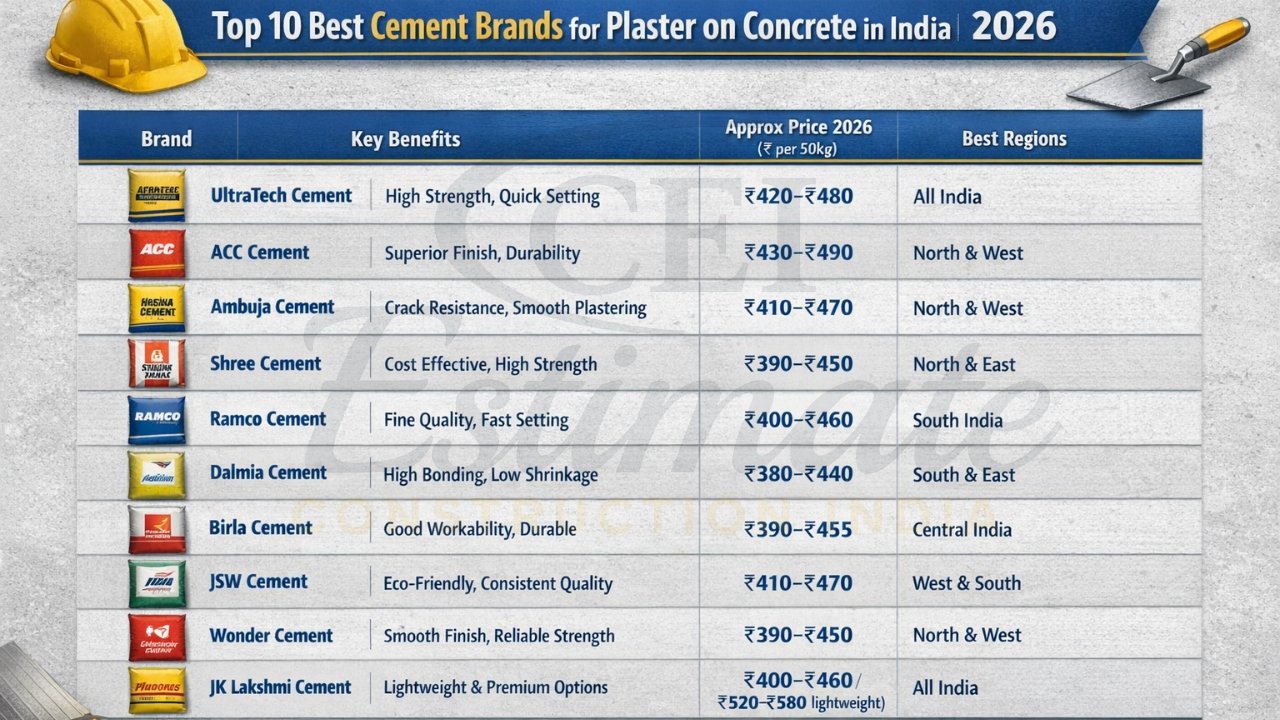
📊 Quick Comparison Table: Best Cement for Concrete Plaster 2026
| Brand | Cement Type | Crack Resistance on Concrete | Workability | Approx Price (50 kg) 2026 | Best Regions |
| UltraTech PPC | PPC | Excellent | Excellent | ₹420–₹480 | Pan-India |
| ACC Gold Water Shield | PPC | Excellent | Excellent | ₹430–₹490 | South, East India |
| Ambuja Plus Roof Special | PPC | Excellent | Excellent | ₹410–₹470 | Pan-India, strong in West/North |
| JK Lakshmi PPC | PPC | Very Good | Very Good | ₹390–₹450 | North, Central India |
| Dalmia DSP | PPC | Very Good | Very Good | ₹400–₹460 | South, East, Central India |
| Wonder PPC | PPC | Good | Good | ₹380–₹440 | North India (budget option) |
| Shree/Bangur PPC | PPC | Very Good | Very Good | ₹390–₹455 | Rajasthan, North India |
| HeidelbergCement Mycem | PPC | Excellent | Excellent | ₹410–₹470 | South India |
| India Cements Coromandel King | PPC | Very Good | Very Good | ₹390–₹450 | South India, coastal areas |
| Birla Perfect Plus | PPC | Good | Good | ₹400–₹460 | Central India |
💬 Get personalized cement brand recommendation for your location + material calculation →
WhatsApp: +91 8630676890
(Tell us your city/district + total wall area to plaster)
How Much Cement Do You Need for Plastering Concrete Walls?
Cement consumption for plaster on concrete is slightly higher than for brick walls because you need a richer mix (more cement) to ensure proper bonding to the dense, non-porous surface.
Standard Cement:Sand Ratios for Concrete Plaster
- For RCC walls, columns, slabs: 1:4 or 1:5 (cement:sand) is ideal
- 1:4 for areas needing extra adhesion (ceiling/overhead plaster, external walls)
- 1:5 for internal walls in dry conditions
- Plaster thickness: Typically 12–20 mm (two coats: 12–15 mm first coat + 8–10 mm second coat for smooth finish)
Cement Consumption per Square Meter
Standard calculation for plaster on concrete:
| Plaster Thickness | Cement:Sand Ratio | Cement Bags per Sq Meter | For 100 Sq Meters |
| 12 mm | 1:4 | 0.16 bags (50 kg) | 16 bags |
| 15 mm | 1:4 | 0.20 bags | 20 bags |
| 18 mm | 1:5 | 0.19 bags | 19 bags |
| 20 mm | 1:5 | 0.22 bags | 22 bags |
Quick Estimation Formula:
For 1:4 ratio plaster:
Cement bags = (Wall area in sq m × Thickness in mm × 0.0133)
For 1:5 ratio plaster:
Cement bags = (Wall area in sq m × Thickness in mm × 0.0106)
Real Example
Let’s say you’re plastering:
- Total RCC wall area: 500 sq meters (typical 1000–1200 sq ft house)
- Plaster thickness: 15 mm
- Ratio: 1:4 (for good concrete bonding)
Cement required = 500 × 0.20 = 100 bags (50 kg each)
At ₹430/bag (UltraTech PPC average) = ₹43,000 for cement alone
Sand required = 100 bags × 4 = 20 cubic feet × 4 = 80 cubic feet ≈ 11.5 brass (1 brass = 100 cubic feet) = ~₹15,000–₹18,000
Total plaster material cost ≈ ₹58,000–₹61,000 (cement + sand + water)
🧮 Don’t guess your material requirement! Get accurate plaster cement quantity + sand quantity + complete BOQ with labor cost →
WhatsApp: +91 8630676890
(We’ll prepare detailed estimate based on your house drawing/measurements)
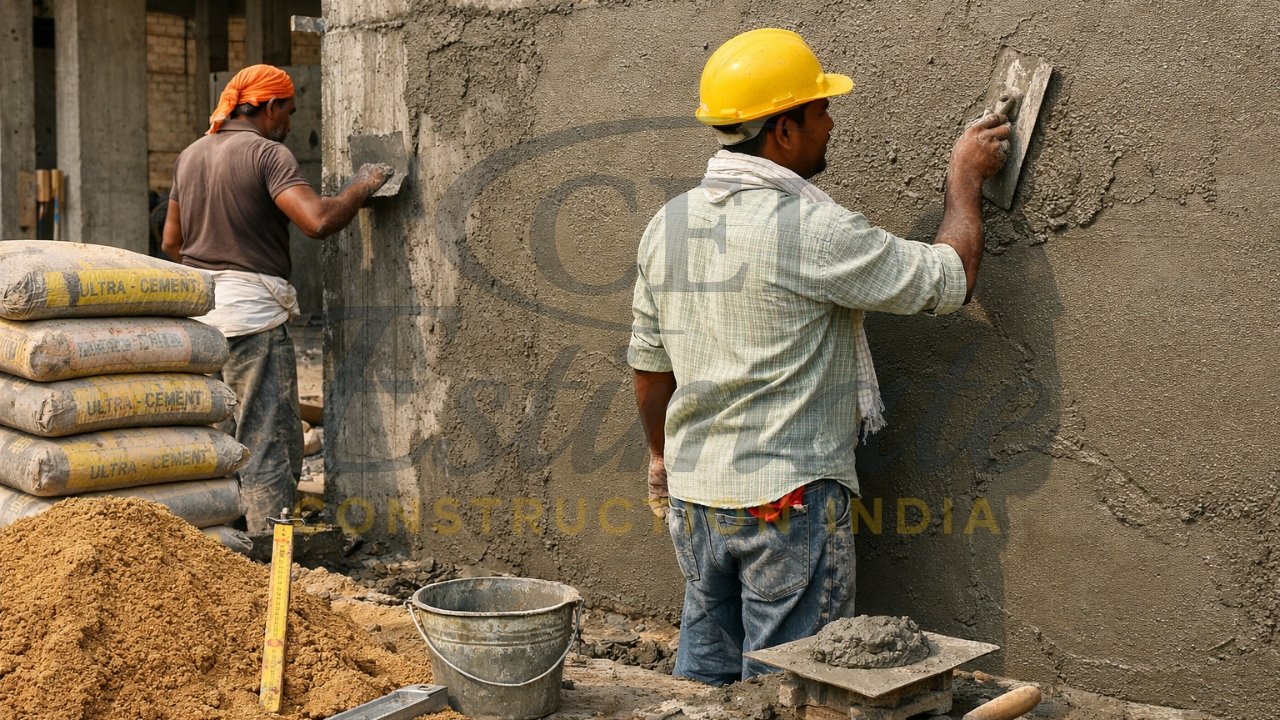
Practical Tips for Crack-Free, Smooth Plaster on Concrete
Getting a perfect plaster finish on RCC surfaces requires more than just good cement—you need the right technique. Here are proven tips from experienced masons:
Before Plastering (Surface Preparation)
- Roughen the concrete surface: Use a bush hammer or chisel to create shallow grooves on smooth RCC walls. This dramatically improves mechanical bonding.
- Clean thoroughly: Remove all dust, loose particles, oil, grease, or formwork release agents. Use wire brush + water wash.
- Apply bonding agent (highly recommended): Use SBR (Styrene Butadiene Rubber) bonding agent or cement slurry (cement + water, 1:1 ratio) before plastering. This creates a bridge between concrete and plaster.
- Dampen the surface: Wet the concrete wall 2–3 hours before plastering (but not dripping wet—just moist). This prevents concrete from sucking water out of fresh plaster too quickly.
During Plastering
- Use correct cement:sand ratio: 1:4 for RCC surfaces (don’t go leaner than 1:5)
- Control water content: Water-cement ratio should be 0.45–0.50. Too much water = weak plaster prone to cracks. Too little = poor workability and bonding.
- Apply in two coats:
- First coat (undercoat): 12–15 mm thick, rough finish with scratched surface (use a comb or nail board). This provides a mechanical key for the second coat.
- Second coat (finish coat): 8–10 mm thick after first coat has set (usually next day). Trowel smooth for final finish.
- Work in manageable sections: Don’t plaster the entire wall in one go—work in 3–4 meter strips to maintain consistent quality and prevent joints.
After Plastering (Curing)
- Start curing within 24 hours: Once plaster has initial set (you can press with finger without leaving mark), start water curing.
- Cure for 10–14 days minimum: This is critical for crack prevention. Wet the plastered surface 3–4 times daily (morning, afternoon, evening). Use jute bags or wet gunny bags for continuous moisture retention.
- Avoid direct sunlight: In summer, hang wet cloth or use shading nets over freshly plastered walls during curing period.
- Prevent rapid drying: Don’t plaster in strong wind or extreme heat (above 40°C). Morning or evening work is best in summer.
Special Tips for Overhead Concrete Plastering (Ceilings/Slabs)
- Use slightly richer mix: 1:3 or 1:4 ratio for better adhesion against gravity
- Apply bonding coat of neat cement paste (cement + water only) just before plastering
- Keep plaster thickness maximum 12–15 mm (avoid thick plaster on ceiling—risk of falling)
- Install chicken mesh for extra safety if plastering over 15 mm thickness
- Cure by keeping wet gunny bags pressed against ceiling for 7 days
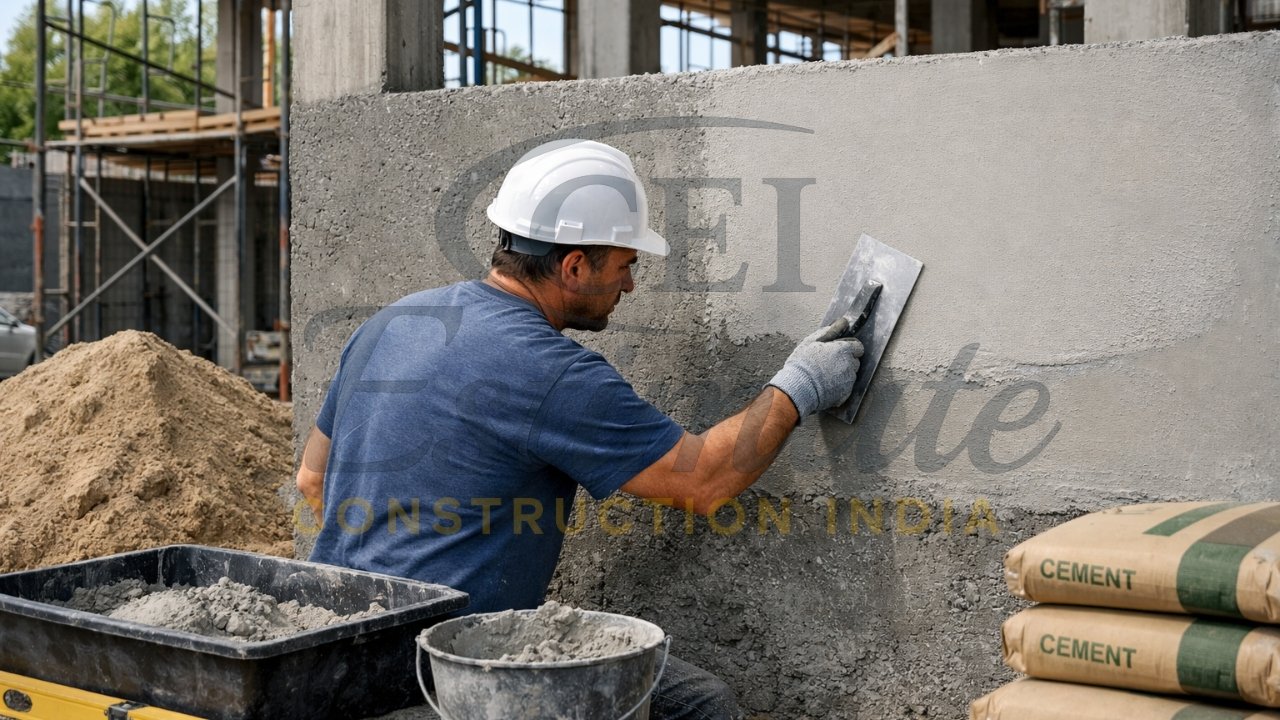
Common Mistakes to Avoid
❌ Using OPC 53 Grade cement for plaster—too much heat, guaranteed cracks
❌ Skipping surface preparation—plaster will delaminate and give hollow sound
❌ Too thick plaster in single coat—causes cracking due to differential shrinkage
❌ Insufficient curing—the #1 reason for hairline cracks within weeks
❌ Plastering on hot surface (after noon in summer)—water evaporates too fast
❌ Using fine sand—causes higher shrinkage; use coarse river sand or manufactured sand
❌ Adding extra water for easy working—weakens plaster significantly
Need Accurate Plaster Material Estimate & Full House Budget?
Planning your house plastering or complete construction project? Don’t rely on rough guesses that lead to material shortage or wastage!
What You Get
✅ Exact cement quantity calculation (based on your wall area, thickness, ratio)
✅ Sand quantity in brass/cubic feet
✅ Complete plaster BOQ (Bill of Quantities) with material breakdown
✅ Labor cost estimation for your city/region
✅ Total plastering cost (material + labor)
✅ Brand-wise comparison for your budget
✅ Full house construction budget (if you’re building new—RCC, brickwork, plaster, finishing, everything)
How It Works?
Step 1: Measure your total wall area to be plastered (or share house drawing if available)
Step 2: WhatsApp the details to +91 8630676890 with:
- Total wall area (sq ft or sq m)
- Internal or external plastering
- Your city/location
- Any specific requirements (bathroom waterproofing, ceiling plaster, etc.)
Step 3: Receive detailed material estimate + BOQ within 10–15 minutes
Step 4: Get supplier recommendations + current market rates in your area
Step 5: Start your plastering with confidence—no material shortfall, no budget overruns!
📲 WhatsApp NOW for Plaster Estimate + Complete House Budget:
+91 8630676890
(8+ years experience | 500+ successful projects | Trusted by contractors & homeowners across India)
Frequently Asked Questions (FAQ)
1. Which cement is best for plastering RCC walls—PPC or OPC?
PPC (Portland Pozzolana Cement) is the clear winner for plaster on RCC/concrete surfaces. PPC has finer particles that bond better to smooth concrete, lower heat generation (less shrinkage cracks), superior workability, and better long-term strength. OPC 43 is acceptable but inferior. Never use OPC 53 for plaster—it causes excessive cracking due to high heat and shrinkage.
2. Why does plaster crack on concrete walls but not on brick walls?
Concrete is dense and non-porous, so plaster doesn’t mechanically key into the surface as it does with porous bricks. Additionally, if you use high-shrinkage cement (like OPC 53) or insufficient curing, the plaster shrinks while trying to bond to rigid concrete—resulting in cracks. Brick walls absorb moisture and allow better bonding, plus they’re slightly flexible. Solution: Use PPC cement, proper surface preparation, bonding agent, and thorough curing for concrete.
3. What is the correct cement:sand ratio for plaster on concrete?
For RCC walls, columns, and concrete blocks, use 1:4 (cement:sand) ratio for best results. This richer mix (more cement than usual 1:6 for brick plaster) ensures excellent adhesion to the smooth concrete surface. For internal walls in normal conditions, you can use 1:5, but never go leaner than that for concrete surfaces.
4. How much does plastering cost per square foot in 2026?
In most parts of India, plastering cost ranges from ₹45–₹75 per sq ft including material and labor (2026 rates):
- Material cost: ₹22–₹35/sq ft (cement + sand)
- Labor cost: ₹23–₹40/sq ft (varies by city—higher in metros, lower in rural areas)
For 1000 sq ft house plastering (internal + external), expect total cost of ₹45,000–₹75,000. Using premium cement brands (UltraTech, ACC) costs 15–20% more than economy brands but saves money long-term by preventing crack repairs.
5. Should I use bonding agent before plastering concrete walls?
Yes, highly recommended. Bonding agents (SBR latex, acrylic polymers) or even a simple cement slurry coat significantly improve plaster adhesion to smooth concrete surfaces. Apply bonding coat 30–60 minutes before plastering. This prevents delamination (hollow sound) and reduces crack risk. Cost is ₹3–₹7 per sq ft but worth every rupee for crack-free results.
6. How long should I cure plaster on concrete walls?
Minimum 10–14 days of continuous water curing is essential for plaster on concrete surfaces. Wet the plastered wall 3–4 times daily (morning, afternoon, evening) or keep wet gunny bags hanging against the wall. Inadequate curing is the #1 cause of hairline cracks. In hot summer months, extend curing to 14–21 days for best results. Don’t rush into painting—wait until plaster is fully cured and dry.
7. Can I use the same cement for brickwork and plaster?
While you can technically use the same PPC cement for both, it’s not ideal. For structural brickwork/RCC, OPC 43 or PPC both work well. But for plaster on concrete specifically, PPC is superior due to its fine particle size, low shrinkage, and excellent bonding properties. If you’re buying cement for both purposes, PPC is the safer universal choice—good for both but may be slightly more expensive than OPC 43.
8. Which cement brand is most economical for large plastering projects?
For large projects where budget is tight but you still want good quality, consider Wonder PPC (₹380–₹440/bag), JK Lakshmi PPC (₹390–₹450/bag), or Shree/Bangur PPC (₹390–₹455/bag). These are 10–15% cheaper than premium brands (UltraTech, ACC) but still deliver decent crack resistance and workability. For small critical areas (drawing room, facade), invest in premium brands; for servant quarters or utility areas, economy brands work fine.
9. Why does my plastered concrete wall sound hollow when I tap it?
Hollow sound indicates delamination—the plaster has separated from the concrete substrate due to poor bonding. Common causes: (1) Concrete surface wasn’t cleaned/roughened before plastering, (2) No bonding coat applied, (3) Wrong cement used (OPC 53 shrinks too much), (4) Insufficient curing. Unfortunately, hollow plaster will eventually crack or fall off. Solution: Chip off hollow areas, prepare surface properly, and re-plaster with PPC cement + bonding agent.
10. Is white cement plaster better than grey cement for concrete walls?
White cement is only for aesthetic finish coat, not primary plaster on concrete. White cement (used in putty, texture finishes) is expensive (₹600–₹800 per 50 kg) and lacks the strength and bonding properties of PPC. Standard process: First apply two coats of PPC grey cement plaster (12–15 mm + 8–10 mm) on concrete, then apply white cement putty (1–2 mm) as final smooth finish before painting. Never use white cement for structural plaster—it will crack and fail.
Conclusion: Choose the Right Cement, Get Crack-Free Walls for Decades
Plastering over RCC/concrete walls demands a different approach than traditional brick plastering. The smooth, dense, non-porous nature of concrete requires cement with superior bonding, minimal shrinkage, excellent workability, and fine particle size—and that cement is PPC (Portland Pozzolana Cement).
Among the top brands available in India 2026, UltraTech PPC, ACC Gold Water Shield, and Ambuja Plus lead the pack for premium crack-free results, while JK Lakshmi, Dalmia DSP, and Wonder PPC offer excellent value for budget-conscious projects. Combine the right cement with proper surface preparation, correct cement:sand ratio (1:4 or 1:5), and thorough 10–14 day curing, and you’ll get smooth, crack-free plaster that lasts 20+ years without peeling, delamination, or hairline cracks.
Remember: spending ₹50–₹80 extra per bag on quality PPC cement today saves you ₹10,000–₹30,000 in crack repair, repainting, and plaster redo work within 2–3 years. It’s not an expense—it’s an investment in your home’s longevity and appearance.
🏗️ Ready to start your plastering project with perfect material planning?
Get Your Detailed Estimate Now:
📲 WhatsApp: +91 8630676890
Share these details:
✔️ Total wall area to plaster (sq ft or sq m)
✔️ Internal + External areas separately
✔️ Your city/location
✔️ Any special requirements (bathroom waterproofing, textured finish, etc.)
You’ll receive within 10 minutes:
✅ Exact cement bags required (with brand options)
✅ Sand quantity in brass
✅ Complete material BOQ
✅ Labor cost for your region
✅ Total project cost breakdown
✅ Full house construction budget (if planning new construction)
Don’t let material guesswork ruin your project budget—get professional estimation!
WhatsApp Now: +91 8630676890