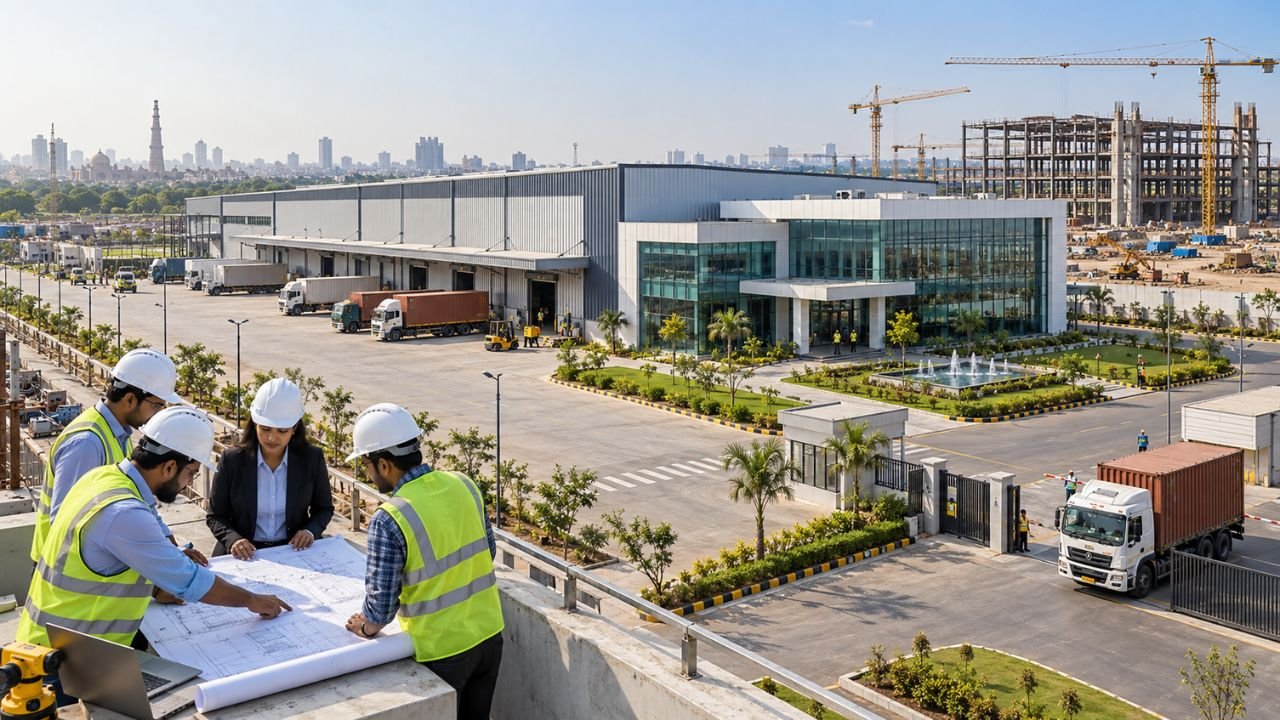
Setting up a production facility in 2026 is an ambitious move within India’s thriving industrial landscape. However, before your machinery begins its first cycle, you must navigate a dense regulatory framework. Understanding the list of licenses required for factory in India is not merely a box-ticking exercise; it is the legal foundation of your business. Operating without the correct approvals—collectively known as “legal oxygen”—can lead to severe penalties, immediate production halts, and the rejection of vital industrial loans.
In the current “Make in India” 2.0 era, while digital single-window portals have streamlined many processes, the sheer volume of factory licenses in India can still overwhelm even seasoned entrepreneurs. Missing even a single approval, such as a Pollution NOC or a Fire Safety clearance, can delay your project by months and lead to massive cost overruns. At Construction Estimator India, we understand that legal compliance and physical construction are inseparable. You cannot secure a building plan sanction without a professional layout, and you cannot get a bank loan without a technical Bill of Quantities (BOQ). This guide provides a comprehensive roadmap for your licensing journey while ensuring your project remains financially viable.
If you need an immediate, accurate civil construction cost estimate or a bank-ready BOQ to support your license applications, WhatsApp our experts at +91 8630676890 for a professional consultation within 24–48 hours.
Why a Complete License Checklist is Critical for Factories
A factory is more than just a building; it is a high-stakes environment involving labor, heavy machinery, and often, hazardous processes. A comprehensive factory license checklist India is critical for three primary reasons:
- Legal Immunity and Safety: Licenses like the Factory License under the Factories Act, 1948, ensure your facility meets safety, health, and welfare standards for workers. Compliance protects you from legal liabilities in case of onsite accidents.
- Financial Accessibility: Most Indian banks and financial institutions will not release industrial loans unless you provide proof of preliminary licenses such as Udyam Registration and the Consent to Establish (CTE) from the Pollution Control Board.
- Operational Continuity: Authorities can seal unauthorized units. Having your approvals required for factory setup in order ensures that your production cycle is never interrupted by sudden inspections or legal notices.
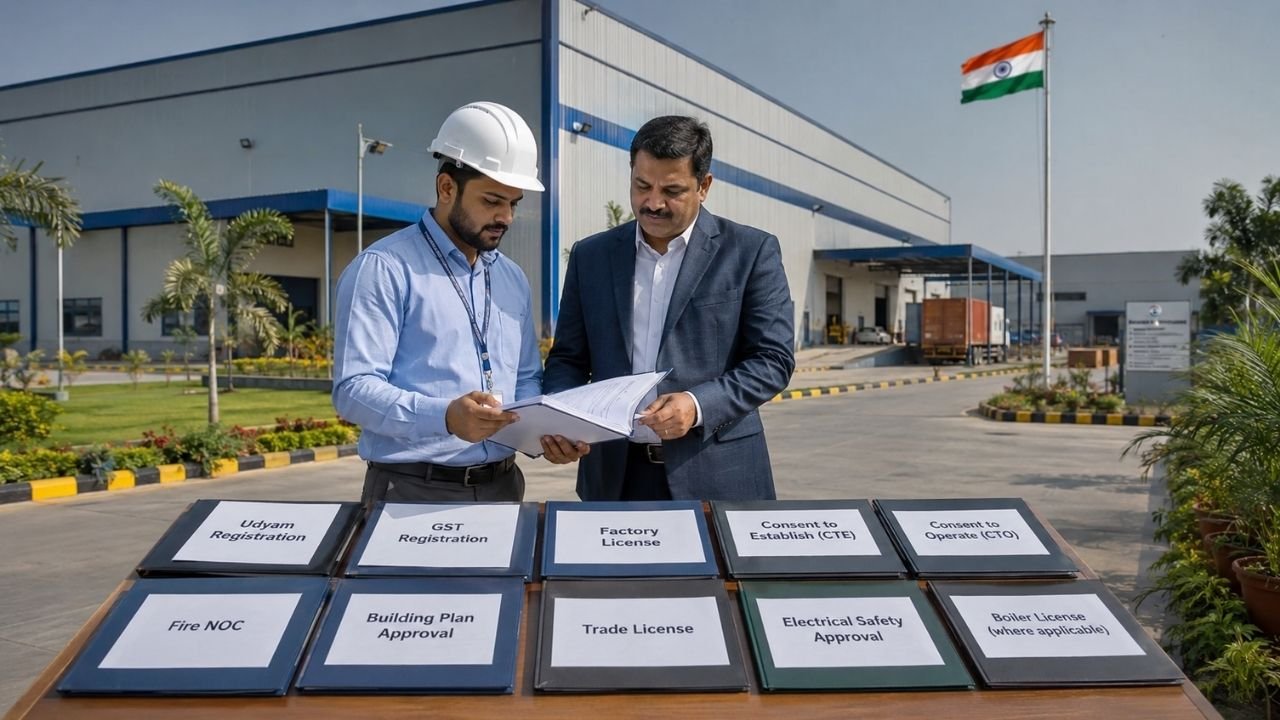
Complete List of Licenses Required for Factory in India
The following is the essential list of licenses required for factory in India that every entrepreneur must secure before and during the setup process.
1. Business Entity Registration
Before seeking industrial approvals, you must have a legal identity. Common structures include a Private Limited Company, LLP, or a Partnership firm. This registration defines the ownership and liability of the factory operations.
2. Udyam (MSME) Registration
This is a cornerstone for manufacturing entrepreneurs. Udyam Registration provides access to government subsidies, priority sector lending at lower interest rates, and protection against delayed payments from buyers.
3. GST Registration
Mandatory for inter-state trade and for any business exceeding the taxable turnover threshold. For manufacturers, GST registration is vital for claiming Input Tax Credit (ITC) on raw materials and high-value machinery.
4. Factory License (Under Factories Act)
Issued by the State’s Chief Inspector of Factories, this is the primary statutory license for factory in India. It is mandatory for units employing 10+ workers (with power) or 20+ workers (without power). It validates your building layout, ventilation, and worker safety protocols.
5. Pollution Control Board Consent (CTE & CTO)
Almost all manufacturing processes require environmental clearance from the State Pollution Control Board (SPCB):
- Consent to Establish (CTE): Obtained before starting any construction on the site.
- Consent to Operate (CTO): Obtained after machinery installation but before production begins.
6. Fire NOC
A mandatory clearance from the fire department ensuring your factory design includes adequate hydrants, fire exits, and extinguishers according to the National Building Code (NBC).
7. Local Authority / Municipal Trade License
While the Factory License covers industrial safety, a Trade License from the local municipality or gram panchayat is often required to legally conduct business within that specific local jurisdiction.
8. Electricity Connection & Load Sanction
Industrial operations require high-tension (HT) or low-tension (LT) power. You must apply to the state electricity board for a sanctioned load that matches your machinery’s total HP/KW requirements.
9. Water Connection / Ground Water NOC
If your process is water-intensive or if you are boring a tube well, you require a No Objection Certificate (NOC) from the Central Ground Water Authority (CGWA) or the local municipal corporation.
10. Industry-Specific Licenses
Depending on what you manufacture, additional licenses required for factory setup may include:
- FSSAI License: For food processing units.
- Drug License: For pharmaceutical manufacturing.
- Explosive License: For units handling hazardous chemicals or gases.
- BIS/ISI Certification: For products requiring mandatory quality standards.
(Image Suggestion: An infographic showing the 10 core licenses for an Indian factory. Alt text: Complete list of licenses required for factory in India 2026)
Which Licenses are Mandatory vs Situation-Specific
Not every factory needs every license. Use this classification to prioritize your applications:
| License / Approval | Requirement Type | Issuing Authority |
|---|---|---|
| Udyam Registration | Mandatory (for benefits) | Ministry of MSME |
| GST Registration | Mandatory (for trade) | Department of Revenue |
| Factory License | Mandatory (based on labor) | State Factory Inspectorate |
| Pollution CTE/CTO | Mandatory (most industries) | State Pollution Control Board |
| FSSAI License | Situation-Specific (Food) | FSSAI |
| Drug License | Situation-Specific (Pharma) | State Drug Controller |
| Ground Water NOC | Situation-Specific (Borewells) | CGWA / Local Body |
Documents Commonly Required Across Most Licenses
Preparing a master folder of these documents will speed up your application for factory licenses in India:
- Land Documents: Registered Sale Deed, Lease Agreement, and the critical Change of Land Use (CLU) certificate if the land was non-industrial.
- Professional Factory Layout: A 2D floor plan showing machinery placement, emergency exits, and utilities.
- Detailed Project Report (DPR): Including a technical Bill of Quantities (BOQ) and civil cost estimate.
- Identity Proofs: PAN, Aadhaar, and photos of all directors/partners.
- Process Flow Chart: A step-by-step description of the manufacturing process.
- Machinery List: Specifications and power load requirements for all equipment.
Recommended Sequence for Applying for Factory Licenses
To avoid delays, follow this logical flow that matches your construction progress:
- Stage 1 (Pre-Construction): Register business entity -> Obtain Udyam & GST -> Secure Land with CLU -> Apply for Consent to Establish (CTE).
- Stage 2 (Design & Approval): Create 2D layout and BOQ -> Submit Building Plan Sanction to local development authority (e.g., UPSIDC, MIDC) -> Apply for Fire NOC.
- Stage 3 (Construction): Execute civil work based on the approved BOQ. Ensure a Stability Certificate is issued by a structural engineer.
- Stage 4 (Pre-Operation): Apply for Consent to Operate (CTO) -> Secure final Factory License -> Apply for power/water connections.
Common Mistakes to Avoid While Obtaining Factory Licenses
Many entrepreneurs face 40% budget overruns due to these errors:
- Starting Construction without CTE: This can lead to heavy environmental fines and orders to demolish unauthorized structures.
- Wrong Industry Categorization: Misclassifying your unit (Red, Orange, Green, White) for pollution can result in the wrong application and rejection.
- Vague BOQs: Relying on “lump sum” contractor quotes instead of a detailed BOQ. This leads to financial shortages that stall the licensing process.
- Retrofitting Safety: Trying to add fire exits or safety zones after construction is 3x more expensive and often delays the Fire NOC.
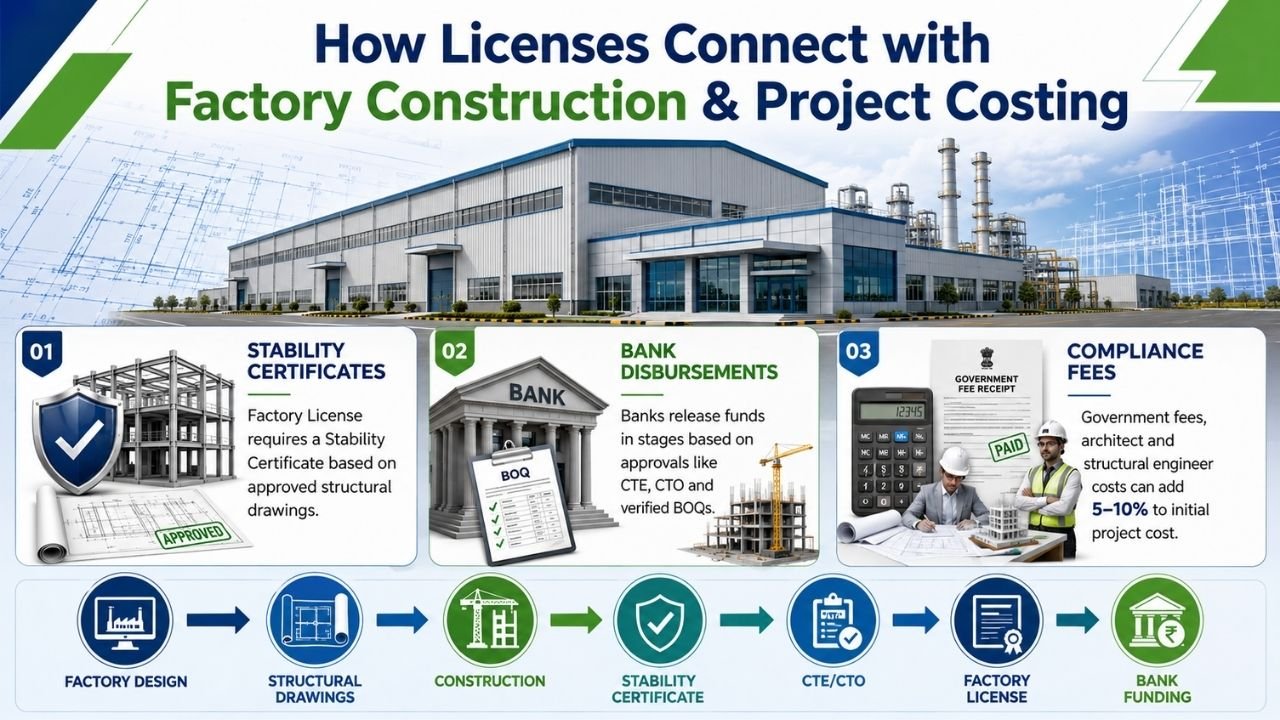
How Licenses Connect with Factory Construction & Project Costing
Licenses and costs are two sides of the same coin. Your approvals required for factory operations directly influence your budget:
- Stability Certificates: You cannot get a Factory License without a Stability Certificate, which requires construction to match approved structural drawings exactly.
- Bank Disbursements: Banks release funds in stages based on your licenses (e.g., CTE for first disbursement, CTO for final) and an accurate BOQ.
- Compliance Fees: Government fees, professional architect charges, and structural engineer fees can add 5–10% to your initial project cost.
How Construction Estimator India Helps Factory Owners During Setup
At Construction Estimator India, we bridge the gap between your industrial vision and a compliant, bank-ready reality.
- Accurate 2026 BOQs: We provide detailed quantity takeoffs based on current market rates for TATA/JSW steel and ACC/Ambuja cement.
- Bank-Ready Reports: Our estimates are accepted by major Indian banks for industrial project financing.
- Material Optimization: We suggest design improvements that can save up to 15% on civil construction costs while maintaining compliance.
- Layout Guidance: We review your 2D plans to ensure they meet NBC safety standards, facilitating faster approval of your factory licenses in India.
Get Complete Factory License Checklist Guidance + Accurate Project Cost Estimate
Don’t leave your manufacturing venture to guesswork. A single error in your licensing or layout can lead to lakhs in rework.
Our Simple 3-Step Process:
- WhatsApp Us: Message your manufacturing type and project details to +91 8630676890.
- Provide Details: Share your plot size, location, and machinery requirements.
- Get Results: Receive professional guidance on the list of licenses required for factory in India and a realistic civil cost estimate/BOQ within 24–48 hours.
Contact Us Now:
WhatsApp / Call: +91 8630676890
Expertise: Accurate Industrial BOQs, Factory Layout Planning, and Cost Estimation 2026.
FAQ: Frequently Asked Questions
- Is a Trade License the same as a Factory License?
No. A Trade License is a general permit from the local municipality, while a Factory License is a specialized industrial approval focused on worker safety and manufacturing standards. - How long does it take to get a complete list of licenses for a factory?
Typically, the journey from CTE to the final Factory License takes 4 to 8 months, depending on your industry category and state-specific portals. - Do I need a Pollution NOC for a “White Category” industry?
Even non-polluting (White Category) industries usually need to notify the SPCB and obtain an acknowledgment, though they may be exempt from the full CTE/CTO process. - Can I build a factory on agricultural land?
No. You must first obtain a Change of Land Use (CLU) certificate. Building on agricultural land without this will result in the rejection of all industrial licenses. - Why do banks demand a BOQ for factory setup?
A Bill of Quantities (BOQ) proves the financial and technical feasibility of your project, ensuring you have calculated the exact funds needed to complete construction. - What is the GST rate on factory construction?
As of 2026, a standard 18% GST is applicable on most construction services and materials in India. - Does a Factory License cover electrical and plumbing?
The license approves the plan for these services. However, the actual electrical load sanction and plumbing installations are separate technical approvals. - Is PEB construction faster for getting licenses?
Yes. Pre-Engineered Buildings (PEB) can be completed 30–50% faster than RCC, allowing you to apply for your Consent to Operate (CTO) and start production much sooner.
Conclusion
Securing the correct list of licenses required for factory in India is the most critical step in safeguarding your industrial investment. By following a structured compliance roadmap—from Udyam registration to the final Factory License—you eliminate legal risks and ensure worker safety. Simultaneously, obtaining an accurate civil construction cost estimate ensures your capital is utilized efficiently without mid-project shortages.
Ready to turn your manufacturing vision into a precision-built, compliant reality? Don’t start with a “rough guess.” Get professional guidance and a bankable BOQ that protects your budget.
WhatsApp Construction Estimator India now at +91 8630676890 for your 2D factory plan guidance and realistic civil cost estimate.