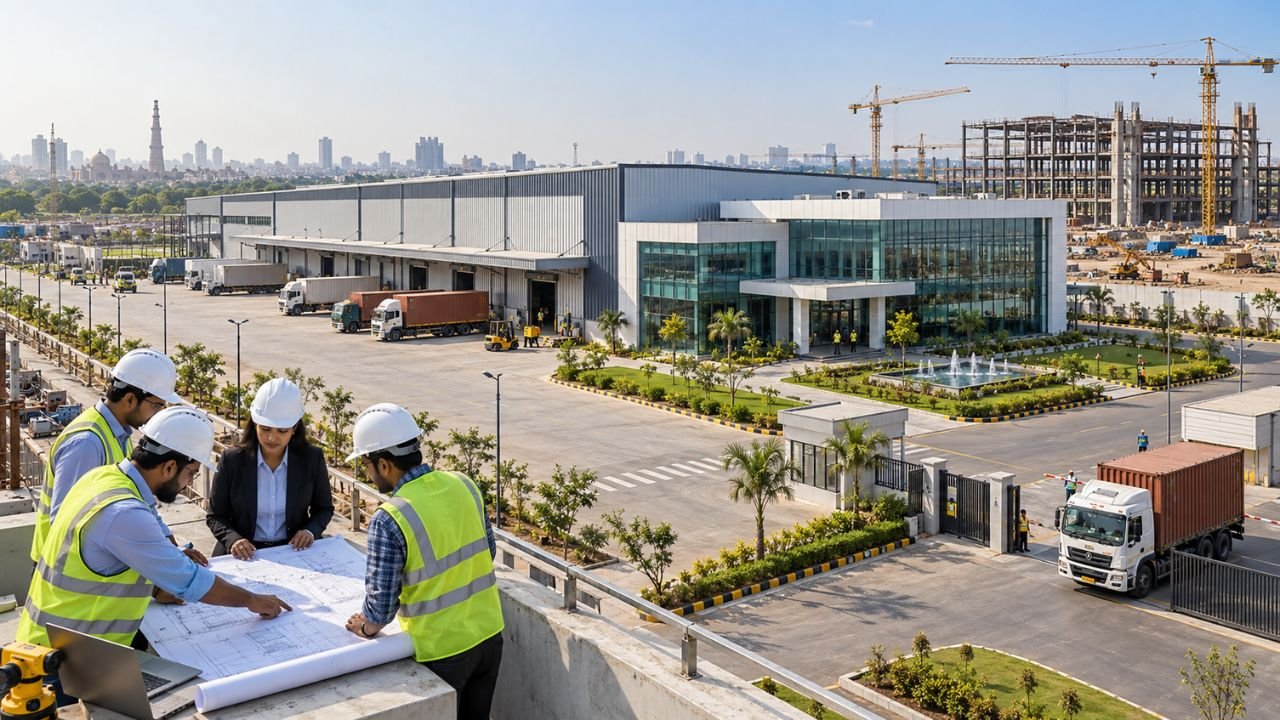
In the rapidly evolving industrial landscape of 2026, setting up a manufacturing unit in India is a high-stakes investment. Whether you are building a factory in the industrial hubs of Uttar Pradesh, Maharashtra, or the Delhi NCR region, navigating environmental compliance is no longer just a legal formality—it is a critical business prerequisite. Understanding how to get noc from pollution control board is the single most important step for any entrepreneur before breaking ground. Without a valid No Objection Certificate (NOC), technically known as “Consent,” your project risks immediate legal shutdowns, heavy environmental compensation fines, and the disconnection of essential utilities like power and water.
The challenge for most factory owners is that the pollution control board noc process is deeply integrated with technical project data, including factory layouts, machinery specifications, and accurate capital investment figures. Many business owners face months of delays simply because their documentation doesn’t align with their physical factory plans or project cost estimates. This guide provides a comprehensive, practical walkthrough of the PCB NOC application process in 2026. At Construction Estimator India, we help you bridge the gap between compliance and construction by providing accurate Bill of Quantities (BOQ) and project cost estimates that ensure your environmental application is both technically sound and financially realistic. Reach out to us at +91 8630676890 for expert guidance on your industrial setup.

What is NOC / Consent from Pollution Control Board?
In India, the “Pollution NOC” is officially termed as Consent. It is a statutory clearance issued by the State Pollution Control Board (SPCB) or Pollution Control Committee (PCC) under the Water (Prevention & Control of Pollution) Act, 1974, and the Air (Prevention & Control of Pollution) Act, 1981. This certificate acts as a legal permit authorizing your industrial unit to operate while ensuring that your emissions, effluents, and noise levels remain within the permissible limits set by the Ministry of Environment, Forest and Climate Change.
Obtaining a pollution NOC for factory operations is mandatory for securing industrial bank loans, electricity connections, and the final Factory License. It serves as a commitment to sustainable manufacturing, where the board monitors your unit’s impact on the local environment.
Types of Consent Issued by Pollution Control Boards (Consent to Establish & Consent to Operate)
The application process is split into two distinct stages. You must understand these to time your factory construction and production start dates correctly.
- Consent to Establish (CTE): This is the primary NOC required before you start any construction work or install machinery. It is based on your proposed site plan, project report, and planned pollution control equipment.
- Consent to Operate (CTO): Once construction is complete and machinery is installed, you must apply for the consent to operate from PCB. This involves a physical inspection by officials to verify that the pollution control systems mentioned in your CTE are functional.
- Consent to Renewal: Most consents are valid for a fixed period and must be renewed before expiry to maintain legal operation.
| Consent Type | When Required | Typical Validity in 2026 |
|---|---|---|
| Consent to Establish (CTE) | Before starting construction or setup | 5 Years (or until commissioning) |
| Consent to Operate (CTO) | After construction, before production | 5, 10, or 15 Years (based on Category) |
Which Industries Need Pollution NOC in India?
Industries are categorized based on their “Pollution Index” score. Identifying your category is the first step in how to apply for pollution NOC.
- Red Category: High pollution potential (e.g., chemical plants, heavy metal processing, large textile units). These require the most detailed technical documentation and frequent inspections.
- Orange Category: Moderate pollution potential (e.g., food processing, pharmaceutical formulations, certain engineering workshops).
- Green Category: Low pollution potential (e.g., assembly units, electronics, small-scale packaging).
- White Category: Practically non-polluting. These units usually do not need a formal CTE/CTO but must submit an online undertaking or “Self-Certification”.
Documents Required for Pollution Control Board NOC Application
A successful application depends on the accuracy of your technical documents. You will typically need:
- Site Plan / Layout Plan: Detailed 2D drawings showing the built-up area and location of machinery, chimneys, and effluent treatment systems.
- Project Report: A technical document detailing your manufacturing process, raw materials, water consumption, and waste generation.
- Proof of Land Ownership: Registered Lease Deed, Sale Deed, or Allotment Letter from industrial authorities (like UPSIDA or MIDC).
- Proof of Capital Investment: A CA-certified document or a professional BOQ showing the total investment in Land, Building, and Machinery. This is critical as your application fees are calculated based on this figure.
- Technical Specs for Pollution Control: Details of Effluent Treatment Plants (ETP) or Air Pollution Control Devices (APCD).
- Udyam Registration & PAN Card: Basic business identity documents.
Step-by-Step Process to Apply for Pollution NOC
In 2026, the process is primarily digital and handled through Single Window Systems (like Nivesh Mitra in UP or MAITRI in Maharashtra) and the SPCB OCMMS portals.
- Registration: Create a profile on the respective state’s single-window portal.
- Unit Profiling: Fill in the Common Application Form (CAF) with your business and industrial plot details.
- Category Selection: Identify if your unit falls under Red, Orange, or Green categories to determine the type of consent to establish pollution control board application needed.
- Filling Technical Details: Enter specific data regarding water consumption, fuel usage, and manufacturing flow.
- Document Upload: Attach your layout plans, project reports, and BOQs.
- Fee Payment: Pay the fees online, which the portal calculates based on your declared Gross Capital Investment.
- Inspection and Query Resolution: Officials may raise queries or schedule a site inspection (mandatory for Red and Orange categories).
- Grant of NOC: Once satisfied, the certificate is issued digitally and can be downloaded.
(Image Position Suggestion: A flowchart of the Online PCB NOC Application Process. Alt text: Step-by-step online process for pollution control board noc application)
Fees, Timeline & Validity of Pollution Consent
- Fees: These are tiered based on the “Gross Capital Investment” (Land + Building + Machinery). Understating this value to save on fees is a major risk, especially if your bank loan figures differ from your PCB filing.
- Timeline: Most boards process applications within 45 to 90 days under “Ease of Doing Business” mandates, though incomplete documentation can cause delays.
- Validity: CTE is usually valid for 5 years or until project commissioning. CTO validity depends on the category: Red (5 years), Orange (10 years), and Green (15 years).
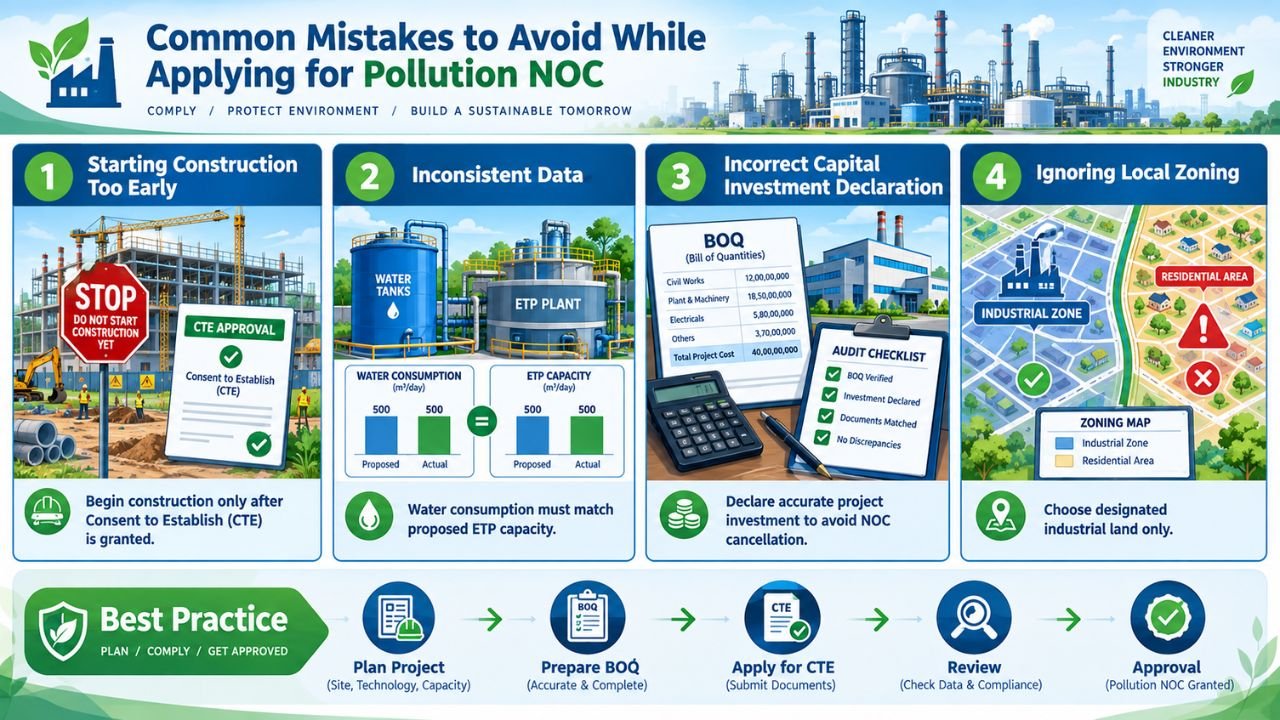
Common Mistakes to Avoid While Applying for Pollution NOC
- Starting Construction Too Early: Physical work or machinery installation should only begin after the CTE is granted.
- Inconsistent Data: Your water consumption figures must match the capacity of the ETP you propose.
- Incorrect Capital Investment Declaration: If the board finds your actual investment is significantly higher than declared during an audit, your NOC can be revoked.
- Ignoring Local Zoning: Ensure your plot is in a designated industrial area; residential zones often lead to immediate rejection.
How Pollution NOC Connects with Factory Construction & Project Costing
Environmental compliance and construction management are two sides of the same coin. Your Consent to Establish dictates how you build your factory. For instance, requirements for specific stack (chimney) heights or dedicated areas for an ETP must be integrated into your initial factory layout and budget.
Adding these facilities as an “afterthought” can increase construction costs by 30-40% due to structural retrofitting. This is why having a professional Bill of Quantities (BOQ) at the start is vital—it ensures all environmental infrastructure is costed correctly from Day 1.
How Construction Estimator India Helps Industrial Units Across India
At Construction Estimator India, we don’t just provide numbers; we provide the technical foundation for your industrial success.
- Accurate Project Costing: We provide detailed estimates for Land, Building, and Machinery, which are essential for your PCB fee calculation and CA certification.
- Technical BOQs: Our Bill of Quantities helps you declare a realistic “Capital Investment,” ensuring your environmental filings match your bank loan documents.
- Layout Review: We analyze your industrial layout to ensure it meets spatial requirements for pollution control equipment, avoiding costly rework.
- Bank-Ready Documentation: Our DPRs and estimates are designed to meet the rigorous standards of Indian banks and state authorities.
Get Pollution Control Board NOC Process Guidance + Accurate Project Cost Estimate
Don’t let compliance hurdles stall your manufacturing vision. Whether you are setting up in Uttar Pradesh, Delhi NCR, Maharashtra, or any other industrial zone, we provide the clarity you need.
Our 3-Step Success Plan:
- Connect: Message us your industry type and location via WhatsApp.
- Detail: Provide your plot size and proposed production capacity.
- Result: Receive professional guidance on your specific PCB NOC category and a realistic construction cost estimate/BOQ within 24–48 hours.
Contact Us for Factory Setup Support
WhatsApp or Call: +91 8630676890
Website: www.constructionestimatorindia.com
FAQ Section
- Is NOC from PCB mandatory for a warehouse?
Yes, if the warehouse handles hazardous materials or has utility requirements like generators, it may require NOC. Even general warehouses often need a “White Category” undertaking. - Can I start construction while the CTE application is pending?
No. Legally, construction or installation of machinery should only begin after the Consent to Establish (CTE) is granted. - How are the application fees calculated?
Fees are tiered based on the “Gross Fixed Assets” (Land + Building + Machinery) without depreciation. - Do I need a separate NOC for water discharge?
The “Consent” (CTE/CTO) covers both Air and Water pollution clearances under a single application in most states. - What is the role of Single Window portals?
Portals like Nivesh Mitra or MAITRI act as the mandatory gateway for submitting your application to the PCB. - What happens if my CTO application is rejected?
You must address the deficiencies mentioned (e.g., ETP capacity or stack height) and re-apply. Operating without a valid CTO is illegal. - How long is a Green category NOC valid?
In 2026, Green category units typically receive a Consent to Operate (CTO) valid for up to 15 years. - Is a professional BOQ necessary for the application?
While a CA certificate is required, a professional BOQ is the best way to ensure your CA has accurate figures for the total project cost. - What is the penalty for operating without Consent?
Penalties include heavy fines, closure of the unit, and disconnection of electricity and water. - Does increasing factory height affect the NOC?
Yes, a change in height affects chimney/stack calculations and structural stability, which must be updated in your technical reports.
Conclusion
Obtaining your pollution control board noc is a critical milestone in your industrial journey. In 2026, the focus is on digital transparency and accurate data. By aligning your application with a professional project cost estimate and layout, you eliminate the risk of rejection and ensure your unit is built for long-term compliance.
Ready to secure your industrial future in India? Get the precision-driven guidance you need to stay on budget and on the right side of the law.
WhatsApp us now at +91 8630676890 for your PCB process guidance and a bank-ready project cost estimate.