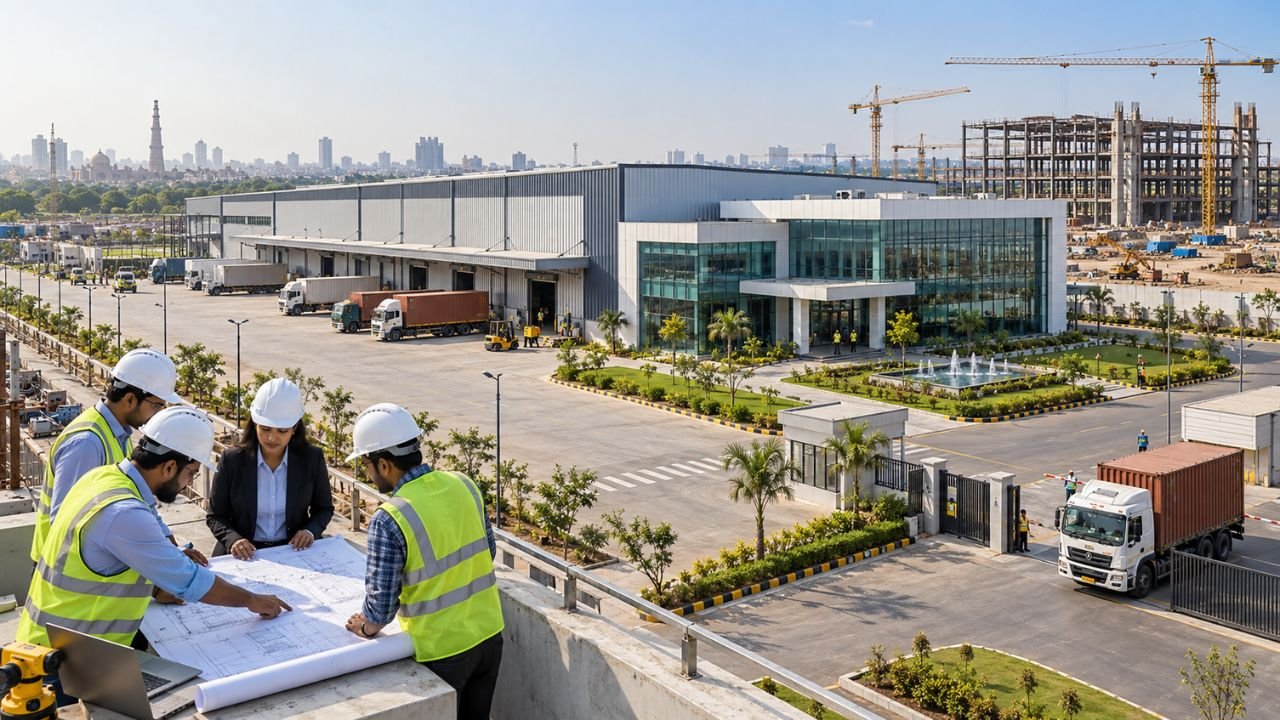
Setting up a factory or a manufacturing unit in Delhi is a high-stakes investment that requires navigating a complex web of legal clearances. In 2026, the industrial landscape in Delhi is governed by strict environmental mandates, making the how to get NOC from pollution control board in Delhi the most critical question for any entrepreneur. Without this No Objection Certificate (NOC), typically issued as “Consent,” your industrial vision can face immediate closure, heavy penalties, or rejection of essential bank loans.
Navigating the Delhi Pollution Control Committee (DPCC) requirements can be overwhelming. Many business owners face delays because they lack a technical roadmap or fail to coordinate their environmental clearances with their factory construction and project costing. This guide provides a practical, step-by-step roadmap for obtaining your pollution control board NOC Delhi. At Construction Estimator India, we bridge the gap between compliance and construction. We help you prepare realistic project cost estimates and detailed Bill of Quantities (BOQ) while you navigate the DPCC consent for manufacturing unit operations, ensuring your project remains financially viable and legally sound.
What is NOC / Consent from Pollution Control Board in Delhi?
In Delhi, the “Pollution NOC” is officially known as “Consent” and is issued by the Delhi Pollution Control Committee (DPCC). This statutory clearance is mandatory under the Water (Prevention and Control of Pollution) Act, 1974, and the Air (Prevention and Control of Pollution) Act, 1981. It ensures that your manufacturing process, whether it involves electronics, textiles, or food processing, adheres to prescribed environmental standards to prevent air, water, and noise pollution.

Obtaining the pollution control board NOC Delhi is a two-stage process designed to monitor an industrial unit from the planning stage through to full-scale operations. Failing to secure these consents before starting physical work or operations is illegal and can lead to the immediate sealing of your unit by authorities.
Types of Consent Issued by DPCC (Consent to Establish & Consent to Operate)
Understanding the distinction between the two types of consent is vital for your project timeline and budget planning.
- Consent to Establish (CTE): This is the primary NOC required before you start any construction work or install machinery. It signifies that the DPCC has reviewed your proposed site, factory layout, and pollution control equipment and granted permission to begin setup.
- Consent to Operate (CTO): Once your factory construction is complete and machinery is installed, you must apply for a DPCC consent to operate. This is mandatory before starting actual production. The DPCC may conduct an inspection to ensure the pollution control measures proposed in the CTE stage are functional and effective.
| Consent Type | When Required | Typical Validity in 2026 |
|---|---|---|
| Consent to Establish (CTE) | Before starting construction or machinery installation | Until project completion (usually 5 years) |
| Consent to Operate (CTO) | Before starting industrial production/operations | 5, 10, or 15 years (based on industry category) |
Which Industries Need Pollution NOC in Delhi?
Not all industries are treated equally by the DPCC. In 2026, the how to apply for pollution NOC Delhi process depends heavily on your industry’s “color categorization,” which is based on the Pollution Index score:
- Red Category: High pollution potential (e.g., large-scale chemical plants, heavy metal industries). These require the most rigorous documentation and frequent renewals.
- Orange Category: Moderate pollution potential (e.g., food processing, certain textile units, pharmaceutical formulations).
- Green Category: Low pollution potential (e.g., small-scale assembly, certain electronics).
- White Category: Practically non-polluting. These units generally do not require a formal NOC but must submit an online undertaking to the DPCC.
Choosing the right category is essential; misclassification can lead to application rejection and wasted fees.
Documents Required for DPCC NOC Application
A professional and complete application is the fastest way to avoid rejections. For a successful DPCC NOC for factory Delhi application, you will typically need:
- Site Plan / Layout Plan: A detailed drawing showing the factory’s physical boundaries and the location of machinery.
- Project Report: A comprehensive document detailing the manufacturing process, raw materials used, and the expected waste generated (effluents/emissions).
- Proof of Ownership: Lease deed, sale deed, or allotment letter for the industrial plot.
- Proof of Capital Investment: A certified document showing the total project cost, including land, building, and machinery. This is where a professional BOQ from Construction Estimator India becomes invaluable.
- Technical Specs of Pollution Control: Details of Effluent Treatment Plants (ETP) or Air Pollution Control Devices (APCD) to be installed.
- Water & Power Connection Proof: Documents showing the source of utilities.
Step-by-Step Process to Apply for Pollution NOC in Delhi
In 2026, the how to get NOC from pollution control board in Delhi process is primarily digital, conducted through the DPCC online portal.
- Online Registration: Create a profile on the DPCC e-governance portal with your industry details.
- Category Selection: Identify if your unit falls under Red, Orange, or Green categories.
- Filling the Application: Complete the Consent to Establish Delhi form with technical details about your production flow and pollution control measures.
- Uploading Documents: Attach all required site plans, ownership proofs, and project reports.
- Payment of Fees: Pay the consent fees online, which are calculated based on your total capital investment.
- Verification & Inspection: DPCC officials review the documents. For Red and Orange categories, a physical site inspection is often mandatory before the DPCC consent for manufacturing unit is granted.
- Issuance of NOC: Once satisfied, the DPCC issues the CTE or CTO digitally.
Fees, Timeline & Validity of DPCC Consent
The financial planning of your industrial unit must account for DPCC fees and timelines.
- Fees: Fees are not flat; they are tiered based on the “Capital Investment on Project” (Fixed Assets like land, building, and machinery). Accurate costing is critical here—if you understate your investment to save on fees, you risk penalties during future audits or bank loan inspections.
- Timeline: A standard pollution NOC for manufacturing unit Delhi can take anywhere from 30 to 90 days depending on the category and the completeness of your documentation.
- Validity: CTE is usually valid for 5 years or until the project is commissioned. CTO validity varies by category (e.g., 5 years for Red, 10 for Orange) and must be renewed before expiry.
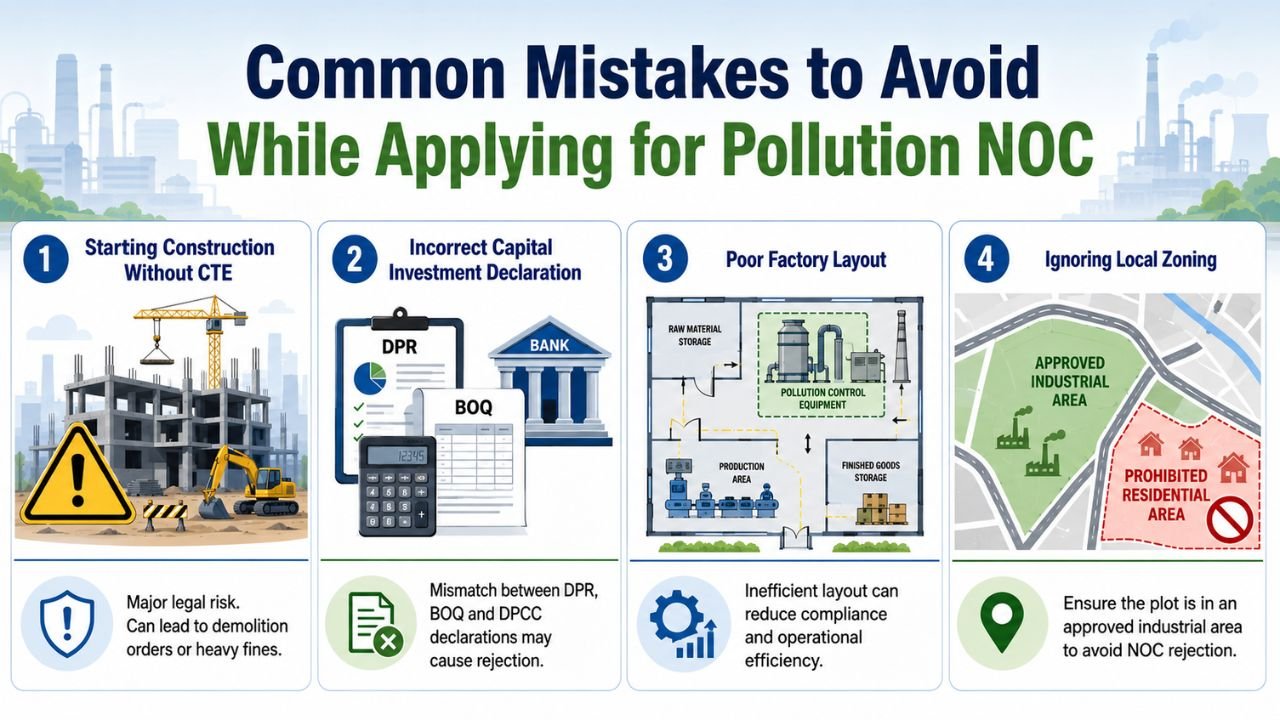
Common Mistakes to Avoid While Applying for Pollution NOC
Many projects in Delhi NCR face budget overruns or delays due to simple errors in the NOC process:
- Starting Construction Without CTE: This is a major legal risk that can lead to demolition orders or heavy fines from the municipal board.
- Incorrect Capital Investment Declaration: Underestimating your project cost can lead to rejection. Banks require a professional DPR and BOQ that match your DPCC declarations.
- Poor Factory Layout: A layout that doesn’t optimize material flow or leaves no room for pollution control equipment can lead to operational inefficiencies.
- Ignoring Local Zoning: Ensure your plot is in a designated industrial area; building in residential zones leads to immediate NOC rejection.
How Pollution NOC Connects with Factory Construction & Project Costing
Environmental compliance is not an isolated step; it is deeply integrated with your factory’s “DNA”.
- Financial Feasibility: Your Pollution NOC application requires a declaration of capital investment. If your estimate is a “guess,” you may face a cash crunch mid-way. A professional Bill of Quantities (BOQ) breaks down every kilogram of steel and bag of cement, providing the only reliable basis for your NOC declaration and bank loan.
- Structural Planning: Installing heavy pollution control machinery requires specific flooring (like VDF) and structural reinforcements. These must be factored into your factory construction cost per sq ft from the beginning.
- Bank Loan Approvals: Banks in 2026 require a Detailed Project Report (DPR) that includes both your technical Consent to Establish and an accurate cost estimate to release funds.
How Construction Estimator India Helps Industrial Units in Delhi NCR
At Construction Estimator India, we specialize in turning industrial visions into data-driven realities. We don’t just provide drawings; we provide bankable financial documents that support your environmental clearances.
- Accurate 2026 Cost Estimates: We provide detailed quantity takeoffs based on current market rates for JSW/TATA steel and labor in Delhi NCR.
- Professional BOQ for NOC: Our BOQs are essential for accurately declaring your capital investment to the DPCC, preventing future legal or financial disputes.
- Factory Layout Review: We analyze your production sequence to ensure your layout is optimized for both efficiency and DPCC compliance.
- Bank-Ready Documentation: Our estimates and DPRs are designed to meet the rigorous standards of major Indian banks for industrial loans.
Get DPCC NOC Process Guidance + Accurate Project Cost Estimate
Don’t leave your industrial investment to guesswork. A single mistake in your how to apply for pollution NOC Delhi strategy or your project costing can lead to lakhs in losses.
Our Simple 3-Step Process to Start:
- Message Us: Share your manufacturing type (e.g., plastic molding, textiles, food processing).
- Provide Details: Tell us your plot size, location in Delhi NCR, and planned machinery.
- Get Results: Receive professional guidance on the DPCC NOC for factory process and a realistic construction cost estimate/BOQ within 24–48 hours.
Contact Us Now
WhatsApp or Call: +91 8630676890
Email: info@constructionestimatorindia.com
Website: www.constructionestimatorindia.com
FAQ Section
- Is it mandatory to get a Pollution NOC for a small factory in Delhi?
Yes, almost all manufacturing units in Delhi require either a Consent (CTE/CTO) or an undertaking (for White category) from the DPCC. - What is the difference between CTE and CTO?
CTE (Consent to Establish) is obtained before construction; CTO (Consent to Operate) is obtained after construction but before production starts. - How are DPCC fees calculated?
Fees are tiered based on the total capital investment (land, building, and machinery) of the project. - Can I apply for a bank loan without a Pollution NOC?
Most banks require at least the Consent to Establish and a professional BOQ to process industrial loans. - How long does it take to get a DPCC NOC in 2026?
Typically 30 to 90 days, provided all documentation like the site plan and project report are accurate. - What happens if I operate my unit without a CTO?
The unit can be sealed, and the owner may face heavy environmental compensation fines or legal action under the Air/Water Acts. - Do I need a professional BOQ for the NOC application?
While not strictly mandatory for the form, a professional BOQ ensures your declared capital investment is accurate and matches your bank loan documents. - Does Construction Estimator India help with the actual filing?
We provide the essential technical data—including accurate cost estimates, BOQs, and layout reviews—that are required for a successful filing. - What is the validity of a Green category CTO?
In Delhi, Green category units often enjoy longer validity periods, typically up to 10 or 15 years, before needing renewal. - How does clear height in a factory affect my budget?
Increasing height (above 30 ft) raises the cost per sq ft due to increased steel weight and wind load, which must be reflected in your project cost declaration.
Conclusion
Obtaining your pollution control board NOC Delhi is the foundation of your business’s physical and legal success in 2026. From selecting the right category to declaring accurate capital investment, every step requires precision. By integrating your DPCC compliance with a professional construction cost estimate, you protect your budget and ensure a smooth path to production.
Ready to secure your industrial future in Delhi NCR? Get the professional guidance and accurate BOQ you need to stay compliant and profitable.
WhatsApp us now at +91 8630676890 for your factory setup guidance and a realistic cost estimate.