The Indian industrial landscape is undergoing a massive transformation. With “Make in India” 2.0 and a booming domestic market, knowing how to start a manufacturing industry is no longer just a business goal—it is a high-stakes investment in one of the world’s fastest-growing economies. However, the journey from a “great idea” to a fully operational factory floor is paved with complexities. Many aspiring entrepreneurs jump into construction or machinery orders without a technical roadmap, only to face congested workflows, missing safety clearances, and massive budget overruns.
In 2026, starting a manufacturing business in India requires more than just capital; it requires precision planning. Whether you are an MSME owner looking to scale or a first-time entrepreneur, you need a clear path through legal registrations, site selection, and most importantly, accurate cost estimation. Without a professional factory 2D plan and a detailed Bill of Quantities (BOQ), you are essentially building in the dark. This guide provides a practical, people-first roadmap to help you navigate the steps to start manufacturing unit operations with financial control and operational efficiency. At Construction Estimator India, we specialize in turning these industrial visions into reality by providing the data-driven foundation you need to succeed.
Why Starting a Manufacturing Industry Still Makes Sense in 2026
India’s manufacturing sector is currently defined by rapid execution, sustainable materials, and “Automation-Ready” structures. In 2026, the shift toward Pre-Engineered Buildings (PEB) and solar-ready roofing has made factory setup faster and more cost-effective than ever before.
- Government Support: Incentives for MSMEs and industrial hubs make it easier to secure land and permits.
- Infrastructure Growth: Improved logistics and power grids reduce the operational hurdles that once plagued Indian manufacturers.
- Cost-Effective Technology: Modern construction methods like PEB can be 20-30% more cost-effective for large spans compared to conventional RCC.
- High Domestic Demand: With a growing middle class, the demand for locally produced electronics, textiles, and food products is at an all-time high.
Learning how to start a manufacturing industry now allows you to leverage these trends while they are at their peak.
Step 1 – Choose the Right Manufacturing Idea / Product
The first step in your manufacturing industry startup guide is product selection. Don’t choose a product based on what everyone else is doing; choose based on market gap and your capability to scale.
- High-Growth Sectors: Look into electronics, EV components, food processing, or sustainable packaging.
- Resource Availability: Ensure you have easy access to raw materials and skilled labor for that specific product.
- Scalability: Can you add a second production line later without demolishing your existing walls?
- Export Potential: In 2026, “local for global” is a key strategy for Indian manufacturers.
Step 2 – Do Market Research & Validate Your Idea
Before investing a single Rupee, you must validate your concept. This involves a deep dive into the supply chain and competitor landscape.
- Supply Chain Analysis: Map out where your raw materials come from and how you will dispatch finished goods.
- Competitor Benchmarking: Understand the pricing and quality standards of existing players.
- Customer Feedback: If possible, get “Letters of Intent” from potential B2B clients to ensure there is a market for your output.
- Feasibility Study: This should include a rough factory layout and cost estimation to see if the project is financially viable.
Step 3 – Complete Legal Registrations & Licenses
Navigating the legal maze is where many entrepreneurs feel most confused. For a manufacturing unit registration in India, you must secure several key documents:
- Business Entity: Register as a Private Limited Company, LLP, or Proprietorship.
- Udyam Registration: Essential for MSMEs to avail of government benefits and industrial loans.
- GST Registration: Mandatory for any manufacturing business with a taxable turnover.
- Factory License: Issued by the Chief Inspector of Factories under the Factories Act.
- Pollution NOC: Consent to Establish (CTE) and Consent to Operate (CTO) from the State Pollution Control Board.
- Fire NOC: Mandatory clearance from the fire department ensuring your layout meets safety standards.
- Building Plan Sanction: Approval from the local development authority before starting construction.
Step 4 – Decide Location & Select Industrial Area
Your location choice directly impacts your long-term operational costs. In India, regional variations in labor and steel transportation can add 10-15% to your budget.
- Proximity to Materials: Being close to steel hubs (like Delhi-NCR or UP) can keep rates competitive.
- Logistics: Ensure the plot has easy access for heavy trucks and proximity to major highways.
- Zoning: You must have “Industrial Land Use” (CLU) permits; building in residential zones leads to heavy penalties.
- Utilities: Check for reliable high-tension (HT) power lines and water supply, as retrofitting these late leads to massive costs.
Step 5 – Plan Factory Layout & Infrastructure
A professional 2D floor plan acts as the DNA of your facility. Knowing how to set up a factory in India starts with optimizing how raw materials enter and how finished goods are dispatched.
- Workflow Optimization: Choose a layout (Linear, U-shaped, or L-shaped) that minimizes material handling time.
- Machinery Footprints: List every machine with its “static” footprint and “dynamic” space for operators and maintenance.
- Aisle Widths: Primary aisles should be at least 3 meters wide for safe forklift movement.
- Safety Zones: Clearly mark fire exits and pedestrian paths to meet National Building Code (NBC) standards.
- Flooring: Use Vacuum Dewatered Flooring (VDF) to prevent cracks from heavy machinery.
Step 6 – Estimate Complete Setup Cost (Land, Building, Machinery, Working Capital)
This is the most critical phase for financial success. In 2026, the average factory construction cost per sq ft in India ranges from ₹1,200 to ₹2,500.
| Setup Stage | Key Activities | Approximate Cost Impact |
|---|---|---|
| Land & Legal | Plot purchase, CLU, GST, Udyam, Licenses | High upfront CAPEX |
| Civil & Structural | Foundation, PEB/RCC Structure, Roofing | 60-70% of building cost |
| Flooring & Fit-out | VDF Flooring, Electrical panels, HVAC, MEP | 15-25% of building cost |
| Machinery | Production equipment, Cranes, Tools | Variable (Sector-specific) |
Key Cost Drivers in 2026:
- Clear Height: Increasing height above 30ft increases wind load and steel weight, raising the cost per sq ft.
- Crane Capacity: Adding a 10-ton EOT crane provision adds ₹250–₹400 per sq ft to structural costs.
- Flooring Type: Standard VDF ranges from ₹180 to ₹350 per sq ft depending on load requirements.
Step 7 – Arrange Finance & Start Construction / Fit-out
Most industrial projects fail their budgets because they rely on “lump sum” quotes from contractors that lead to disputes.
- The BOQ Advantage: A professional Bill of Quantities (BOQ) breaks down every kilogram of steel and cubic meter of concrete, preventing contractor overcharging.
- Bank Loans: Banks require a technical Detailed Project Report (DPR), including a professional 2D layout and certified cost estimate/BOQ.
- Construction: Choose between PEB (Pre-Engineered Buildings), which are 30-50% faster to complete, or conventional RCC for multi-story units.
Common Mistakes to Avoid When Starting a Manufacturing Unit
- Ignoring Soil Bearing Capacity (SBC): Placing heavy machines on weak soil leads to floor cracks and downtime.
- Underestimating Electrical Loads: Factoring in HT/LT panels and transformers too late causes expensive redesigns.
- Neglecting Fire Safety: Retrofitting sprinklers later is 3x more expensive than planning them initially.
- Forgetting Future Expansion: Not designing a modular layout prevents you from adding lines without major demolition.
- Choosing the “Lump Sum” Trap: Vague quotes lead to 40% budget overruns. Always demand a line-item BOQ.
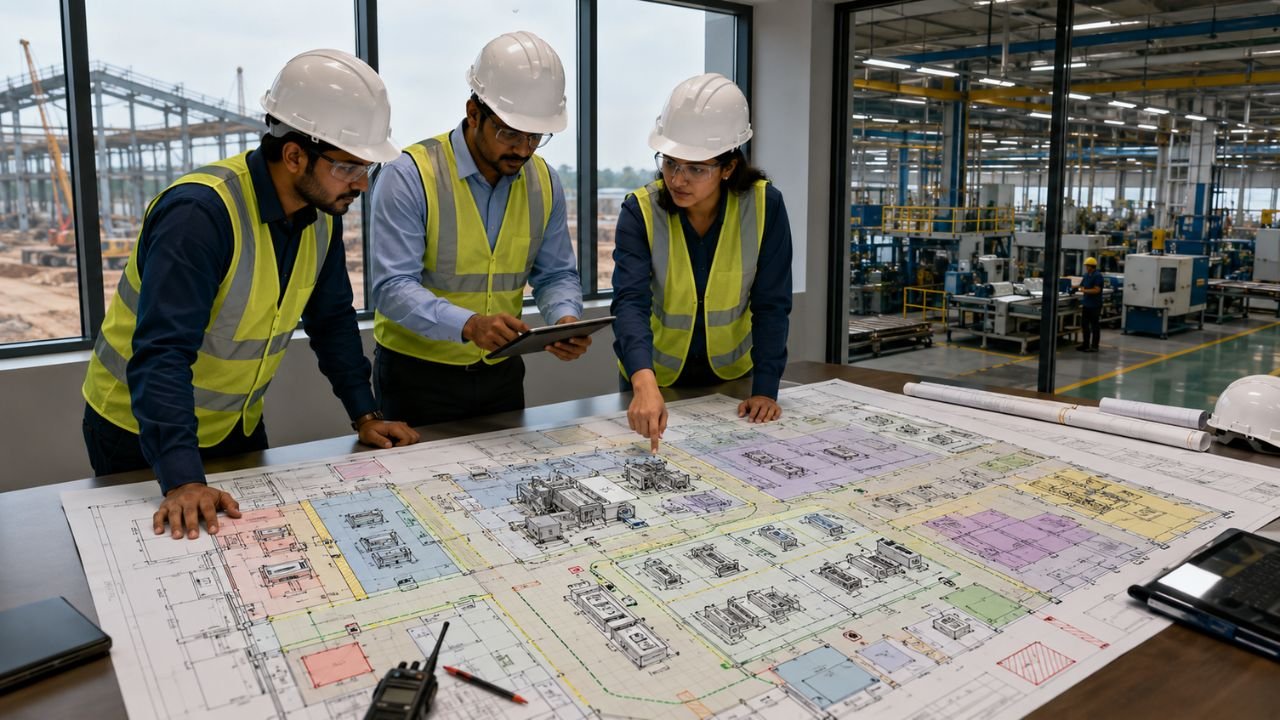
How Construction Estimator India Helps You Start on the Right Track
At Construction Estimator India, we bridge the gap between your industrial vision and a realistic budget. We don’t just give you a drawing; we give you a bankable financial document.
- Practical Layout Review: We analyze your production sequence to suggest improvements that reduce waste.
- Accurate 2026 BOQs: We provide detailed quantity takeoffs based on current market rates for JSW/TATA steel and labor.
- Material Optimization: We help you choose high-strength steel (Grade 345 MPa) to reduce structure weight and cost.
- Bank-Ready Estimates: Our reports are essential for securing industrial loans from major Indian banks.
Get Expert Guidance + Accurate Factory Setup Cost Estimate
Don’t leave your industrial investment to guesswork. A single mistake in your factory layout or cost estimation can cost lakhs in rework.
Our Simple 3-Step Process to Start:
- Message Us: Share your manufacturing type (e.g., plastic molding, textiles, food processing).
- Provide Details: Tell us your approximate plot size, process flow, and location.
- Get Results: Receive professional layout guidance and a realistic construction cost estimate/BOQ within 24–48 hours.
📱 Contact Us Now
WhatsApp or Call: +91 8630676890
Website: www.constructionestimatorindia.com
FAQ Section
- How much does it cost to start a small manufacturing business in India?
In 2026, construction costs for a standard PEB factory range from ₹1,200 to ₹1,850 per sq ft. Total setup cost depends heavily on machinery and land. - Can I use a regular architect for my factory layout?
While they can draw walls, a manufacturing plan requires industrial knowledge of machinery flow, floor loading (VDF), and MEP services specific to production. - Is PEB better than RCC for a manufacturing unit?
Yes, PEB is 20-30% more cost-effective for large spans and offers faster ROI because it is 30-50% faster to build. - What is VDF flooring, and is it necessary?
Vacuum Dewatered Flooring (VDF) increases compressive strength and abrasion resistance, preventing cracks from heavy machinery and forklift traffic. - How do I get a bank loan for my manufacturing startup?
Banks require a professional 2D layout and a detailed Bill of Quantities (BOQ) to ensure the project is financially viable before releasing funds. - What is the standard aisle width for a factory?
Primary aisles should be at least 3 meters (10 feet) for forklifts, while pedestrian paths should be 1–1.5 meters. - How does clear height affect my construction budget?
Higher heights (above 30 ft) increase wind load, requiring thicker steel columns and deeper foundations, which raises the cost per sq ft. - Do I need municipal approval for my factory plan?
Yes, you must obtain a Building Plan Sanction from your local development authority or municipality before starting physical construction. - Why do I need a BOQ if my contractor gave a total price?
“Lump sum” quotes often lead to disputes and hidden costs. A BOQ breaks down every item, ensuring you only pay for what is actually used. - How much contingency fund should I keep?
We recommend keeping 10-15% of the total estimate as a buffer for material price fluctuations or design changes during construction.
Conclusion
Understanding how to start a manufacturing industry in India is the foundation of your business’s physical and financial success. A clear, well-dimensioned, and flow-optimized plan reduces waste and provides the only reliable basis for accurate construction costing. In 2026, don’t rely on “rough guesses” or vague contractor quotes.
Ready to turn your vision into a precision-built reality? Get the professional guidance and accurate BOQ you need to protect your budget and secure your industrial loan.
WhatsApp us now at +91 8630676890 for your factory setup guidance and a realistic cost estimate.