
As a general contractor or a specialty tradesperson, your craftsmanship might be flawless, but before a client ever sees your work on the job site, they see your paperwork. A construction bid is a formal proposal detailing the scope of work, the estimated costs, and the terms of execution for a specific project. It is your first impression, your sales pitch, and the foundation of your future contract.
If you submit a disorganized, confusing document—or worse, an estimate casually typed into the body of an email—you are signaling to the client that your project management might be just as messy. Knowing exactly how to format a construction bid is one of the most critical business skills you can develop. A well-structured bid builds immediate trust, reduces back-and-forth questions, and dramatically increases your chances of winning profitable jobs.
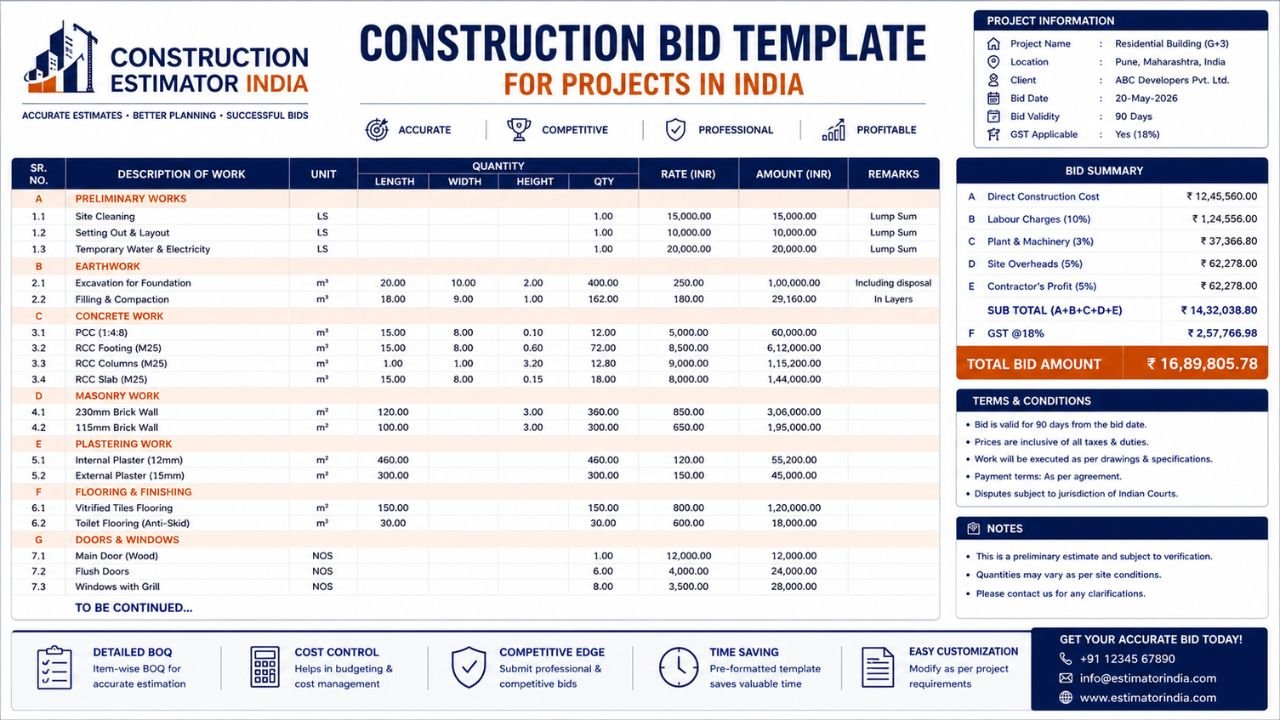
In this comprehensive guide, we will walk you through exactly how to structure, write, and format a professional construction bid from top to bottom.
Why Construction Bid Formatting Matters
When property owners, developers, or General Contractors (GCs) review bids for a project, they are often comparing three to five different proposals. They are looking for the contractor who offers the best value, but they are also looking for clarity.
A standardized construction bid format matters for several key reasons:
-
Easy Comparison: A clean layout allows the client to easily compare your scope of work and pricing against competitors. If they cannot figure out what is included in your base price, they will simply discard your bid.
-
Fewer Disputes: Clear formatting that separates the scope of work from exclusions and assumptions leaves no gray areas. When everyone knows exactly what is (and isn’t) included, you eliminate the risk of mid-project arguments over unbilled work.
-
Professional Branding: A highly organized document signals that you are an organized contractor. It shows you pay attention to detail, which reassures the client that you will apply the same diligence to their physical building.
-
Faster Approvals: When a construction bid proposal flows logically from the project details down to the payment terms and signature lines, clients can review and approve it much faster.
Core Sections Every Construction Bid Should Include
A professional bid is not just a total price at the bottom of a page. To protect your business and inform your client, your layout must include specific, distinctly separated sections. Here is a breakdown of the core elements every construction bid should include:
1. Bid Heading and Project Identification
The top of your document should immediately identify what the document is and what project it relates to.
-
Document Title: Clearly state “Construction Bid,” “Estimate,” or “Proposal” at the top.
-
Project Name: (e.g., “Smith Residence Kitchen Remodel” or “Downtown Office Fit-Out”).
-
Project Address: The physical location of the job site.
-
Date & Proposal Number: The date the bid is submitted and a unique tracking number for your records.
2. Client and Contractor Information
Create two distinct blocks of contact information.
-
Contractor Info: Your company name, logo, physical address, phone number, email address, and contractor license number.
-
Client Info: The property owner, developer, or GC’s name, address, phone, and email.
3. Scope of Work (Narrative)
This is the heart of your bid. Do not just write “Build new addition.” Break down the exact work you are going to perform. For residential or light commercial jobs, write this in simple, easy-to-understand language. Group the work by trade (e.g., Demolition, Framing, Electrical, Plumbing) or by project phase. Detail the materials to be used, the finishes, and the specific areas where the work will occur.
4. Cost Breakdown / Pricing
Your pricing section should be easy to read. Depending on the project requirements, you can format this in a few ways:
-
Base Bid: A lump-sum total for the entire scope of work.
-
Line Item Pricing: A breakdown showing costs for individual trades or phases.
-
Allowances: Specific budget placeholders for items the client hasn’t chosen yet (e.g., “$5,000 allowance for custom light fixtures”).
-
Alternates & Unit Prices: Separate line items for optional upgrades (e.g., “Add $2,500 for quartz countertops instead of granite”) or unit costs (e.g., “$15 per square foot for extra rock excavation”).
👉Buy Professional Construction BID Template at 299 INR only
5. Exclusions and Assumptions
This section is just as important as your scope of work. Explicitly list what you are not doing.
-
Exclusions: (e.g., “Excludes asbestos testing and removal,” “Excludes landscaping,” or “Owner to supply all plumbing fixtures”).
-
Assumptions: State the conditions your price relies on (e.g., “Assumes existing electrical panel has sufficient capacity for new HVAC load” or “Assumes free and clear access to the site during normal working hours”).
6. Schedule and Timeline
Clients need to know how long the disruption will last. You do not need to provide a daily Gantt chart at the bidding stage, but you should include:
-
Estimated start date (e.g., “Two weeks from contract signing and permit approval”).
-
Estimated duration or completion date (e.g., “Project to take approximately 8 to 10 weeks”).
-
Major milestones if applicable.
7. Payment Terms
Tell the client exactly how and when you expect to be paid. Good formatting here prevents cash flow problems later.
-
Deposit: (e.g., “20% due upon contract signing”).
-
Progress Payments: (e.g., “Monthly billing based on percentage of completion” or milestone payments like “30% upon completion of rough framing”).
-
Retainage & Final Payment: (e.g., “Final 10% due upon substantial completion and final walkthrough”).
8. Bid Validity and Conditions
Material prices change, and your schedule fills up. You must put an expiration date on your offer.
-
Validity: “This bid is valid for 30 days from the date of submission.”
-
Escalation Clauses: A brief note stating that sudden, extreme spikes in material costs (like lumber or steel) may require a price adjustment before contract signing.
9. Signature and Acceptance Section
Provide a clean space at the bottom of the document to turn this bid into an active agreement.
-
Include a short acceptance statement: “By signing below, the client agrees to the scope of work, pricing, and terms outlined in this proposal.”
-
Lines for Client Signature, Printed Name, and Date.
-
Lines for Contractor Signature, Printed Name, and Date.
Step-by-Step: How to Format a Construction Bid from Scratch
If you are wondering exactly how to write a construction bid, the key is to separate your internal estimating math from the external presentation. Here is a step-by-step process for building your document:
Step 1: Gather Project Documents
Before formatting anything, review the architectural drawings, engineering specifications, and any addenda. Ensure you understand the complete scope.
Step 2: Build Your Estimate (The Math)
Use your internal spreadsheets to calculate material takeoffs, labor hours, equipment rentals, subcontractor quotes, overhead, and your profit margin. Do not put this messy math directly into the bid; keep it internal.
Step 3: Decide on Your Bid Structure
Will this be a lump-sum bid or an itemized bid? If the client requested a specific breakdown, follow their format strictly. If it is up to you, group your work logically—usually chronological (from foundation to roof) or by trade.
Step 4: Draft Your Scope and Exclusions
Open your document and type out the narrative. Be highly specific in the scope section. Then, create a separate heading for Exclusions and Assumptions. Never mix what you are doing with what you aren’t doing in the same paragraph.
Step 5: Insert Your Pricing Table
Format a clean table or a bulleted list for your pricing. Make sure the Base Bid amount is in bold and easy to find at a glance. Place any Alternates or Allowances distinctly below the base price.
Step 6: Add Logistics and Terms
Paste in your standard boilerplate text for the schedule, payment terms, and bid validity. Customize the dates and percentages to fit this specific project.
Step 7: Review and Finalize
Read through the entire document. Check the math one last time. Ensure that your fonts and headings are consistent, and that the document flows logically.
Example Construction Bid Format (Copy-Ready Outline)
👉Buy Professional Construction BID Template at 299 INR only
If you are setting up your own document, you can use the following text-based outline as a blueprint.
[YOUR COMPANY LOGO]
CONSTRUCTION BID / PROPOSAL
Date: [Submission Date]
Proposal No: [000-123]
PREPARED FOR:
[Client Name]
[Client Address]
[Phone Number]
[Email Address]
PROJECT DETAILS:
[Project Name]
[Job Site Address]
1. SCOPE OF WORK:
We propose to furnish all materials, labor, and equipment necessary to complete the following work:
-
Demolition: [Details…]
-
Framing: [Details…]
-
Electrical: [Details…]
-
Finishes: [Details…]
2. PRICING & COST BREAKDOWN:
-
Base Scope of Work: $[Amount]
-
Allowance: Custom Cabinetry – $[Amount]
-
Alternate 1: Upgrade to Hardwood Flooring – Add $[Amount]TOTAL BASE BID: $[Total Amount]
3. EXCLUSIONS & ASSUMPTIONS:
-
Excludes [Item 1]
-
Excludes [Item 2]
-
Assumes [Condition 1]
4. PROJECT SCHEDULE:
-
Estimated Start Date: [Date/Condition]
-
Estimated Duration: [Weeks/Months]
5. PAYMENT TERMS:
-
[Percentage]% Deposit upon signing.
-
[Percentage]% Upon completion of rough-in.
-
[Percentage]% Upon final walkthrough and approval.
6. BID VALIDITY:
This proposal is valid for [30/60] days from the date issued above.
7. ACCEPTANCE OF PROPOSAL:
By signing below, the client authorizes the contractor to proceed with the work as outlined above based on the stated pricing and terms.
Client Signature: ______________________ Date: __________
Contractor Signature: _________________ Date: __________
Formatting Tips for Excel, Word and PDF Bids
The software you use dictates how professional your construction bid format will look.
Using Word for Narrative:
Microsoft Word or Google Docs is excellent for residential and light commercial bids because it handles text narratives beautifully. Use standard, easy-to-read fonts like Arial, Calibri, or Helvetica at 11 or 12-point sizes. Use Bold text for your section headers so the client can easily skim the document.
Using Excel for Pricing Tables:
If your bid requires a highly detailed line-item breakdown (often requested by commercial GCs), Excel is your best friend. It prevents math errors. However, raw Excel grids can look ugly. Turn off the gridlines before printing, bold your total rows, and ensure your column widths are neat.
Always Convert to PDF:
Never send a client an editable Word document or Excel file. Someone could accidentally (or intentionally) alter a price, change a scope item, or delete a crucial exclusion. Once your format is perfect, “Save As PDF” or “Print to PDF.” A PDF locks your formatting in place, ensures it looks identical on any device, and protects your legal phrasing.
Common Mistakes to Avoid When Formatting a Construction Bid
Even experienced contractors make formatting errors that cost them jobs. Here are the most common mistakes and how to fix them:
-
Mistake: Mixing Scope and Exclusions. Burying an exclusion in the middle of a thick paragraph about framing makes it impossible to read.
-
Fix: Give exclusions their own dedicated, bolded heading. Use bullet points.
-
-
Mistake: Not Listing Alternates Separately. Lumping optional upgrades into the base price makes your bid look artificially expensive compared to competitors.
-
Fix: Keep the base bid lean and list upgrades as separate, optional line items at the bottom of the pricing section.
-
-
Mistake: Hiding Assumptions. If your low price relies on the owner moving their own furniture, or the site having existing 220v power, you must state it.
-
Fix: Create a bolded “Assumptions” list right below your exclusions.
-
-
Mistake: Forgetting Bid Validity. Sending an open-ended bid means a client could call you a year from now and demand you honor a price that was based on last year’s material costs.
-
Fix: Make the 30-day validity clause a permanent fixture in your template.
-
-
Mistake: Messy Aesthetics. Different fonts, varying text sizes, and misaligned margins look careless.
-
Fix: Use the “Format Painter” tool in Word to ensure all your headings and body text match perfectly.
-
Using Templates to Speed Up Construction Bid Formatting
Drafting a highly detailed bid from scratch every single time you price a job is an inefficient use of your time. The secret to fast, accurate, and professional proposals is creating a master construction bid template.
Spend a few hours creating a flawless layout in Word or your preferred software. Insert your logo, set your fonts, and write out all the standard boilerplate text (Payment Terms, Validity, Signature lines) that rarely changes from job to job. Leave blank brackets like
[Insert Scope Here] and [Insert Total Price] where the project-specific details go.Whenever you win a new opportunity, simply duplicate your master template, fill in the blanks, and save it as a new PDF. Not only does this save you hours of formatting per week, but it also ensures you never accidentally forget to include a crucial legal clause or a signature line.
Conclusion: Make Your Bid Easy to Read, Easy to Accept
Learning exactly how to format a construction bid is not just an administrative chore; it is a vital part of your sales and risk management strategy. A sloppy bid leaves money on the table, invites scope creep, and frustrates clients.
By utilizing a structured layout that clearly defines the scope, separates the pricing, highlights exclusions, and lays out transparent terms, you demonstrate ultimate professionalism. Treat your bid format as a direct reflection of your physical craftsmanship. When your paperwork is organized, accurate, and easy to read, clients will feel confident that your construction management will be exactly the same—making it incredibly easy for them to sign on the dotted line.