
If you’ve asked three Quantity Surveyors how they charge for BOQ preparation, you’ve probably gotten three different answers — and three very different invoices. Some quote per square foot. Some quote a percentage of your project value. Some hand you a flat lump sum and walk away. None of them are “wrong” — but one of them is almost certainly wrong for your project.
At Construction Estimator India, we’ve prepared Bills of Quantities for over 500 residential, commercial and industrial projects across Uttarakhand, UP, Delhi-NCR, Gujarat and other major states. In that time, we’ve quoted — and been asked to match — every fee model in this article. This guide breaks down exactly how each one works, where it saves you money, where it can quietly cost you more, and how to pick the right one before you sign a contract.
Per Sq Ft fee structures work best for straightforward residential projects with predictable layouts. Percentage-based fees suit large or evolving commercial and industrial projects where scope may shift. Lump sum fees are ideal when you want zero billing surprises on a well-defined, fixed-scope project. For transparent BOQ preparation fee structures, professional estimation or Excel BOQ Template across India, WhatsApp or call us today at +91 8630676890.
📞 Buy the BOQ Preparation Fee Structure Template today and streamline your estimating services.
What Are BOQ Preparation Fee Structures?
A BOQ preparation fee structure is simply the method a Quantity Surveyor or estimation firm uses to calculate what they charge you for preparing your Bill of Quantities — the detailed, itemized document that lists every material, labor activity and quantity needed to complete your construction project.
In India, three fee models dominate the market in 2026:
- Per Sq Ft — a rate multiplied by your total built-up area
- Percentage (%) — a percentage of your total estimated or contracted project value
- Lump Sum — a single fixed fee agreed upfront, regardless of area or value
Each model shifts risk differently between you and your estimator. Understanding that risk shift — not just the headline number — is what separates a good decision from an expensive mistake. This is exactly why BOQ Preparation Fee Structures deserve more scrutiny than most homeowners and contractors give them.
We follow standard practices for BOQ preparation fees in India 2026 across every project we take on, so clients always know how a quote was arrived at, not just what the final number is.
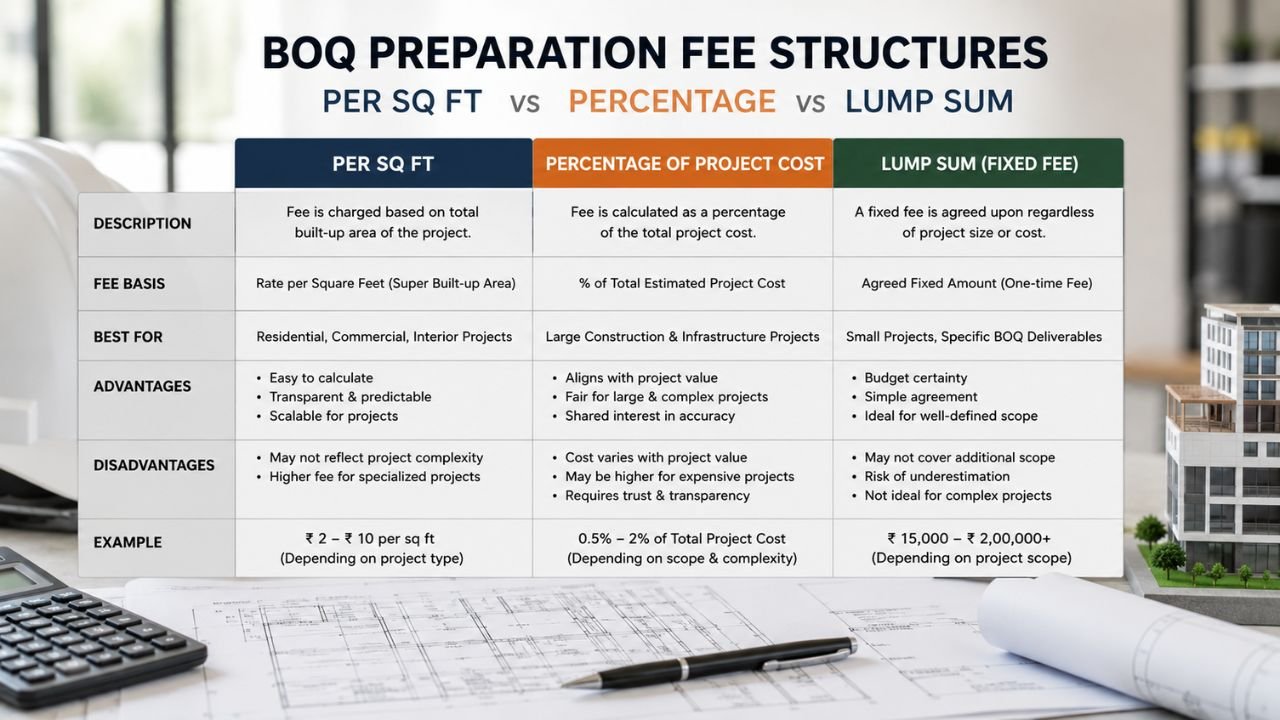
Per Sq Ft Fee Structure
How It Works
Under BOQ preparation charges per sq ft, the estimator multiplies your total built-up area (in square feet) by a fixed rate. If your rate is ₹X per sq ft and your project is 2,000 sq ft, your BOQ preparation fee is a straightforward calculation — no negotiation, no guesswork, no percentage debates.
This is the most common model for residential projects because built-up area is almost always known early, and it doesn’t change much once the layout is finalized.
Advantages
- Predictable and easy to calculate — you know your fee the moment your drawings are ready.
- Fair for standard layouts — a 2,000 sq ft home costs roughly the same to estimate whether it’s owned by a first-time builder or a repeat client.
- Transparent for comparison shopping — it’s easy to compare quotes across estimators when everyone quotes per sq ft.
- Scales naturally — larger homes generate proportionally more line items, so the fee tracks the actual estimation workload reasonably well.
Disadvantages
- Doesn’t account for complexity — a 2,000 sq ft home with intricate false ceilings, custom joinery and multiple finish levels takes far more estimator hours than a simple 2,000 sq ft box, but the fee stays the same.
- Can undervalue small, complex projects — a 900 sq ft renovation with heavy structural work may not generate enough fee to justify the actual effort.
- Less suited to commercial/industrial work — where area doesn’t correlate well with the number of trades, systems and specifications involved.
Percentage (%) Fee Structure
How It Works
Under BOQ preparation percentage fees, the estimator charges a percentage of your total estimated or contracted project value. A ₹50 lakh project at a given percentage rate generates a proportionally higher fee than a ₹15 lakh project, even if both are the same built-up area.
This model is common for commercial and industrial projects, where high-value systems (HVAC, fire-fighting, structural steel, MEP) drive project cost far more than floor area does.
Advantages
- Aligns fee with project value and complexity — high-spec finishes, structural systems and services naturally generate higher fees, matching the estimator’s actual workload.
- Works well when scope is still evolving — as design develops and value shifts, the fee structure flexes with it rather than requiring renegotiation.
- Common in large commercial/industrial contracts — where per sq ft rates would badly undervalue high-density technical work like data centers, hospitals or factories.
Disadvantages
- Less predictable upfront — until a firm project value is set, the exact fee remains an estimate.
- Can feel disproportionate on very high-value projects — a fixed percentage on a ₹5 crore project can look large in absolute terms even if the estimation effort isn’t proportionally higher.
- Requires trust in valuation — clients need clarity on what “project value” the percentage is calculated against (estimated cost vs. final contract value) to avoid disputes.
Lump Sum Fee Structure
How It Works
Under a lump sum BOQ preparation cost model, you agree on one fixed fee for the entire BOQ preparation scope — regardless of area or value — before work begins. The estimator absorbs the risk of underestimating effort; you get zero surprises on the invoice.
This model works best when the scope is well-defined: finalized drawings, a clear specification list, and no expected mid-project changes.
Advantages
- Total billing certainty — you know the exact cost before signing, which is ideal for tight budgets and fixed-price contracts.
- No disputes over area measurement or valuation — removes two common sources of friction in the other two models.
- Encourages efficient scoping upfront — both parties are motivated to nail down drawings and specifications early, which often improves overall project planning.
Disadvantages
- Requires a well-defined scope — if drawings change significantly mid-way, you may face a renegotiation or a change-order fee anyway.
- Can be priced conservatively by the estimator — to protect against scope creep, some firms build in a buffer, which can make lump sum quotes slightly higher than a pure per sq ft or percentage calculation for the same project.
- Less flexible for phased or fast-track projects — where full scope isn’t known when BOQ work needs to start.
🚀 Win more clients with transparent, accurate, and standardized BOQ pricing.
Detailed Comparison: Per Sq Ft vs % vs Lump Sum
| Factor | Per Sq Ft | Percentage (%) | Lump Sum |
| Best for | Residential, standard layouts | Commercial, industrial, high-value projects | Fixed-scope projects, tight budgets |
| Predictability | High | Medium | Very High |
| Fairness for complex designs | Low-Medium | High | Medium |
| Risk borne by | Shared, area-based | Client (value-linked) | Estimator (scope-based) |
| Ease of comparison across quotes | Very Easy | Moderate | Difficult (quotes vary by scope definition) |
| Suits evolving scope | No | Yes | No |
| Billing surprises | Low | Medium | Very Low (if scope holds) |
| Common project size | Small–Medium homes | Large commercial/industrial | Any size, fixed scope |
Recent latest 2026 trends in Quantity Surveyor and BOQ preparation charges show a growing shift toward hybrid models — a base lump sum with a percentage add-on for high-value MEP or structural packages — as projects increasingly mix standard and specialized scope in the same building.
Which Fee Structure Is Best for Different Types of Projects?
Residential Projects
For individual homes, villas and small apartment buildings with reasonably standard layouts, per sq ft is usually the fairest and simplest choice. It’s also the easiest to explain to a homeowner comparing multiple quotes.
Commercial Projects
For offices, retail spaces, hotels and mixed-use developments where MEP systems, finishes and structural complexity vary widely, percentage-based fees typically reflect the real estimation workload more accurately than a flat area rate.
Industrial Projects
For factories, warehouses and process plants, where value is driven by specialized equipment, structural steel and utility systems rather than floor area, percentage or a hybrid lump sum + percentage model tends to work best.
Renovation & Interior Fit-Out Projects
Where scope is well-defined and unlikely to expand mid-project (a fixed renovation package, for instance), lump sum removes billing ambiguity for both sides.
Factors That Influence BOQ Preparation Fees in 2026
Regardless of which model you choose, several factors move the actual number:
- Project complexity — number of trades, structural systems, MEP scope, and finish levels
- Drawing readiness — finalized drawings cost less to estimate than evolving concept designs
- Project location — logistics and local material/labor rate research add time in some regions
- Turnaround time required — rush BOQs typically carry a premium
- Level of detail requested — a summary BOQ costs less than a fully itemized, trade-wise BOQ with GST and labor breakdowns
- Revisions expected — projects likely to see design changes benefit from percentage or hybrid pricing over pure lump sum
We follow best practices for transparent BOQ preparation fee structures in Indian construction when quoting, so every one of these factors is explained to the client before a fee model is finalized — not buried in fine print afterward.
How Construction Estimator India Approaches Transparent Fee Structures
Over 10+ years and 500+ projects, we’ve learned that the “best” fee structure isn’t a fixed answer — it depends on your drawings, your project type, and how much certainty you need upfront. That’s why our estimation team walks every client through all three models before recommending one.
For residential clients seeking house construction cost estimation services, we typically recommend per sq ft pricing for its simplicity and transparency. For commercial and industrial clients, we scope out professional house construction estimation services using a percentage or hybrid model that reflects the real complexity of MEP, structural and finishing packages. Whichever model fits, you get a clear breakdown — not just a final number — backed by our 10+ years of construction estimating expertise.
Every quote we issue includes:
- The fee model used and why it fits your project
- A clear scope of what’s included (quantities, rates, GST calculations, labor breakdowns)
- Timeline for delivery
- What triggers a revision or additional fee, if anything
How an Excel BOQ Template Supports Cost-Effective BOQ Preparation
Not every project needs a fully outsourced BOQ. For smaller renovations, self-builders, or contractors who want to manage their own estimation workflow, our ready-to-use Excel BOQ Template with auto GST and labor calculations offers a cost-effective middle ground.
The template lets you:
- Enter quantities and get automatic material, labor and GST calculations
- Standardize your BOQ format across multiple projects
- Reduce dependency on manual rate lookups
- Cross-check contractor quotes against a transparent, structured baseline
For projects where full-service BOQ preparation isn’t necessary, the Excel BOQ Template pairs well with our professional consultation for spot-checking complex sections like structural steel or MEP packages.
Tips to Choose the Right BOQ Preparation Fee Structure
- Match the model to your project type — residential leans per sq ft, commercial/industrial leans percentage, fixed-scope work leans lump sum.
- Ask what “project value” means in a percentage quote — estimated cost, contracted value, or final settled cost can all differ.
- Get the scope in writing — regardless of fee model, a clear scope prevents disputes later.
- Compare like-for-like — a per sq ft quote and a lump sum quote aren’t directly comparable unless you know exactly what’s included in each.
- Ask about revision triggers — know upfront what changes in your drawings will trigger additional fees.
- Don’t chase the lowest number alone — a suspiciously low BOQ preparation fee often means a less detailed, less useful BOQ.
- Ask for a sample BOQ — reviewing a past deliverable tells you more about value than the fee structure itself.
FAQs
- What is the average BOQ preparation fee structure used in India? Per sq ft is the most common for residential projects, while percentage-based fees dominate commercial and industrial work. The right choice depends on your project type and scope.
- Is percentage-based BOQ pricing more expensive than per sq ft? Not necessarily — it depends on your project value and complexity. Percentage pricing tends to be fairer for high-value, complex projects, while per sq ft is simpler for standard residential layouts.
- Can I switch fee structures mid-project? Generally, no — switching mid-project usually requires renegotiation. It’s best to choose the right model upfront based on how well-defined your scope is.
- Does a lump sum BOQ preparation fee cover design changes? Typically not automatically. Most lump sum agreements define a fixed scope, and significant design changes trigger a separate revision fee — always confirm this before signing.
- Which fee structure is best for a small residential renovation? Lump sum or per sq ft both work well, depending on how finalized your scope is. If your renovation plan is locked in, lump sum offers the most billing certainty.
- How does Construction Estimator India decide which fee structure to recommend? We assess your project type, drawing readiness and complexity, then recommend the model that gives you the fairest, most transparent outcome — explaining the reasoning before you commit.
- Do BOQ preparation fees include GST? This varies by provider and should always be confirmed upfront. Our Excel BOQ Template automatically calculates GST alongside material and labor costs for full transparency.
- Is it worth paying more for a detailed, itemized BOQ over a summary BOQ? For most construction and renovation projects, yes — a detailed, trade-wise BOQ reduces contractor disputes and change-order surprises later, often saving far more than the extra preparation fee.
Conclusion
There’s no single “best” BOQ preparation fee structure — only the model that best fits your project’s size, complexity and how locked-in your scope already is. Per sq ft rewards simplicity, percentage rewards fairness on complex or high-value work, and lump sum rewards certainty. What matters most is transparency: knowing exactly what you’re paying for and why.
At Construction Estimator India, we’ve helped 500+ clients across residential, commercial and industrial projects choose — and get real value from — the right fee structure for their specific project. Whether you need a fully outsourced BOQ, a second opinion on a contractor’s quote, or our Excel BOQ Template to manage estimation in-house, our team is ready to help.
For transparent BOQ preparation fee structures, professional estimation or Excel BOQ Template across India, WhatsApp or call us today at +91 8630676890.