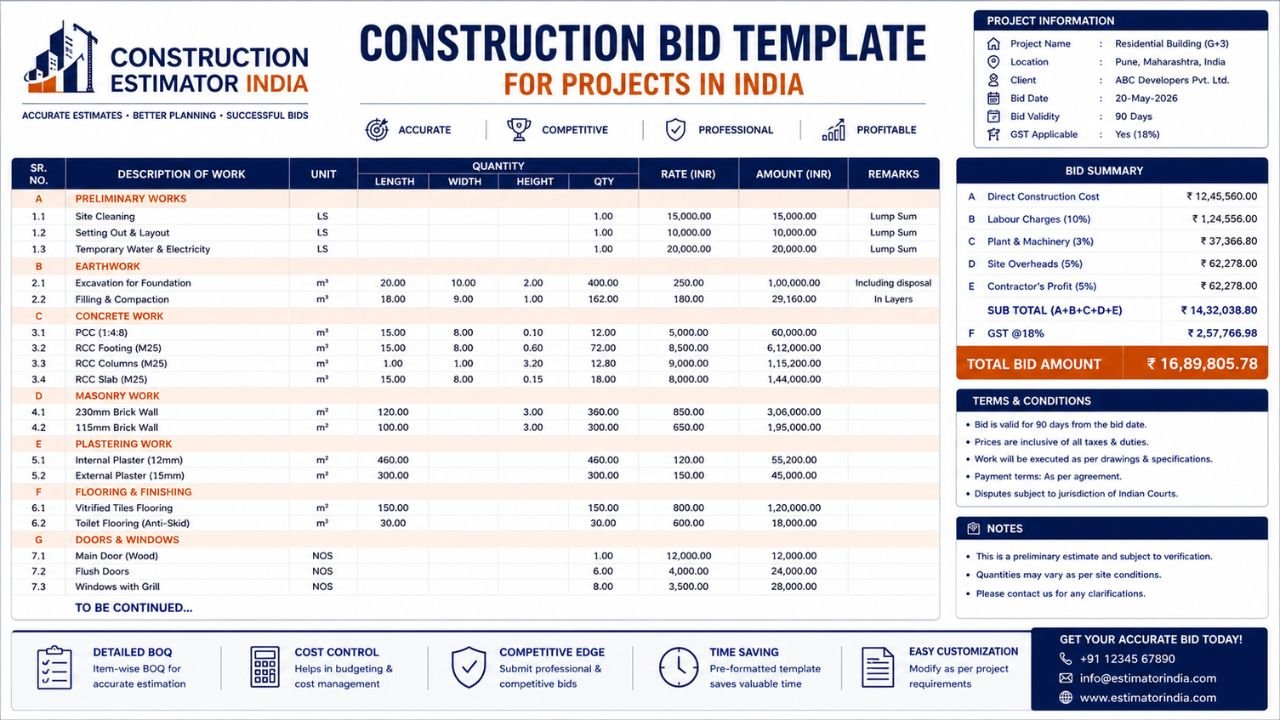
Selecting the right house gate design is one of the most critical decisions an Indian homeowner can make during the final stages of construction or renovation. A well-planned main gate serves as the primary guardian of your family’s safety and privacy while simultaneously acting as the “handshake” of your home, offering guests their first visual impression.
In many Indian residential colonies, homeowners often fall into the trap of prioritizing intricate patterns from a catalog without considering the practical weight of the steel, the turning radius of their car, or the long-term maintenance required by the local climate. This oversight often leads to gates that sag within a year, tracks that get clogged with monsoon silt, or openings that are too narrow for a modern SUV.
👉 Choose a House Gate Design That Enhances Security, Style, and Curb Appeal.
This handbook is designed to bridge the gap between pure aesthetics and practical engineering, a core philosophy of effective project management consultancy (PMC). Whether you are building an independent villa or a house on a compact urban plot, understanding how gate systems function—and how they impact your wallet—is essential.
Construction Estimator India provides expert support in calculating the exact steel weight, fabrication charges, and paint requirements for any house gate design you choose. If you are currently comparing different designs and want to understand how they will affect your total construction budget, you can contact Construction Estimator India on WhatsApp / Call +91 8630676890 for a detailed cost breakdown before you commit to a fabricator.
Understanding the Role of House Gate Design
Security, Privacy, and First Impression
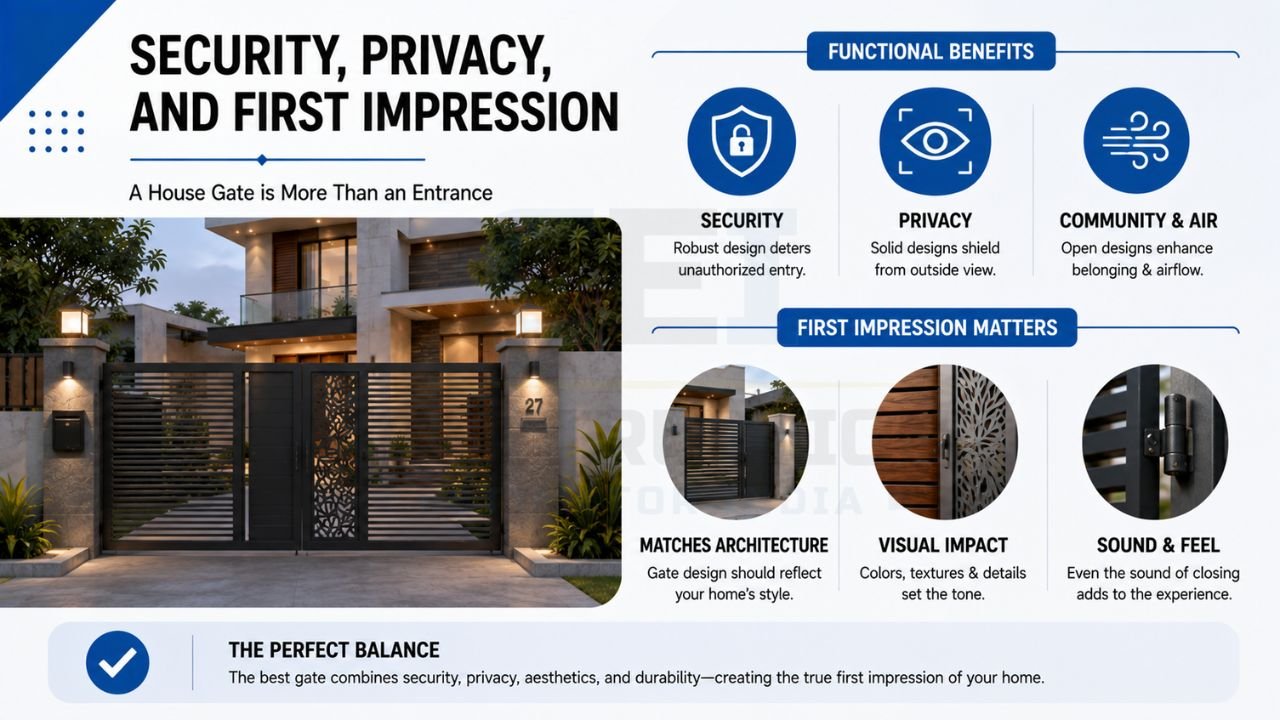
In the context of Indian residential architecture, the house gate design is far more than an entrance; it is a multi-functional barrier. From a security standpoint, the gate must be robust enough to deter unauthorized entry while allowing residents to clearly see who is at the threshold. The height of the gate and the spacing between its bars or panels determine the level of privacy. For homes on busy streets, a more solid design with minimal gaps is often preferred to shield the front yard from the prying eyes of passersby. Conversely, on quieter lanes, a more open design can create a sense of belonging within the community and allow for better air circulation.
The visual impact of the gate cannot be understated. It is the first element of your property that visitors interact with, setting the tone for the architectural language used inside. A modern, minimalist home would feel disconnected with a heavy, ornate iron gate. Balancing these atmospheric qualities with a sturdy structural frame, supervised by competent building contractors, is the hallmark of a successful design.
Relationship Between Gate, Compound Wall, and House Front
A common architectural mistake is designing the house gate in isolation from the rest of the property. For a harmonious look, the house gate design must be viewed as an extension of the compound wall and the house front elevation. The pillars that hold the gate should be architecturally consistent with the wall’s finish—whether that is stone cladding, textured paint, or exposed brick. If your house features specific elements like wooden rafters or grey concrete finishes, incorporating these same materials or colors into the gate design creates a cohesive visual narrative.
Proportions are equally important. A gate that is too tall for the compound wall can look imposing and out of place, while one that is too short might fail to provide the necessary security. Typically, the gate height should match or be slightly higher than the compound wall. The spacing between the pillars must also be carefully calculated to ensure they can handle the structural load of the gate without cracking. If you are unsure how the weight of a larger gate will affect your pillar design, reaching out to Construction Estimator India can help you determine the necessary RCC reinforcement needed for the gate supports based on the expected steel load.
👉 Transform Your Home Entrance with a Modern and Elegant Gate Design.
Gate Dimensions, Road Width, and Vehicle Movement
Perhaps the most practical constraint on house gate design in India is the physical space available for vehicle movement. Many urban plots face narrow roads where a car needs a wide turning radius to enter the driveway safely. If the gate opening is too narrow, you risk damaging your vehicle or the gate pillars daily. Generally, a minimum clear opening of 10 to 12 feet is recommended for a single-car entry, but if the road is less than 20 feet wide, you might need a 14-foot opening to allow for a comfortable turn.
The height of the gate must also account for the type of vehicles that will enter. If you plan to park a tall SUV or a vehicle with a roof carrier, ensure there is no overhead beam or decorative arch that restricts vertical clearance. Furthermore, the direction in which the gate opens—whether it swings inward or slides along the wall—depends entirely on the depth of your parking porch and the availability of side space. Small errors in these measurements can lead to a gate that hits the car bumper or blocks the pedestrian path.
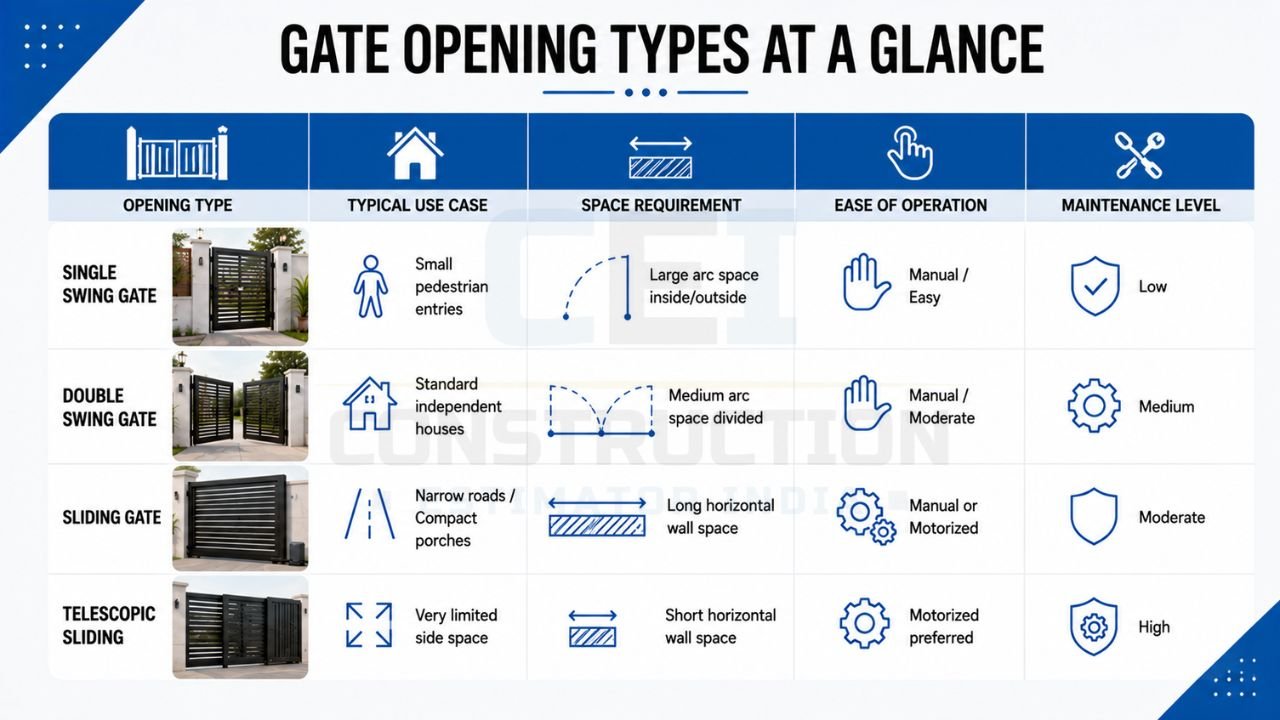
The following table compares common gate opening systems to help you identify which mechanism suits your plot’s spatial constraints.
| Opening Type | Typical Use Case | Space Requirement | Ease of Operation | Maintenance Level |
|---|---|---|---|---|
| Single Swing Gate | Small pedestrian entries | Large arc space inside/outside | Manual / Easy | Low |
| Double Swing Gate | Standard independent houses | Medium arc space divided | Manual / Moderate | Medium |
| Sliding Gate | Narrow roads/Compact porches | Long horizontal wall space | Manual or Motorized | Moderate |
| Telescopic Sliding | Very limited side space | Short horizontal wall space | Motorized preferred | High |
This table serves as a starting point for spatial planning. If you find that your plot has a steep slope or very limited clearance, consulting with Construction Estimator India for a material and feasibility check via our building material estimation service can prevent expensive rework.
👉 Create a Grand First Impression with a Stylish and Durable Entrance Gate.
Types of House Gate Opening Systems
Swing Gates: Single and Double Leaf
Swing gates are the most traditional choice for house gate design in India. A single-leaf swing gate consists of one large panel that hinges on a single pillar. While simple, these are usually restricted to smaller openings because a very wide single leaf puts immense strain on the hinge and pillar, potentially leading to sagging over time. Double-leaf swing gates are the standard for most Indian driveways, as they split the total width into two manageable halves. This reduces the arc of the swing, which is crucial if your parking space is shallow.
One major advantage of swing gates is that they do not require a ground track, making them ideal for driveways with uneven surfaces or where debris might clog a track. However, they do require a completely clear “sweep area.” If your driveway slopes upward toward the house, an inward-swinging gate will hit the ground. In such cases, you must either design the gate to swing outward (which may be restricted by municipal rules regarding the road) or opt for a different opening system altogether.
Sliding and Telescopic Gates
For many modern urban homes, the sliding gate has become the preferred house gate design. Sliding gates move horizontally along a track installed at the base of the compound wall. They are the ultimate space-savers because they do not require any “sweep area” in the driveway, allowing you to park your car right up against the gate. This is particularly beneficial on narrow plots where every inch of driveway depth counts. The primary requirement for a sliding gate is a clear, straight run of wall space to the left or right of the opening, equal to the width of the gate itself.
In situations where there isn’t enough wall space for a full sliding gate to retreat, a telescopic sliding gate is an ingenious solution. This system uses two or more panels that overlap as they slide, requiring only a fraction of the side space. While more complex to fabricate and maintain due to the multiple tracks and pulleys involved, it allows for a wide opening on even the most constrained plots. Because of the technical complexity, it is wise to have the steel and hardware quantities verified by Construction Estimator India to ensure the motor and tracks are appropriately rated for the weight.
Folding and Automated Gate Options
Folding gates, often referred to as bifold gates, consist of panels that fold back on themselves like an accordion. These are excellent for wide driveways where neither swing space nor side-sliding space is available. They offer a unique, modern aesthetic and can be designed to fold very compactly against the pillars. However, they involve more hinges and moving parts, which means they require high-quality fabrication to ensure they operate smoothly without rattling.
Automation can be added to almost any house gate design, providing a level of convenience that is highly valued in busy Indian cities. A motorized gate allows you to enter your property without leaving the comfort of your car—a major benefit during the monsoon or late at night. Most automated systems come with remote controls, and high-end versions can even be integrated with smartphone apps. When planning for automation, ensure your gate is not excessively heavy, as this will require a more expensive, high-torque motor. Construction Estimator India can assist you in calculating the total weight of your gate design to help you choose the right motor capacity and avoid overspending.
Gate Materials and Structural Considerations
Common Materials for House Gates in India
The material you choose for your house gate design significantly impacts its durability, appearance, and cost. Mild Steel (MS) is the most common material used across India due to its versatility and affordability. It can be easily cut, welded, and molded into various patterns. Wrought iron is a premium alternative, known for its heavy, traditional feel and intricate handcrafted details. While beautiful, wrought iron is significantly heavier than MS and requires robust pillars and hinges.
For a more modern or “natural” look, many homeowners are now opting for combination gates. These use a steel or aluminum frame infilled with materials like Wood Plastic Composite (WPC), high-pressure laminates (HPL), or even toughened glass. WPC and HPL are popular because they offer the warmth of wood without the high maintenance of real timber, which tends to warp or rot in the Indian sun and rain. Stainless steel (SS) is another option, favored for its rust resistance, though its shiny, industrial look doesn’t suit every architectural style.
Strength, Weight, and Supporting Pillars
A house gate design is only as good as the structure supporting it. For swing gates, the hinges must be heavy-duty and securely anchored into an RCC (Reinforced Cement Concrete) pillar. Knowing exactly what is RCC construction proves why simple brick pillars are often insufficient for wide or heavy gates.
The thickness of the steel sections—often referred to as the “gauge”—is a critical factor. Finding the “Goldilocks” weight is a job for an expert structural engineering design team.
Maintenance and Rust Protection
In India’s tropical climate, rust is the greatest enemy of any metal house gate design. Salt air in coastal regions and high humidity in other areas can degrade a gate within a few seasons if not properly treated. The standard protection involves a coat of red oxide or zinc-chromate primer followed by high-quality synthetic enamel paint. For a more durable finish, powder coating or “PU” (Polyurethane) painting is recommended, though these are more expensive and harder to touch up if the gate gets scratched.
Galvanized steel is an excellent choice for those living in high-rainfall areas, as the zinc coating provides superior rust protection even if the top paint layer is damaged. Regular maintenance, such as lubricating the hinges or oiling the sliding tracks, is essential to keep the gate functioning silently. If you are debating between standard paint and more expensive powder coating, Construction Estimator India can help you estimate the long-term cost-benefit of these finishes relative to your initial budget.
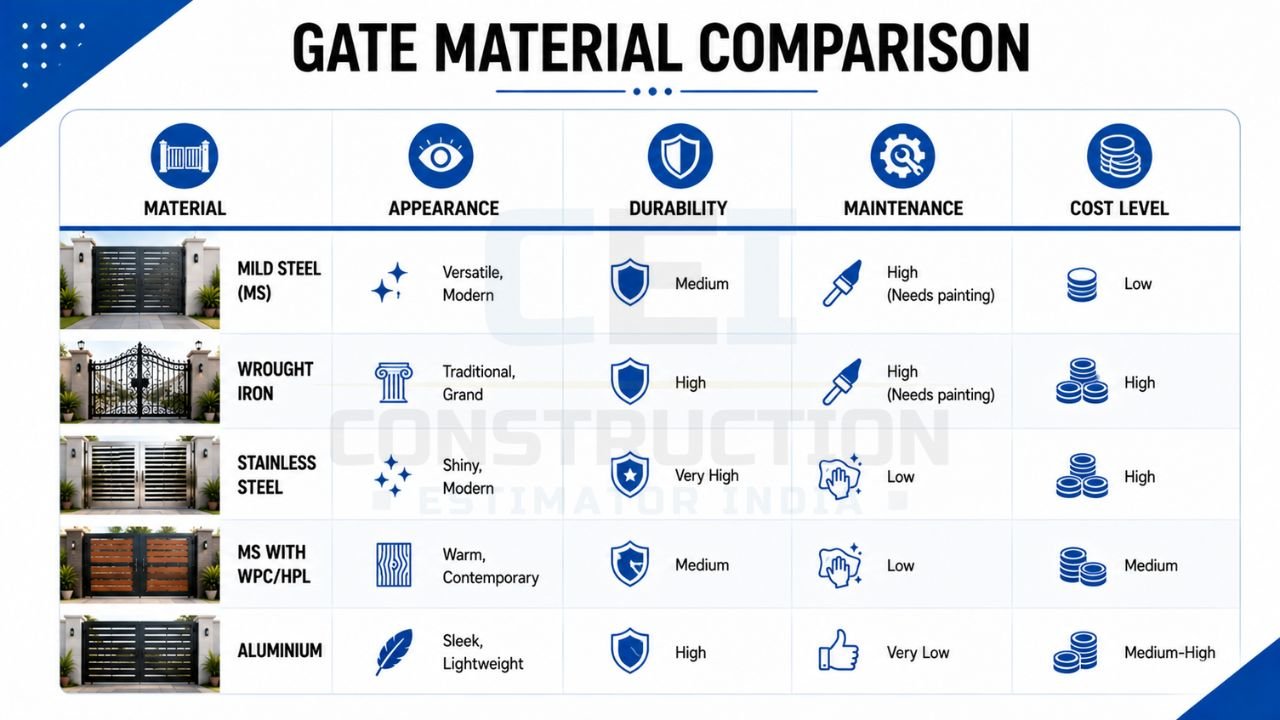
The table below summarizes the characteristics of various gate materials to help you balance aesthetics with practicality.
| Material | Appearance | Durability | Maintenance | Cost Level |
|---|---|---|---|---|
| Mild Steel (MS) | Versatile, Modern | Medium | High (Needs painting) | Low |
| Wrought Iron | Traditional, Grand | High | High (Needs painting) | High |
| Stainless Steel | Shiny, Modern | Very High | Low | High |
| MS with WPC/HPL | Warm, Contemporary | Medium | Low | Medium |
| Aluminium | Sleek, Lightweight | High | Very Low | Medium-High |
This comparison highlights that while MS is cost-effective, it requires regular upkeep. Homeowners should consider their local environment and how much time they can dedicate to maintenance before choosing a material. For a precise calculation of the material costs for these different options, the team at Construction Estimator India is available to provide detailed quantity takeoffs.
👉 Get Expert Guidance for Customized House Gate Design Solutions.
Design Styles and Patterns for House Gates
Simple and Minimalist House Gate Designs
The modern trend in Indian residential architecture leans heavily toward simplicity. A simple house gate design often uses clean horizontal or vertical lines, flat metal slats, or perforated sheets. These designs are aesthetically pleasing because they don’t compete with the house’s architecture; rather, they complement it. From a practical standpoint, minimalist gates are often lighter, easier to fabricate, and easier to paint, which can result in significant cost savings.
A popular minimalist pattern involves using MS box sections with small gaps between them. This allows for airflow and a “peek-a-boo” view of the street, making the property feel less enclosed. You can also experiment with “laser-cut” or CNC designs where a single sheet of metal is cut into a specific geometric or organic pattern. This adds a high-end, custom look to even a very simple gate frame.
Decorative, Traditional, and Ornamental Gate Designs
For homeowners who prefer a more majestic or “old-world” charm, decorative house gate designs remain a top choice. These gates often feature cast iron motifs, floral scrolls, and pointed finials (spikes) at the top. While these elements add to the security by making the gate harder to climb, they also add significant weight and surface area for rust to take hold. Ornamental gates are most effective when they match a house with classical features like arched windows, pillars, or sloped tile roofs.
When choosing an ornamental design, it is important to ensure that the pattern isn’t so busy that it becomes a maintenance nightmare. Every nook and cranny in a decorative gate is a place where dust and moisture can collect, leading to localized rusting. If you love the look of a heavy ornamental gate but are worried about the cost of the raw material, Construction Estimator India can provide a detailed bill of quantities to help you see exactly how much the decorative elements are adding to your total fabrication bill.
Semi-Privacy and Full-Privacy Gate Patterns
Privacy is a deeply personal choice. Some families prefer a fully solid house gate design that acts as a total visual barrier. This is common in densely packed urban areas where the house is close to the street. Solid gates can be made using metal sheets, but they can feel heavy and block all breeze. To mitigate this, many designers use louvers—angled slats that allow air to pass through while blocking the line of sight from the street.
Semi-privacy designs are often a better compromise. By using a combination of solid panels at the bottom (where pets or debris might enter) and more open patterns at eye level, you can achieve security without feeling “walled in.” Perforated metal sheets with small holes or “jalli” patterns are also excellent for creating a sense of privacy while still allowing light and air to filter into the driveway.
Matching Gate Design with Plot Size and House Type
Gate Design for Small Houses and Narrow Fronts
On a small plot, usually 20×40 or 30×40 feet, the frontage is limited. A small house gate design should aim to make the entrance look wider and more open. Using horizontal lines can create a visual illusion of width. It is also advisable to keep the gate relatively light in appearance; a heavy, solid black gate on a narrow front can make the entire house look smaller and more cramped.
In these compact settings, every square inch of the driveway is valuable. A sliding gate is almost always the best choice here, as it leaves the entire porch clear for parking. If you are building on a small plot and want to ensure your gate design doesn’t exceed your budget, you can contact Construction Estimator India on WhatsApp / Call +91 8630676890 to get a ballpark estimate for a compact, cost-effective gate.
Gate Design for Double Floor Houses and Wider Plots
A double-floor home or a larger plot (40×60 feet and above) can handle a much more substantial house gate design. Here, you have the luxury of height and width. You might choose a grand double-leaf swing gate with decorative pillars or a long, sleek sliding gate that spans the entire frontage. For wider plots, it is often a good idea to divide the gate into segments to prevent any single part from becoming too heavy to handle.
With a larger frontage, you can also incorporate more landscaping around the gate. Built-in planters on the gate pillars or a small green strip between the road and the gate can soften the look of a large metal structure. The goal for a large home is to ensure the gate is proportional to the building’s scale—a tiny, flimsy gate in front of a grand three-story villa will look unbalanced and weak.
Corner Plots and Multiple Entry Points
Corner plots offer a unique opportunity for house gate design because they have two frontages. Frequently, homeowners choose to have the main vehicle gate on the wider road and a smaller pedestrian gate or a secondary car entry on the narrower side road. Consistency is key here; both gates should share the same design language, materials, and colors to ensure they feel like part of the same property.
Managing the security and cost of two separate gates can be challenging. It is important to decide which gate will be the primary entrance and allocate your budget accordingly. You might choose a more decorative design for the main front gate and a simpler, more functional version for the side entrance. Construction Estimator India helps homeowners plan for these multiple entry points by providing a consolidated material estimate, ensuring you don’t over-purchase steel or paint for the secondary gate.
Integration with Parking, Slope, and Services
Working with Driveway Levels and Road Slope
One of the most overlooked aspects of house gate design in India is the slope of the ground. Many plots are intentionally built higher than the road to prevent flooding during the monsoon. If your driveway has a steep incline, a standard swing gate might not have enough ground clearance to open inward. You may need to “raise” the hinges or design a gate with a curved bottom edge, both of which require precise fabrication.
For sliding gates, the track must be perfectly level even if the ground around it slopes. This often requires building a small concrete plinth for the track. If the track is not level, the gate will be incredibly heavy to open in one direction and might slam shut dangerously in the other. Before you finalize a sliding gate design for a sloped plot, it is essential to have a civil engineer or an estimator check the levels.
Pedestrian Gate vs Vehicle Gate
For most Indian households, a separate pedestrian gate is a huge convenience. It allows family members, delivery personnel, and domestic help to enter and exit without having to open the heavy main vehicle gate. This saves wear and tear on the main gate’s hinges or motor and provides a higher level of security, as you don’t have to leave a large opening exposed.
The pedestrian gate can either be a separate small door built into the compound wall or a “wicket gate” built directly into the main leaf of the vehicle gate. While a separate door is more aesthetically pleasing and easier to use, a wicket gate is a good space-saving solution for narrow plots. When designing a wicket gate, ensure the “step-over” height is not so high that it becomes a tripping hazard for the elderly.
Position of Intercom, Doorbell, and Letterbox
A modern house gate design is not complete without the integration of essential services. The placement of the doorbell, intercom camera, and letterbox should be decided during the design phase, not after the gate is installed. These elements should be placed at a comfortable height (typically 4 to 5 feet) and be easily accessible from the street.
Wiring for these services, as well as for gate lights and automation motors, must be planned before the pillars are cast or the driveway is paved. Running wires in exposed conduits later looks messy and is prone to damage. If you are planning a smart home setup, Construction Estimator India can help you account for the extra costs of high-quality conduits and cabling in your overall electrical and gate estimation.
Cost Planning for House Gate Design
What Drives Gate Cost the Most
The “weight” of the material is the primary cost driver, as most fabricators in India charge based on the total weight of the steel in kilograms. The complexity of the fabrication also plays a role. Laser-cut patterns and specialized hardware add to the labor cost. Evaluating this against your baseline house construction per sq ft rate in India ensures gate costs don’t unexpectedly blow the budget.
The complexity of the fabrication also plays a role. Laser-cut patterns, intricate wrought iron scrolls, and specialized hardware like high-quality rollers or heavy-duty hinges add to the labor cost. Finally, the finish—whether it’s a basic primer or a high-end powder coating—can change the total price by 10% to 20%. Understanding these variables is the first step toward a realistic budget.
Balancing Looks, Durability, and Budget
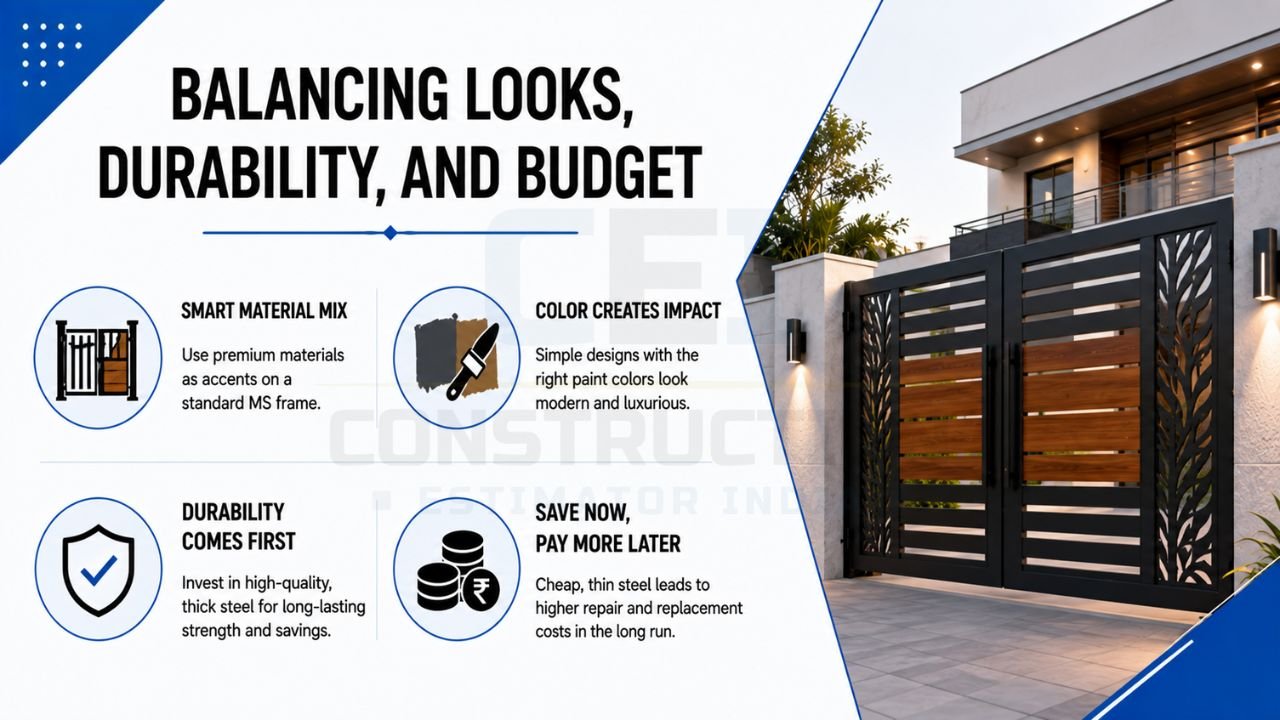
It is entirely possible to achieve a stunning house gate design without breaking the bank. One strategy is to use expensive materials like wood or stainless steel only as “highlights” or “accents” on a standard MS frame. This gives you the premium look at a fraction of the cost. Another tip is to keep the structure simple and use paint colors to create visual interest; a well-chosen charcoal grey or a deep bronze can make even a basic gate look luxurious.
Durability should never be sacrificed for a lower initial price. Using thin, “cheap” steel might save you a few thousand rupees today, but the cost of repairs and early replacement will far exceed those savings. It is better to have a simpler design made of high-quality, thick-gauge steel than a complex design made of flimsy material.
How Construction Estimator India Helps with Gate Costing?
Building a home involves managing dozens of different contractors. Construction Estimator India acts as your financial guide, providing clarity through a precise Bill of Quantities (BOQ). By knowing exactly how many kilograms of steel your house gate design requires, you can negotiate with fabricators from a position of knowledge.
👉 Build an Entrance That Reflects Your Style and Personality.
Common Mistakes in House Gate Design
Ignoring Vehicle Turning Radius and Parking Space
The single most common mistake in house gate design is failing to account for how a car actually moves. Homeowners often measure the gate width based on the width of their car (usually 6 feet) and think an 8-foot gate is plenty. However, they forget that a car doesn’t enter in a perfectly straight line from the road. If you have to make a 90-degree turn from a narrow lane, you need a much wider opening to avoid scraping your car’s sides.
Similarly, if you have a swing gate that opens inward, you must ensure there is enough depth in the driveway for the gate to open completely even when the car is parked inside. If the gate hits the car’s bumper, you will be forced to park on the street, defeating the purpose of having a driveway.
Making the Gate Too Heavy or Too Delicate
Finding the right balance of weight is crucial for the longevity of your house gate design. A gate that is too heavy puts immense pressure on the hinges, leading to “gate sag” where the end of the gate scrapes against the ground. This makes the gate incredibly difficult to open and can eventually damage the pillars. On the other hand, a gate that is too light and delicate can be easily bent or forced open, providing poor security and a “cheap” feel.
The weight also affects automation. A very heavy gate requires a high-end industrial motor, which significantly increases your costs. Construction Estimator India can review your design drawings and advise if the weight is appropriate for the chosen hinges or motor, helping you avoid these common structural pitfalls.
Copying Random Designs Without Adapting to Plot and Climate
In the age of social media, it is tempting to download a beautiful house gate design from a foreign website and ask a local fabricator to replicate it. However, a gate designed for a dry, temperate climate may not survive the Indian monsoon or the intense tropical sun. For example, a design with many horizontal surfaces might collect water and rust quickly in a high-rainfall area like Kerala or Mumbai.
Always adapt a design to your local conditions. This means choosing the right rust protection, ensuring proper drainage for sliding tracks, and selecting materials that won’t warp or fade. Professional guidance from Construction Estimator India ensures that your chosen design is not only beautiful but also practical for the specific environment of your plot.
FAQs: House Gate Design for Indian Homes
Which gate type is best for a small 20×40 urban plot?
For small plots where driveway depth is limited, a sliding gate is almost always the best option. It doesn’t require any internal swing space, allowing you to use every inch of your porch for parking. If side space is also limited, consider a telescopic sliding gate or a bifold folding gate.
Are sliding gates more expensive than swing gates?
Generally, yes. While the metal fabrication cost might be similar, a sliding gate requires a ground track, rollers, and a guiding system, which adds to the initial cost. If you automate the gate, a sliding gate motor is also typically more expensive than a swing gate arm. However, the space-saving benefits often outweigh the extra investment.
Which material is best for a house gate near the sea?
In coastal areas with high salt content in the air, rust is a major issue. Stainless Steel (Grade 316) is the most durable but expensive. A more cost-effective alternative is using Aluminum or Galvanized Steel with a high-quality PU paint or powder coating. Avoid standard Mild Steel (MS) as it will rust very quickly regardless of the paint quality.
How often does a metal house gate need repainting?
In most parts of India, a well-painted MS gate should be repainted every 3 to 5 years to keep it looking fresh and to prevent rust. If you notice small rust spots appearing, it is best to sand them down and touch them up immediately rather than waiting for the whole gate to degrade.
When should I involve Construction Estimator India in my gate planning?
The best time to contact us is once you have a few design ideas or a rough sketch from your architect, but before you have finalized the order with a fabricator. This allows us to provide a detailed cost and quantity estimate, helping you choose a design that fits your budget and ensuring you aren’t overcharged for materials.
Conclusion: Choose a House Gate Design That Looks Good and Works Every Day
A house gate design is one of the few elements of your home that you will interact with multiple times every single day. The best gate is one that you don’t have to think about—it opens smoothly, provides a sense of security, and looks as good ten years from now as it does the day it’s installed. By balancing the aesthetic desires of your family with the practical realities of your plot size, road width, and budget, you can create an entrance that truly enhances your living experience.
Remember that a beautiful design on paper is only the beginning. The success of your gate depends on high-quality materials, professional fabrication, and accurate cost planning. Don’t leave your gate budget to chance or guesswork. Before you finalize your house gate design and place an order, contact Construction Estimator India on WhatsApp / Call +91 8630676890. Our experts will help you understand the realistic costs, steel quantities, and material options available, ensuring your dream home has the perfect entrance it deserves.