A farmhouse is more than just a structure; it is a lifestyle choice that prioritizes peace, connection with nature, and space for recreation. In India, farmhouses have evolved from simple agricultural shelters into sophisticated weekend retreats and event venues. Creating a successful farmhouse plan India requires a balance between the built-up area and the surrounding landscape to ensure functional harmony.
Mastering how to plan home construction in India is essential, but a farmhouse demands a different set of rules compared to urban residential builds. If you are considering a farmhouse plan and want to know how much it could cost for your land, you can contact Construction Estimator India on WhatsApp / Call +91 8630676890. They help landowners estimate realistic construction costs and material quantities for farmhouses on any plot size.
👉 Planning Your Dream Farmhouse? Get Expert Guidance for Design, Budget, and Constructio
Understand What a Farmhouse Plan India Means
Farmhouse vs Normal City House
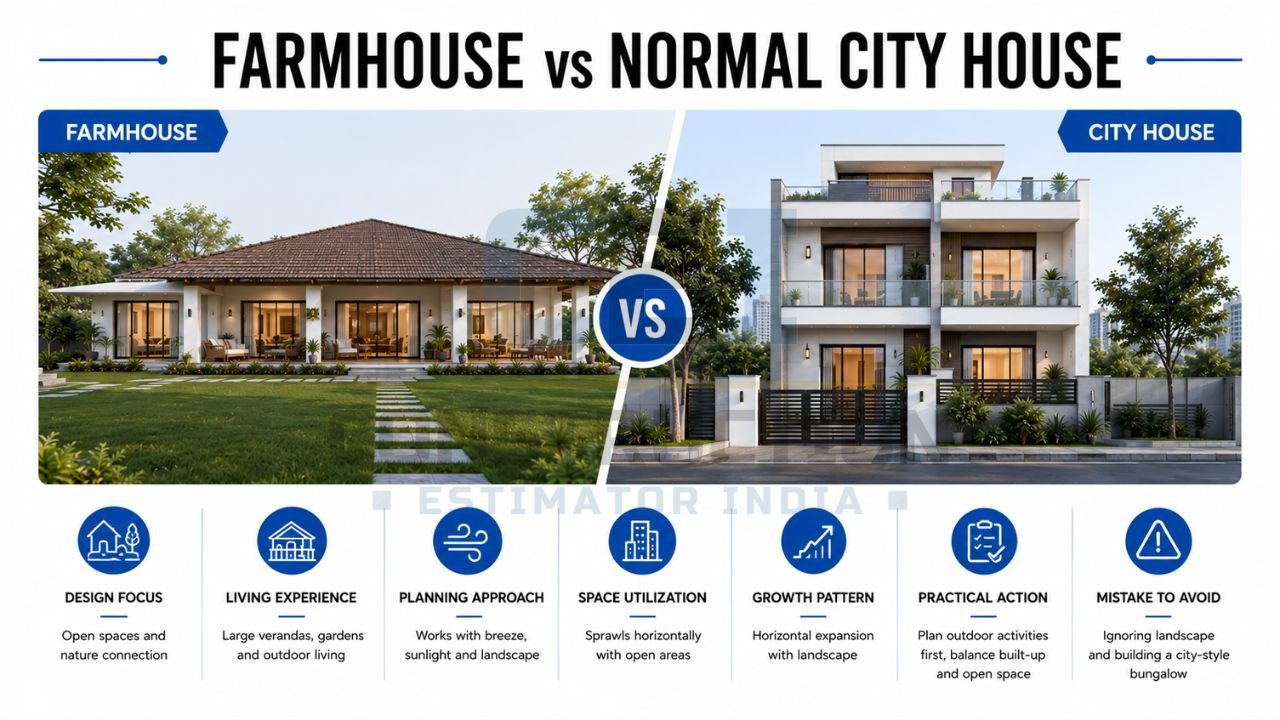
A city house is designed for density and efficiency, often maximizing every inch of the plot for indoor living. In contrast, a farmhouse plan India focuses on the relationship between the indoors and outdoors. The primary goal is to escape the claustrophobia of urban life. This means larger windows, extensive verandas, and a layout that encourages movement toward the garden or orchard.
In a farmhouse, the “living area” often extends to the lawn or a deck. While a city house might prioritize vertical growth due to land costs, a farmhouse typically sprawls horizontally. The planning involves not just the walls and roof, but also how the breeze flows through the property and how the sun hits the outdoor seating area at tea time.
Practical Action: When starting your plan, list the outdoor activities you enjoy. Do you want to host large dinners on a lawn or have a quiet morning coffee under a tree? This will dictate the proportion of built-up area to open space.
Mistake to Avoid: Building a “bungalow” that looks like it belongs in a city, ignoring the natural landscape. Partnering with top architects and architecture firms ensures the design respects the topography.
Typical Functions of a Farmhouse
Modern farmhouses in India serve multiple purposes: a weekend getaway for the family, a guest house for visiting friends, a venue for small gatherings, or even a base for active farming. Understanding your primary function is critical for zoning. If the house is purely for weekend stays, you might prioritize a large kitchen and dining area over multiple bedrooms.
If the farmhouse is meant for “agritourism” or rentals, the layout needs to provide privacy for different guest groups. For farm support, you will need dedicated zones for storage, staff, and perhaps a small dairy or poultry unit. Each function adds specific structural requirements and costs.
Practical Action: Define your “90% use case.” If you will be there mostly with just your spouse and children, don’t build five bedrooms. Instead, build two high-quality bedrooms and a flexible mezzanine or veranda for occasional guests. This keeps maintenance low and budget under control. Construction Estimator India provides guidance on planning built-up area versus open landscape to match your intended usage.
👉 Build a Farmhouse That Blends Comfort, Style, and Nature.
When a Farmhouse Plan Makes Sense for Your Land and Lifestyle
Investing in a farmhouse plan makes sense when you have a plot—usually outside city limits—where the local bylaws from authorities like the Town and Country Planning Organisation (TCPO) allow for a low FSI (Floor Space Index) and a high percentage of green cover.
If your land is agricultural, you must also consider the legalities of “farm building” versus “residential construction,” adhering to guidelines set by the Department of Agriculture & Farmers Welfare.
Practical Action: Check your local land conversion status (NA vs. Agricultural). Ensure your plan leaves enough room for a driveway and service entry. Before you finalise your farmhouse plan with an architect or designer, Construction Estimator India can help you estimate the budget and compare different layout options. Reach out on WhatsApp / Call +91 8630676890.
Study Land Size, Shape, Access, and Basic Conditions
Small Plots (30×30, 40×60) vs Large Plots (1 acre+)
The size of your land is the biggest constraint on your farmhouse plan India. On a small 30×30 or 40×60 ft plot, the design must be incredibly efficient. Here, the “farmhouse” feel is achieved through vertical gardens, a small central courtyard, or a rooftop gazebo. You cannot have a sprawling orchard, so the design focuses on “compact luxury.”
On a 1 acre+ plot, the challenge is scale. Placing the house in the dead center might feel prestigious, but it splits your land into four smaller, less usable quadrants. Tucking the house toward one side or a corner can leave a massive, contiguous space for a productive orchard. Knowing which foundation types for house construction in India to use ensures the footprint remains stable regardless of placement.
Practical Action: For small plots, use “L-shaped” layouts to create a private corner garden. For large plots, conduct a site survey to identify the highest point of the land for the house to avoid water logging. A common mistake is ignoring the scale; building a tiny house on a huge plot without proper landscaping makes the house look lost. You can share your land size and basic farmhouse requirements with Construction Estimator India to get a rough idea of construction cost and quantity takeoff.
Road Access, Entry Gate Position, and Parking
The entry point determines the “sequence of arrival.” In a farmhouse design India, the driveway is part of the experience. Ideally, the road should lead the visitor through a bit of greenery before reaching the house. The parking area should be near the kitchen or service entry for easy unloading of groceries, but it shouldn’t dominate the front elevation.
If your plot is on a slope, the entry gate position is even more critical to ensure vehicles can climb the gradient safely during monsoon. You also need to plan for “turning radii” for larger vehicles like water tankers or delivery trucks that might need to enter the property.
Practical Action: Plan for a separate pedestrian gate and a main vehicle gate. Keep the parking under a pergola with creepers instead of a heavy concrete slab to maintain the “farm” aesthetic. Avoid placing the parking directly in front of the main living room windows to keep the view focused on nature. Construction Estimator India can estimate the costs for various driveway materials, from simple gravel to paved stone.
Water Source, Power Supply, and Basic Services?
A farmhouse plan is incomplete without a “services plan.” Most farmhouse plots in India lack municipal water and sewage. You must plan for a borewell or an open well, a water storage tank (overhead and underground), and a robust septic tank system or a small STP (Sewage Treatment Plant).
Power reliability in rural areas can be a challenge. Your plan should include space for a generator room or, more ideally, a solar power setup on the roof. These utility areas need to be tucked away where they don’t cause noise or visual pollution but remain accessible for maintenance.
Practical Action: Map out the “wet zones” (kitchen and bathrooms) and try to keep them clustered to save on plumbing costs. Plan your septic tank away from the borewell (at least 50-60 feet) to prevent contamination. Ignoring these basics is a major mistake that leads to expensive digging and re-piping later. Contact Construction Estimator India to understand the material estimation for these essential service structures.
Zoning Your Farmhouse Land
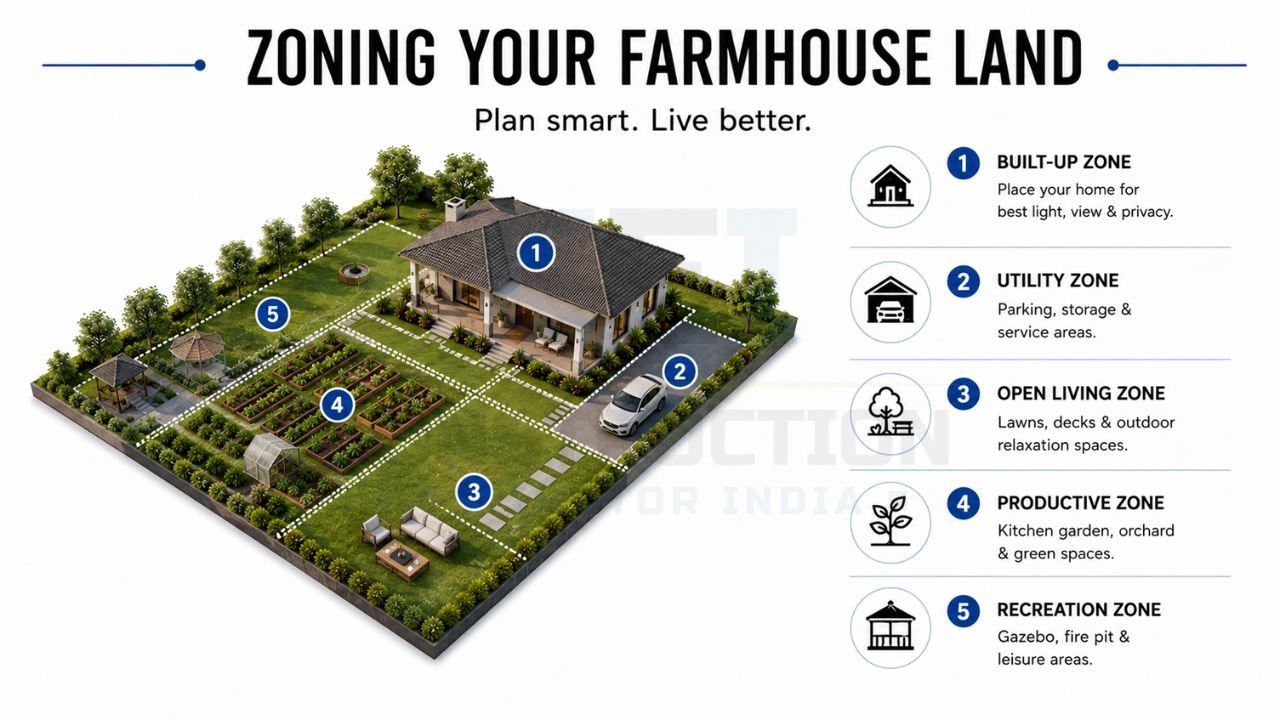
House Zone (Built Area, Veranda, Private Spaces)
The house zone is the heart of your farmhouse plan. It should be positioned to capture the best views and the prevailing breeze. In Indian climates, the “Veranda” is the most important room in the house. Understanding exactly what is RCC construction helps you plan the structural spans needed for these wide, shaded outdoor spaces.
Private spaces like bedrooms should be placed in the quietest part of the zone, away from the driveway and the outdoor party area. If you have a two-story design, the ground floor is usually for “public” functions like the living room and kitchen, while the first floor is for private retreats.
Practical Action: Ensure your veranda is at least 8 to 10 feet wide. Anything narrower feels like a corridor and won’t fit a dining table or a swing comfortably. A common mistake is building small windows to save on cost; in a farmhouse, large openings are essential for the “outdoor-in” feel. Construction Estimator India can help you understand how large spans and verandas impact your structural steel requirements.
👉 Get Customized Farmhouse Plans and Accurate Cost Estimates from Industry Experts.
Outdoor Living Zone (Lawn, Seating, Firepit, Pergola, Pool)
This zone is where the “weekend” happens. It should be an immediate extension of the living room or veranda. A well-designed farmhouse layout with garden includes different “pockets” for different times of the day. A morning tea spot facing the east, a shaded afternoon pergola, and a evening firepit zone for winters.
If you are planning a swimming pool, it needs to be in a spot that gets sun (to keep the water warm) but is also private. The pool deck should be made of non-slip, heat-resistant materials. The outdoor zone requires careful lighting to be usable at night without attracting too many insects.
Practical Action: Use local stones or bricks for seating areas to blend with the environment. If you want a pool, consider a “plunge pool” if the budget is tight. Mistake to avoid: Placing the firepit too close to dry plantation or trees. Before you finalize these features, Construction Estimator India can provide a cost comparison for different outdoor flooring and pool construction options.
Farm/Utility Zone (Cattle Shed, Storage, Vegetable Garden, Orchard)
Even if you aren’t a full-time farmer, a farmhouse plan India often includes a utility zone for a kitchen garden or fruit trees. This zone should be “downwind” if you plan to keep animals like cows or chickens to avoid smells reaching the house. It also needs a dedicated tool shed for garden equipment, fertilizers, and extra pipes.
The orchard or plantation acts as a privacy screen and a windbreak. Choosing native fruit trees like Mango, Guava, or Chiku ensures survival with minimal water. This zone needs its own irrigation layout, separate from the domestic water line.
Practical Action: Plan a “compost pit” in this zone to recycle kitchen and garden waste. Ensure there is a service path for a tractor or a small trolley to move soil or harvest. Avoid placing large trees too close to the house foundation. Construction Estimator India can help you estimate the cost of boundary walls, fencing, and basic utility structures needed for this zone.
Planning the Farmhouse Building Layout
Compact 1–2 BHK Farmhouse Plans for Small Plots
On smaller plots, a compact low-budget plan focuses on a large, open-plan living and dining area. The kitchen should be compact but functional, ideally with a door leading directly to an outdoor herb garden. Hiring certified building contractors ensures that even small spaces are executed to a high standard without material waste.
3–4 BHK Family Farmhouse for Larger Land
A larger farmhouse plan India allows for a “Courtyard” or “H-shaped” layout. This separates the guest wing from the family wing, providing privacy for everyone. The 3rd or 4th bedroom can be designed with a separate entrance, making it ideal for grown-up children or elderly parents who want their own space.
In a large family farmhouse, the kitchen becomes a social hub. Plan for a large island counter and a pantry for bulk storage, as farmhouses are often far from supermarkets. The living room should have multiple seating clusters—one for TV/movies and another for conversation facing the garden.
Practical Action: Include “attached semi-open bathrooms” for a luxury resort feel. Use wide sliding doors that can disappear into walls to merge the living room with the veranda. Mistake to avoid: Building a massive house that is hard to clean. Reach out to Construction Estimator India on WhatsApp / Call +91 8630676890 to estimate the costs of high-end finishes and larger structural spans.
Guest Rooms, Staff Room, and Flexible Multi‑use Spaces
A farmhouse often hosts more people than a city home. Guest rooms should be comfortable but low-maintenance. A “Staff Room” is essential if you have a permanent caretaker or if you hire help for the weekend. This room should have its own toilet and a small kitchenette.
Multi-use spaces like a “Mezzanine” under a sloping roof or a “Glass House” can serve as an office, a yoga studio, or an extra sleeping area for kids. These spaces add a lot of character to the weekend home farmhouse design without significantly increasing the footprint.
Practical Action: Position the staff room near the entry gate or the utility zone for better security and privacy. Use durable, easy-to-clean flooring like kota stone or oxide finish in guest and utility areas. A common mistake is forgetting a dedicated bathroom for outdoor staff/laborers. Construction Estimator India helps you plan these “ancillary” spaces within your overall budget.
Style Choices – Village, Modern, or Hybrid Farmhouse
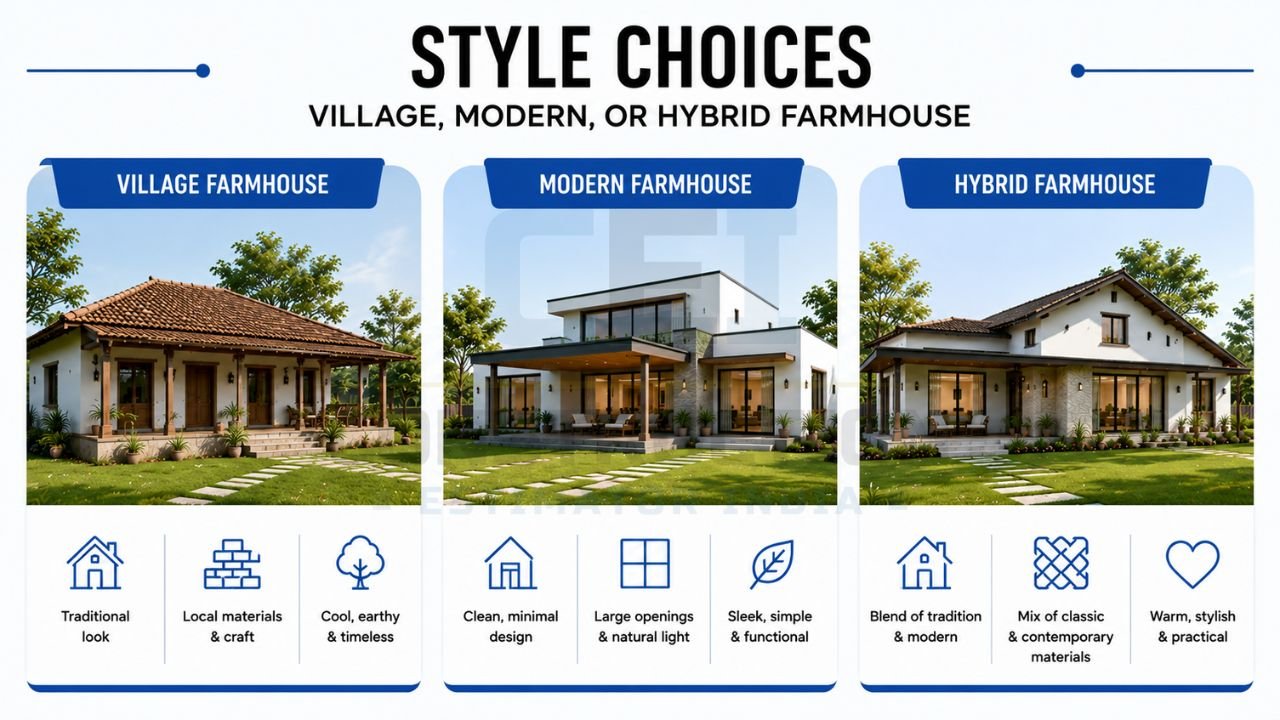
Village‑Style Farmhouse with Courtyard and Veranda
The village-style farmhouse plan is deeply rooted in Indian tradition. It typically features a central courtyard (Aangan) which acts as a natural ventilator. Thick brick or stone walls, clay tile roofs (Mangalore tiles), and wooden pillars are the hallmarks of this style. This design is excellent for thermal comfort in hot Indian summers.
This style feels “timeless” and blends perfectly into a rural landscape. It encourages a communal way of living, where the courtyard becomes the center of all activity—from drying pickles to evening storytelling.
Practical Action: Use local crafts and materials like terracotta jalis for ventilation. Ensure the courtyard has proper drainage for the monsoon. A common mistake is using cheap, non-waterproof wood for outdoor pillars which rot quickly. Construction Estimator India can help you find cost-effective local material alternatives that maintain the traditional look.
👉 Start Your Farmhouse Project with Professional Planning and Cost Analysis.
Modern Farmhouse with Large Glass, Decks, and Clean Lines
A modern farmhouse elevation uses industrial materials like steel, large glass panels, and concrete finishes. It often features flat or butterfly roofs and “cantilevered” decks that seem to float over the landscape. This style is perfect for those who want a “resort” feel and have a great view to frame.
The modern style allows for “open floor plans” and seamless transitions. However, in the Indian context, large glass panels must be high-quality (double-glazed) to prevent the house from turning into a greenhouse in the summer.
Practical Action: Use “deep overhangs” or shades to protect the glass from direct sun. Incorporate “exposed brick” or “stone cladding” to add warmth to the modern lines. Mistake to avoid: Using too much glass on the west-facing wall, which will make the AC bills skyrocket. Construction Estimator India can provide cost breakdowns for specialized modern materials like UPVC windows and structural steel.
Blending Traditional and Modern Elements for Comfort
The “Hybrid” style is increasingly popular in India. It takes the soul of a village house—like a sloping roof and a veranda—and combines it with modern comforts like large ensuite bathrooms and a modular kitchen. You might see a traditional heavy wooden main door paired with sleek minimalist furniture.
This style offers the best of both worlds: the “cozy” feeling of a farm and the “functional” ease of a city home. It allows for creative use of materials, such as using old reclaimed wooden beams in a modern living room.
Practical Action: Keep the shell traditional for better climate response but make the interiors modern for ease of use. Invest in high-quality hardware for doors and windows. A common mistake is a “mismatch” of styles where the house looks like a confused patchwork. Construction Estimator India can help you estimate the budget and compare different layout options for hybrid designs.
Structural, Climate, and Maintenance Considerations
Climate‑Responsive Design (Sun, Wind, Rain)
India has diverse climates, and your farmhouse plan India must respond to local conditions. In high-rainfall areas like Kerala or Konkan, steep sloping roofs and wide eaves are mandatory to protect walls from dampness. In hot and dry regions like Rajasthan, thick walls and small openings on the exterior with a cooling central courtyard work best.
Wind direction is also vital. You want the “cool breeze” to enter the living areas but you must be able to “shut down” the house during dust storms or heavy monsoons. Orientation is the cheapest way to save on energy; placing the long side of the house along the North-South axis minimizes heat gain.
Practical Action: Study the path of the sun on your plot during different seasons. Use “cross-ventilation” by placing windows on opposite walls. A common mistake is building a “flat roof” in a high-rainfall zone without proper waterproofing. Construction Estimator India provides support for basic structural awareness and climate-specific material choices.
Material Choices and Long‑Term Durability
Since a farmhouse is often in a remote location, getting repairs done is difficult. Therefore, your material choices should prioritize “durability” and “weathering.” For example, using “exposed brick” or “natural stone” on the exterior is better than paint, which fades and peels in the sun and rain.
Inside, choose flooring that can handle a bit of mud and dust—because people will be walking in from the farm. Natural stones like Granite, Kota, or Tandur are much better than polished vitrified tiles which show every footprint.
Practical Action: Use high-quality external grade electrical fittings and plumbing pipes to avoid frequent leakages. Invest in termite-proofing the foundation and any wooden elements. Mistake to avoid: Using “indoor-grade” materials for the veranda or patio. Construction Estimator India offers material estimation and quantity takeoffs to ensure you buy the right grade of cement and steel.
Easy Maintenance for an Occasionally Used Property
A farmhouse is often locked up for days or weeks. The design must be “low maintenance” and “secure.” Avoid complex water features that can become mosquito breeding grounds if not cleaned daily. Use “mesh screens” on all windows to keep out insects while allowing air to circulate.
Security is also a concern. Plan for robust “collapsible gates” or high-quality shutters that don’t ruin the look of the house but provide peace of mind when you are away in the city. Remote-monitored CCTV and smart locks are also great additions.
Practical Action: Choose plants for the garden that are “hardy” and don’t require daily pruning. Ensure the roof drainage is clear so dry leaves don’t block the pipes. A common mistake is having too many “hidden corners” where dust and cobwebs accumulate. Construction Estimator India can help you plan for self-construction with maintenance-friendly materials.
Cost Planning and Budgeting for a Farmhouse
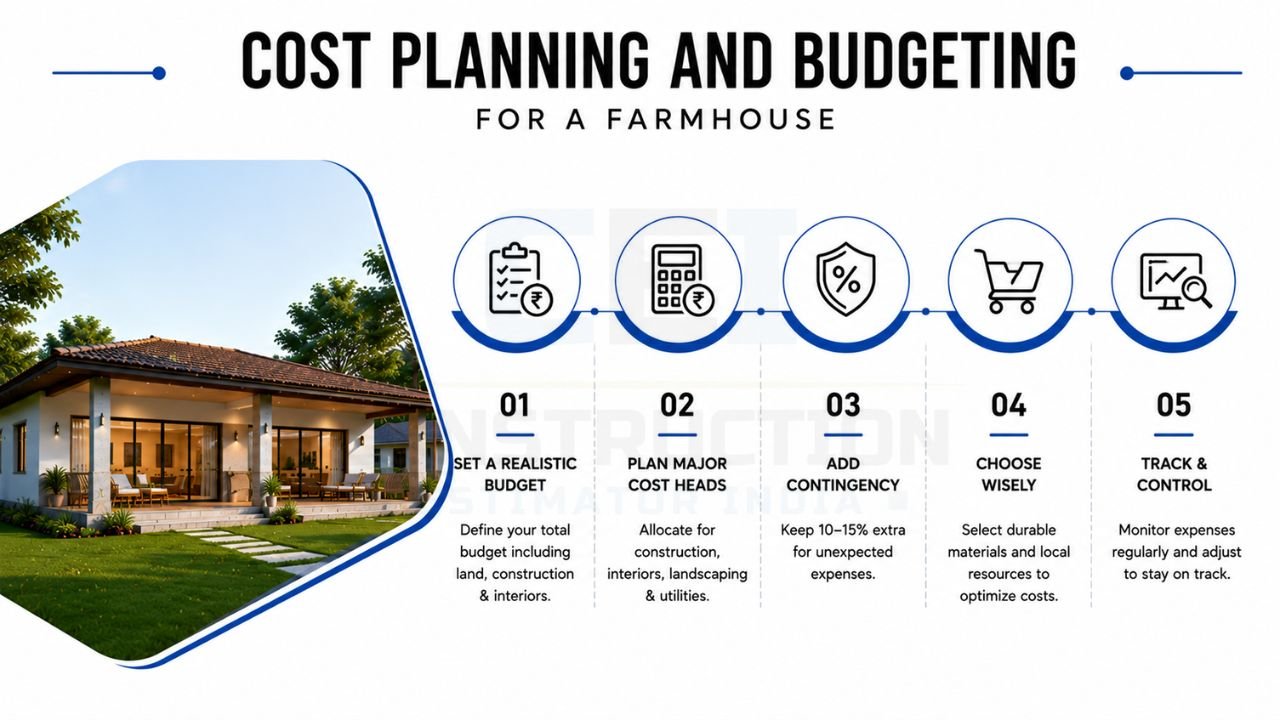
Major Cost Drivers in Farmhouse Construction
The cost of building a farmhouse in India is influenced by three main factors: Location, Specifications, and Scale. Being in a remote location increases the “transportation cost” of materials and the “mobilization cost” of labor. If your site is 50km from the nearest city, expect a 10-15% premium on material delivery.
Specifications—like the type of flooring, the quality of windows, and the roofing system—can double the cost even if the area remains the same. A simple RCC slab is cheaper than a high-end Mangalore tile roof with a wooden under-structure.
Practical Action: Create a “priority list.” Spend more on the “bones” (foundation, walls, roof) and “services” (plumbing, electrical) and save on “cosmetics” (expensive lights, fancy paint) which can be upgraded later. Construction Estimator India helps owners understand these hidden cost drivers before they start digging.
👉 Build Smarter with Expert Farmhouse Design and Construction Solutions.
Built‑up Area vs Landscape Development Cost
A common trap in farmhouse plan India budgeting is only counting the cost of the “rooms.” In a farmhouse, the “Landscape” (lawns, paths, boundary wall, gate, lighting, irrigation) can easily account for 20% to 40% of the total budget.
A 1,000 sq. ft. house might cost ₹20 lakhs to build, but the boundary wall and gate for a 1-acre plot could cost another ₹10 lakhs. If you don’t budget for the outdoors, you will end up with a nice house sitting in a dusty, unfinished wasteland.
Practical Action: Budget for the landscape simultaneously with the house. If the budget is tight, develop the landscape in phases, starting with the area immediately around the house. A common mistake is neglecting the cost of the boundary fence. Construction Estimator India can help you estimate the budget and compare different layout options for both house and land.
How Construction Estimator India Helps With Quantity and Cost Estimation?
Before you finalise your farmhouse plan, you need an “expert second opinion” on the numbers. Construction Estimator India provides forensic-level quantity takeoffs. This means they tell you exactly how many bags of cement, tons of steel, and cubic feet of sand you need.
This data prevents “over-billing” by contractors and helps you negotiate better rates with suppliers. They also provide a Bill of Quantities (BOQ) which you can use to get competitive quotes from different builders, ensuring you get an “apples-to-apples” comparison.
Practical Action: Don’t rely on “per square foot” thumb rules. They are almost always wrong for farmhouses. Instead, send your drawings to Construction Estimator India for a detailed estimate. If you want to understand realistic construction costs for your land, you can contact Construction Estimator India on WhatsApp / Call +91 8630676890 for practical estimation support.
Common Mistakes People Make with Farmhouse Plans
Overbuilding the House and Underusing the Land
Many people build a massive 4-5 bedroom house and then realize they spend all their time on the veranda. They use up their entire budget on “indoor space” and have nothing left for the garden, the pool, or the orchard—the very reasons they bought a farm in the first place.
This results in a high maintenance bill and a property that feels like a suburban house rather than a farmhouse. It also makes the house harder to cool and clean.
Practical Action: Keep the indoor footprint small and the outdoor “covered” areas (verandas, decks) large. Think about how many people will actually sleep over regularly. A common mistake is building for the “once a year” family reunion. Construction Estimator India helps you balance your built-up area versus open landscape to maximize your ROI.
Poor Zoning of Parking, Services, and Quiet Areas
Placing the “generator” or “staff toilet” right next to the master bedroom window is a classic zoning mistake. Another common error is placing the “parking” in a way that blocks the primary view of the garden from the living room.
If the “active” zone (pool/lawn) is too far from the kitchen, it becomes a logistical nightmare to serve snacks and drinks during a party. Zoning is about “flow” and “functional proximity.”
Practical Action: Draw “bubbles” on your plot layout for “Noise,” “Peace,” “Service,” and “Activity.” Ensure they don’t overlap in annoying ways. Mistake to avoid: Placing the main entry gate too close to a blind curve on the access road. Contact Construction Estimator India to discuss your layout options before you finalize the plan.
Ignoring Water Management and Access Paths
In the excitement of designing the house, many people forget about “rainwater” and “walkways.” Without proper drainage, a beautiful lawn can turn into a swamp during the monsoon. Similarly, if you don’t plan permanent paths, you will end up with muddy tracks all over your property.
Access paths should be wide enough for two people to walk side-by-side and should be made of “permeable” materials that allow water to soak into the ground rather than running off.
Practical Action: Plan for “rainwater harvesting” from the start—it’s a requirement in many states and great for your borewell. Create “natural swales” or slopes to direct water away from the house. A common mistake is building the house at the lowest point of the plot. Construction Estimator India provides guidance on planning these essential site services.
Planning for Future Expansion and Uses
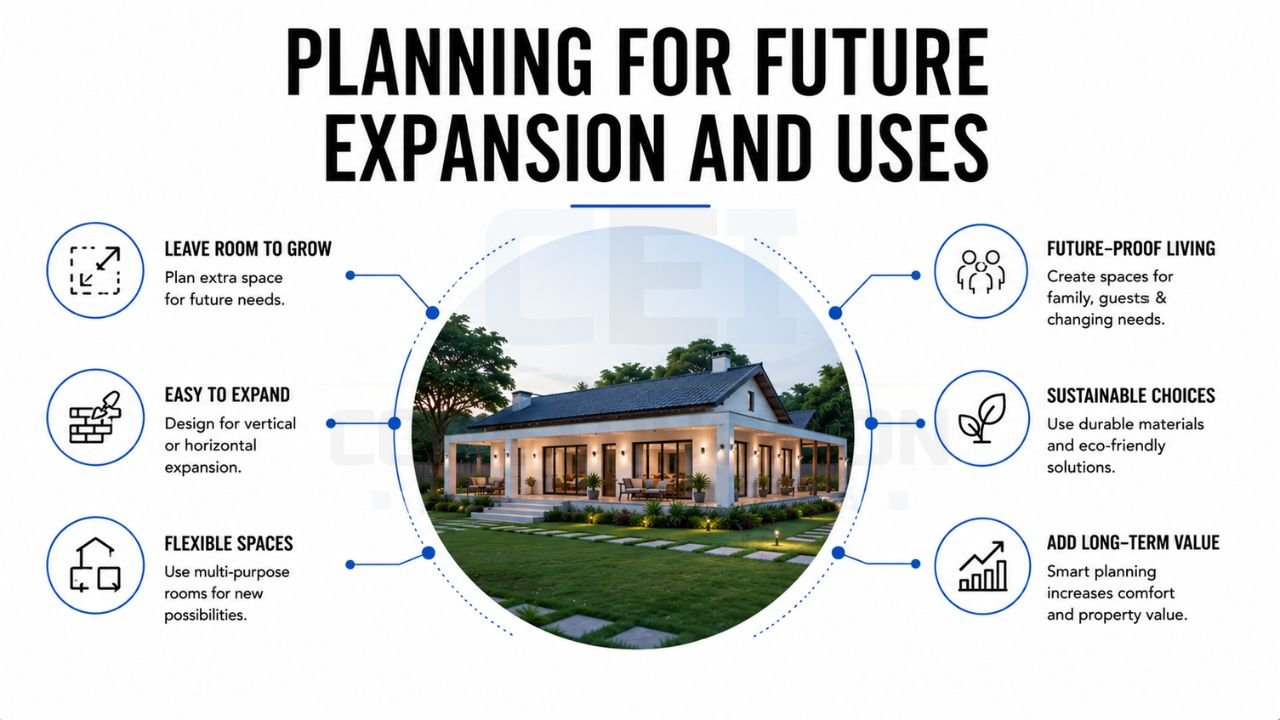
Scope for Adding More Rooms or Amenities Later
Your needs might change in 5 to 10 years. A good farmhouse plan India is “future-proof.” This means designing the foundation to support an extra floor or placing the house in a way that leaves room for a future guest cottage or a swimming pool.
Even if you don’t build everything today, mark these “future zones” on your master plan. This prevents you from planting a permanent tree or laying a main pipe exactly where you might want a pool later.
Practical Action: Lay “dummy pipes” or conduits to future zones now—it costs very little during initial construction but saves thousands in digging costs later. Use a “modular design” that can be extended easily. Construction Estimator India can help you estimate the cost of “phased construction” so you can plan your cash flow.
👉 Bring Your Dream Farmhouse to Life with Trusted Construction Experts.
Considering Rental, Events, or Agritourism Use
If you plan to rent out your farmhouse on platforms like Airbnb, the design needs to be “rugged” and “photogenic.” You will need a lockable “owner’s closet” to keep your personal belongings and perhaps a more robust kitchen that can handle different guests.
For hosting events like small weddings or corporate retreats, you need to plan for extra parking, a larger outdoor toilet block, and a dedicated “catering service area” that is hidden from the guests.
Practical Action: Invest in “Instagrammable” features like an outdoor shower or a unique fireplace. Ensure your “Guest Wing” has a high degree of acoustic privacy. A common mistake is not having enough bathrooms for day-guests. Construction Estimator India can provide ROI analysis for those looking at their farmhouse as a business.
Keeping Services (Plumbing, Electrical) Flexible and Accessible
Don’t bury all your pipes and wires under concrete. In a farmhouse, things break, and you need to be able to fix them without breaking your house. Use “service ducts” or “exposed plumbing” (designed aesthetically) for easier maintenance.
Keep a “Map of Services” showing exactly where the underground pipes, cables, and septic tank are located. Future owners or even you, 10 years later, will thank you for this.
Practical Action: Use high-quality “Manhole Covers” that are easy to open. Place the main electrical panel in an accessible but protected spot. Mistake to avoid: Planting trees with “invasive roots” near your sewage lines. Reach out to Construction Estimator India on WhatsApp / Call +91 8630676890 for support in planning these critical backend systems.
FAQs: Farmhouse Plan India
What plot size is ideal for a basic farmhouse in India?
For a basic farmhouse with a small garden and a couple of trees, even a 5,000 to 10,000 sq. ft. plot is sufficient. However, for a “true” farm feel with an orchard and complete privacy, 1 acre (approx. 43,560 sq. ft.) is considered ideal.
Can I build a low‑budget farmhouse on a small plot?
Yes, by focusing on a compact 1 BHK or studio layout and using local materials like exposed brick and stone, you can create a beautiful low budget farmhouse plan. The key is to minimize the built-up area and maximize the usable outdoor space.
How much open land should I keep around the farmhouse?
In most Indian states, farmhouse regulations require you to leave a large percentage (often 80% to 90%) of the land as open/green space. Practically, you should try to keep at least 60-70% of your plot open to maintain the farmhouse aesthetic.
How do I estimate the budget for my farmhouse plan?
The best way is to get a detailed Bill of Quantities (BOQ) based on your specific drawings. You can contact Construction Estimator India to get a forensic-level breakdown of material quantities and costs customized for your location.
When should I contact an estimator like Construction Estimator India during planning?
The best time is before you finalize your architectural drawings. An estimator can tell you if your design is exceeding your budget, allowing you to make changes on paper rather than face expensive surprises during construction.
Do I need a boundary wall for my farmhouse?
A boundary wall or a very strong fence is highly recommended for security and to prevent encroachment. On large plots, many people use a mix of a solid wall near the entry and “chain-link fencing” with a thick hedge for the rest of the perimeter to save costs.
Conclusion: Plan Your Farmhouse for Nature, Comfort, and Budget
Designing a farmhouse plan India is a journey of creating a sanctuary. It requires a thoughtful understanding of your land, a clear vision of your lifestyle, and a disciplined approach to budgeting. From zoning the “House Zone” to choosing between a “Village” or “Modern” style, every decision impacts your long-term happiness and the maintenance of the property.
Early cost planning is the most important step to ensure your dream doesn’t turn into a financial burden. By understanding the “why” behind every rupee spent—from foundation to the final tree in your orchard—you can build a legacy that your family will enjoy for generations.
If you are planning a farmhouse on your land in India and want help estimating construction cost, quantities, and practical layout options, you can contact Construction Estimator India on WhatsApp / Call +91 8630676890 before you finalise your farmhouse plan.