
A G+1 house plan refers to a residential building consisting of a ground floor and one upper floor. This configuration is the most popular choice for Indian families as it maximizes living space on smaller plots while offering privacy and a prestigious “independent villa” feel.
Effective planning of a G+1 house plan, guided by a solid understanding of how to plan home construction in India, significantly impacts your daily comfort, long-term maintenance costs, and the ability to expand in the future. Construction Estimator India specializes in helping homeowners estimate realistic construction costs and material quantities for G+1 projects to ensure financial discipline from day one.
If you are considering a G+1 house plan and want to know how much it could cost on your plot, you can contact Construction Estimator India on WhatsApp / Call +91 8630676890.
👉 Planning a G+1 House? Get Expert Guidance for Design, Budget, and Construction.
Understand What a G+1 House Plan Involves
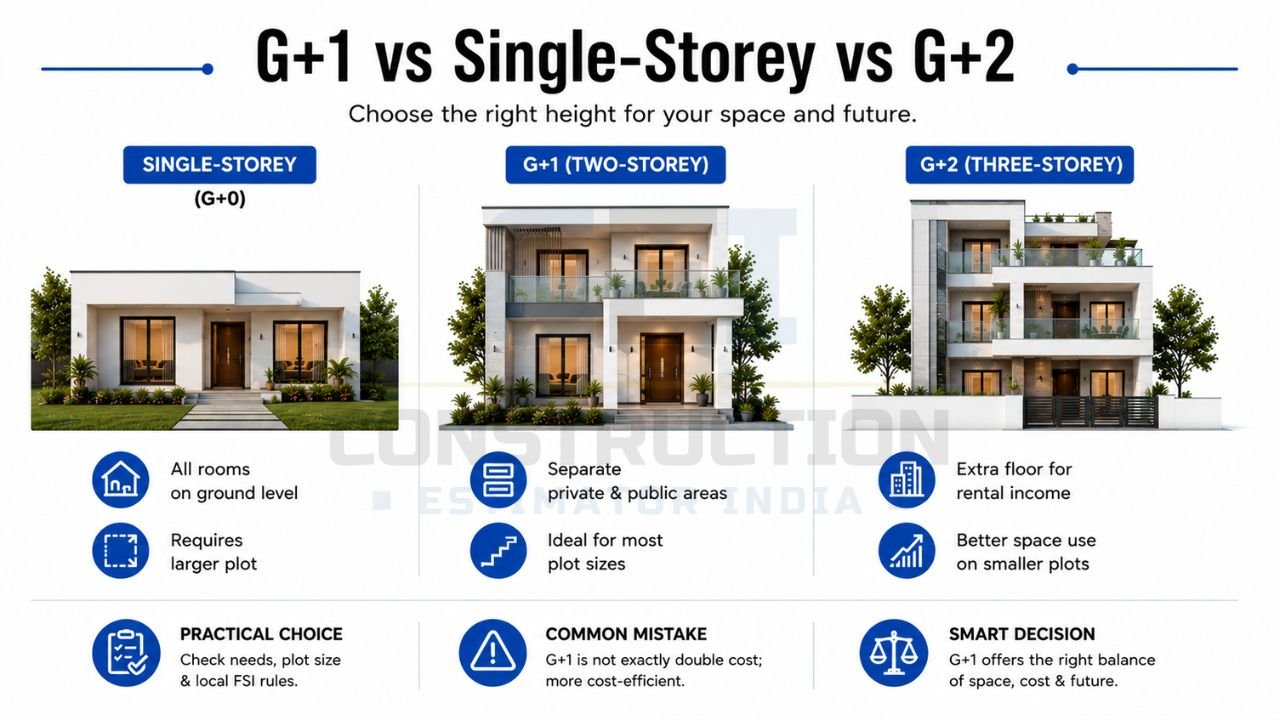
G+1 vs Single-Storey vs G+2
A G+1 house plan, often referred to as a duplex or a two-storey house, involves constructing two vertical levels of living space. In contrast, a single-storey (G+0) house places all rooms on the ground level, which requires a much larger plot to achieve the same number of rooms. A G+2 structure adds a second upper floor, often used for rental income or larger extended families.
Choosing a G+1 house plan matters because it allows you to separate public areas from private quarters efficiently. For example, you can have a spacious living and dining area on the ground floor while keeping bedrooms on the first floor for quietness.
Practical Actions:
- Assess your current and future room requirements (e.g., 3BHK or 4BHK).
- Compare your plot size against the required built-up area; if your plot is under 1,500 sq ft, G+1 is often necessary for a 3-bedroom home.
- Check local Floor Space Index (FSI) rules to see how much total area you are allowed to build.
Common Constraints: In many Indian municipalities, height limits or FSI restrictions might limit your ability to go beyond G+1 without specific permissions.
Common Mistake: Homeowners often assume a G+1 house costs exactly double a single-storey house. In reality, while the slab and wall costs repeat, the foundation and roofing costs are shared, often making G+1 more “per-square-foot” efficient for larger total areas.
Construction Estimator India can provide a comparative cost analysis between single-storey and G+1 options for your specific plot size.
Typical Use Pattern in G+1 Homes (Ground vs First Floor Functions)
The “zoning” of a G+1 house plan is critical for a smooth lifestyle. Typically, the ground floor serves as the social hub, containing the parking, living room, kitchen, and a guest bedroom or elderly-friendly room. The first floor is reserved for the master suite, children’s rooms, and a family lounge.
This separation matters because it prevents guests from intruding into private family spaces and allows for better noise control. If children are studying upstairs, they won’t be disturbed by a television or guests on the ground floor.
Practical Actions:
- Designate the ground floor for “high-traffic” zones.
- Ensure at least one bedroom is on the ground floor for elderly parents who may struggle with stairs.
- Plan for a “double-height” living room if you want a grand, luxury feel, though this reduces the first-floor floor area.
Common Mistake: Failing to provide a bathroom on the ground floor that is accessible to guests without passing through a bedroom.
Common Constraints: On very small plots, you may be forced to move the kitchen or dining to the first floor to accommodate parking, which can be inconvenient for daily grocery hauling.
👉 Turn Your G+1 House Plan into a Beautiful and Well-Planned Home.
When a G+1 House Plan Makes Sense for Your Family?
A G+1 house plan is ideal when you have a plot size ranging from 800 to 2,400 sq ft and need more than two bedrooms. It is also the perfect choice for families who want to maintain a garden or parking area on the ground level while still having a large home.
It provides a “future-ready” framework. Even if you don’t need five bedrooms today, a G+1 structure allows you to have a dedicated home office or a gym on the upper floor that can later be converted into a child’s room.
Before you finalize your G+1 house plan with top architects and architecture firms, Construction Estimator India can help you estimate the budget and compare different layout options. Reach out on WhatsApp / Call +91 8630676890.
Practical Actions:
- Evaluate your family’s lifestyle—do you host many guests? If yes, a G+1 layout with a guest suite on the ground floor is best.
- Consider the age of family members; G+1 provides the necessary separation for adult children seeking privacy.
- Identify if you want to use the upper floor for rental income in the future.
Common Mistake: Building a massive ground floor that leaves no space for setbacks or a small garden, whereas a G+1 would have allowed for more open space.
Common Constraints: Budget is the primary constraint; a G+1 requires a more robust foundation designed for two-storey loads.
Before you finalize your G+1 house plan with the architect, Construction Estimator India can help you estimate the budget and compare different layout options. Reach out on WhatsApp / Call +91 8630676890.
Study Your Plot Size, Shape, and Basic Regulations
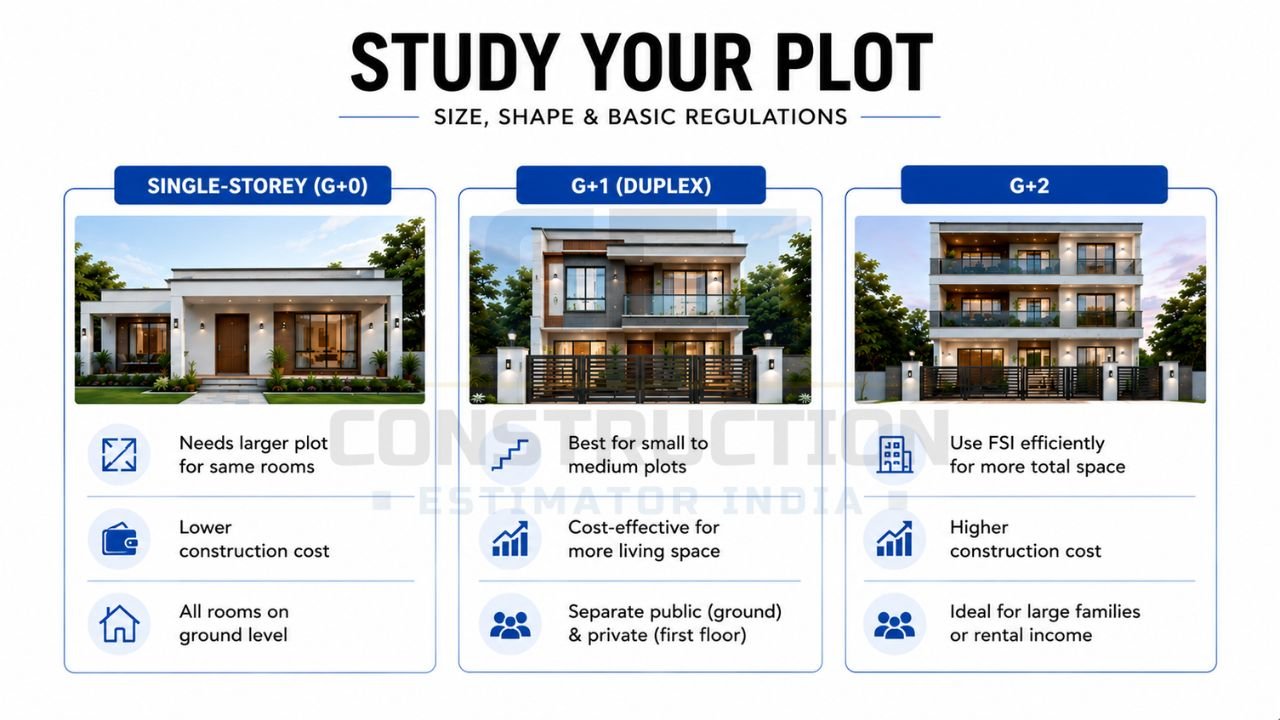
Common Plot Sizes and Their G+1 Potential
In India, typical residential plots come in sizes like 20×40 ft (800 sq ft), 30×40 ft (1,200 sq ft), or 30×50 ft (1,500 sq ft). A G+1 house plan on a 30×40 plot can comfortably offer a 3BHK or 4BHK layout with parking.
Understanding your plot size matters because it dictates the maximum “footprint” your house can have. For example, on a 20×40 plot, you must build vertically (G+1) to have a decent living room and three bedrooms while still leaving space for a car.
Practical Actions:
- Measure your plot boundaries accurately before starting the design.
- For a 30×40 plot, aim for a ground floor built-up area of about 800-900 sq ft to allow for setbacks.
- Consult a professional to see how your plot shape (rectangular, L-shaped, or irregular) impacts structural costs.
Common Mistake: Planning a house based on a “standard” plan without checking if it fits the actual dimensions and orientation of your specific plot.
Common Constraints: Narrow plots (less than 20 ft wide) make it difficult to include a side staircase or a wide car porch.
👉 Build Your G+1 Home with Accurate Planning and Professional Support.
Setbacks, Road Width, and Height Limits (Simple Awareness)
Setbacks are the mandatory open spaces you must leave between your house walls and the plot boundary. These are required by law for fire safety, ventilation, and light, often following guidelines set by the Town and Country Planning Organisation (TCPO). Road width often determines how high you can build; a wider road might allow for a G+2 or G+3 structure later.
This matters because violating setback rules can lead to legal notices from municipal authorities or even demolition of the extended parts. Furthermore, proper setbacks ensure your G+1 house plan has windows that actually let in light rather than just facing a neighbor’s wall.
Practical Actions:
- Check your local building bylaws for the required front, rear, and side setbacks.
- Ensure your balconies do not overhang into the mandatory setback area unless permitted.
- Plan your drainage and plumbing lines within these setback zones for easy maintenance.
Common Mistake: Building right up to the edge of the plot to “maximize space,” which results in a dark, poorly ventilated home and legal risks.
Common Constraints: In densely populated urban areas, small plots may have very restrictive setback requirements that limit the actual buildable area significantly.
How Plot Constraints Shape Your G+1 Layout?
Your plot’s orientation (North, East, West, South) and the location of the access road will dictate where your main entrance and parking must go. In a G+1 house plan, the placement of the staircase is often the first decision made because it connects the two levels and influences the flow of both floors.
Plot constraints matter because they force you to prioritize certain rooms. If your plot faces a noisy main road, you might place the bedrooms at the rear of the first floor for peace.
Practical Actions:
- Identify the “best” side for light and air (usually North or East) and place your living room and balconies there.
- Determine if you need an internal or external staircase; an external one allows the first floor to be a separate rental unit.
- Ensure the parking area doesn’t block the main entry “path of travel” into the house.
Common Mistake: Ignoring the sun’s path; placing large glass windows on a West-facing wall in India will make the house incredibly hot in the afternoon.
You can share your plot size, city, and basic requirements with Construction Estimator India to get a rough idea of construction cost and quantity takeoff for your G+1 home.
Plan Ground Floor Spaces in a G+1 House
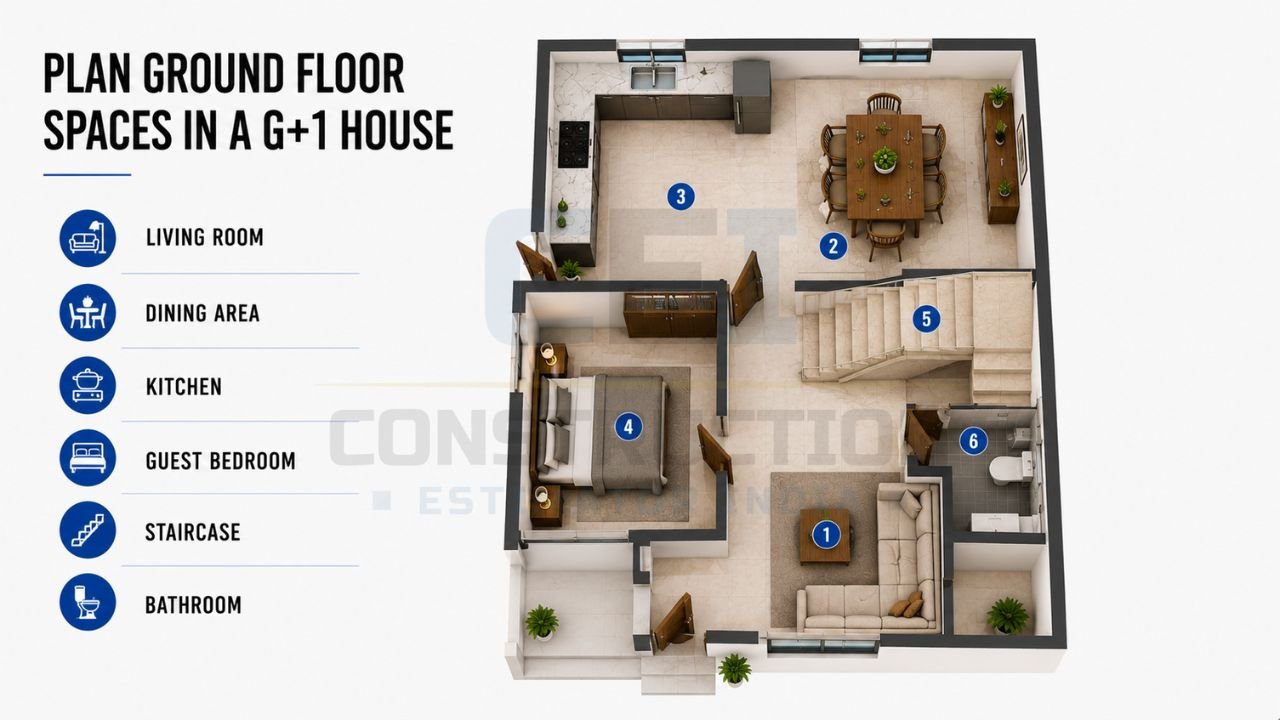
Parking, Entry, and Outdoor Area
The ground floor entry sets the tone for the entire home. In a G+1 house plan, you must balance the space needed for a car (typically 10×15 ft minimum) with an inviting main entrance. If space permits, a small garden or “verandah” adds immense value to the living experience.
This matters because the parking area is often the first thing people see. Poorly planned parking can make it difficult to maneuver a car or block the main door, making the house feel cramped and disorganized.
Practical Actions:
- Dedicate a clear “porch” area that is at least 11 feet wide if you plan to park an SUV.
- Create a “transition space” like a foyer so guests don’t walk directly from the street into your private dining area.
- Use the setback areas for small planters or a walkway to the backyard.
Common Mistake: Not calculating the “swing” of the car gate, which might hit the car or obstruct the pedestrian entry.
Common Constraints: On 20×40 plots, the parking area often eats up 25% of the ground floor area, forcing a smaller living room.
👉 Get Customized G+1 House Plans and Cost Estimates from Industry Experts.
Living Room, Kitchen, Dining, and One Bedroom/Guest Room
The heart of a G+1 house plan is the ground floor living zone. An “open-concept” layout where the living, dining, and kitchen flow into each other makes a small plot feel much larger. Including one bedroom on this floor is essential for guests or elderly family members.
This matters for long-term “age-in-place” living. If you or your parents cannot climb stairs due to injury or age, having a full-functioning ground floor (kitchen, bath, bed) ensures the house remains usable.
Practical Actions:
- Place the kitchen near the dining area for convenience.
- Ensure the ground floor bedroom has easy access to a bathroom with a wide door (for potential wheelchair access).
- Plan for a “Utility Area” or “Wash Area” attached to the kitchen for heavy cleaning tasks.
Common Mistake: Making the kitchen too small to accommodate modern appliances like a double-door fridge, dishwasher, and microwave.
Common Constraints: In many North Indian homes, a separate “drawing room” for formal guests is preferred, which can make the layout feel fragmented if the plot is small.
Staircase Position from Ground Floor
The staircase is the most important structural and functional element in a G+1 house plan. Its position determines whether the floors are “connected” (internal stairs) or “independent” (external stairs). Popular locations include the living room (for a grand look) or near the entrance (for privacy/rental).
This matters because the staircase consumes a significant amount of “dead space” (usually 60-80 sq ft per floor). If placed poorly, it can create awkward corners or block natural light from reaching the center of the house.
Practical Actions:
- Choose a U-shaped or L-shaped staircase for better space efficiency in small homes.
- Consider using the space under the staircase for a powder room (small toilet) or a storage closet.
- Ensure the “riser” height is no more than 6-7 inches for comfortable climbing.
Common Mistake: Placing the staircase in a way that it cuts through the middle of a room, ruining the furniture layout.
Common Constraints: If you plan for a lift later, you must leave a “shaft” space (approx 5×5 ft) near the staircase from day one.
Construction Estimator India provides guidance on planning built-up area, number of rooms, and floor layout in line with your budget.
Plan First Floor Spaces
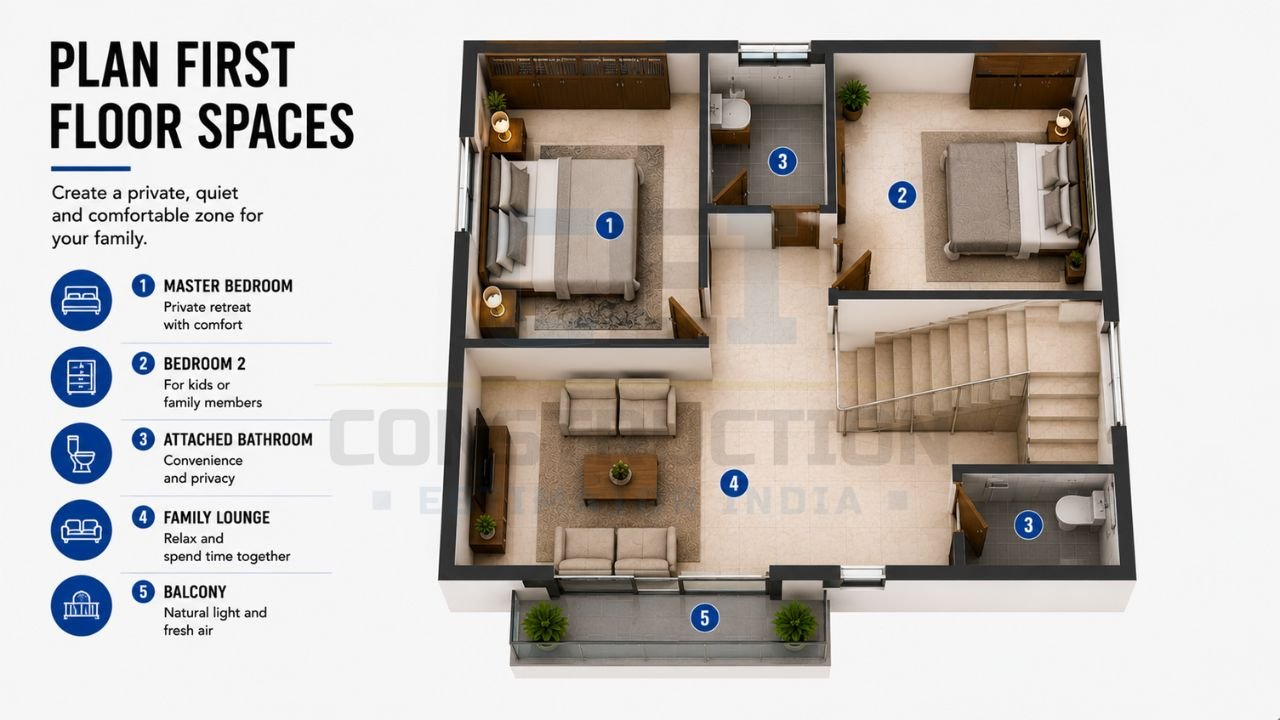
Master Bedroom, Children’s Bedroom, and Common Area
The first floor of a G+1 house plan is typically the “private zone.” It should house the master bedroom—usually the largest room with an attached balcony and a walk-in wardrobe—and bedrooms for children. A small “family lounge” or “study nook” here provides a quiet space away from the ground floor activities.
This matters because it creates a sanctuary for the nuclear family. Having all immediate family bedrooms on the same floor is often preferred by parents with young children for safety and proximity during the night.
Practical Actions:
- Position the master bedroom to face the best view or the most private part of the plot.
- Ensure each bedroom has its own attached bathroom to increase the home’s resale value.
- Include enough power points for study desks and charging gadgets in the children’s rooms.
Common Mistake: Not providing a “common” area on the first floor, forcing family members to go to their individual rooms immediately, which reduces family interaction.
Common Constraints: Large bedrooms on the first floor can lead to “cantilevered” slabs (overhanging parts), which increase structural costs due to extra steel reinforcement.
👉 Start Your G+1 House Project with Expert Planning and Cost Analysis.
Balconies, Terrace Access, and Utility Spaces
Balconies are the “lungs” of a G+1 house plan. They provide a connection to the outdoors and are essential for ventilation. Additionally, the first floor must provide a safe and easy way to access the terrace (the roof of the first floor) for maintenance of water tanks and solar panels.
This matters for lifestyle and maintenance. In the Indian climate, a shaded balcony is a favorite spot for morning tea. Access to the terrace is vital for drying clothes or hosting small gatherings.
Practical Actions:
- Ensure balconies have proper drainage to prevent rainwater from entering the bedrooms.
- Use high-quality railings (stainless steel or toughened glass) for safety and aesthetics.
- Plan the terrace door so it is easily accessible but secure against intruders.
Common Mistake: Building very narrow balconies (less than 3 feet) that are essentially useless for sitting or keeping plants.
Common Constraints: In many cities, balconies that extend beyond a certain limit are counted towards the FSI, which might reduce your internal room sizes.
Privacy and Noise Considerations Between Floors
One of the biggest advantages of a G+1 house plan is the ability to manage noise. However, without proper planning, sounds from the ground floor (like a loud TV or kitchen clatter) can travel up the staircase “well” and disturb those on the first floor.
This matters for the mental well-being of the residents. A home should offer quiet zones. Privacy is also about “line of sight”—ensure that the first-floor bedroom doors are not directly visible from the ground-floor living area when looking up the stairs.
Practical Actions:
- Use “solid core” wooden doors for bedrooms to provide better sound insulation.
- Consider adding a door at the top or bottom of the staircase if you want to completely seal off the floors for noise or cooling (AC) efficiency.
- Place the children’s study area away from the staircase opening.
Common Mistake: Designing a “cut-out” or “void” in the first floor for a double-height ceiling without realizing it will amplify every sound from the ground floor throughout the house.
If you are planning a G+1 house and want to understand realistic construction costs for your plot, you can contact Construction Estimator India on WhatsApp / Call +91 8630676890 for practical estimation support.
Variations in G+1 House Plans for Different Needs
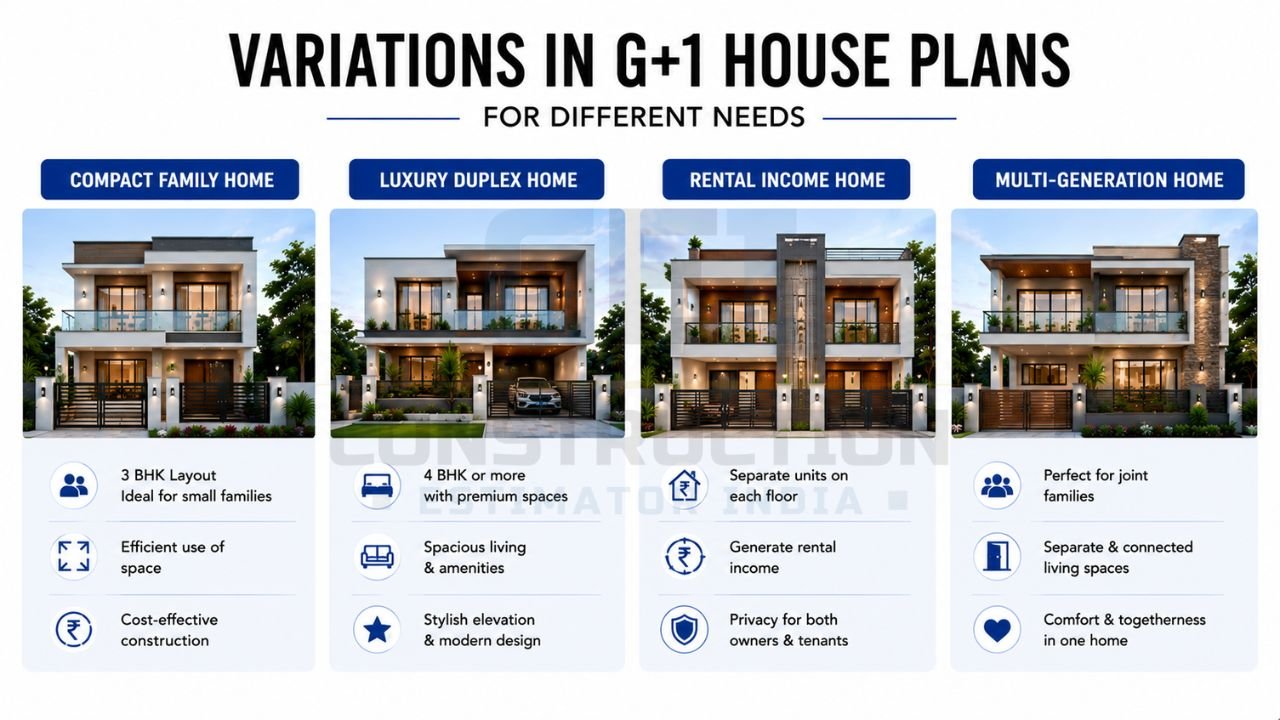
Compact G+1 for Smaller Plots
On plots smaller than 1,000 sq ft, a compact G+1 house plan focuses on vertical efficiency. You might have only the living, kitchen, and one small bath on the ground floor, with two bedrooms and two baths on the first floor. This “skinny” house approach is common in urban centers.
This matters because it proves you don’t need a massive plot to have a comfortable 2BHK or 3BHK home. By building up, you maximize your investment in the land.
Practical Actions:
- Use “sliding doors” to save space in small rooms.
- Opt for a straight-flight or spiral staircase if space is extremely tight.
- Maximize vertical storage with floor-to-ceiling wardrobes.
Common Mistake: Cramming too many rooms into a small plot, resulting in “cabin fever” where every room feels like a box without light.
Common Constraints: Small plots often have “shared walls” with neighbors, which restricts where you can place windows.
👉 Build Smarter with Professional G+1 House Design and Construction Guidance.
Larger G+1 With Multiple Balconies and Family Area
For plots over 2,000 sq ft, a G+1 house can be a luxurious “independent villa.” This allows for a grand foyer, a dedicated pooja room, multiple balconies for every bedroom, and a large home theater or gym on the first floor.
This matters because it significantly increases the property’s luxury appeal and lifestyle quality. It allows for “Hero Features” like a large deck or a semi-open courtyard (angan).
Practical Actions:
- Focus on 2-3 “Hero Features” like a grand entry door or a double-height glass wall.
- Ensure the “flow” between indoor and outdoor spaces is seamless.
- Plan for a large master suite with a walk-in closet and a “four-fixture” bathroom (shower, tub, two sinks).
Common Mistake: Over-complicating the layout with circular walls or too many levels, which makes construction and maintenance incredibly expensive.
G+1 With Rental or Home Office Component
Many Indian homeowners design their G+1 house plan so the first floor (or a portion of it) can function independently. This is done by providing an external staircase and separate utility meters. Alternatively, a “Work from Home” cabin can be built on the first floor or terrace.
This matters for financial flexibility. A rental unit on the first floor can help pay off the home loan. A dedicated office space is essential in the modern “hybrid work” era.
Practical Actions:
- Include provisions for separate plumbing and electrical lines from day one.
- Ensure the “Home Office” has enough plug points and internet cabling (LAN).
- Check local “Use of Land” rules to ensure your home office doesn’t violate residential bylaws.
Common Mistake: Not providing a separate entrance for the rental unit, which compromises the owner’s privacy.
Construction Estimator India helps homeowners estimate construction costs and quantities for G+1 houses with rental or office components.
Structural, Staircase, and Safety Considerations
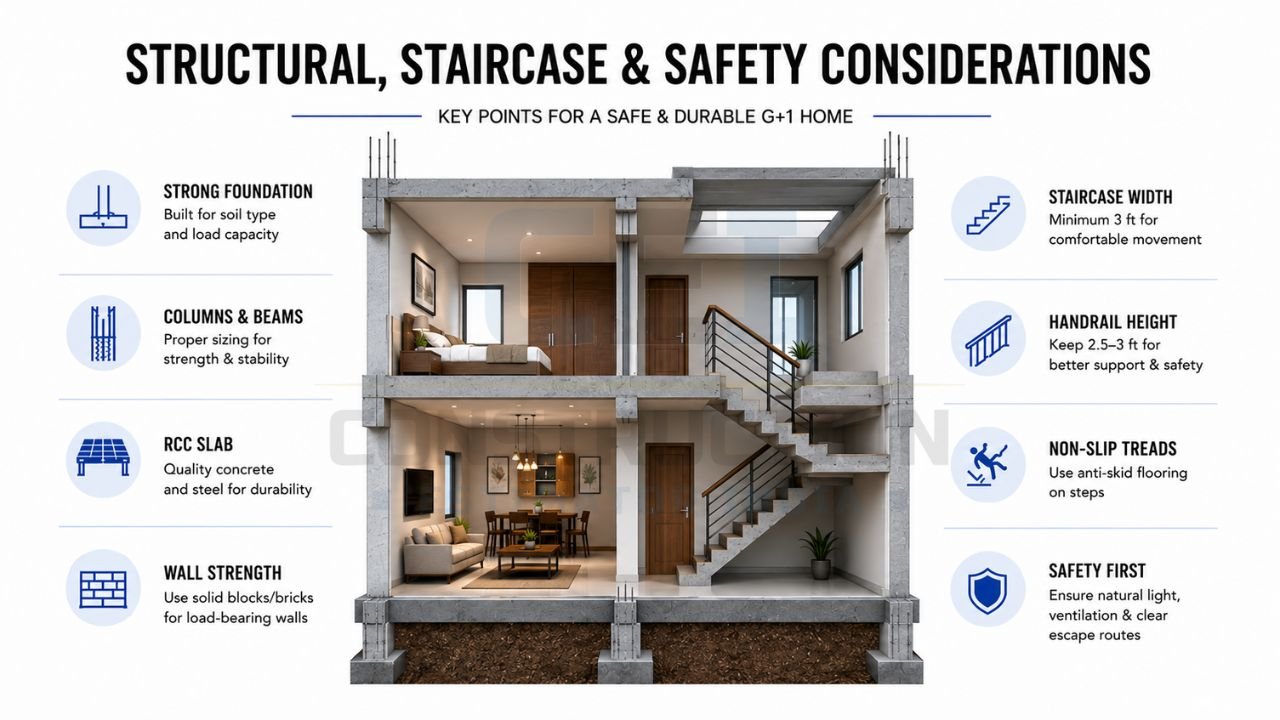
Basic Structural Thinking for Two Floors
A G+1 house plan requires an RCC (Reinforced Cement Concrete) frame consisting of a foundation, columns, beams, and slabs. Understanding exactly what is RCC construction and the difference between RCC and brick construction in India is essential for this multi-level approach.
Unlike a single-storey house, the ground-floor columns must be strong enough to carry the weight of the first floor. It is recommended to use at least Fe500D grade TMT steel (from reputable brands like Tata Tiscon) and 53-grade cement for these structural members, ensuring they meet the Bureau of Indian Standards (BIS).
Practical Actions:
-
Conduct a soil test to ensure the foundation depth is correct for your specific land and the proper foundation types for house construction in India are selected.
- Ensure the “column grid” is aligned—columns should ideally be in a straight line from the foundation to the roof.
- Plan for “starter bars” (exposed steel) on the first-floor roof if you plan to add a second floor later.
Common Mistake: Using a foundation designed only for G+1 and then trying to add a second floor later, which can lead to structural collapse.
👉 Avoid Costly Mistakes with Expert G+1 House Planning Solutions.
Staircase Design for Comfort and Safety
The staircase in a G+1 house plan is used dozens of times a day. It must be designed for “ergonomic comfort.” This means the steps shouldn’t be too steep, and there should be a “landing” (a flat platform) halfway up to allow people to rest.
This matters because a poorly designed staircase is a major safety hazard, especially for children and the elderly. It should be well-lit, have non-slip surfaces, and feature sturdy handrails.
Practical Actions:
- Maintain a minimum width of 3 to 3.5 feet for the staircase to allow two people to pass or for moving furniture.
- Install “foot-lights” (low-level lights on each step) for safe use at night.
- Ensure the head clearance (the height between the step and the ceiling above) is at least 7 feet.
Common Mistake: Making the steps “winding” (triangular steps at a corner) to save space, which are very easy to trip on.
Fire Safety, Escape Routes, and Child/Elderly Friendly Planning
In a G+1 house plan, the people on the first floor are more “trapped” in case of an emergency like a fire on the ground floor. Therefore, safety planning is paramount. This includes having wide balconies that can serve as escape points and ensuring no windows are completely blocked by permanent grills.
This matters for peace of mind. A home should be a safe haven. Small details like “grab-bars” in bathrooms and “anti-skid” tiles in wet areas can prevent life-altering accidents.
Practical Actions:
- Ensure every bedroom on the first floor has at least one large window that can be used for emergency exit.
- Install smoke detectors in the kitchen and near the staircase.
- Plan for a “wide door” (at least 3 feet) for the ground floor bedroom to allow for wheelchair access if needed in the future.
Common Mistake: Placing the inverter or electrical mains board directly under the only wooden staircase in the house.
Construction Estimator India offers support for self-construction planning, material estimation, and basic structural awareness.
Cost Planning and Budgeting for a G+1 House
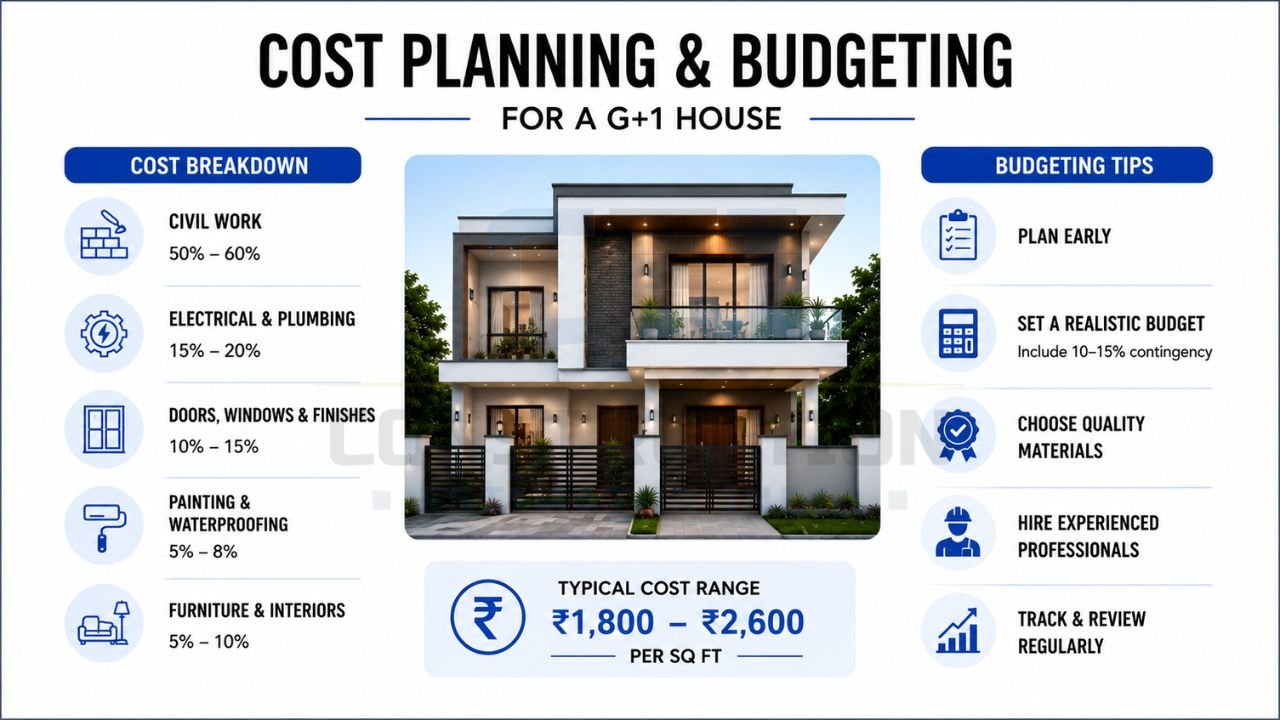
Major Cost Drivers in G+1 Construction
The cost of a G+1 house plan is driven by the “Grey Structure” (RCC and brickwork) and the “Finishing” (tiles, paint, woodwork). In 2026, the RCC work for a G+1 house typically consumes about 40-50% of the total budget. Establishing your baseline house construction per sq ft rate helps calculate your absolute limits.
This matters because knowing where the money goes helps you make trade-offs. For example, if you spend more on a high-end staircase, you might have to choose a more modest floor tile to stay within budget.
Practical Actions:
- Track the prices of steel and cement, as these fluctuate weekly and can impact your budget by lakhs.
- Get a detailed “Bill of Quantities” (BOQ) before starting work to avoid “hidden costs” from contractors.
- Allocate a 10-15% contingency buffer for unexpected price hikes or design changes.
Common Mistake: Focusing only on the “per square foot” rate and ignoring the quality of materials being used.
👉 Need a Custom G+1 House Plan? Consult Our Construction Experts Today.
Built-up Area vs Budget: Simple Thinking
Your total budget divided by the current construction rate (e.g., ₹2,200 per sq ft) gives you the maximum built-up area you can afford. In a G+1 house plan, you have to decide how to split this area between the two floors.
This matters because building a house that is “too big” for your budget leads to stalled projects. It is better to have a beautifully finished 1,500 sq ft G+1 house than a 2,500 sq ft “shell” that you can’t afford to paint or furnish.
Practical Actions:
- Prioritize “needs” over “wants”—do you really need a fourth bedroom or would a larger living room be better?
- Consult an estimator to see how adding a balcony or a porch impacts the total square footage cost.
- Consider “Phased Construction” where you build the ground floor fully and finish the first floor later as funds become available.
Common Mistake: Underestimating the cost of “invisible” items like boundary walls, underground water tanks, and government deposits.
How Construction Estimator India Helps With Quantity and Cost Estimation?
Construction Estimator India provides professional-grade insights that empower homeowners to stay in control of their projects. They offer independent quantity takeoffs, which tell you exactly how many bags of cement or tons of steel your G+1 house plan requires.
This transparency prevents reliable building contractors from over-ordering materials and ensures bids remain aligned with Central Public Works Department (CPWD) benchmarks.
Practical Actions:
- Send your architectural drawings to Construction Estimator India for a professional budget estimate.
- Use their BOQ to compare multiple contractor bids on an “apples-to-apples” basis.
- Seek their advice on “Complex vs Simple” designs to see how much money you can save by simplifying the elevation.
Common Mistake: Relying on a contractor’s “rough estimate” which often doubles by the time the house is finished.
Reach out to Construction Estimator India on WhatsApp / Call +91 8630676890 for a free preliminary estimate for your G+1 project.
Common Mistakes in G+1 House Planning
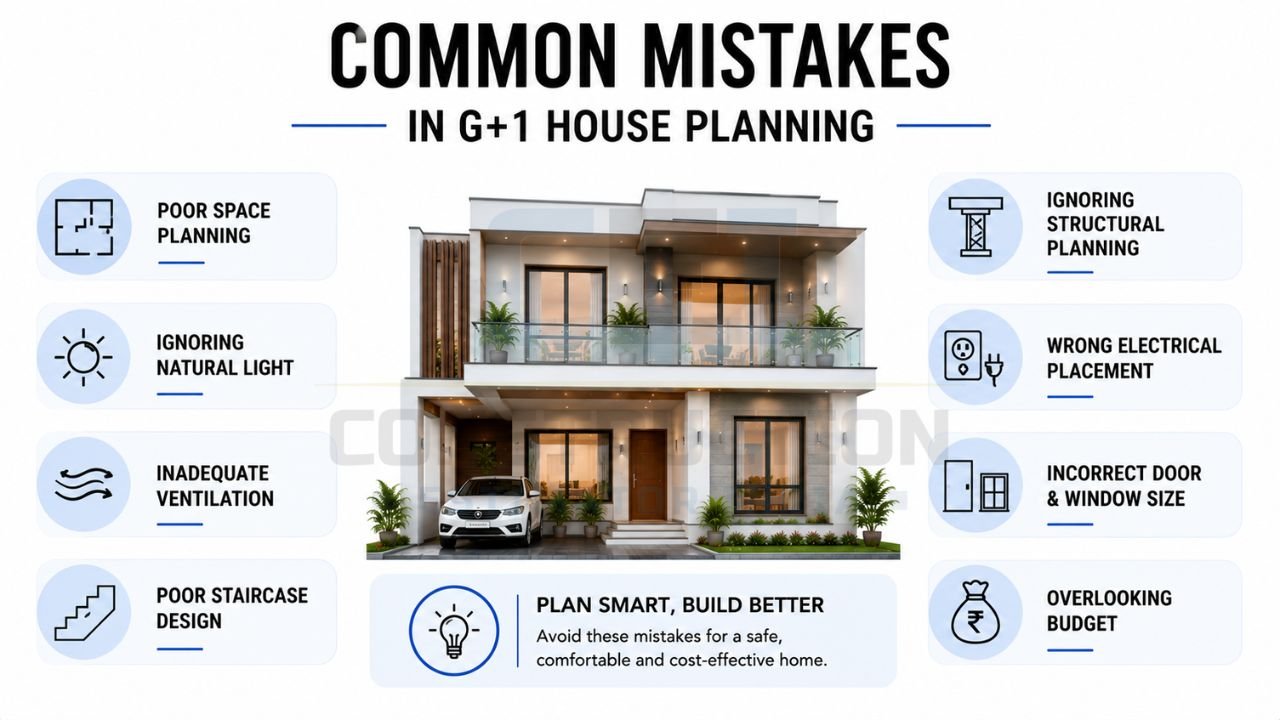
Poor Staircase Location and Awkward Movement
A common error in a G+1 house plan is placing the staircase in a corner that requires walking through the entire house to reach the upper floor. Or, placing it in a way that the “landing” hits a window or a door.
This matters because the “flow” of the house becomes frustrating. Every time you want to go to your bedroom, you might have to pass by the dining table where guests are eating.
Practical Actions:
- Review the “furniture layout” on your floor plan to ensure the staircase path is clear.
- Ensure the staircase is wide enough to carry a mattress or a large wardrobe up to the first floor.
- Avoid placing the only staircase outside if you live in a region with extreme heat or heavy rain.
Common Mistake: Not checking the “headroom” on the staircase, leading to tall people hitting their heads on the upper slab.
👉 Build Your Dream G+1 Home with Confidence and Expert Support.
Ignoring Parking and Entry Experience
Many homeowners focus so much on the rooms that they treat the parking and entry as an afterthought. In a G+1 house plan, the area under the first-floor balcony is often used for parking. If this isn’t designed well, it can feel like a dark tunnel.
This matters because the entrance is your “daily welcome.” If you have to squeeze past a car every time you come home, the house will always feel poorly designed.
Practical Actions:
- Ensure the parking area is well-lit and has easy-to-clean flooring (like parking tiles or granite).
- Design the main door to be “visible” from the street for better security and aesthetics.
- Include a small “shoe rack” area near the entrance that doesn’t block the path.
Common Mistake: Not providing enough space for the car doors to open fully within the parking porch.
Overloading the First Floor Without Structural Coordination
Sometimes, homeowners decide to add a heavy “Hero Feature” to the first floor—like a large water feature, a heavy granite kitchen island, or even a small terrace pool—without telling the structural engineer.
This matters because the first-floor slab of a G+1 house plan is only designed to carry standard “residential loads” (approx 200kg per sqm). Overloading it can cause structural cracks or even failure.
Practical Actions:
- Finalize your “heavy furniture” or feature plans before the structural design is completed.
- Communicate clearly if you plan to use a room for a specific heavy purpose (like a library with thousands of books).
- Ensure the plumbing for first-floor bathrooms is aligned with ground-floor walls for easy pipe routing.
Common Mistake: Adding a heavy “false ceiling” or extra-thick floor topping without checking if the slab can handle the extra dead load.
Construction Estimator India can review your plans to ensure they are optimized for both cost and space.
Planning for Future Flexibility
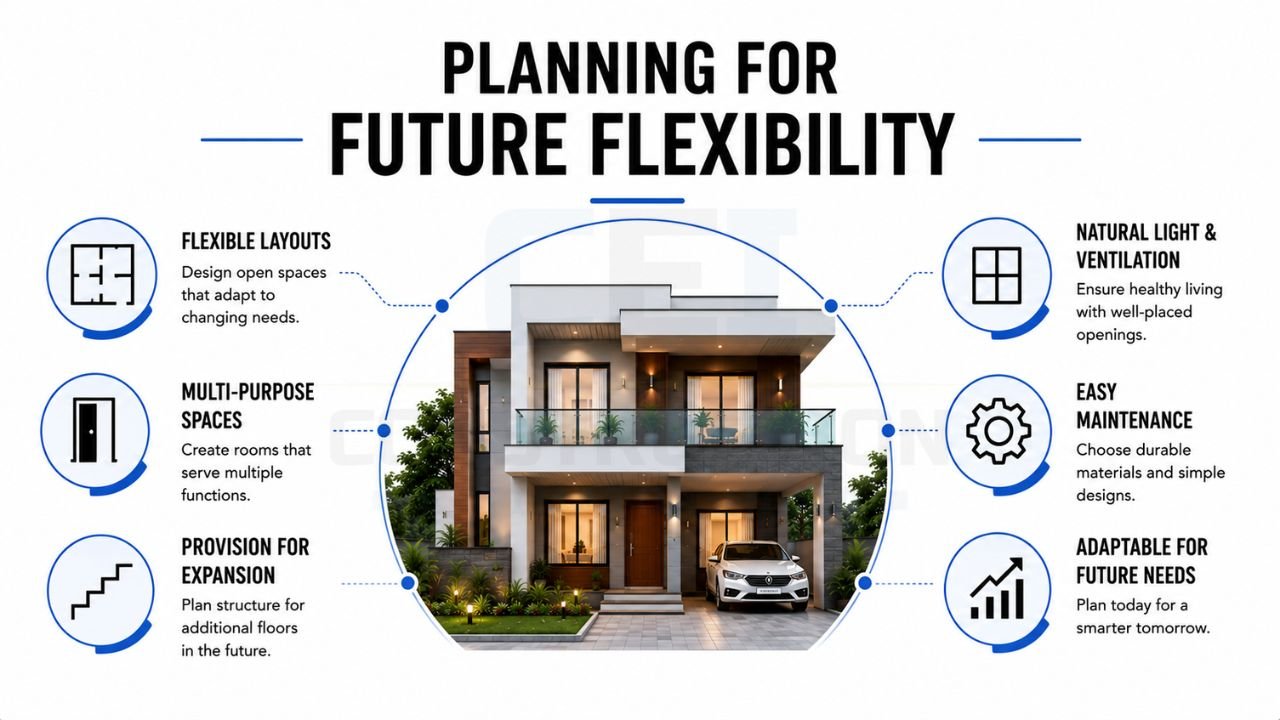
Scope for Extension or G+2 (Where Allowed)
In many Indian towns, you can build up to G+2 or even G+3. Even if you only have the budget for a G+1 house plan today, you should design your foundation and columns to support an extra floor in the future.
This matters because it is the most cost-effective way to “grow” your home as your children grow up or as you need more rental income. A foundation cannot be easily “strengthened” once the house is built.
Practical Actions:
- Design the foundation for the “maximum possible” floors allowed in your area.
- Keep the staircase “continuous” so it can easily lead to a future second floor.
- Ensure the water tank is positioned so it doesn’t have to be moved when you add a new floor.
Common Mistake: Designing a “sloped roof” on the first floor that makes it impossible to add another floor later without demolition.
👉 Create a Functional, Stylish, and Future-Ready G+1 Home.
Adapting Spaces as Family Grows or Ages
Your needs today will not be your needs in 15 years. A smart G+1 house plan accounts for the “Future Version” of your family. This includes planning for children who will eventually need their own study desks and more privacy.
This matters because it saves you from expensive renovations later. For example, a “Common Lounge” on the first floor can be designed so it can be easily partitioned into a fourth bedroom if needed.
Practical Actions:
- Use “non-load bearing” internal walls (like 4-inch brick or gypsum partitions) where you might want to change the layout later.
- Ensure children’s rooms have enough power and data points for future technology needs.
- Plan the ground floor bedroom to be “elderly-friendly” with grab-bars and wide doors from day one.
Common Mistake: Building very specific “themed” rooms that cannot be easily repurposed (e.g., a room with a permanent built-in bed that can’t be moved).
Keeping Services (Plumbing, Electrical) Easy to Access
Maintenance is the “hidden cost” of a G+1 house. In a two-storey home, plumbing leaks from a first-floor bathroom can ruin the ground-floor ceiling. A good G+1 house plan groups all “wet areas” (kitchens and baths) in vertical stacks.
This matters because it reduces the length of pipes needed and makes it easier to find and fix leaks. Easy access to electrical “conduit boxes” also makes it simpler to upgrade your wiring for solar or smart-home features later.
Practical Actions:
- Place first-floor bathrooms directly above ground-floor bathrooms or the kitchen.
- Use a “Shaft” (a vertical cutout) to hide all plumbing pipes; this keeps them accessible for repair without breaking walls.
- Keep a “Master Switch” for each floor so you can easily turn off power to the upper floor if it’s not in use.
Common Mistake: Routing plumbing pipes through “columns” or “beams,” which weakens the structure and makes repairs impossible.
Construction Estimator India provides free guidance on how to plan these “future-ready” features within your current budget.
FAQs: G+1 House Plan in India
Is a G+1 house more expensive than a single-storey house?
While the total cost is higher because of the increased area, the “per square foot” cost is often similar or slightly lower because the cost of land, foundation, and roof is spread over two floors. Construction Estimator India can give you a precise comparison for your plot.
What plot size is suitable for a comfortable G+1 house plan?
A plot size of 30×40 ft (1,200 sq ft) is ideal for a comfortable 3BHK or 4BHK G+1 home with parking. However, even 20×40 ft (800 sq ft) plots can accommodate a compact G+1 layout.
How should I plan my staircase in a G+1 home?
If you want privacy for each floor, place the staircase near the entrance or outside. If you want a grand family home, an internal staircase in the living room is better. Ensure it is at least 3 feet wide for safety.
How do I estimate the budget for my G+1 house?
In 2026, basic construction costs in North India range from ₹1,900 to ₹2,200 per sq ft. Multiply your total planned built-up area by this rate and add 15% for contingencies. For a professional BOQ, contact Construction Estimator India.
When should I contact an estimator like Construction Estimator India during planning?
The best time is before you finalize your architectural drawings. This allows you to adjust the room sizes or design if the estimated cost exceeds your budget.
Is a soil test mandatory for a G+1 house?
Yes. Even for a two-storey house, a soil test ensures your foundation is designed correctly for your specific ground conditions, preventing future cracks or sinking.
What grade of steel is best for G+1 construction?
Fe500D or Fe550D TMT bars are recommended because they offer the right balance of strength and flexibility, which is crucial for structural safety.
Conclusion: Plan Your G+1 House for Comfort, Cost, and Future Needs
Building a G+1 house is a rewarding journey that provides your family with space, privacy, and a sense of pride. By understanding the zoning of floors, studying your plot constraints, and planning for future flexibility, you can create a home that lasts for generations.
Remember that “simplicity is elegance”—avoid over-complicating your design, as it only leads to higher costs and maintenance headaches. Protecting your dream requires basic technical knowledge and professional planning. Use tools like a professional Bill of Quantities (BOQ) and structural designs to keep your project on track and within budget.
If you are planning a G+1 house on your plot in India and want help estimating construction cost, quantities, and practical layout options, you can contact Construction Estimator India on WhatsApp / Call +91 8630676890 before you finalize your house plan.