
The Real Estate (Regulation and Development) Act, 2016 (RERA) is a landmark Indian law that regulates the real estate sector to boost transparency, accountability, and efficiency. Before this legislation, the Indian property market was often compared to the “Wild West,” where homebuyers faced immense risks including delayed projects, fraud, and a total lack of refund guarantees. The Real Estate Regulation and Development (RERA) Act, 2016 is considered one of the landmark legislations passed by the Government of India (MoHUA), designed specifically to reform the sector by encouraging greater transparency, citizen-centricity, and financial discipline.
👉 Understanding RERA? Get Expert Guidance for Your Real Estate and Construction Projects.
Its primary objective is to bring clarity and fair practices that protect the interests of buyers while imposing strict penalties on errant builders who fail to meet their commitments. Enacted by the Parliament in March 2016, the Act fully came into force on May 1, 2017. For homebuyers, this meant a shift from 5-10 year court disputes to a specialized 60-90 day dispute resolution mechanism. Understanding RERA is the first step in learning how to plan home construction in India. Construction Estimator India offers a free RERA consultation at +91 8630676890 to help you verify if your developer is compliant with these transformative rules.
What is RERA: Full Form, Meaning & Basic Definition
RERA Full Form
The full form of RERA is the Real Estate (Regulation and Development) Act, 2016. While the Act itself is a federal law, it mandated the establishment of a “Real Estate Regulatory Authority” (also abbreviated as RERA) in every state to monitor local transactions and resolve disputes. It is essentially the supreme regulator for the real estate industry, much like how the RBI regulates banks or SEBI regulates the stock market.
What Does RERA Stand For?
RERA stands for the Real Estate Regulatory Authority. Its meaning goes beyond a simple acronym; it represents a promise of government-backed security for property investors. It acts as a watchdog that ensures every developer who advertises a project has the legal right to do so and has deposited the necessary funds to complete the construction as promised.
Simple Definition of RERA
In simple terms, RERA is a government law that controls how builders sell properties and protects you, the buyer, from being cheated. If a builder tells you they will give you a house in three years but takes six, RERA forces them to pay you interest for every month of delay. It makes the “Sale Agreement” a balanced legal document rather than a one-sided contract favoring the builder.
When Did RERA Come Into Force?
The Act was passed by the Indian Parliament in 2016 to address the growing complaints of homebuyers across the country. All sections of the RERA Act officially came into force with effect from May 1, 2017. This was a turning point for Indian real estate, as it required all ongoing projects that had not yet received a Completion Certificate (CC) to register with the authority within three months.
Who Implements RERA in Each State?
While the Act is central, the implementation is handled by state-level nodal departments. For example, the Department of Housing in the Government of Karnataka is the nodal department for implementing the RERA Act in that state. Consequently, we have individual portals like MahaRERA (Maharashtra), GujRERA (Gujarat), RERA Uttarakhand, and TNRERA (Tamil Nadu). Each state has its own specific RERA portal where buyers can verify project registration numbers and builder history.
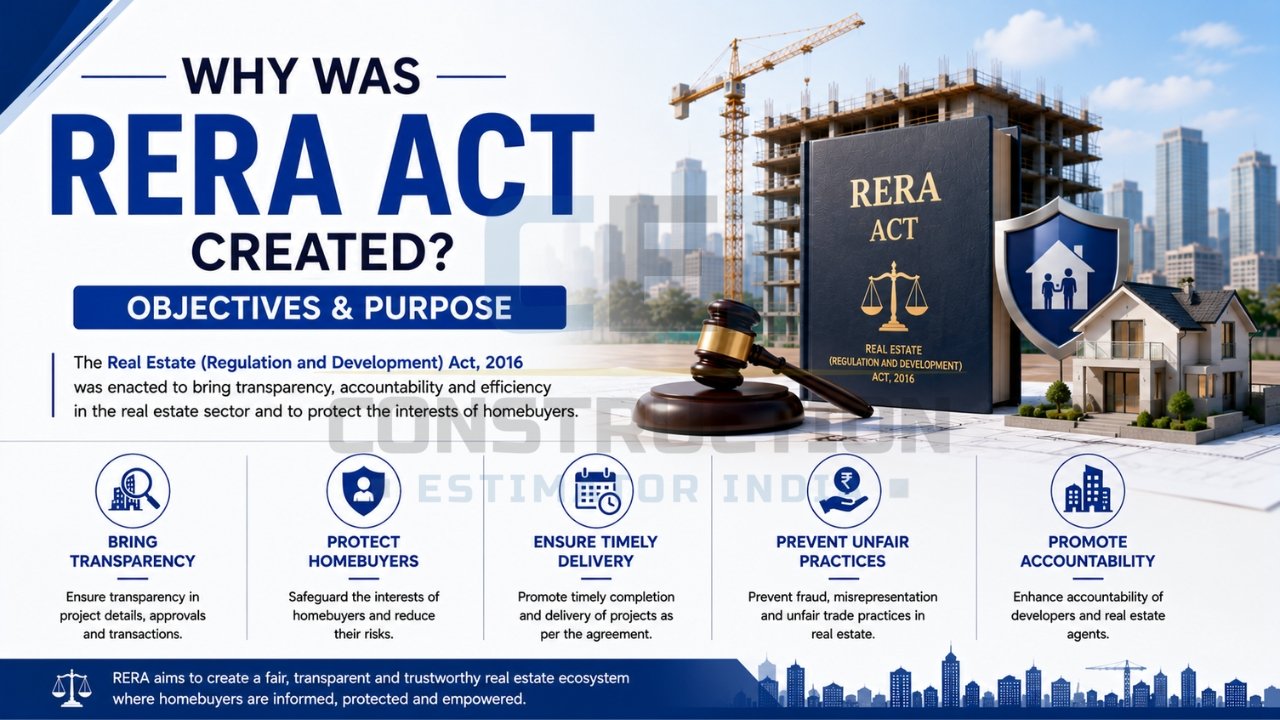
Why Was RERA Act Created? Objectives & Purpose
Problem Before RERA: Builder Fraud & Delays
Before 2017, the real estate sector was plagued by “ghost projects” and massive fund diversions. Builders would often collect money from buyers for “Project A” and use that money to buy land for “Project B.” This led to a domino effect where neither project was completed on time. Homebuyers often found their hard-earned money stuck for a decade with no legal recourse other than slow-moving trial courts. RERA was created to end this lack of accountability.
👉 Make Informed Property Decisions with Expert RERA Insights.
Objective 1: Greater Transparency
One of the core objectives is to boost transparency by making it mandatory for promoters to upload all details of their proposed project on the RERA website. This includes the approved layout plan, the list of approvals taken, and the types of apartments or plots booked. Buyers no longer have to rely on glossy brochures; they can verify the legal “Seerat” or truth of a project directly on a government portal.
Objective 2: Citizen Centricity
RERA is a consumer-first law. Its objective is to reform the sector by encouraging “citizen centricity,” meaning the laws are designed to protect the individual homebuyer over the powerful developer lobby. This is reflected in provisions like the 7-year defect liability period, which ensures that if your house develops cracks in the RCC construction shortly after you move in, the builder must fix them for free.
Objective 3: Accountability
Accountability is enforced through a strict penalty system. Both the promoter and the buyer are now liable to pay an equal rate of interest in case of any default from either side. If a builder delays possession, they must pay interest (typically 10-12% per annum) to the buyer. This financial pressure ensures that builders stick to their promised timelines.
Objective 4: Financial Discipline
To prevent the diversion of funds, RERA introduced the mandatory 70% Escrow Account rule. Developers must deposit 70% of the money collected from buyers into a separate bank account used exclusively for the construction and land costs of that specific project. This ensures that even if the developer faces financial trouble in other ventures, your project remains funded.
Impact on India’s Growing Real Estate Economy
This regulation is in line with the vast and growing economy of India. With urban space demand projected to reach 700–900 million sq meters every year between now and 2030, a regulated environment is essential to attract both domestic and foreign investment. Construction Estimator India provides free property verification to ensure you are investing in a project that contributes to this growth safely.
Key Features of RERA Act 2016
Feature 1: Mandatory Project Registration
Registration of all real estate projects and agents is mandatory under RERA. Specifically, any project where the land area exceeds 500 square meters or the number of apartments exceeds eight must be registered before the developer can even begin marketing or advertising the property. Failure to register can lead to a fine of 10% of the project cost or even imprisonment.
Feature 2: Escrow Account (70% Money Safety)
As established, the 70% escrow requirement is the “financial heart” of RERA. It prevents builders from using your money as a revolving credit line for their other businesses. Withdrawals from this account are only allowed in proportion to the percentage of completion of the project, certified by an engineer, an architect, and a chartered accountant.
Feature 3: Carpet Area Guarantee
Before RERA, builders sold properties based on “Super Built-up Area,” which included corridors, lifts, and even balconies you couldn’t use. RERA mandates that properties be sold only on Carpet Area—the net usable floor area of an apartment. This eliminates hidden area fraud and ensures you pay only for the space you actually live in.
Feature 4: 7-Year Structural Defect Liability
This is a critical safety feature. If any structural defect or any other defect in workmanship, quality, or provision of services (such as poor plastering leading to moisture) is brought to the notice of the promoter within five to seven years (depending on state rules) from the date of handing over possession, the promoter is bound to rectify it without further charge within 30 days.
Feature 5: On-Time Completion with Penalty
The Act enforces the “date of completion” mentioned during registration. If a builder fails to give possession by that date, the buyer has the right to withdraw from the project and receive a full refund with interest. If the buyer chooses to stay, the builder must pay monthly interest for every month of delay.
Feature 6: Full Disclosure on RERA Portal
Every registered project has a dedicated page on the state RERA website. This page acts as a digital ledger where the builder must update the progress of construction every quarter. Buyers can see how many units are sold, how much money is in the escrow account, and if there are any active legal cases against the project. Evaluating this data alongside current market rates—such as the house construction per sq ft rate roorkee (or in your region)—helps buyers determine if the pricing is fair.
Feature 7: Fast Dispute Resolution (RERA Tribunal)
Any aggrieved person may file a complaint with the Regulatory Authority for any violation under the Act. Unlike traditional courts that take years, the RERA Adjudicating Officer is expected to resolve cases within 60 to 90 days. You can even file these complaints online through the respective state portals.
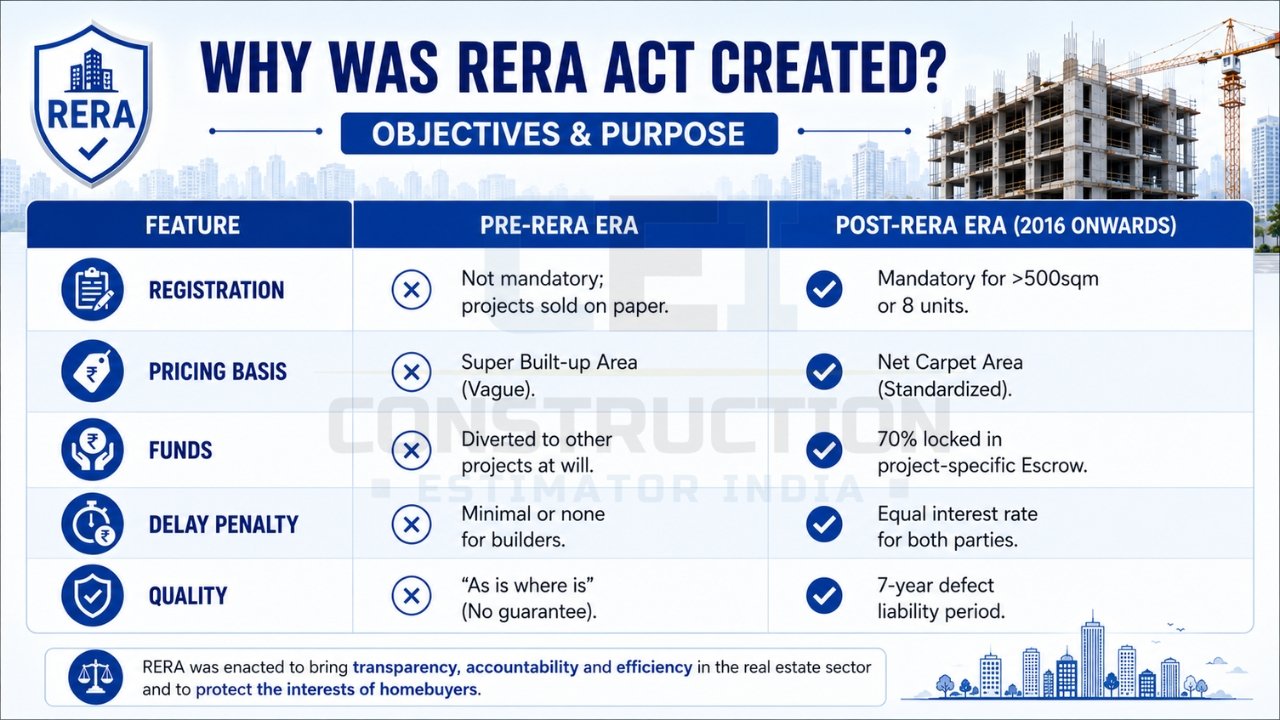
| Feature | Pre-RERA Era | Post-RERA Era (2016 onwards) |
|---|---|---|
| Registration | Not mandatory; projects sold on paper. | Mandatory for >500sqm or 8 units. |
| Pricing Basis | Super Built-up Area (Vague). | Net Carpet Area (Standardized). |
| Funds | Diverted to other projects at will. | 70% locked in project-specific Escrow. |
| Delay Penalty | Minimal or none for builders. | Equal interest rate for both parties. |
| Quality | “As is where is” (No guarantee). | 7-year defect liability period. |
Benefits of RERA for Homebuyers
Benefit 1: Protection Against Project Abandonment
The biggest fear for a buyer is the builder running away with the money. Because of the 70% escrow rule, even if a builder goes bankrupt, the money required to finish the building is usually still in the bank. If a project is abandoned, RERA can facilitate the takeover of the project by the association of allottees to ensure completion.
👉 Need Help Understanding RERA Regulations? Consult Our Experts Today.
Benefit 2: No Area Fraud (Carpet Area Only)
You no longer have to guess how big your rooms will be. By mandating sales on carpet area, RERA ensures that the price per square foot is transparent. If the builder provides a smaller area than promised in the agreement, they must refund the excess amount with interest.
Benefit 3: Delayed Possession Compensation
RERA turned the tide on delays. Since builders are now legally obligated to pay interest for delays, they are much more careful about promising realistic completion dates. This has significantly reduced the “wait time” for new homeowners across India.
Benefit 4: Quality Guarantee for 7 Years
Imagine moving into your dream home and finding the ceiling leaking during the first monsoon. Under RERA, you don’t have to spend your own money on these repairs if you used certified building contractors. The builder is structurally liable, giving you a “warranty” on your most expensive investment.
Benefit 5: Transparent Project Information
Before you pay even ₹1, you can check the “legal health” of the building. You can see the Sale Deed, the Encumbrance Certificate (EC), and the building plan approval status on the RERA website. This prevents you from buying into “unauthorized” colonies or disputed land.
Benefit 6: Quick Legal Justice
Filing a complaint under Section 31 of the RERA Act is simple and can be done in Form ‘M’ or Form ‘N’. You don’t necessarily need a lawyer for the initial stages, and the focus is on quick mediation and resolution rather than endless litigation.
Benefits of RERA for Builders/Developers
Benefit 1: Credibility & Trust
For honest builders, RERA is a blessing. Being “RERA Registered” acts as a badge of quality and legality. It helps reputable developers stand out from fly-by-night operators, making it easier for them to attract genuine buyers and investors.
Benefit 2: Standardized Process
RERA has brought a standard set of rules to the construction industry. Builders now have a clear roadmap for what documents are needed, how to draft a sale agreement, and how to manage project finances. This professionalism helps in securing bank loans at better interest rates.
Benefit 3: Faster Approvals
As the real estate sector becomes more organized, government departments are also moving toward “Single Window Clearances” to match the speed required by RERA. This helps builders get their building plan sanctions and NOCs faster, reducing overall project timelines.
How RERA Changed India’s Construction Industry?
Change 1: Reduced Project Delays
The era of indefinite delays is ending. Builders now prioritize completion over new launches because they cannot collect money for a new project until the current one’s financial milestones are met. This shift has brought much-needed discipline to construction schedules.
Change 2: Increased Transparency
Transparency is no longer optional. With quarterly updates mandatory on government portals, every stakeholder—from the buyer to the bank—has access to the same information. This has drastically reduced the information asymmetry that used to favor builders.
Change 3: Improved Quality Standards
Because of the long-term defect liability, builders are now investing in better quality materials and skilled labor. They know that a poorly built wall today will cost them a repair bill three years later. Knowing the difference between RCC and brick construction in India helps developers make durable choices. Construction Estimator India assists builders in maintaining these high standards through precise project planning and audits.
When to Contact Construction Estimator India for RERA Help
Navigating the complexities of RERA, building plan sanctions, and structural stability can be overwhelming. Construction Estimator India acts as your expert liaison to ensure your property journey is safe and legally sound. Whether managing small updates via house renovation roorkee or monitoring large-scale builds, we are here to help.
Contact us at WhatsApp/Call: +91 8630676890 if:
- You are about to book an under-construction flat and need Free RERA verification.
- You want to check if a project’s land has a clear Sale Deed and Encumbrance Certificate.
- You are a developer who needs assistance with RERA registration and compliance.
- You need a Free legal consultation for a RERA dispute or delayed possession.
- You want to verify if your home’s Carpet Area matches the RERA-approved plan.
FAQs
Q1: What is the full form of RERA?
It stands for the Real Estate (Regulation and Development) Act, 2016.
Q2: When did RERA come into effect in India?
The Act fully came into force on May 1, 2017.
Q3: What is the main purpose of RERA Act?
To ensure transparency, protect homebuyers, and bring financial discipline to the real estate sector.
Q4: Who needs to register under RERA?
Any project with a land area >500 square meters or more than 8 apartments must register.
Q5: What are the benefits of RERA for homebuyers?
Key benefits include carpet area pricing, 70% money safety in escrow, 7-year defect liability, and compensation for delays.
Q6: What is an escrow account in RERA?
A separate bank account where 70% of buyer funds are kept to be used only for that specific project’s construction.
Q7: What is carpet area vs super area under RERA?
Carpet area is the actual usable floor area. Super area includes common spaces like lifts and corridors. RERA mandates selling by carpet area only.
Q8: What is the 7-year defect liability period?
The builder is responsible for fixing structural or workmanship defects for free for up to 7 years after possession.
Q9: How do I file a complaint with RERA authority?
You can file a complaint online on your state’s RERA portal using Form ‘M’ or ‘N’.
Q10: What is the penalty if a builder doesn’t register under RERA?
Fines can go up to 10% of the project’s total estimated cost, and persistent defaults can lead to imprisonment.
Q11: Does RERA apply to ready-to-move properties?
If the property received its Completion Certificate (CC) before May 2017, it might not be registered. However, all new ready-to-move projects must be registered.
Q12: How do I contact Construction Estimator India for RERA help?
You can call or WhatsApp us at +91 8630676890 for a free consultation.
Contact Construction Estimator India for RERA Services
Don’t let your dream home become a legal nightmare. Construction Estimator India provides professional oversight and technical verification to ensure your investment is 100% compliant and secure.
- Company: Construction Estimator India
- WhatsApp/Call: +91 8630676890
- Services: Free RERA verification, Free property legal audit, Free project timeline planning.
- Email:
Conclusion: RERA Protects Your Real Estate Investment
The Real Estate (Regulation and Development) Act, 2016 is more than just a piece of legislation; it is the “legal shield” for every Indian family. By enforcing transparency, accountability, and financial discipline, it has transformed real estate from a speculative gamble into a safe, regulated asset class. Whether it is the guarantee of your money in an escrow account, the certainty of carpet area, or the safety of a 7-year defect liability, RERA ensures that the “Seerat” or the true value of your home is protected.
Construction Estimator India is dedicated to helping you navigate this new, safer landscape. By following the 8-step guide from project verification to receiving your Occupancy Certificate (OC), you ensure that your home is not just a building, but a secure legacy for your family. Build smart, build legal, and build with the confidence that RERA and Construction Estimator India have your back. Reach us today at +91 8630676890.