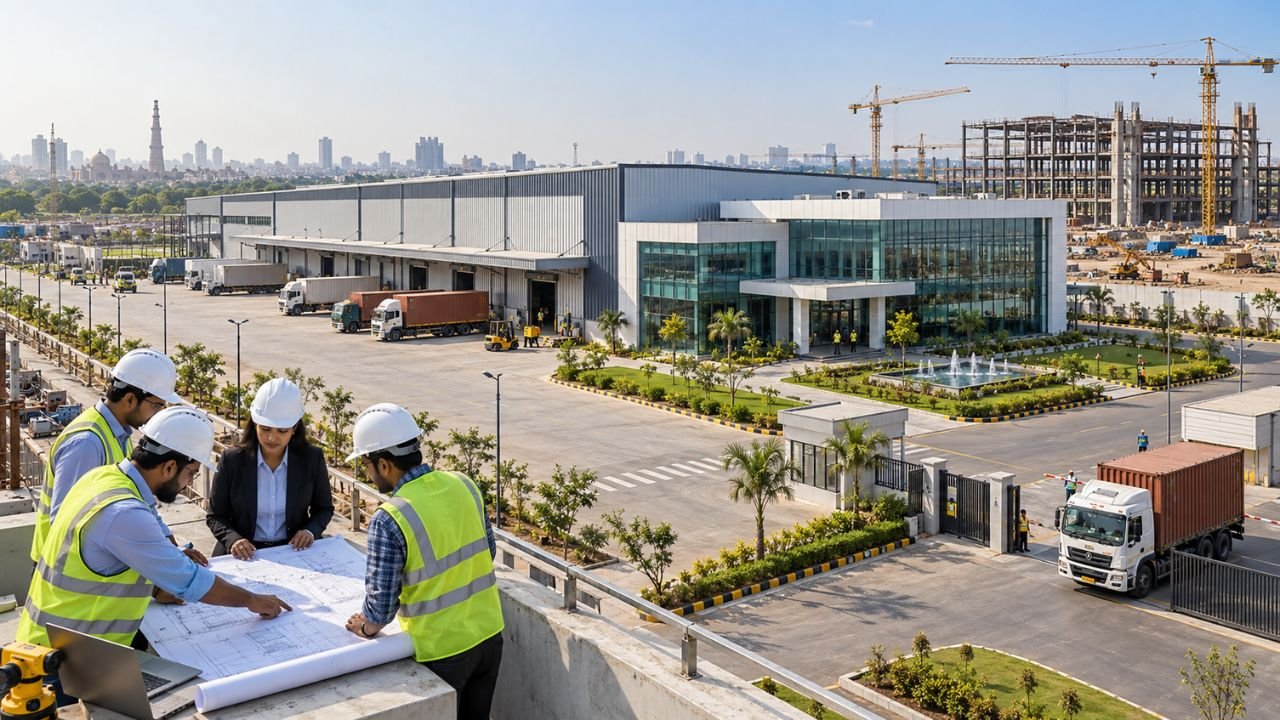
Building approval, also known as building plan sanction or a building permit, is the official permission from the local authority—be it a municipal corporation, panchayat, or development authority—to begin construction on a specific piece of land. This formal decision is granted only after the local authority reviews your proposed building design and site plan to ensure they align with regional safety, zoning, and structural standards. In India, navigating this process is not just a formality; it is a critical legal bridge between having a piece of land and owning a legally recognized structure.
👉 Need Building Plan Approval? Get Expert Guidance for a Smooth and Hassle-Free Process.
Without this approval, any construction activity is deemed “unauthorized” by the government. This carries severe risks, including mandatory demolition by local authorities and the permanent inability to secure essential utility services like water and electricity. Furthermore, a building without a sanctioned plan is legally uninhabitable because you will never receive an Occupancy Certificate (OC), making the property ineligible for bank loans or future resale. Conversely, having a legal approval ensures your construction is recognized by the state, qualifies for financial assistance, and maintains a high property market value.
The timeline for securing these permissions typically ranges from 15 to 30 days for an individual residential house, provided all documents are accurate and submitted through the appropriate portal. However, the complexity of bylaws can often be overwhelming for homeowners. Construction Estimator India offers a free plan approval consultation at +91 8630676890 to help you navigate these legal waters from the very start.
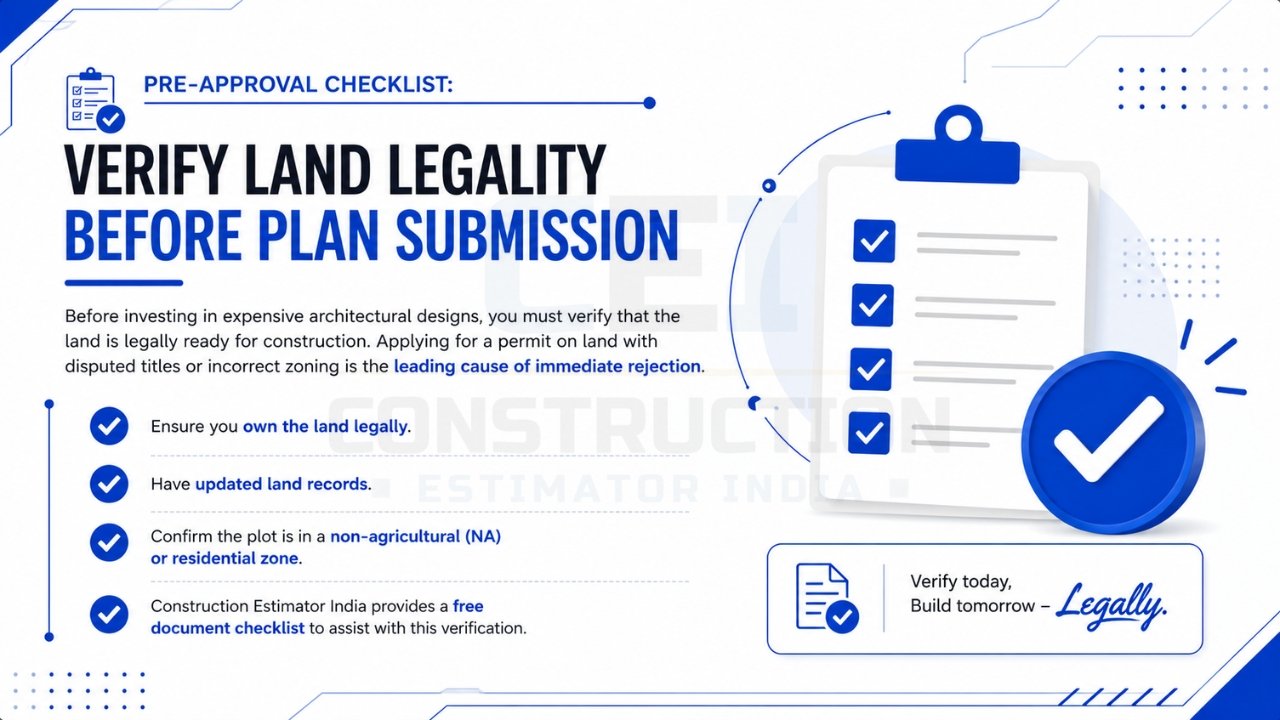
Pre-Approval Checklist: Verify Land Legality Before Plan Submission
Before investing in expensive architectural designs, you must verify that the land is legally ready for construction. Applying for a permit on land with disputed titles or incorrect zoning is the leading cause of immediate rejection. You must ensure you own the land legally, have updated land records, and confirm the plot is in a non-agricultural (NA) or residential zone. Construction Estimator India provides a free document checklist to assist with this verification.
Required Document: Sale Deed / Ownership Deed
The Sale Deed is the foundational legal proof of land ownership. For building approval, it must be registered with the local sub-registrar’s office.
- Why It’s Critical: Authorities need to verify that you have the absolute right to build on the property.
- Currency: Local authorities typically require a copy that is not older than three months to ensure no recent transfers have occurred.
- Cost: None (already paid during land purchase).
- Timeline: 1–2 days for verification by your legal advisor.
👉 Avoid Approval Delays and Ensure Your Building Plans Meet Local Regulations.
Required Document: Patta/Chitta or Land Record
This is the government’s official record of land ownership and extent. Names vary by state: Patta or Chitta in Tamil Nadu, Khata in Karnataka or Kerala, and Jamabandi or Fard in North India.
- Why It’s Critical: It proves the land is recorded in the government’s revenue books in your name, matching the Sale Deed exactly.
- Cost: ₹500–₹2,000 for obtaining fresh copies or minor corrections.
- Timeline: 3–7 days via government e-portals.
Required Document: Encumbrance Certificate (EC)
An EC proves the land is free from legal disputes, pending loans, or mortgages.
- Why It’s Critical: It ensures the property isn’t collateral for a loan you didn’t know about. If a loan is active, a No Objection Certificate (NOC) from the bank is mandatory.
- Period: Authorities usually demand an EC covering at least the last 13 to 15 years.
- Cost: ₹500–₹1,500.
- Timeline: 7–15 days depending on the workload of the sub-registrar office.
Land Use: Residential vs Agricultural Zone
You cannot build a house on land zoned for agriculture without an “NA Conversion” (Non-Agricultural).
- Why It’s Critical: Construction on agricultural land without conversion leads to immediate demolition notices.
- How to Execute: Check the Master Plan of your city to confirm zoning.
- NA Conversion Cost: ₹10,000–₹1,00,000 (highly variable by state).
- Timeline: 30–90 days.
FSI/FSR Compliance Check
The Floor Space Index (FSI) or Floor Area Ratio (FAR) determines the total built-up area allowed relative to the plot size.
- Why It’s Critical: Exceeding these limits is a major violation that prevents approval. For example, an FSI of 2.0 on a 1,000 sq. ft. plot allows for 2,000 sq. ft. of construction.
- Strategy: Construction Estimator India (+91 8630676890) provides free approval timeline planning to ensure your design matches these local limits.
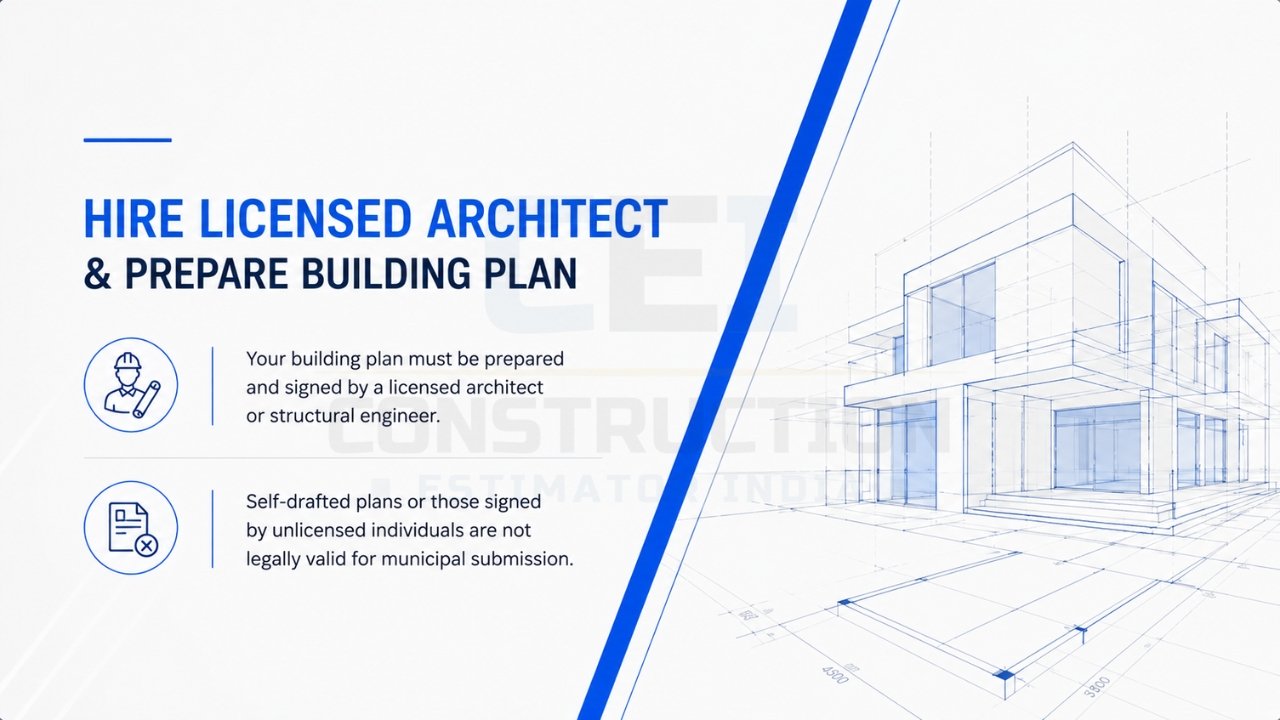
Hire Licensed Architect & Prepare Building Plan
Your building plan must be prepared and signed by a licensed architect or structural engineer. Self-drafted plans or those signed by unlicensed individuals are not legally valid for municipal submission.
Hire Licensed Architect or Engineer
In India, only architects registered with the Council of Architecture (CoA) or engineers licensed by the local municipal body can legally sign approval drawings.
- Why It’s Critical: Their registration number must be present on every sheet of the drawing to validate compliance with the National Building Code.
- Cost: ₹15,000–₹75,000 for standard approval-ready plan design.
- Timeline: 7–15 days for the initial design phase.
Required Drawing: Site Plan
A bird’s-eye view of your plot showing the exact position of the proposed building and setbacks (distance from building to boundary).
- Execution: It must show the location of septic tanks, parking, and open spaces as per local bylaws.
- Scale: Usually 1:500 or 1:1000.
👉 Get Professional Support for Building Plan Approval and Construction Compliance.
Required Drawing: Floor Plans
Detailed floor plans for every level (Ground, First, etc.) showing room dimensions, wall thickness, and placement of utilities.
- Requirement: All dimensions in plans submitted must be indicated in metric units.
- Scale: Typically 1:100.
Required Drawing: Elevation & Section Drawings
Elevation drawings show the exterior views (front, rear, side). Section drawings are “cut-through” views revealing room heights, slab thickness, and foundation depth.
- Scale: 1:100.
Required Drawing: Structural Drawings & Certificate
For safety, a licensed structural engineer must provide reinforcement details and sign a “Structural Stability Certificate,” which is vital in high-seismic zones.
- Cost: ₹10,000–₹40,000 depending on complexity.
Required Statement: Area Statement & FSI Calculations
A table showing total plot area, ground coverage, and total built-up area across all floors to prove FSI compliance.
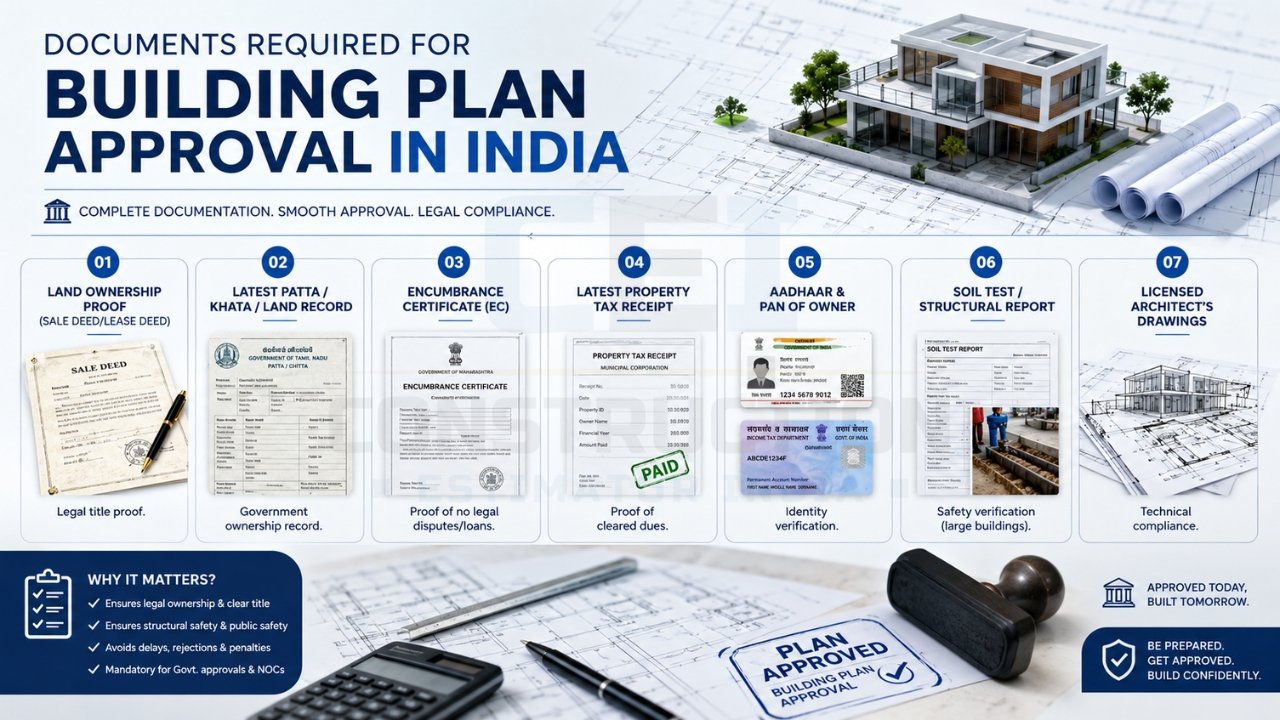
Attach Mandatory Documents for Plan Submission
Missing a single document can result in your application being returned, resetting your timeline. Construction Estimator India can provide a comprehensive digital file checklist to prevent this.
Required Documents Checklist
| Document | Purpose |
|---|---|
| Land Ownership Proof (Sale Deed/Lease Deed) | Legal title proof |
| Latest Patta / Khata / Land Record | Government ownership record |
| Encumbrance Certificate (EC) | Proof of no legal disputes/loans |
| Latest Property Tax Receipt | Proof of cleared dues |
| Aadhaar & PAN of Owner | Identity verification |
| Soil Test / Structural Report | Safety verification (large buildings) |
| Licensed Architect’s drawings | Technical compliance |
Soil Test Report (For Plots >200 sq yd or G+2)
While not always mandatory for small G+1 houses on standard soil, it is strictly required for larger plots or buildings with more than G+2 floors.
- Why It’s Critical: It determines if the foundation design is safe for specific ground conditions.
- Cost: ₹5,000–₹25,000.
- Timeline: 7–15 days.
👉 Navigate Building Plan Approvals with Confidence and Expert Guidance.
Building Plan in DXF Format
Most modern Online Building Plan Approval Systems (OBPAS) in India require the building plan in a specific .dxf (AutoCAD) format for automated scrutiny.
- Cost: ₹2,000–₹10,000 for professional digitization.
Apply Online or Offline for Plan Approval
The method of application has shifted significantly toward digital platforms across India to reduce corruption and delays.
Online Portals by State/City
| State/City | Online System |
|---|---|
| Tamil Nadu | CMDA, DTCP Online Portal |
| Maharashtra | AutoDCR |
| Karnataka | BBMP’s e-Aasthi / One |
| Telangana | DPMS |
| Delhi | DDA OBPAS |
Upload Documents Online
Once registered on the portal, you must upload digital copies of all mandatory documents and drawings.
- Why It’s Critical: The system generates an initial application fee to initiate the file movement.
- Cost: ₹500–₹2,000 (scanning/printing).
- Timeline: 1–2 days.
Obtain NOCs from Relevant Departments
No Objection Certificates (NOCs) are clearances from different departments proving your building won’t interfere with public infrastructure.
Fire Department NOC (Buildings >15m)
Mandatory for buildings taller than 15 meters (roughly G+4 floors).
- Cost: ₹10,000–₹1,00,000.
- Timeline: 15–30 days.
Airport Authority of India (AAI) NOC
Required if your plot is within a 10–15 km radius of an airport to ensure height clearance.
- Cost: ₹5,000–₹50,000.
- Timeline: 15–45 days.
Environment/Forest Department NOC
Required if land is near protected forests, riverbeds, or coastal zones.
- Cost: ₹10,000–₹1,00,000.
- Timeline: 30–90 days.
Pay Scrutiny Fees & Development Charges
Once your plan passes the initial document check, the authority will issue a demand note for final fees.
Scrutiny Fee
This covers the cost of the engineer’s time to check your plan against bylaws.
- Cost: ₹5,000–₹50,000.
Total Approval Fees
For an individual residential house (1,000–2,000 sq. ft.), the total cost typically ranges from ₹50,000 to ₹5,00,000. For commercial complexes, this can reach ₹20,00,000 or more.
Technical Scrutiny & Site Inspection
A municipal engineer will perform a deep dive into your application, verifying if your plan adheres to the National Building Code (NBC) and local bylaws regarding setbacks, parking, and height.
- Site Inspection: An inspector will physically visit your plot to verify boundaries and road width.
- Timeline: 15–90 days depending on the city.
Receive Building Plan Approval with Permit Number
If everything is in order, the authority issues the final “Sanctioned Plan” and a “Building Permit Number”.
- Validity: The permit is usually valid for 3 to 5 years. You must complete construction or reach a certain stage within this period or apply for an extension.
- Timeline: 15–30 days for an individual house if documents are correct.
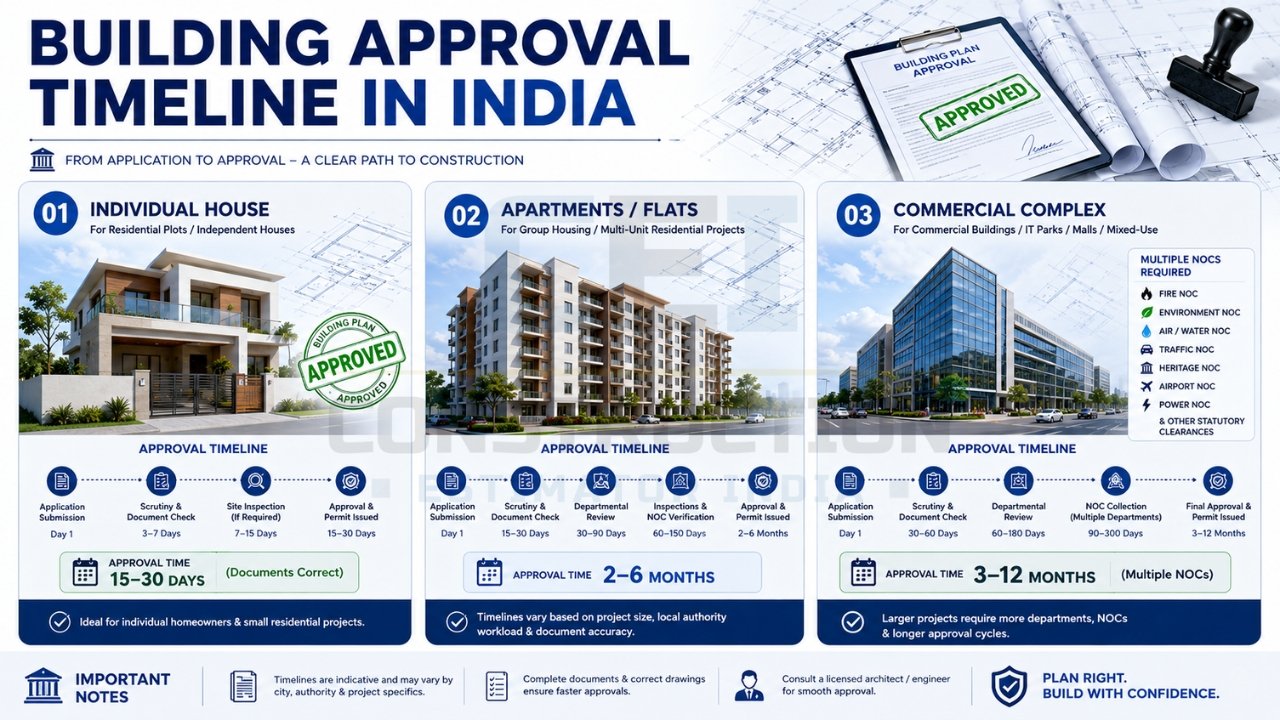
Time Taken for Approval by Building Type
| Type of Building | Time for Approval |
|---|---|
| Individual house | 15–30 days (if documents are correct) |
| Apartments / Flats | 2–6 months |
| Commercial Complex | 3–12 months (multiple NOCs) |
Post-Construction: Get Completion Certificate & Occupancy Certificate
Your legal journey doesn’t end with construction. After completion, you must apply for a Building Completion Certificate (CC) and then an Occupancy Certificate (OC).
- Why It’s Critical: Only after receiving the OC is the building legally fit for occupation. Without it, the building remains “illegal,” preventing utility connections and bank loan eligibility.
👉 Planning to Build? Consult Our Experts Before Submitting Your Plans.
When to Contact Construction Estimator India for Plan Approval Help
Navigating government portals and bylaw technicalities can be overwhelming. Construction Estimator India acts as your professional liaison to ensure your file moves quickly. Contact us at +91 8630676890 if:
- You need a comprehensive document checklist for your city.
- You require approval timeline planning to coordinate with your bank loan.
- You need expert help with online OBPAS submissions or DXF file creation.
- You want to verify if your current architect’s plan is 100% compliant.
We offer a Free Plan Approval Consultation to get you started on the right legal path.
FAQs
Q1: How long does building plan approval take in India?
For an individual residential house, it typically takes 15–30 days if documents are accurate.
Q2: What is the total cost for building plan approval?
For a standard house, costs range from ₹50,000 to ₹5,00,000 including scrutiny and development charges.
Q3: Is building plan approval mandatory for individual houses?
Yes, it is strictly mandatory. Building without it makes your home “unauthorized,” leading to demolition risks.
Q4: Can I start construction before getting plan approval?
No. You must wait for the sanctioned plan and permit number to avoid heavy fines.
Q5: What happens if my building plan is rejected?
You will receive a notice with reasons. You must modify the plan to comply and resubmit.
Q6: How long is building plan approval valid?
It is generally valid for 3 to 5 years.
Q7: Do I need NOCs for small houses (G+1)?
Usually no, unless near an airport or restricted zone. Utility NOCs are always needed.
Q8: Can I modify an approved plan after approval?
Minor changes require a “Revised Plan” application. Major changes require a new approval process.
Q9: How do I apply for building plan approval online?
Visit your city’s OBPAS portal (e.g., BBMP One, CMDA), upload digital documents, and pay the fee.
Q10: What documents are mandatory for plan approval?
Sale Deed, Patta/Land record, Encumbrance Certificate, Latest Tax Receipt, and Licensed Architect’s drawings.
Q11: Do I need a soil test for house plan approval?
It is mandatory for plots > 200 sq. yd. or buildings with G+2 floors and above.
Q12: How do I contact Construction Estimator India for plan approval help?
You can WhatsApp or Call us at +91 8630676890 for a free consultation.
Contact Construction Estimator India for Building Plan Approval Services
Don’t let bureaucracy delay your dream home. Construction Estimator India provides expert technical oversight to ensure your construction journey is 100% compliant from day one.
- Company: Construction Estimator India
- WhatsApp/Call:+91 8630676890
- Email:
Conclusion: Get Legal Plan Approval for Safe, Compliant Construction
Getting a building plan sanctioned is the most critical step in your construction journey. It is more than just a permit; it is the legal shield that protects your investment and your family’s future. By following this guide—from land verification to securing the final permit—you ensure that your home is safe, compliant, and structurally sound.
While the cost for approval can range from ₹50,000 to ₹5,00,000, it is a small price compared to the risk of demolition. Construction Estimator India offers a free plan approval consultation at +91 8630676890 to help you build smart, build legal, and build with confidence.