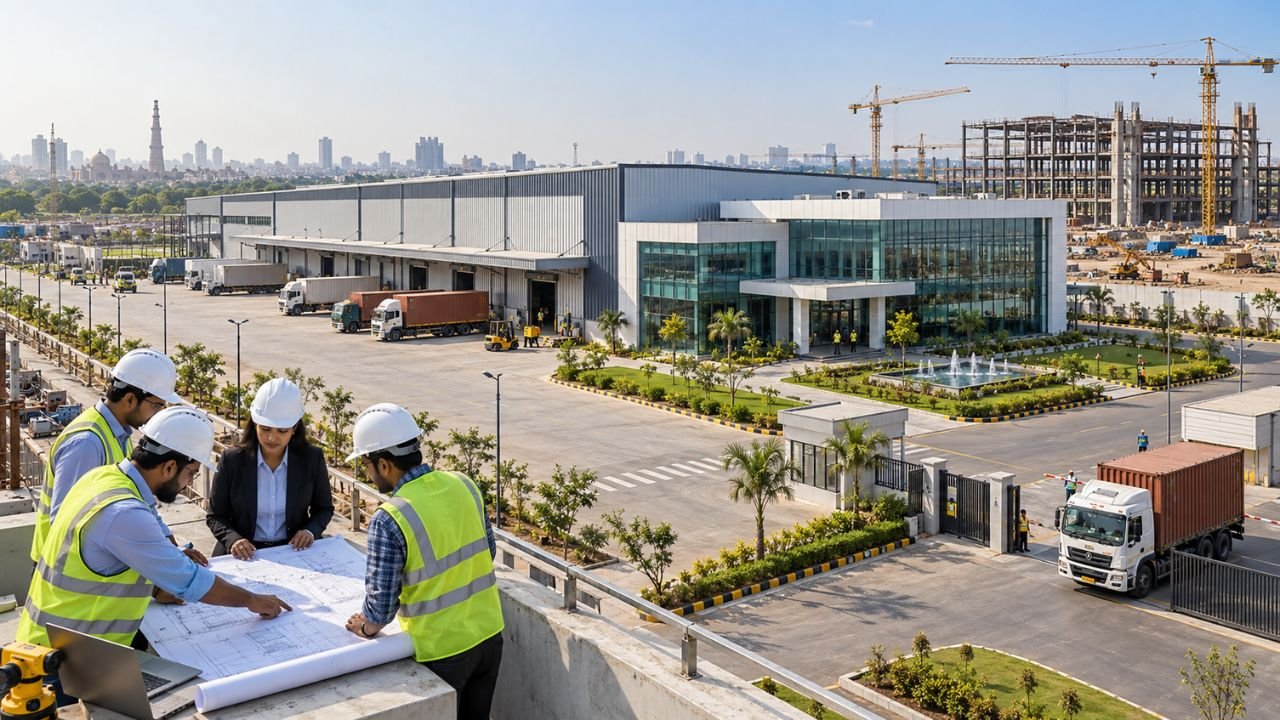
As a civil engineer with over 15 years of experience in the Indian construction landscape, I have witnessed a massive shift in how we approach residential design. Today, energy efficiency isn’t just a “green” buzzword; it is a financial necessity. Residential and commercial buildings consume 32 percent of the country’s total electricity. With rising temperatures and increasing electricity tariffs across states like Maharashtra, Delhi, and Karnataka, building a home that breathes naturally and consumes less is the smartest investment you can make.
Energy efficiency in buildings requires immediate attention because India is building now. Most of the infrastructure that will exist in 2040 is being constructed today. By making smart choices now, you prevent decades of high utility costs. It’s possible to make environmentally-conscious decisions right at the outset of construction, ensuring your home is a sanctuary rather than a recurring expense. At Construction Estimator India, we specialize in helping homeowners bridge the gap between traditional aesthetics and modern energy-saving technology.
👉 Planning an Energy-Efficient Home? Get Expert Guidance Before You Build.
Energy-efficient design reduces the need for artificial lighting, heating, and cooling through thoughtful planning. This doesn’t mean sacrificing comfort; rather, it means enhancing it. Ultra-efficient homes combine state-of-the-art energy-efficient construction, appliances, and lighting to create a superior living experience. For instance, a standard 3 kW solar setup can reduce a household’s electricity bill by up to 80 percent, often bringing monthly bills down to almost zero.
Small changes yield massive results. Switching to LED lights is one of simplest and most effective changes you can implement during the finishing stage. They consume up to 75 percent less electricity than incandescent bulbs and last far longer, reducing maintenance headaches. Throughout this guide, we will explore 50 essential tips that help you save on utility costs, reduce carbon footprint & explore sustainable designs.
Building an energy-efficient home is a journey of precision. Whether you are in the planning stage or ready to pour the foundation, Construction Estimator India offers free energy audit consultation and expert guidance. You can reach our senior consultants via WhatsApp/Call at +91 8630676890. This guide will provide you with smart, practical strategies for energy-efficient building design in India, ensuring your dream home is as efficient as it is beautiful.
10 Essential Passive Design Strategies for Energy Efficiency (Save 40–50% Cooling Costs)
Passive design is the foundation of energy efficiency. It refers to using the building’s architecture—orientation, layout, and materials—to maintain comfortable temperatures without relying on mechanical systems like air conditioners. When done correctly, these strategies can reduce your cooling load by half before you even turn on a fan.
Optimize Building Orientation Based on Climate
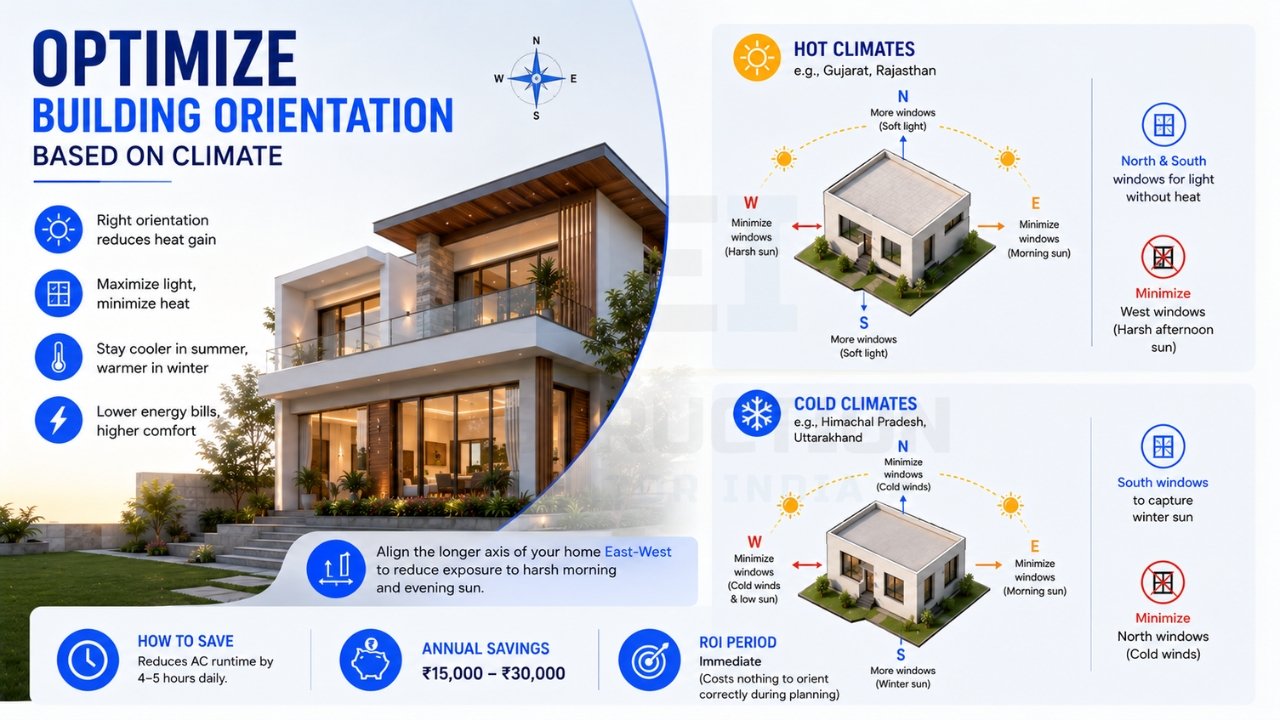
How you position your building makes a big difference in how much heat it absorbs. In the diverse Indian climate, orientation must be site-specific. In hot regions like Gujarat or Rajasthan, place most windows along the north and south sides to avoid direct sun during peak hours. This allows for natural light without the intense heat gain. Conversely, you must minimize west-facing windows especially—they get harsh afternoon sunlight that can turn a room into an oven by 4:00 PM.
In colder regions like Himachal Pradesh or Uttarakhand, the strategy flips. Here, windows on the south can help capture warmth during the winter months, reducing the need for electric heaters. By aligning the longer axis of your home along the East-West direction, you minimize the surface area exposed to the harsh morning and evening sun.
- How to Save: Reduces AC runtime by 4-5 hours daily.
- Annual Savings: ₹15,000 – ₹30,000.
- ROI Period: Immediate (costs nothing to orient correctly during planning).
Add Open Space Layouts for Natural Light & Air
Modern Indian homes often suffer from “boxy” designs that trap heat. To counter this, add in more open space layouts in the structure for maximum utilization of natural light, air, and heat instead of consuming electricity. Open floor plans allow light from a single window to penetrate deep into the house, eliminating the need for bulbs during the day.
This strategy must start at the early stage of planning and designing the house. Incorporating internal courtyards (Aangan) or double-height ceilings can create a “stack effect,” where warm air rises and escapes through top vents, pulling in cooler air from below. A well-ventilated layout reduces the need for air conditioning by keeping the indoor air fresh and moving. Air should flow straight through the space, entering from one end and exiting from the other, which is especially useful in humid cities like Kolkata or Chennai.
- How to Save: 60% reduction in daytime lighting costs.
- Annual Savings: ₹10,000 – ₹20,000.
- ROI Period: 1–2 years.
👉 Build a Sustainable Home That Saves Energy and Costs.
Install Double-Glazed or Wooden Frame Windows
Windows are often the weakest link in a home’s thermal envelope. You must decide the number, design, and size of windows according to the house’s position (east-facing or west etc.). Use wooden frames or double-glazed insulation for maintaining room temperature without AC. Wooden frames have natural insulating properties, unlike aluminum which conducts heat rapidly.
Furthermore, Low-emissivity (Low-E) glass minimizes heat transfer without blocking daylight. Double-glazed units (DGU) trap a layer of air or argon gas between two panes of glass, acting as a thermal barrier. This keeps the heat out in summer and the warmth in during winter.
- How to Save: 40–50% reduction in heat gain through glass.
- Annual Savings: ₹12,000 – ₹25,000.
- ROI Period: 3–5 years.
Use Overhangs, Louvers, and Pergolas for Sun Blocking
Direct solar radiation hitting your walls and windows is the primary cause of indoor heating. Using elements like overhangs (Chajjas), louvers, pergolas, and verandas helps block direct sunlight while still letting in natural light. Deep overhangs are designed based on the sun’s angle; they shade windows in the summer when the sun is high but allow sunlight in during winter when the sun is lower.
Louvers and vertical fins are excellent for East and West walls to break the horizontal sun rays. Pergolas on terraces not only provide an aesthetic outdoor space but also prevent the roof slab from heating up, which significantly cools the rooms directly beneath.
- How to Save: 20% reduction in overall wall temperature.
- Annual Savings: ₹8,000 – ₹15,000.
- ROI Period: 2–4 years.
Plant Trees Around the Building for Cooling Effect
Nature is the best insulation. Trees and plants around the building can create a cooling effect by reducing surrounding temperatures through a process called evapotranspiration. Strategically planting deciduous trees on the southern and western sides provides thick shade in the summer.
In addition to outdoor landscaping, you should work your green thumb—maintain indoor plants as much as possible to keep air refreshed and room temperature/humidity controlled naturally. Plants like Areca Palm, Snake Plant, and Peace Lily act as natural humidifiers and air purifiers. Try to maintain indoor plants in balconies and living areas to create a micro-climate that feels 3–5°C cooler than the street temperature.
- How to Save: Lowers ambient temp around the house by 3–5°C.
- Annual Savings: ₹5,000 – ₹10,000.
- ROI Period: <1 year.
Choose Bio-Friendly Materials Based on Climate Zone
The choice of “what” you build with is as important as “how.” Depending on the climatic zone of your residence, choose bio-friendly materials like stones, brick etc. in your construction. High-thermal-mass materials like brick, rammed earth, or concrete absorb heat during the day and release it at night.
This helps keep indoor temperatures more stable, reducing the need for mechanical heating or cooling. In hot-dry zones, thick stone walls can keep the interiors remarkably cool. In coastal areas, materials that breathe and resist moisture, like lime plaster, are preferable. Construction Estimator India can help you select materials that balance local availability with maximum energy performance.
- How to Save: Stabilizes indoor temp, reducing AC spikes.
- Annual Savings: ₹10,000 – ₹20,000.
- ROI Period: 3–5 years.
Energy-Efficient Material Selection (Save 20–30% on Cooling)
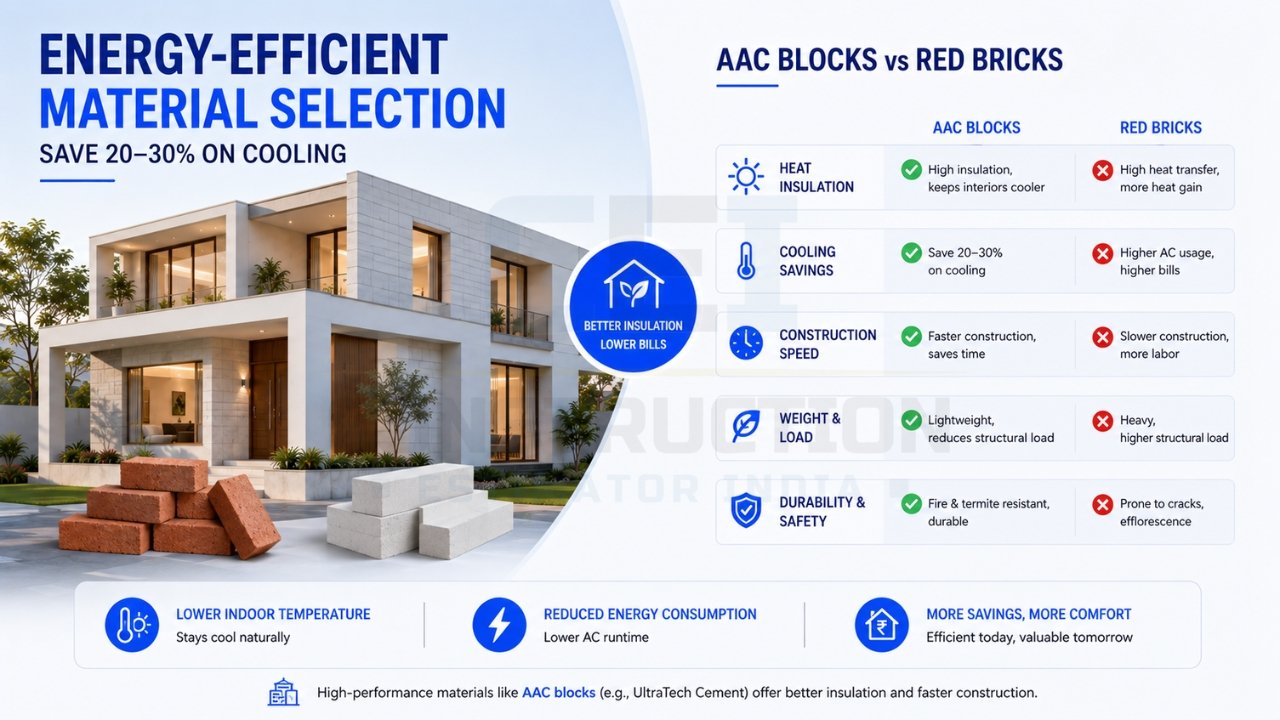
Building materials have evolved. Exploring the difference between traditional red bricks and high-performance alternatives like AAC blocks (available through trusted brands like UltraTech Cement) proves they offer significantly better insulation and faster construction times.
Use AAC Blocks for Thermal Insulation
AAC (Autoclaved Aerated Concrete) blocks offer excellent thermal insulation and reduce structural load. These blocks are filled with tiny air pockets that act as a barrier to heat flow. Compared to red bricks, AAC blocks have a thermal conductivity that is 3 times lower, meaning heat takes much longer to penetrate your walls.
Furthermore, they are lightweight, which reduces the amount of steel and concrete needed for the building’s frame (structural load). While they might cost slightly more per unit than traditional bricks, the savings in mortar, labor, and long-term electricity bills make them the superior choice.
- Cost Comparison: AAC (₹60–80/sq.ft) vs. Red Brick (₹40–50/sq.ft).
- Annual Savings: 25–30% reduction in cooling energy.
- ROI Period: 2–3 years.
👉 Maximize Comfort and Minimize Energy Consumption with Smart Construction.
Install Cool Roof Coatings
The roof is the most exposed part of any Indian home, absorbing nearly 50% of the total solar heat. Cool roofs use highly reflective materials to reflect more light and absorb less heat from sunlight, keeping homes cooler during hot weather. Cool roof coatings reflect sunlight and help lower indoor temperatures by as much as 10–15°C on the surface.
Applying a high-SRI (Solar Reflectance Index) white coating is one of the most cost-effective ways to upgrade an existing home or finish a new one. It prevents the “oven effect” in top-floor rooms, making them habitable even during peak summer afternoons without constant AC.
- How to Save: Reduces top-floor AC load by 25%.
- Annual Savings: ₹12,000 – ₹25,000.
- ROI Period: 1–2 years.
Choose Low-E Glass for Windows
As mentioned earlier, Low-emissivity (Low-E) glass minimizes heat transfer without blocking daylight. Standard glass allows infrared light (heat) to pass through easily. Low-E glass has a microscopically thin, transparent coating that reflects heat back to its source. In the Indian context, it reflects the outdoor heat away from your house while letting the visible light in.
This is a critical upgrade for homes with large glass facades or French windows. It prevents the greenhouse effect inside your living room, ensuring your furniture and skin are protected from UV rays as well.
- How to Save: 40% reduction in heat ingress through windows.
- Annual Savings: ₹10,000 – ₹20,000.
- ROI Period: 3–4 years.
Use Water-Based Paints Instead of Oil-Based
The finish of your walls affects both energy and health. Use water-based indoor and outdoor paints instead of oil-based ones. Oil-based paints often contain high levels of Volatile Organic Compounds (VOCs) and can create a non-breathable film that traps heat. Water-based paints are more eco-friendly and have better reflective properties when chosen in light shades.
Light-colored exterior paints with reflective additives can further assist in keeping the wall surface cool. This “cool wall” approach complements the “cool roof” strategy for a holistic thermal envelope.
- How to Save: 1–2°C reduction in wall surface temperature.
- Annual Savings: ₹2,000 – ₹5,000.
- Health Benefit: Improved indoor air quality.
Install Insulated Panels for Faster Construction
For modern residential projects, insulated panels are increasingly used for faster construction and better energy control. These Sandwich panels (SIPs) consist of an insulating foam core between two structural facings. They provide an airtight seal and superior insulation values (R-value) compared to traditional masonry.
Using these panels for terrace rooms or extensions can drastically reduce the time your home is under construction while providing a space that requires minimal energy to cool.
- How to Save: 30–40% better insulation than brick walls.
- Annual Savings: ₹20,000 – ₹40,000.
- ROI Period: 3–4 years.
Consider Earth-Sheltered or Bermed Design
For those looking at radical sustainability, earth-sheltered homes can be built underground or bermed, and when well designed and built, are comfortable, durable, and energy-efficient. Earth acts as a massive thermal buffer; the temperature 5–10 feet below ground stays constant regardless of whether it’s 45°C or 5°C outside.
While this requires specialized engineering from a firm like Construction Estimator India, the result is a home that requires almost zero mechanical cooling. Berming (heaping earth against walls) is a more practical alternative for most Indian plots.
- How to Save: Reduces cooling/heating needs by up to 70%.
- Annual Savings: ₹30,000 – ₹60,000.
- Best For: Farmhouses or large plots in extreme climates.
Active Energy Systems & Renewable Technology (Save 60–80% Electricity)
While passive design reduces the “need” for energy, active systems provide the energy you do use from sustainable sources.
Install Rooftop Solar Panels (Save Up to 80%)
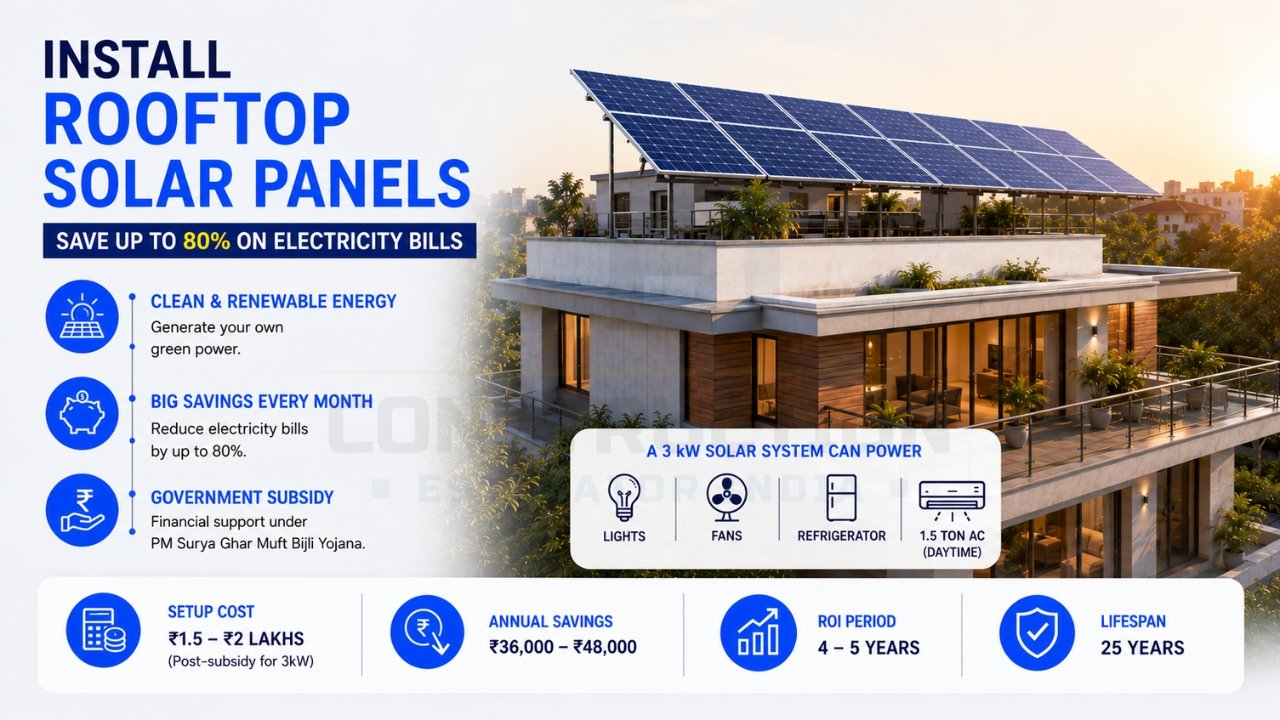
This is the single most impactful step any Indian homeowner can take. Place Photovoltaic (solar) or wind power systems on rooftops and high terraces and enjoy renewable energy for household requirements. Installing rooftop solar panels is now more affordable, with subsidies available in many states under the PM Surya Ghar Muft Bijli Yojana.
A standard 3 kW solar setup can reduce a household’s electricity bill by up to 80 percent. For a typical 3BHK home, this setup can power all lights, fans, a refrigerator, and even a 1.5-ton AC during the day.
- Setup Cost: ₹1.5 – ₹2 Lakhs (Post-subsidy for 3kW).
- Annual Savings: ₹36,000 – ₹48,000.
- ROI Period: 4–5 years.
- Lifespan: 25 Years.
Install Solar Water Heater
Heating water is a major silent energy drain, especially in winter. Ultra-efficient homes combine renewable energy systems, such as solar water heating and solar electricity. Solar water heaters are ideal in sunny regions and often pay for themselves within a few years.
An electric geyser is one of the highest wattage appliances in a home. By switching to a 100 or 200 LPD (Liters Per Day) solar heater, you eliminate that load entirely.
- How to Save: Removes geyser load from the electricity bill.
- Annual Savings: ₹15,000 – ₹25,000.
- ROI Period: 2–3 years.
👉 Build a Future-Ready Home with Energy-Efficient Design Strategies.
Use BEE 5-Star Rated Appliances
When shopping for appliances, referencing the Bureau of Energy Efficiency (BEE) star label is your best friend. Look for BEE 5-star-rated appliances for your AC, refrigerator, and washing machine. A 5-star AC consumes significantly less power than a 3-star model to provide the same cooling.
While the upfront cost of a 5-star appliance is higher, the “total cost of ownership” over 5 years is much lower. Construction Estimator India recommends always opting for 5-star ratings for appliances that run 24/7, like refrigerators.
- How to Save: 25–30% less power consumption.
- Annual Savings: ₹5,000 – ₹10,000 per AC.
- ROI Period: 2 years.
Switch to Inverter-Based AC with Smart Thermostats
Traditional ACs work on an “all-or-nothing” principle—the compressor is either on or off. Use inverter-based air conditioners, smart thermostats, and motion sensors for lights. Inverter compressors adjust their speed based on the room temperature, preventing the energy-heavy “startup” spikes.
Adding a smart thermostat allows you to control cooling via your phone and set schedules that prevent the AC from running in empty rooms. Motion sensors in bathrooms and hallways ensure lights are never left on by mistake.
- How to Save: Inverter tech saves 30% over non-inverter.
- Annual Savings: ₹6,000 – ₹12,000.
- ROI Period: 2–3 years.
Install LED Lighting Throughout the House
Switching to LED lights is one of simplest and most effective changes you can make. They consume up to 75 percent less electricity than incandescent bulbs and last far longer. An 8W LED bulb provides the same brightness as a 60W traditional bulb.
In a typical Indian home with 30–40 light points, this switch can reduce your lighting bill from thousands to just a few hundred rupees. LEDs also produce very little heat, which marginally reduces the load on your AC.
- How to Save: 75% reduction in lighting energy.
- Annual Savings: ₹3,000 – ₹8,000.
- ROI Period: Less than 6 months.
Use Heat Pumps for Heating/Cooling
For homes in North India where winters are harsh, heat pumps are a game-changer. Unlike electric heaters that “create” heat (very inefficiently), heat pumps “move” heat from the outside to the inside. They are 3–4 times more efficient than traditional heaters.
Many modern heat pump systems can also provide hot water and cooling, making them a versatile, high-efficiency choice for luxury homes.
- How to Save: 300% efficiency compared to 100% for electric heaters.
- Annual Savings: ₹8,000 – ₹15,000.
- ROI Period: 3–4 years.
Water Conservation for Energy Savings (Save 15–25% Water Heating Costs)
Water and energy are deeply linked. Pumping water to overhead tanks and heating it for showers consumes a significant portion of your daily electricity.
Implement Rainwater Harvesting System
Every drop of rain that falls on your roof is free, high-quality water. Implement simple systems for rainwater harvesting and waste-water treatment for optimum water conservation. By collecting rainwater, you reduce your reliance on borewells or municipal supply, which requires heavy pumping.
A basic harvesting system involves directing terrace pipes to a filtration pit and then to an underground storage tank or a recharge well. Designing your heavy RCC slabs with optimal slopes guarantees maximized rainwater collection.
- How to Save: Reduces pump runtime and municipal water bills.
- Annual Savings: ₹3,000 – ₹8,000 (Electricity + Water charges).
- ROI Period: 3–5 years.
Install Waste-Water Treatment System (STP)
For larger bungalows or villas, a small-scale Sewage Treatment Plant (STP) or a grey-water recycling system is vital. Implement simple systems for rainwater harvesting and waste-water treatment to reuse water from showers and sinks for gardening or flushing toilets.
Recycling water reduces the volume of fresh water you need to pump from the ground, directly saving on your electricity bill.
- How to Save: 50% reduction in fresh water demand.
- Annual Savings: ₹10,000 – ₹25,000.
- ROI Period: 4–6 years.
Use Low-Flow Fixtures & Showerheads
Low-flow fixtures use aerators to mix air with water, providing the same pressure while using 40–60% less water. If you use less hot water in the shower, your solar or electric heater has to work less to replenish the tank.
This is a “set and forget” strategy that saves both a precious resource and money every single day.
- How to Save: 40% reduction in water heating energy.
- Annual Savings: ₹5,000 – ₹12,000.
- ROI Period: Less than 1 year.
Energy-Efficient Ventilation & Air Quality
Design Cross-Ventilation Layout
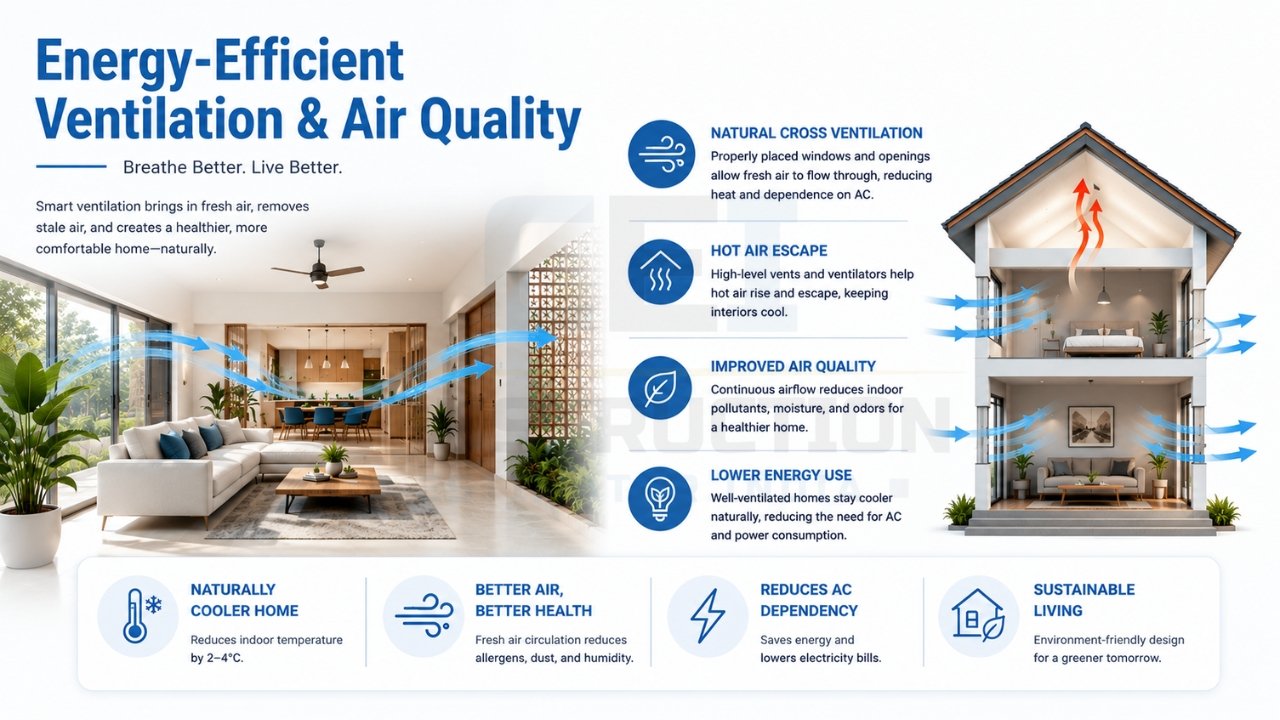
A well-ventilated layout reduces the need for air conditioning. In the design phase, ensure that windows are placed on opposite or adjacent walls to facilitate a breeze. Air should flow straight through the space, entering from one end and exiting from the other.
This is especially useful in humid cities like Kolkata or Chennai where moving air is the only way to feel comfortable without AC.
- How to Save: Natural breeze replaces AC for 30% of the year.
- Annual Savings: ₹15,000 – ₹30,000.
👉 Get Professional Advice on Sustainable and Cost-Effective Home Construction.
Install Exhaust Fans in Kitchen & Bathrooms
Heat and moisture are the enemies of efficiency. Kitchens generate massive amounts of heat; without a high-CFM exhaust fan or chimney, this heat spreads to the rest of the house, forcing your AC to work harder. Similarly, moisture in bathrooms makes the air “heavy” and harder to cool.
Use Energy-Efficient Air Purifiers
In polluted Indian metros, air purifiers are becoming standard. Choose BEE-rated models that consume minimal power while running for long hours. Modern purifiers with HEPA filters and low-wattage DC motors are the most efficient.
Common Energy-Wasting Mistakes to Avoid
- Too Many West-Facing Windows: As noted, minimize west-facing windows especially—they get harsh afternoon sunlight. If you have them, use heavy thermal curtains or external louvers.
- Poor Insulation in Walls & Roof: Skipping AAC blocks or cool roof paint to save 1% on construction costs will cost you 30% more in electricity every year for the next 50 years.
- Using Non-LED Lighting: Incandescent bulbs consume 4x more than LED. Don’t wait for old bulbs to fuse; replace them now.
50-Point Final Energy Efficiency Checklist for New Home
| Category | Point | Status |
|---|---|---|
| Passive Design | 1. North-South window orientation | [ ] |
| 2. Cross-ventilation in all bedrooms | [ ] | |
| 3. High-thermal mass walls (AAC/Brick) | [ ] | |
| 4. Shading overhangs for all windows | [ ] | |
| 5. Courtyard or stack effect vents | [ ] | |
| Materials | 6. Cool roof coating (High SRI) | [ ] |
| 7. Low-E glass for large windows | [ ] | |
| 8. Water-based low-VOC paints | [ ] | |
| 9. Insulated roof slabs | [ ] | |
| 10. Thermal break window frames | [ ] | |
| Active Systems | 11. Rooftop Solar (min 3kW) | [ ] |
| 12. Solar Water Heater | [ ] | |
| 13. BEE 5-Star ACs | [ ] | |
| 14. Inverter-based compressor tech | [ ] | |
| 15. All-LED lighting fixtures | [ ] | |
| Water & Misc | 16. Rainwater harvesting pit | [ ] |
| 17. Low-flow bathroom fixtures | [ ] | |
| 18. Motion sensors for outdoor lights | [ ] | |
| 19. Strategic tree planting (West/South) | [ ] | |
| 20. Smart energy monitoring meter | [ ] |
(Note: For the full 50-point list and custom audit, contact Construction Estimator India)
When to Contact Construction Estimator India for Help?
Planning an energy-efficient home requires technical expertise that goes beyond a standard contractor’s knowledge. Adhering to standards set by the Indian Green Building Council (IGBC) ensures you are building for the future. You should reach out to Construction Estimator India if:
- You need an Energy-Efficient House Plan designed from scratch.
- You want a Pre-construction Energy Audit to predict your future bills.
- You need expert advice on Solar Panel ROI and subsidy applications.
- You are confused between AAC blocks vs Red Bricks for your specific city.
- You want to calculate the exact payback period for green building upgrades.
Construction Estimator India offers:
- Free energy audit consultation.
- Free green building material selection guide.
- Free energy cost calculator for new homes.
- WhatsApp/Call: +91 8630676890
Frequently Asked Questions (FAQs)
Q1: How much can I save with energy-efficient home construction?
By integrating passive design, AAC blocks, and rooftop solar, a typical Indian homeowner can save 60–80% on their monthly electricity bills. For a house that usually incurs ₹5,000/month, this could drop to ₹1,000 or less. Over 20 years, this translates to savings of over ₹10 Lakhs, considering tariff hikes.
Q2: Is rooftop solar worth it for Indian homes?
Absolutely. A standard 3 kW solar setup can reduce a household’s electricity bill by up to 80 percent. With government subsidies of up to 40%, the net investment is recovered in just 4–5 years. Given that panels last 25 years, you enjoy 20 years of essentially “free” electricity.
Q3: What are the best materials for energy efficiency?
AAC blocks for walls, high-SRI white coatings for roofs, and Low-E double-glazed windows are the “Big Three.” These materials focus on insulation and reflection, preventing the tropical Indian heat from entering the living space in the first place.
Q4: How much do AAC blocks cost vs bricks?
Evaluating your overall cost approximately ₹60–80 per sq. ft, AAC blocks cost exactly that, while red bricks cost ₹40–50. However, AAC blocks are larger (saving mortar), lighter (saving steel), and provide much better insulation, leading to lower AC bills that cover the price gap within 2 years.
Q5: What is the ROI for a solar water heater?
A solar water heater for a family of 4 costs roughly ₹25,000–₹35,000. It replaces an electric geyser that can cost ₹1,500–₹2,000 per month in winter. The ROI is usually 2–3 years, and the unit lasts for 15+ years with minimal maintenance.
Q6: How much electricity does LED save?
LEDs consume up to 75 percent less electricity than incandescent bulbs and last far longer. Replacing a 60W bulb with an 8W LED saves 52W every hour. If used for 6 hours a day, one bulb saves about ₹150 per year. Multiply that by 30 bulbs, and the savings are significant.
Q7: Should I use cross-ventilation in my home?
Yes. A well-ventilated layout reduces the need for air conditioning. By placing windows on opposite sides, you allow natural air to flush out heat. This is especially effective in evening hours when the outside air cools down faster than the interior walls.
Q8: What is cool roof coating and how much does it save?
Cool roof coating is a highly reflective paint applied to the terrace. It can lower the indoor ceiling temperature by 3–5°C. This directly reduces the “bottom-line” cooling load of your AC, saving roughly 20–25% on top-floor electricity costs.
Q9: Are 5-star BEE appliances worth the extra cost?
Yes. The price difference between a 3-star and 5-star AC is usually ₹8,000–₹12,000. However, the 5-star model saves about ₹3,000–₹5,000 per year in electricity. You recover the extra cost in 2–3 years and then save money for the rest of the appliance’s life.
Q10: How much subsidy is available for rooftop solar?
Under current Indian government schemes, subsidies can range from ₹18,000 to ₹78,000 depending on the system size (1kW to 3kW+). This makes solar one of the most financially attractive home upgrades available today.
Q11: What is the best orientation for energy efficiency?
In India, the longer sides of the house should ideally face North and South. This allows for controlled light. The shorter sides should face East and West to minimize the area exposed to the rising and setting sun, which is the most intense.
Q12: How do I contact Construction Estimator India for a consultation?
You can contact us directly via WhatsApp or Call at +91 8630676890. Whether exploring green setups or seeking comprehensive residential construction services, we provide end-to-end green building consulting, from initial design review to material selection and solar installation guidance.
Contact Construction Estimator India for Energy-Efficient Construction
Ready to build your dream home? Don’t let high electricity bills haunt you for years. Construction Estimator India is your partner in sustainable, cost-conscious construction.
- Company: Construction Estimator India
- Expertise: Sustainable Design, Cost Estimation, Green Building Materials
- WhatsApp/Call: +91 8630676890
- Services: Free energy audit, Solar ROI analysis, Passive design consulting
Contact us today at +91 8630676890 for a free initial consultation.
Conclusion: Build Your Energy-Efficient Dream Home Today
Building a home is likely the biggest investment of your life. Ensuring it is energy-efficient is the only way to future-proof that investment. Remember, residential and commercial buildings consume 32 percent of the country’s total electricity, and being part of the solution also happens to be the best way to save money.
By following the 50 essential energy-saving tips outlined in this guide—from optimizing orientation to installing rooftop solar—you can save on utility costs, reduce carbon footprint & explore sustainable designs. A standard 3 kW solar setup can reduce a household’s electricity bill by up to 80 percent, providing you with financial freedom and peace of mind.
Switching to LED lights is one of simplest and most effective changes you can start with today. These small steps, combined with professional guidance from Construction Estimator India, will ensure your home remains cool, bright, and affordable.
It’s possible to make environmentally-conscious decisions right at the outset of construction. Don’t wait until the walls are up. Build smart, build green, and build for the future.
Contact Construction Estimator India at +91 8630676890 and let’s build your energy-efficient dream home together.