
Introduction: What is a Civil BOQ with Rates?
In the construction industry, a Bill of Quantities (BOQ) is the financial and technical blueprint of a project. A civil BOQ with rates is a comprehensive document that goes beyond a simple list of materials; it itemizes every work activity, from site clearance to the final coat of paint, and assigns a specific monetary value to each unit of work.
 Click Here to Purchase the Civil Work BOQ Template for ₹249
While a basic quantity list might only tell you that a project requires 100 cubic meters of concrete, a full civil BOQ with rates provides a detailed description of that concrete (e.g., M25 grade, including shuttering and curing), the unit of measurement, the quantity, and the pre-agreed unit rate. This document is fundamental for three primary stages of a project:
- Tendering: It provides a level playing field for contractors to submit competitive bids based on identical specifications.
- Budgeting: It helps developers and project owners understand the precise financial commitment required.
- Contract Administration: It serves as a legally binding reference for processing payments, managing variations, and closing the project.
Click Here to Purchase the Civil Work BOQ Template for ₹249
Essentially, the civil BOQ with rates transforms architectural drawings into a clear financial roadmap, ensuring that every “bag of cement and every hour of labor is accounted for” before construction begins.
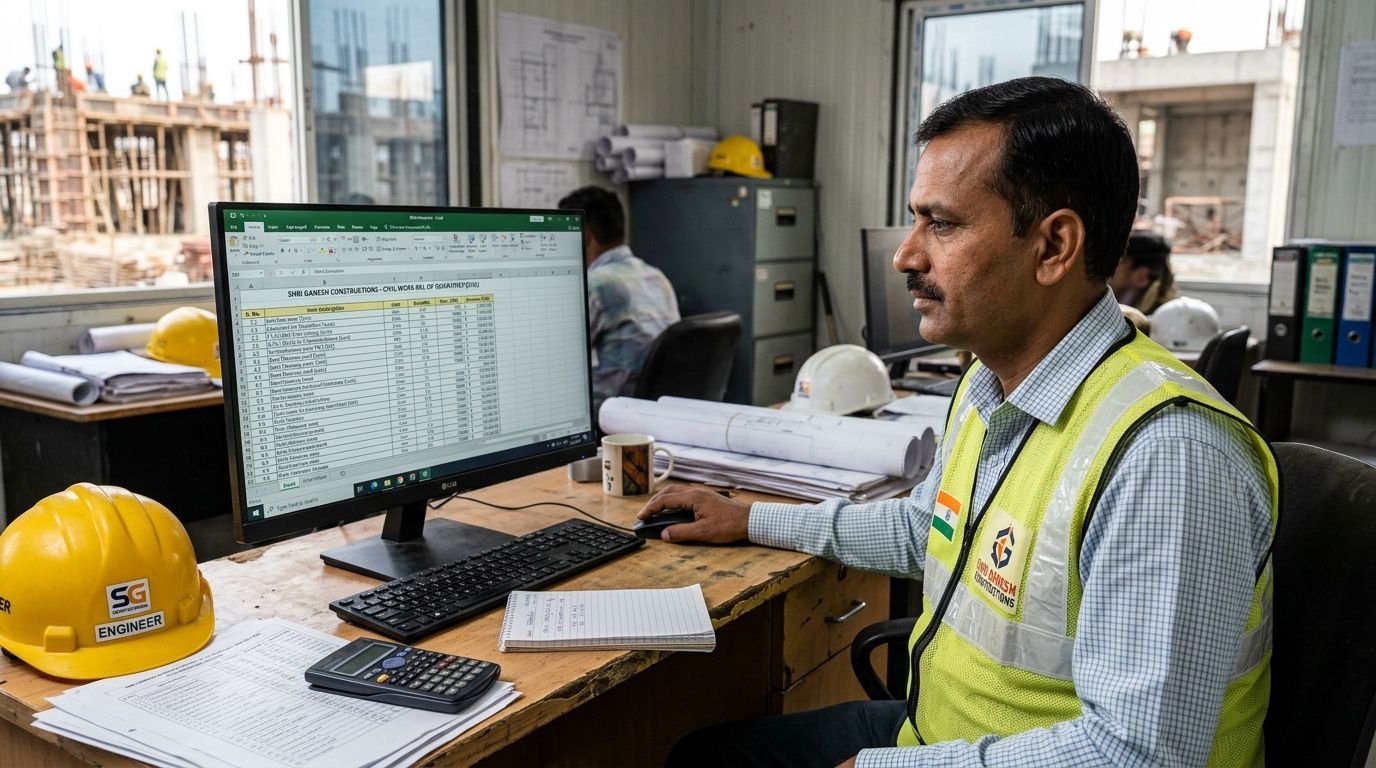
Why a BOQ with Rates is Essential in Civil Projects
Preparing a professional civil work BOQ format is not just a formality; it is a critical cost-control mechanism.
Transparency in Cost Breakdown
A detailed BOQ ensures that all stakeholders are speaking the same language. When multiple contractors bid on a project using a standardized civil BOQ with rates, the project owner can compare bids “item-by-item”. This transparency makes it easy to identify if a contractor has under-quoted a specific high-volume item or inflated the price of finishing works.
Better Budgeting and Cost Control
The BOQ acts as the baseline for the entire project lifecycle. During execution, it serves as the foundation for “Running Account” (RA) bills. Since the unit rates are fixed, the owner pays for the actual work measured on-site against the quantities in the BOQ. This prevents “budget creep” and allows for real-time tracking of expenses against the initial estimate.
Click Here to Purchase the Civil Work BOQ Template for ₹249
Reduced Disputes
Most construction disputes arise from ambiguity in the scope of work. A professional BOQ includes precise descriptions and units (e.g., specifying “M25 grade” concrete instead of just “concrete”). By defining what is included (like shuttering and curing) and what is excluded, the document significantly reduces arguments during the execution and billing phases.
Basic Structure of a Civil BOQ with Rates
A professional civil work BOQ format is typically structured in a table with seven core columns:
- S. No. (Serial Number): A unique identifier for each work activity (e.g., 1.01, 1.02).
- Item Description: A technical specification of the task, often referencing brands or quality standards.
- Unit: The standard unit of measurement (e.g., Cum, Sqm, Kg).
- Quantity: The precise numerical measurement derived from project drawings.
- Rate: The per-unit cost, which includes material, labor, and overheads.
- Amount: The total cost for that line item (Quantity × Rate).
- Remarks: References to specific drawings, site conditions, or technical codes (e.g., IS 1200).
In India, quantities must be measured according to standardized rules, such as IS 1200 (Method of Measurement of Building and Civil Engineering Works) or local PWD schedules, to ensure technical and legal compliance.
Click Here to Purchase the Civil Work BOQ Template for ₹249
Step-by-Step Process to Prepare a Civil BOQ
Preparing a reliable civil estimate with rates requires a systematic approach.
Step 1 – Study Drawings and Specifications
Before any calculations begin, you must thoroughly review the architectural, structural, and MEP (Mechanical, Electrical, and Plumbing) drawings. Understanding the project’s scope, such as soil conditions and finish requirements, is the foundation of an accurate BOQ.
Step 2 – Break the Project into Work Sections
To maintain organization, group the work into logical categories:
- Earthwork: Excavation, backfilling, and anti-termite treatment.
- Concrete Work: Foundations (PCC) and structural elements (RCC).
- Masonry: Brickwork or blockwork for walls.
- Finishing: Plastering, flooring, and painting.
- Roofing & Waterproofing: Protection for terraces and sunken slabs.
Step 3 – Take Off Quantities
Quantity take-off is the process of extracting exact dimensions from drawings. Precision is vital here. Use the following standard units for consistency:\
- Cubic Metre (m³): For volume-based items like excavation and concrete.
- Square Metre (m²): For area-based items like plastering, flooring, and painting.
- Running Metre (Rmt): For linear items like pipes, beams, or cornices.
- Numbers (Nos): For distinct units like doors, windows, or plumbing fixtures.
Step 4 – Assign Unit Rates
A unit rate is more than just the price of a material. To build a realistic rate, you must account for:
- Material Cost: Current market prices for cement, steel, sand, etc.
- Labour Cost: Daily wages for skilled and unskilled workers (e.g., masons vs. helpers).
- Equipment: Costs for machinery like mixers, vibrators, or excavators.
- Overheads & Profit: Usually 10–15% for civil works to cover administrative costs and business profit.
- Wastage: Typically 3–5% for concrete and 10% for bricks.
Note: Market rates vary significantly by location and time. Always verify current local rates before finalizing your BOQ.
Step 5 – Calculate Item Amounts and BOQ Totals
Finally, multiply the quantity by the unit rate to find the Amount. Sum the amounts for each section to get a sub-total, and then add all sub-totals to reach the Grand Total. In the modern Indian context, you must also add 18% GST to this final figure for compliance.
Example Sections of a Civil BOQ with Rates
The following table provides realistic examples of item descriptions and units for a construction BOQ example.
| Item No. | Description of Work | Unit | Quantity | Rate (₹) | Amount (₹) |
|---|---|---|---|---|---|
| 1.0 | Earthwork | ||||
| 1.01 | Earthwork in excavation by mechanical means in foundation trenches… | m³ | 200 | Rate: X per m³ | – |
| 2.0 | Concrete Work | ||||
| 2.01 | Providing and laying M25 grade RCC for columns, including shuttering… | m³ | 45 | Rate: Y per m³ | – |
| 2.02 | PCC (1:4:8) using 40mm stone aggregate under footings… | m³ | 12 | Rate: Z per m³ | – |
| 3.0 | Masonry & Plaster | ||||
| 3.01 | 230mm thick brick masonry in 1:6 cement mortar for external walls… | m³ | 80 | Rate: A per m³ | – |
| 3.02 | 12mm thick cement plaster (1:4) on internal wall surfaces… | m² | 450 | Rate: B per m² | – |
| 4.0 | Finishing | ||||
| 4.01 | Providing and laying vitrified floor tiles (600x600mm) with 1:4 mortar… | m² | 120 | Rate: C per m² | – |
| 4.02 | Two coats of premium acrylic emulsion paint over a coat of primer… | m² | 600 | Rate: D per m² | – |
Using Excel or Google Sheets for BOQ Preparation
Excel is the industry standard for preparing a civil work BOQ format because of its automation capabilities.
Setting Up the Header
Include the project name, client name, contractor details, date, and a version number (e.g., Rev 0) to keep records organized.
Automating with Formulas
- Amount Column: Use a formula like =Quantity * Rate for every row.
- Sub-totals: Use the SUM function to group costs by section (e.g., =SUM(E10:E20)).
- GST Calculation: Add a final row to calculate 18% GST on the sub-total.
Professional Output
Use data validation (dropdowns) for units and work categories to minimize manual entry errors. Apply cell borders and subtle colors to headers to make the document readable for evaluators. Using “Frozen Panes” helps keep headers visible while scrolling through long lists of items.
Click Here to Purchase the Civil Work BOQ Template for ₹249
How to Handle Rate Revisions and Variations
Construction projects are dynamic, and changes are inevitable.
- Base BOQ: This is the original, agreed-upon document with a fixed set of rates.
- Variation Items: These are extra works or change orders requested after the contract is signed.
- New Items: If the project requires an item not in the original BOQ (e.g., switching from clay bricks to AAC blocks), a new rate must be derived. This is often done using “Rate Analysis” based on the current market price of the new material.
Always record every revision with a date and a new version number to maintain a clear “audit trail”.
Tips for Preparing a Reliable Civil BOQ with Rates
To ensure your BOQ is a professional management tool, follow these expert tips:
- Cross-Check Everything: Always verify quantities against structural and architectural drawings to avoid missing high-cost items like specialized waterproofing.
- Use Standard Units: Stick to IS 1200 norms for units (e.g., kg or tonnes for steel reinforcement) to avoid disputes over measurements.
- Be Specific: Avoid vague descriptions like “miscellaneous work”. Detailed descriptions prevent “scope creep” and ensure you get paid for exact specifications.
- Separate Disciplines: Keep civil, electrical, and plumbing sections distinct, as they often have different measurement focus areas and labor rates.
- Keep Backup Notes: Maintain “Measurement Sheets” that show exactly how you calculated the quantities from the drawings.
Conclusion: Make Your Civil BOQ with Rates a Control Tool
A detailed civil BOQ with rates is far more than a clerical task; it is an essential engineering and management activity. It protects contractors from underquoting and gives owners the transparency they need to manage their investments.
By mastering the art of BOQ preparation—using standardized formats, precise measurements, and automated Excel tools—you ensure that your projects are “tender-ready” and financially safe. In the competitive landscape of 2026, precision is your only path to long-term profitability and success in the construction business.