
In the fast-paced Indian construction industry, a 5% error in your initial estimate doesn’t just mean a small mistake; it can lead to massive financial losses or the rejection of a critical tender. Many contractors and engineers still rely on “gut feeling” or outdated manual calculations, only to find their profit margins evaporating midway through the project. Whether you are building a small residential house or a large-scale commercial complex, having a standardized civil work estimate format is the difference between a project that succeeds financially and one that becomes a liability.
 Click Here to Purchase the Civil Work BOQ Template for ₹249
As a veteran civil engineer with over 15 years of experience on the ground in India, I have seen projects stall simply because the civil work estimate in excel lacked detail or used incorrect measurement norms. A professional estimate acts as your financial blueprint. It protects you from underquoting and ensures that every brick, bag of cement, and kilogram of steel is accounted for with local market precision. In this guide, I will break down exactly how to create a tender-ready construction estimate format for 2026, using real-world Indian examples.
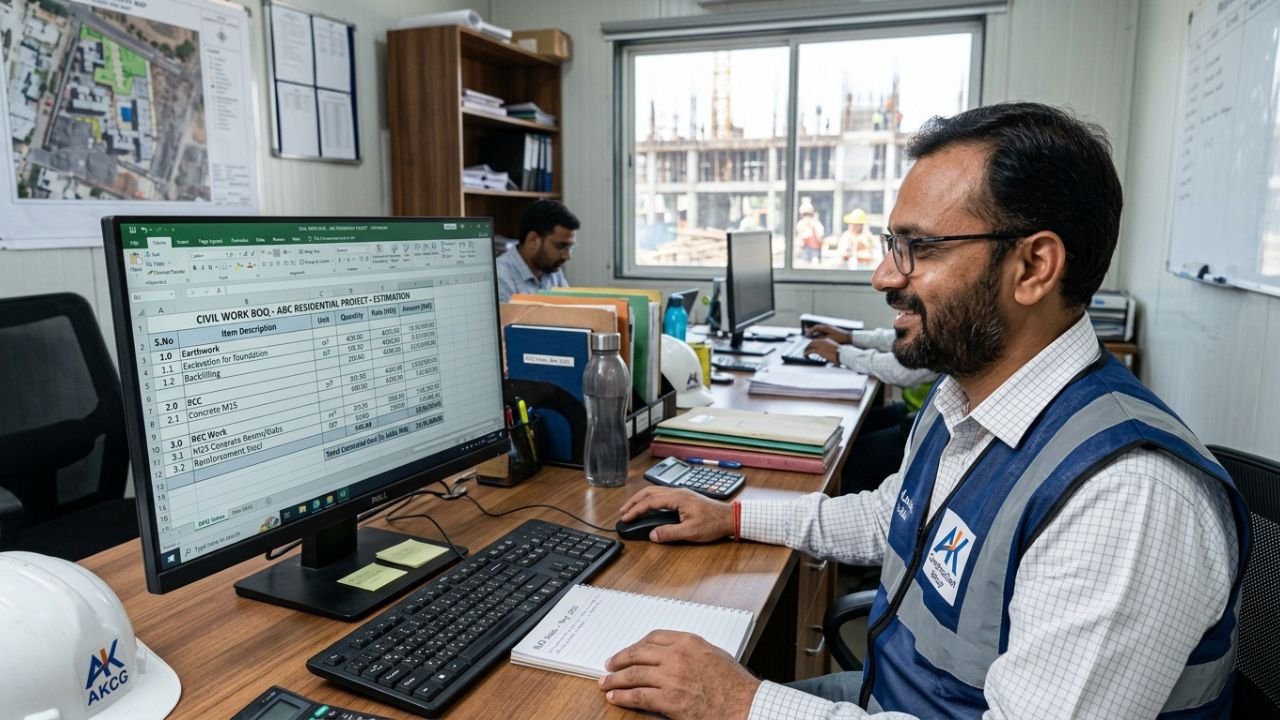
What is a Civil Work Estimate Format?
A civil work estimate format is a structured document, typically created in Microsoft Excel, that lists every item of work required for a construction project along with its quantity, unit of measurement, unit rate, and total cost. In the Indian context, this format must be incredibly detailed to account for regional variations in material prices (like the 2026 market rates in UP or Delhi NCR) and labor wages.
Unlike a simple quote, a professional estimate is based on a detailed civil work estimate format that follows standardized measurement codes like IS 1200. It provides a transparent breakdown that builds trust with clients and satisfies the stringent requirements of government and private tender evaluations.
Difference Between BOQ and Detailed Estimate
While often used interchangeably, there is a fundamental difference between a Bill of Quantities (BOQ) and a detailed estimate.
- Detailed Estimate: This is the primary document prepared during the planning stage. It includes a “Quantity Take-off” where dimensions are pulled directly from architectural and structural drawings (Length x Breadth x Height). It calculates the exact amount of work to be done.
- Bill of Quantities (BOQ): This is the summary document derived from the detailed estimate. It focuses on the description of work and the pricing. For example, while the detailed estimate shows exactly where 42.00 Cu.m of earthwork excavation is needed, the BOQ simply lists the total quantity and the rate to arrive at the final cost.
Understanding this BOQ and estimate format relationship is crucial for any quantity surveyor aiming for accuracy.
Click Here to Purchase the Civil Work BOQ Template for ₹249
Essential Components of a Professional Civil Work Estimate Format
To ensure your detailed civil estimate format is professional and legally sound, it must include these sections:
- Project Header: Includes the project name, client details (e.g., Mr. Rajesh Kumar Sharma), location (e.g., Lucknow, UP), and the built-up area.
- Document Control: Information regarding the revision number (e.g., R0 or R1), estimate date, and the names of the engineers who prepared and approved it.
- Detailed Item Columns: The core of the sheet must have columns for Item No., Description of Work, Unit, Quantity, Rate, and Amount.
- Rate Source: A clear indication of whether rates are based on the CPWD Delhi Schedule of Rates (DSR) or local Market Rates.
- GST and Overheads: In 2026, including a separate 18% GST slab and 10-15% for contractor profit and site overheads is mandatory for transparency.
- Assumptions and Terms: Clearly stating exclusions (like land cost or utility connection fees) prevents future disputes.
Step-by-Step Guide to Creating Civil Work Estimate Format in Excel
Creating a civil work estimate format manually is a 20 to 40-hour task, but doing it right saves hundreds of hours later. Follow this professional workflow:
Step 1: Set Up the Worksheet Architecture
Create separate tabs for “Market Rates,” “Quantity Take-off,” “BOQ,” and “Abstract”. This modular approach ensures that if the price of TMT steel changes from ₹78,500 to ₹80,000 in your rate sheet, the entire project cost updates automatically.
Step 2: Build Your Rate Analysis Format
A rate analysis format is the secret to accurate pricing. For an item like RCC M20 Grade concrete, don’t just guess a rate. Calculate the cost of 7.87 bags of cement, 0.420 Cu.m of sand, 0.830 Cu.m of aggregate, and the skilled labor required for mixing and vibrating per cubic meter. Add a 3% wastage allowance to protect your margins.
Step 3: Implement Measurement Norms
Use IS 1200 standards for all measurements. For instance, when calculating plastering quantities, ensure you are making proper deductions for door and window openings as per the code. In Excel, use formulas like =Length * Breadth * Height in your measurement sheet to avoid manual math errors.
Step 4: Use Data Validation and Formulas
Use Excel’s “Data Validation” to create dropdowns for units (Cu.m, Sq.m, Kg, Tonne). Link your BOQ “Rate” column directly to your “Market Rates” sheet using VLOOKUP or direct cell references. Use the =ROUND(Quantity * Rate, 0) formula for all amount cells to maintain a clean financial look.
Standard Formats Used in India
In India, civil work estimates generally align with one of three major standards:
- CPWD DSR Based: Used for most government tenders and large corporate projects. It follows the latest Delhi Schedule of Rates.
- PWD/State Schedules: Many states like Uttar Pradesh or Maharashtra have their own PWD schedules that must be followed for regional government works.
- Market-Based Formats: Used for private residential and commercial builds. These rely on real-time quotes from local suppliers for materials like UltraTech cement or TATA Tiscon steel.
Ensuring your Excel sheet can toggle between these standards is a high-level professional requirement.
Click Here to Purchase the Civil Work BOQ Template for ₹249
Sample Civil Work Estimate Format (1800 Sq.ft G+1 House)
Based on 2026 market rates for a typical residential project in North India, here is how a civil work estimate format should look for major sections.
Section 1: Earthwork and Foundation
| Item No. | Description of Work | Unit | Quantity | Rate (₹) | Amount (₹) |
|---|---|---|---|---|---|
| 1.1 | Site clearance and removal of vegetation | Sq.m. | 222.97 | 25.00 | 5,574 |
| 1.2 | Earthwork excavation in trenches up to 1.5m depth | Cu.m. | 42.00 | 180.00 | 7,560 |
| 1.3 | Anti-termite treatment with 1.0% emulsion | Sq.m. | 110.00 | 85.00 | 9,350 |
| 1.4 | Sand filling under floor, rammed and consolidated | Cu.m. | 14.00 | 850.00 | 11,900 |
Section 2: Concrete and RCC Works
| Item No. | Description of Work | Unit | Quantity | Rate (₹) | Amount (₹) |
|---|---|---|---|---|---|
| 2.1 | PCC 1:4:8 with 40mm aggregate under foundation | Cu.m. | 4.50 | 5,800.00 | 26,100 |
| 2.2 | RCC M20 grade in foundation footings (excl. steel) | Cu.m. | 8.50 | 7,800.00 | 66,300 |
| 2.3 | RCC M20 in roof slabs (150mm thick) | Cu.m. | 27.00 | 8,400.00 | 226,800 |
Section 3: Reinforcement and Masonry
| Item No. | Description of Work | Unit | Quantity | Rate (₹) | Amount (₹) |
|---|---|---|---|---|---|
| 3.1 | Supply and fixing TMT Fe500 reinforcement bars | Tonne | 5.99 | 82,000.00 | 491,180 |
| 3.2 | Brick masonry 230mm thick in CM 1:6 | Cu.m. | 24.00 | 6,800.00 | 163,200 |
| 3.3 | 12mm thick cement plaster CM 1:4 on internal walls | Sq.m. | 380.00 | 240.00 | 91,200 |
Note: The above rates include basic material and labor but exclude 18% GST.
Click Here to Purchase the Civil Work BOQ Template for ₹249
Best Practices & Pro Tips for Accurate Estimation
- Never Use Lump Sums: Avoid “L.S.” for major items. Always break down costs into measurable units to avoid disputes during billing.
- Verify the BBS: Ensure your steel quantity comes from a proper Bar Bending Schedule (BBS). A typical G+1 house consumes roughly 3.43 kg of steel per square foot.
- Include Contingencies: Always add a 5% contingency for unforeseen site conditions, such as hitting hard rock during excavation or sudden material price spikes.
- Check Lead and Lift: Factor in the distance for material transport. For example, a 20km lead is usually free, but anything beyond requires an extra charge per Cu.m.
- Use 2026 Realistic Rates: In 2026, OPC 43 Grade cement is hovering around ₹510 per bag, and TMT steel is roughly ₹78,500 per tonne. Using 2023 or 2024 rates will result in an immediate underbid.
Recommended Tools and Templates
Creating these sheets from scratch every time is a recipe for burnout and human error. To save 30+ hours per project and present a world-class document to your clients, I highly recommend our Professional Civil Work Estimate & BOQ Template.
This is the exact system we use at Construction Estimator India to manage high-value projects. It’s not just an Excel sheet; it’s a complete estimation engine.
Key Features of Our 2026 Template:
- Auto-Calculation Engine: Enter your measurements once, and the BOQ, Abstract, and Material list update instantly.
- DSR & Market Toggle: Switch between government DSR rates and your own local market rates with one click.
- Built-in Rate Analysis: Pre-configured detailed cost breakdowns for concrete, masonry, and plaster.
- BBS Sheet Included: Automatically calculates steel weight by diameter (8mm to 25mm) using IS 2502 standards.
- GST-Ready: Professional summary sheets with 18% GST, contingencies, and overheads already formatted.
Download the Professional Civil Work Estimate & BOQ Template today and take your construction business to the next level of professionalism.
Conclusion with Key Takeaways
A standardized civil work estimate format is more than just a list of costs; it is a shield for your business’s profitability. By following the IS 1200 measurement norms and integrating real-time 2026 market rates, you ensure that your bids are both competitive and safe.
Remember the key takeaways:
- Always separate your detailed measurements from your pricing BOQ.
- Perform a rigorous rate analysis for every major work item.
- Factor in modern requirements like GST, safety cess, and material wastage.
- Leverage automated tools to eliminate math errors and save time.
Construction is a game of millimeters and rupees. Don’t leave your success to chance. Start using a professional estimate format today and watch your tender win rate soar.
Ready to simplify your estimation process?
Download our Professional Civil Work Estimate Template Now
External Authority Resources:
- Government e-Marketplace (GeM)
- Central Public Procurement Portal (CPPP)
- Indian Standards (IS) Codes – Bureau of Indian Standards
- National Building Code (NBC) 2016
- RICS (Royal Institution of Chartered Surveyors) India