
Building a home is often the single most significant financial and emotional investment an Indian family makes. It is the culmination of years of savings and dreams. However, the path from a vacant plot to a finished home is riddled with challenges. In the current 2026 market, where material costs are volatile and labor dynamics are shifting, the success of your project depends almost entirely on one person: your contractor.
Learning how to choose a contractor for house construction in India is the most critical skill you need before laying the first brick. A wrong choice can lead to heartbreaking consequences—structural defects, endless delays, massive cost escalations, and even legal disputes that leave your project unfinished. Many homeowners fall into the trap of hiring based on the lowest price, only to find that “cheap” becomes very expensive later on.
In this comprehensive guide, we will provide you with a practical, step-by-step roadmap to navigate the Indian construction landscape. You will learn how to verify credentials, evaluate technical capabilities, and understand the documentation required to protect your investment. Whether you are building in a bustling metro or a Tier-2 city, this guide will empower you with the knowledge to select a partner who delivers quality and transparency.
Understand the Difference Between a Builder and a Contractor
Before you start your search, you must understand exactly who you need to hire. In the Indian context, the terms “builder” and “contractor” are often used interchangeably, but they serve different functions. A builder usually refers to a company or individual who develops entire projects, such as apartment complexes or plotted developments, often handling everything from land acquisition to sales.

A contractor, on the other hand, is a service provider you hire to execute the construction on your own land based on provided designs. There are civil contractors who handle the “grey structure” and turnkey contractors who manage everything from excavation to the final coat of paint. Understanding these roles helps you set the right expectations for supervision and accountability.
To understand the exact difference and which one fits your specific needs, see: What Is the Difference Between a Builder and a Contractor?
Define Your Project Scope and Budget Clearly
You cannot choose the right partner if you haven’t defined the destination. Start by finalizing your requirements: How many floors? How many bedrooms? Do you want a standard finish or a luxury interior? In 2026, building a house construction cost estimate India involves more than just calculating bricks and cement; you must account for modern electrical needs, EV charging points, and smart home features.
Knowing your rough budget acts as a filter. If a contractor quotes significantly lower than the market average, it’s a red flag—they might be planning to cut corners on material quality or demand “extra” payments mid-project. Having a baseline cost helps you stay in control of the conversation.
For a detailed guide on the current cost of building a house in India, read: Cost of Building a House in India
Shortlist 3–5 Contractors and Ask for BOQ-Based Quotes
The biggest mistake Indian homeowners make is asking for a “per square foot” rate. This is a vague metric that hides more than it reveals. A rate of ₹2,000 per sq. ft. tells you nothing about the grade of steel, the brand of cement, or the quality of plumbing pipes being used.
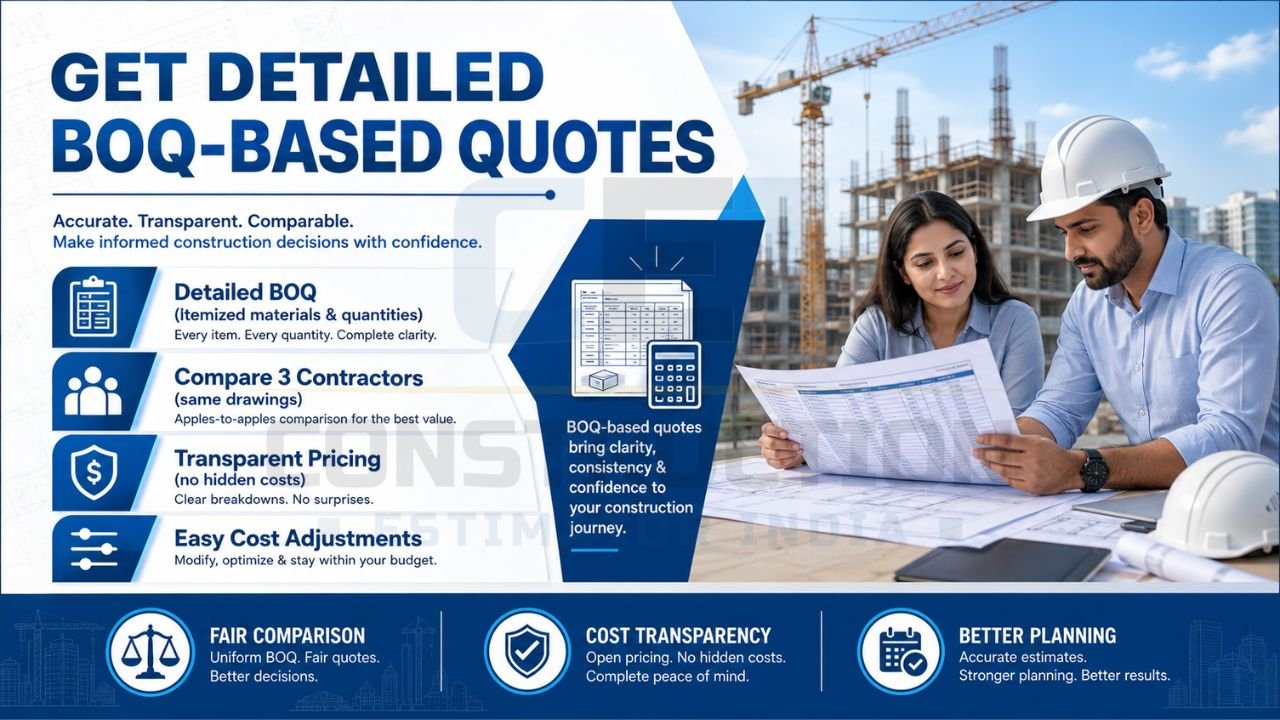
Instead, you should ask for construction contractor quotes India based on a Bill of Quantities (BOQ). A BOQ is a detailed document that lists every single item of work—from excavation volume to the number of electrical points—along with their specific quantities and unit rates. This allows you to compare different contractors on an “apples-to-apples” basis. If Contractor A is cheaper but has omitted the cost of a water tank or boundary wall, the BOQ will make that omission visible.
To understand why this document is the backbone of a successful build, see: What Is BOQ in Construction?
Check Licenses, Experience, and Past Work
In the Indian construction industry, reputation is built on the ground, not on social media. When you have a shortlist, perform a deep dive into their credentials. This is where your contractor selection checklist India comes into play.
- Legal Documents: Ask for their GST registration, PAN card, and any relevant trade licenses. If they are a registered firm, check their history on government portals.
- Experience: How many years have they been in business? Have they built houses of a similar scale and style to yours?
- Physical Verification: Never hire a contractor without visiting their current and past sites. When you visit an ongoing site, look at the discipline: Is the site clean? Are the workers wearing safety gear? Are the materials stored properly?
- Client References: Speak to at least two past clients. Ask specifically about three things: Did the contractor finish on time? Did they ask for more money than the agreed quote? How did they handle mistakes?
For a detailed checklist of what to verify, see: What to Check Before Hiring Contractor for House Construction in India
Understand the Tender and Bidding Process (Even for Small Homes)
Many homeowners think a “tender” is only for multi-crore government projects. In reality, the construction BOQ and tender India process is just a structured way of asking for bids. Even for a 1,000 sq. ft. home, you are essentially “issuing a tender” when you share your drawings and ask for quotes.
By following a mini-bidding process, you force contractors to be competitive and transparent. It signals to them that you are an informed owner who understands technicalities. This process usually involves:
- Sharing architectural and structural drawings.
- Providing a blank BOQ for them to fill in their rates.
- Conducting a “pre-bid” meeting to answer their questions about site access or water availability.
- Opening the bids and analyzing the “rate analysis” to see where the money is going.
To understand the basics of how this works for residential projects, see: What Is Tender in Construction?
Review the Contract Agreement Carefully
A verbal promise in construction is worth nothing. Once you select a contractor, every detail must be captured in a written construction contract agreement India. This document is your only legal shield if things go wrong.
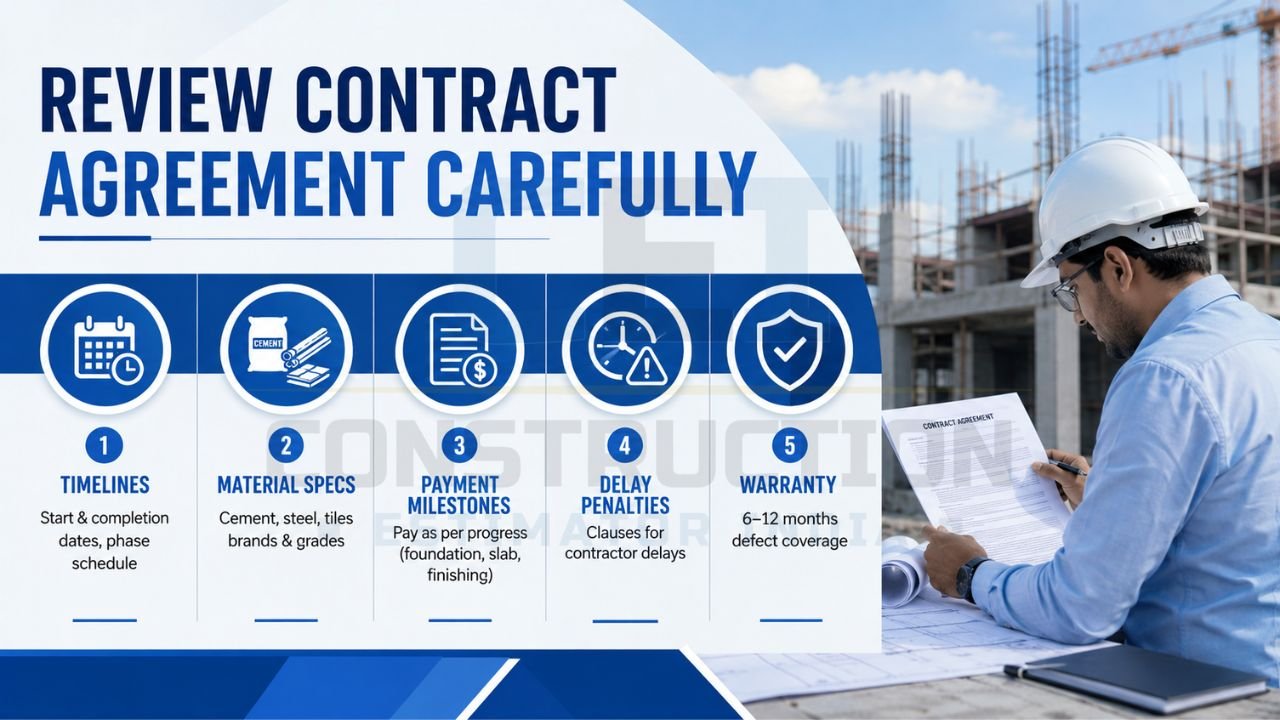
A robust contract must include:
- Detailed Scope of Work: Referencing the BOQ and the final drawings.
- Material Specifications: Exact brands and grades of cement, steel, tiles, and fixtures.
- Payment Schedule: Link payments to physical milestones (e.g., 10% after foundation, 15% after first slab) rather than dates.
- Timeline: A clear start date and completion date, including a “liquidated damages” clause for delays.
- Defects Liability Period: A guarantee (usually 12 months) where the contractor fixes any cracks or leakages for free.
For a sample format and essential clauses, see: Construction Contract Agreement Format India
Avoid Common Costly Mistakes When Choosing a Contractor
Most project failures are predictable. Over the years, we have seen homeowners repeat the same errors that lead to financial loss. To ensure a smooth experience, keep these warnings in mind:
- The “Lowest Bid” Trap: The cheapest contractor often ends up being the most expensive because they use sub-standard materials or leave the work midway when they realize they can’t make a profit.
- Lack of Professional Drawings: Never hire a contractor if you don’t have structural drawings. Building by “thumb rules” leads to sagging slabs and cracked walls.
- Paying Too Much Upfront: Never pay more than 5–10% as an advance. The contractor should have the financial capacity to start the work.
- Ignoring the “Vibe”: Construction is a long-term relationship. If the contractor is dismissive of your questions or lacks transparency during the bidding phase, they will be much harder to deal with once work starts.
To learn more about what to avoid, see: 7 Common Expensive Mistakes in House Construction in India
Use External Resources for Extra Guidance
While this guide covers the core selection process, building a home involves many technical layers. We recommend consulting official guidelines and reputable industry sources to stay updated on the latest standards:
- For a detailed house construction step-by-step process in India, see Magicrete’s guide: House Construction Step-by-Step Process in India.
- For a field-tested guide on how to hire a reliable contractor in India, see JK Cement: How to Hire a Reliable Contractor in India.
- For a first-timer’s essential guide to selecting the right contractor, see OnGrid: A First-Timer’s Essential Guide to Selecting the Right Contractor in India.
- For a broader checklist of 50 critical factors to consider when building your home, see Tata Steel Aashiyana: Building Your Home: 50 Critical Factors.
Why Use Construction Estimator India Before Choosing a Contractor?
At Construction Estimator India, we believe that “Information is Power.” Most disputes between owners and contractors happen because of a “knowledge gap.” The contractor knows the costs, and the owner is just guessing. We bridge that gap by providing professional, data-backed estimation services.
By getting a professional estimate before you even talk to a contractor, you gain several advantages:
- Negotiation Power: You know the actual market rate for every bag of cement and every ton of steel.
- Zero Scope Creep: With a clear BOQ, the contractor cannot charge you for “extra items” that should have been part of the original scope.
- Bank Readiness: Our detailed estimates are often used by homeowners to secure home construction loans with ease.
- Material Control: You get a “material takeoff” sheet, which helps you track if the contractor is wasting material on-site.
For a proper cost estimate and BOQ before construction, contact Construction Estimator India on Call / WhatsApp: 8630676890.
Conclusion
Mastering how to choose a contractor for house construction in India is about shifting from “trusting” to “verifying.” By insisting on BOQ-based quotes, checking physical site performance, and signing a detailed contract agreement, you eliminate 90% of the risks associated with home building.
Remember, a good contractor is not just someone who builds walls; they are a project manager who respects your budget and your timeline. Don’t rush the selection process. Spend the extra time now to investigate, interview, and estimate. Before choosing a contractor, get a clear cost estimate and BOQ to compare quotes and avoid surprises. Happy building!
FAQs – How to Choose a Contractor for House Construction in India
What is the first step in choosing a contractor for house construction in India?
The first step is having your architectural and structural drawings ready. Without these, no contractor can give you an accurate quote, and you won’t be able to compare bids fairly.
Why is a BOQ important when choosing a contractor?
A BOQ (Bill of Quantities) ensures transparency. It prevents contractors from using vague per-square-foot rates and allows you to see the exact quality and quantity of materials they are promising.
How many contractor quotes should I get before deciding?
We recommend getting at least 3 to 5 quotes. This gives you a clear sense of the “market rate” for your specific project and helps you identify outliers who are either too expensive or suspiciously cheap.
What documents should I check before hiring a contractor?
You should check their GST registration, PAN card, past project completion certificates, and current labor insurance. Additionally, verify if they have a permanent office address and a valid bank account.
What are the biggest mistakes when choosing a contractor?
The most common mistakes are choosing the lowest price without checking quality, not having a written contract, failing to visit past project sites, and paying large sums of money as an advance.
Do I need a written contract for house construction?
Yes, absolutely. A written contract is mandatory to define the scope, timeline, payment terms, and material specifications. Never start work based on a verbal agreement or a simple one-page quotation.