Imagine walking into your living room and seeing a finish so smooth that the light glides across it without a single shadow or brush mark. Most homeowners think this “Royale” look is only possible with a crew of twelve, but the truth is hidden in the technique. Learning how to paint walls like professional is less about the speed of the roller and more about the precision of the preparation and the science of the materials. Whether you are in the dust-prone streets of Meerut or a high-rise in Pune, professional results are achieved by following a strict technical sequence that respects the Indian climate.
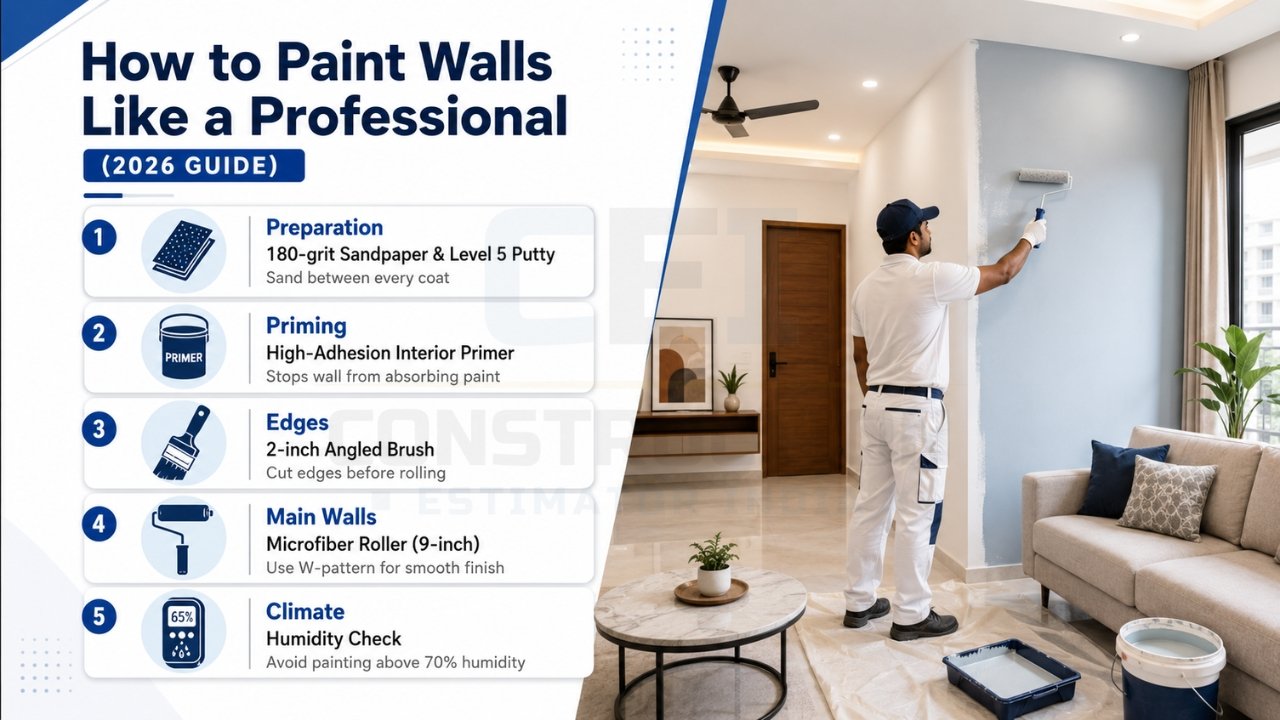
The Direct Answer for 2026: To paint walls like a professional, you must achieve a “Level 5” finish through meticulous surface preparation—scraping, sanding, and applying two coats of acrylic wall putty followed by a dedicated primer. Professionals use a “cutting-in” technique for edges and a “W” or “N” rolling pattern to ensure uniform thickness, maintaining a “wet edge” to avoid visible overlaps.
2026 Professional Painting Quick Checklist
| Step | Professional Tool / Tip | 2026 Pro Secret |
|---|---|---|
| Preparation | 180-grit Sandpaper & Level 5 Putty | Sand between every single coat. |
| Priming | High-Adhesion Interior Primer | Prevents the wall from “drinking” your expensive paint. |
| Edges | 2-inch Angled Synthetic Brush | “Cut in” the entire room before you touch the roller. |
| Main Walls | Microfiber Roller (9-inch) | Use the “W” pattern for 100% streak-free coverage. |
| Climate | Hygrometer Check | Never paint if humidity is above 70% (Monsoon rule). |
For professional wall painting, cost estimation or BOQ in India, WhatsApp or call us today at +91 8630676890.
The Science of Surface Preparation: The Level 5 Finish
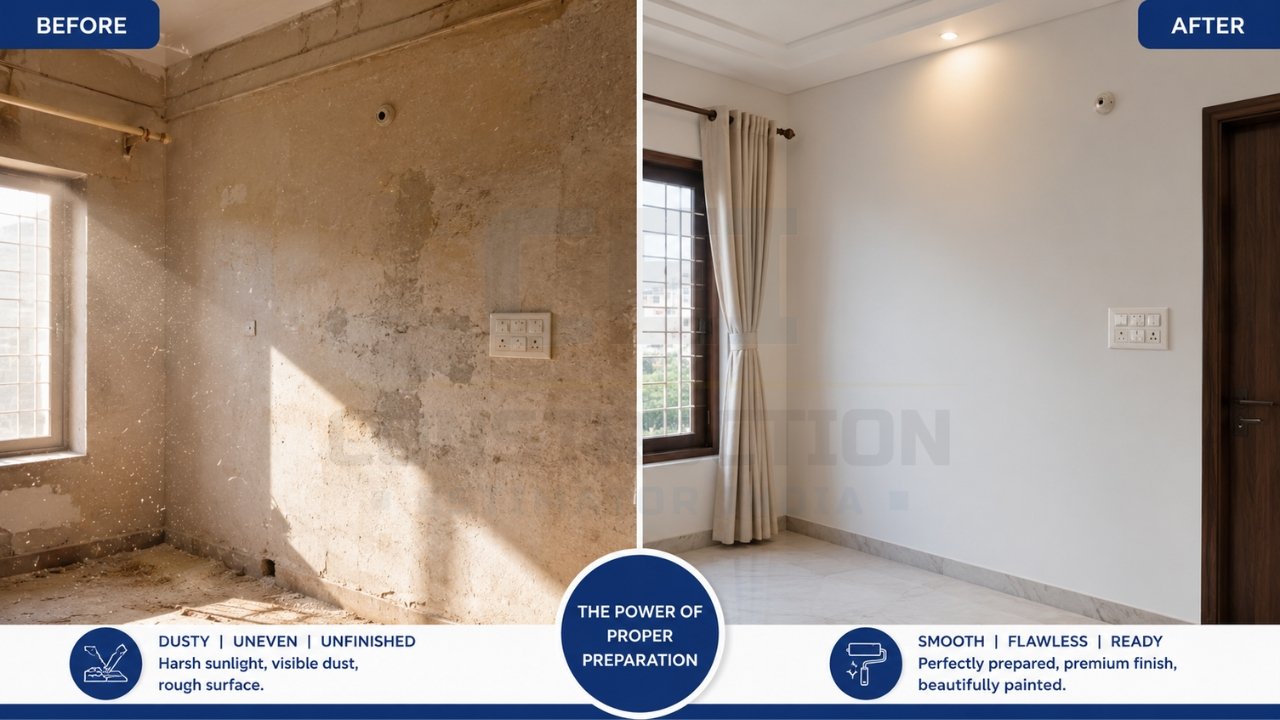
We at Construction Estimator India often tell our clients: “The paint is only as good as the wall underneath it.” In the industry, we aim for a “Level 5” finish. This means the surface is so smooth it lacks any original texture from the plaster or previous paint layers.
Why Preparation is Non-Negotiable?
In Indian homes, dust and atmospheric pollution are your biggest enemies. If you paint over a dusty wall, the paint will peel within 18 months. Professionals start by washing the walls with a mild detergent solution to remove grease—especially in kitchens.
Sanding: The Secret to Adhesion
You must sand the wall twice. First, use a coarse grit to remove old flakes. After applying putty, use a fine 180-grit sandpaper to achieve a glass-like surface. This creates “mechanical teeth” for the primer to grab onto. Our house construction cost estimation services always factor in these labor-intensive prep steps because skipping them is a “false economy”.
The 2026 Professional Tool Kit: What You Actually Need
To paint walls like a pro India 2026, you cannot rely on local “set” brushes that shed bristles. Quality tools save you hours of rework.
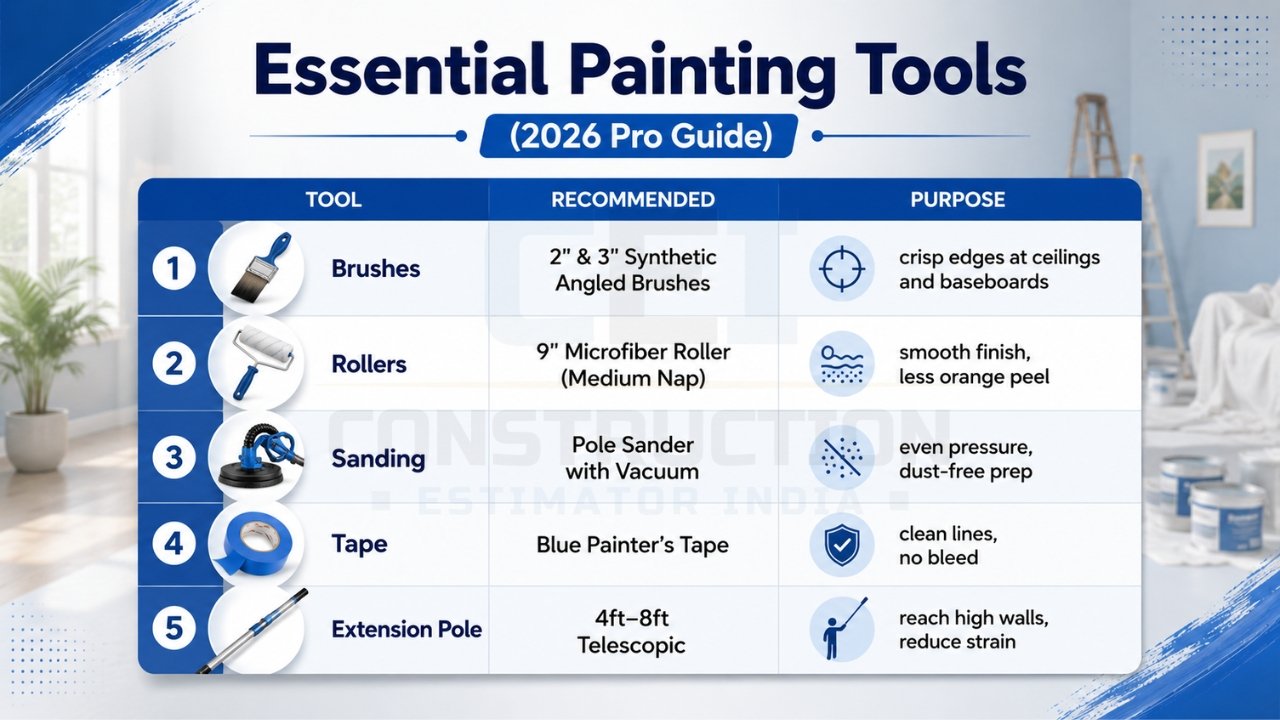
| Tool Category | Recommended Specification | Professional Purpose |
|---|---|---|
| Brushes | 2″ & 3″ Synthetic Angled Brushes | For crisp lines at ceilings and baseboards. |
| Rollers | 9″ Microfiber Roller (Medium Nap) | Holds more paint and reduces “orange peel” texture. |
| Sanding | Pole Sander with Vacuum Attachment | Ensures even pressure and keeps your home dust-free. |
| Tape | Multi-Surface Painter’s Tape (Blue) | Prevents paint bleed; remove while paint is slightly damp. |
| Extension Pole | 4ft – 8ft Telescopic Pole | Better leverage and prevents back strain during wall rolling. |
Refer to the Asian Paints 2026 professional wall painting guide for a detailed list of their approved application tools for the Royale and Apcolite ranges.
Step-by-Step Guide: How to Paint Walls Like Professiona
Step 1: Clear the Arena
Remove all furniture or move it to the center and cover it with heavy-duty plastic sheets. Use drop cloths (canvas is better than plastic) for the floor to absorb spills.
Step 2: Patch and Putty
Identify every dent, scratch, or nail hole. Use a high-quality acrylic wall putty. In 2026, we recommend two thin coats rather than one thick one to prevent cracking.
Step 3: Priming (The Critical Bridge)
Apply one coat of primer. This seals the porous putty and ensures your final color looks exactly like the swatch. Without it, you might need 4 coats of expensive emulsion to get the right shade.
Step 4: Cutting In
Using your 2-inch angled brush, paint a 3-inch border around the ceiling, corners, and baseboards. This is called “cutting in”. Work in sections so the “cut” area doesn’t dry before you roll the main wall.
Step 5: The “W” Rolling Technique
This is how you paint walls like a pro. Dip your roller and roll it on the tray until it’s evenly saturated but not dripping.
- Start near the corner and draw a large “W” on a 3ft x 3ft section.
- Fill in the gaps of the “W” without lifting the roller.
- Feathering: Lightly roll over the edges of the section to blend it with the next area.
Step 6: The Second Coat
Wait at least 4–6 hours (depending on humidity). Sand very lightly with ultra-fine paper to remove any dust nibs before the final coat.
India-Specific Factors: Humidity, Dust, and the Monsoon
In India, the weather dictates the quality of your finish. Construction Estimator India leverages our 10+ years of construction estimating expertise to advise clients on the optimal window for painting.
- The Monsoon Rule: High humidity (above 70%) prevents paint from curing. This leads to “bubbling” or a “tacky” finish that attracts dust. In coastal cities like Mumbai or Chennai, use specialized moisture-resistant primers.
- The Dust Factor: In North India (Delhi, Meerut), keep windows closed during the drying phase. Fine dust particles can settle on wet paint, ruining a “Silk” finish.
- The “Level 5” Wall: Most Indian plastered walls are uneven. We recommend using a professional interior painting cost per sq ft in India 2026 calculator to account for the extra putty needed to level these surfaces.
For the most accurate technical specs, check the latest 2026 professional painting techniques by Berger and Nerolac regarding their climate-specific formulations.
The 60-30-10 Rule and Vastu Shastra Color Tips
A professional finish isn’t just about the stroke; it’s about the harmony of the room. We use the 60-30-10 rule in our professional interior painting estimation services:
- 60% Base Color: Your main wall color (e.g., Warm Greige).
- 30% Secondary Color: Accent walls or curtains (e.g., Muted Sage).
- 10% Accent Color: Pops of color in decor (e.g., Ochre Sand).
Vastu-Compliant Choices
- North-East (Water): Light Blue or White for clarity.
- South-East (Fire): Pink or Orange for prosperity.
- South-West (Earth): Yellow or Light Brown for family stability.
Common Mistakes That Ruin Your Finish
Even with the best paint, these errors will result in a DIY look:
- Over-rolling: Rolling over paint that has already started to dry (the “tack” stage) creates a rough texture.
- Skipping the Sanding: If you don’t sand between coats, you’ll see every “nib” and dust particle.
- Poor Lighting: Always paint under the same lighting conditions you will use. A color that looks great in daylight might look “patchy” under 2700K LEDs.
- Using Cheap Tape: Local masking tape often leaves adhesive residue or rips the paint off when removed. Use professional-grade blue tape.
Expert Cost-Saving Tricks for 2026
At Construction Estimator India, we help you maximize your budget without sacrificing quality.
- Bulk Buying: Purchasing 20-liter buckets instead of 1-liter cans can save you 15–20% on material costs.
- Ceiling Strategy: Use distemper for ceilings. It’s cheaper, and because ceilings aren’t touched, the lower durability doesn’t matter.
- Primer Power: One coat of primer is cheaper than the two extra coats of premium emulsion you’ll need if you skip it.
- Neutral Advantage: Vibrant reds and deep blues use more expensive pigments and often require 3–4 coats for full opacity.
When to Hire Professionals vs. DIY
While DIY can save you 50–60% on labor costs, it often takes three times longer and leads to material wastage.
Hire a pro if:
- You have high ceilings or stairwells requiring scaffolding.
- You want a specialized “Texture” or “Metallic” finish.
- You are preparing a home for sale and need a flawless, high-ROI result.
- You need a guaranteed professional interior painting estimation services and a Bill of Quantities (BOQ) to ensure no contractor overcharges you.
For professional wall painting, cost estimation or BOQ in India, WhatsApp or call us today at +91 8630676890.
Frequently Asked Questions (FAQ)
- Can I paint directly over old paint?
Yes, if the old paint is in good condition. However, if you are moving from a dark to a light color, or if the old paint is glossy, you must sand and prime first to ensure adhesion. - How many liters of paint do I need for a 10×12 room?
On average, a standard room requires 7–8 liters of emulsion for two coats on the walls and 2–3 liters of distemper for the ceiling. - What is the best time of year to paint in India?
The best time is during the dry months of October to March. Avoid the high humidity of the monsoon (July–August) and the extreme dust-storms of May. - How many coats of paint are needed for a professional look?
For a “Royale” finish, we recommend one coat of primer followed by two coats of premium emulsion. Fresh walls require two coats of putty first. - Why does my paint look patchy after drying?
This is usually due to “lap marks” caused by not maintaining a “wet edge” while rolling, or skipping the primer coat on porous putty. - Does Vastu affect color choice?
Yes, many Indian families choose colors based on the room’s orientation to ensure positive energy flow (Prana). For example, Light Blue is preferred for North-East facing rooms. - How much does professional painting labor cost in India 2026?
Labor ranges from ₹4 per sq ft for basic distemper to ₹35+ per sq ft for premium luxury finishes or textures, depending on your city.
Conclusion
Mastering how to paint walls like professional is a journey of patience and precision. By following the “Level 5” preparation standard, using microfiber rollers, and respecting the Indian climate, you can transform your home into a masterpiece. Remember, the difference between a DIY job and a professional result lies in the details—the sanding between coats, the quality of the primer, and the accuracy of your initial estimation.
Don’t leave your home’s finish to guesswork. Whether you’re in Meerut, Delhi, or Pune, accuracy is your best friend in 2026.
For professional wall painting, cost estimation or BOQ in India, WhatsApp or call us today at +91 8630676890.