
Imagine standing in your home office in Gurgaon or a vibrant kids’ room in Mumbai, looking at a wall that does more than just hold color. It holds your ideas, your children’s artwork, and your project timelines—all without a single pin or piece of tape. Magnetic walls have moved from a niche luxury to a staple of the “Smart Home” era in 2026. However, the most common frustration we hear at Construction Estimator India is from homeowners who spent thousands on specialty paint only to find that their magnets slide right off. The culprit? An incorrect number of layers.
The direct answer to how many coats of magnetic paint are needed for functional strength in 2026 is 3 to 6 coats. While 3 coats provide a baseline for lightweight decorative magnets, we recommend 6 coats for a truly “industrial strength” wall that can support heavy planners or framed photos.
At Construction Estimator India, we have spent our 10+ years of construction estimating expertise helping over 500 clients navigate the complexities of specialty coatings. We know that magnetic paint isn’t just a finish; it’s a technical installation where the number of coats directly dictates your material volume, labor hours, and the final Bill of Quantities (BOQ).
For accurate painting cost estimation or BOQ for your magnetic paint project in India, WhatsApp or call us today at +91 8630676890.
2026 Magnetic Paint Quick Reference
| Strength Level | Recommended Coats | Ideal Use Case | BOQ Cost Impact |
|---|---|---|---|
| Decorative | 3 Coats | Light fridge magnets, kids’ ABCs | Baseline Specialty Cost |
| Functional | 4-5 Coats | Photos, to-do lists, calendars | +25% Material/Labor |
| Professional | 6+ Coats | Heavy reference materials, offices | +50% Material/Labor |
Standard 2026 Application Sequence: 1 Coat Primer + 3–6 Coats Magnetic Paint + 1–2 Coats Standard Emulsion Topcoat.
The Science of Attraction: Why Multiple Coats are Mandatory
Magnetic paint is not actually a magnet. It is a high-density emulsion infused with thousands of tiny particles of iron dust. When you apply one coat, you are scattering these particles across the surface. When you apply six coats, you are creating a dense, metallic “plate” hidden behind your wall color.
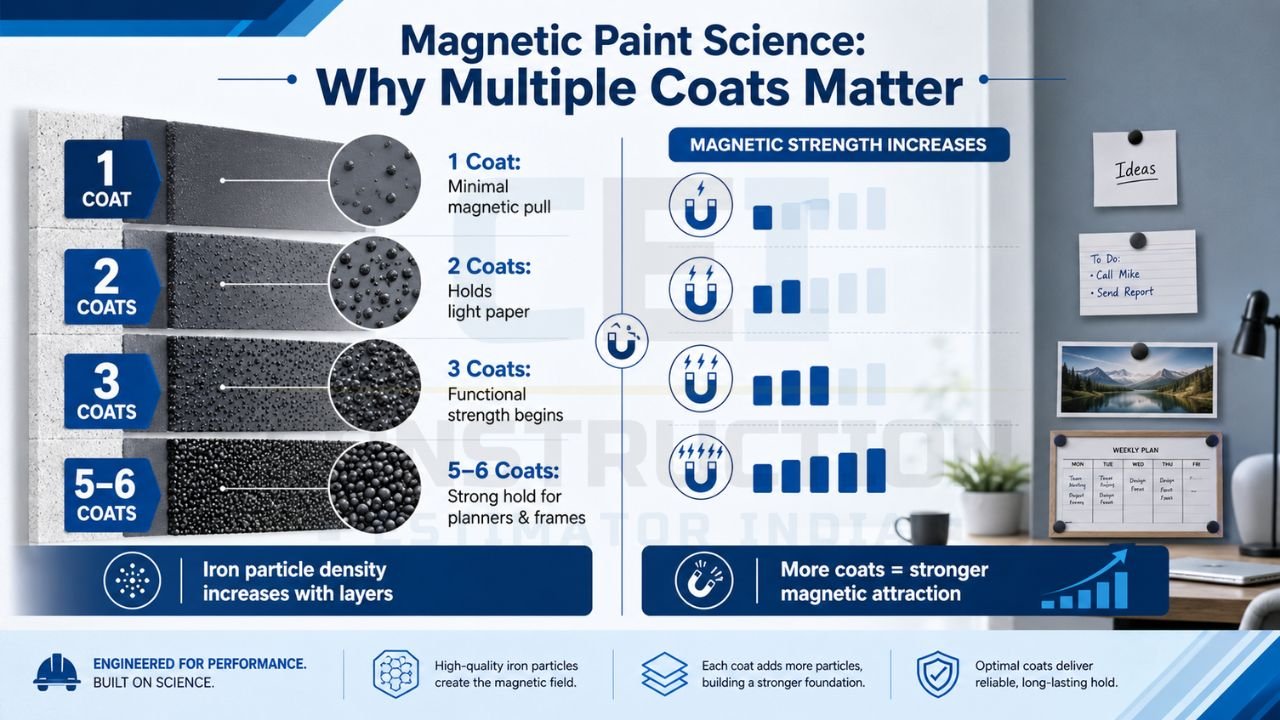
In our experience with professional interior painting estimation services, we’ve found that the magnetic pull follows an exponential curve. One coat has almost zero pull. Two coats might hold a single piece of paper. It is only at the third coat that the surface begins to behave as intended. By the sixth coat, you achieve maximum saturation, ensuring that expensive “Neo-Magnets” perform at their peak.
Refer to the official manufacturer guide on magnetic paint coats 2026 for the technical physics behind iron particle density and attraction levels.
How Many Coats of Magnetic Paint are Needed: The 2026 Breakdown
In the Indian market, particularly with the high humidity of the monsoon and the dust of cities like Meerut or Delhi, the application process must be precise.
1. The Baseline: 3 Coats
This is the absolute minimum. At this level, you can expect the wall to hold very light, high-quality magnets. It is suitable for a nursery where you might only hang flashcards. However, if you use a heavy topcoat (like a thick silk emulsion), 3 coats might not be enough to penetrate the finish.
2. The Sweet Spot: 4-5 Coats
For most Indian homes and residential projects, 4 to 5 coats represent the best balance between performance and interior painting cost per sq ft in India 2026. This thickness allows for standard magnets to hold photos and lightweight calendars without sliding.
3. The Industrial Standard: 6 Coats
In corporate offices in Noida or home offices for “High-Performance” professionals, we always specify 6 coats in the BOQ. This ensures that even with a durable, washable topcoat, the magnetism remains powerful enough to hold multiple layers of blueprints or heavy magnetic trays.
The Impact of Surface Type: Drywall vs. Traditional Masonry
The substrate significantly affects how many layers of magnetic paint are required to reach full strength.
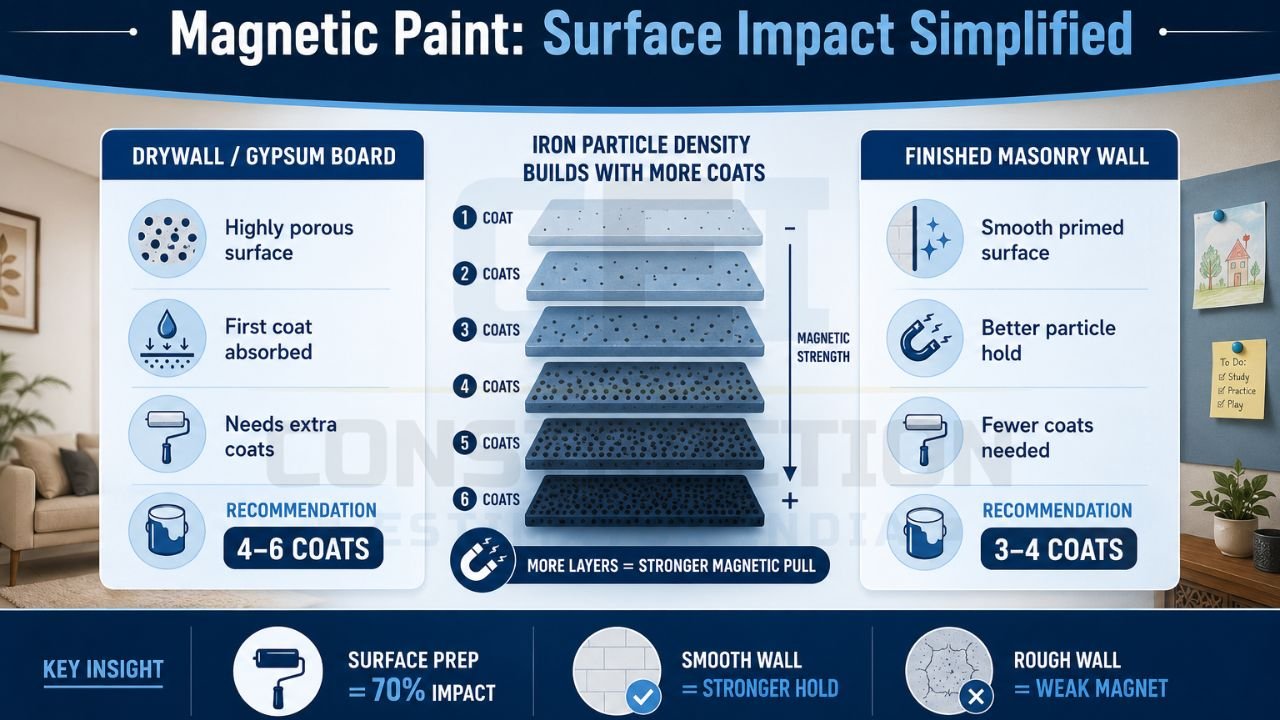
- New Drywall/Gypsum Board: These surfaces are incredibly porous. They “suck in” the initial layers of paint. Even with a primer, the first coat of magnetic paint often gets absorbed into the board. On drywall, we recommend adding one extra coat compared to masonry to ensure the iron particles stay on the surface.
- Finished Masonry Walls: If the wall is already finished with Level 5 putty and a smooth primer, the magnetic paint sits better. Here, 3-4 coats may suffice for decorative use.
According to the CPWD guidelines for specialty interior painting and coatings, surface preparation is 70% of the job. A rough wall creates “air gaps” between the magnet and the iron particles, weakening the pull regardless of how many coats you use.
Brand Analysis: Asian Paints vs. Berger vs. Global Standards
Choosing the right brand is as important as the number of coats. In 2026, the formulations have evolved to include higher iron concentrations.
- Asian Paints / Berger Specialty Ranges: These are formulated for the Indian climate. They tend to have a slightly longer drying time but offer excellent spreadability. Review the latest 2026 magnetic paint coat recommendations by Asian Paints and Berger to see how their specific iron-to-binder ratios impact coverage.
- Global Brands (Rust-Oleum/MagPaint): These often have a higher density of iron per liter but are significantly more expensive in the Indian market. Because of their thickness, you might achieve the same strength in 3 coats that a local brand achieves in 5.
For accurate comparisons, we use house construction cost estimation services to calculate the “Cost per Attraction Unit,” helping you decide if 3 coats of a premium brand are cheaper than 5 coats of a standard brand.
The Estimator’s Secret: How Extra Coats Change Your BOQ
This is where Construction Estimator India provides the most value to contractors and developers. Magnetic paint is heavy—a single liter can weigh three times as much as standard emulsion. This impacts every stage of your budget:
- Material Volume: If you increase from 3 to 6 coats, you aren’t just doubling the paint; you are doubling the most expensive liquid in your painting schedule. In 2026, magnetic paint costs roughly 4x to 6x more than luxury emulsions.
- Labor Intensity: Magnetic paint is thick and “gritty.” It requires constant stirring and careful rolling to avoid clumps. Labor rates for magnetic paint are typically 30-40% higher than standard painting.
- Drying Time & Project Timeline: Every coat needs 4-6 hours to dry. A 6-coat job adds 2-3 days to your room’s completion timeline. In a high-stakes commercial project in Bangalore or Mumbai, this can be a deal-breaker.
For accurate painting cost estimation or BOQ for your magnetic paint project in India, WhatsApp or call us today at +91 8630676890.
Application Guide: Achieving Strength in the Indian Climate
To ensure your coats of magnetic paint are effective, follow this 2026 expert framework:
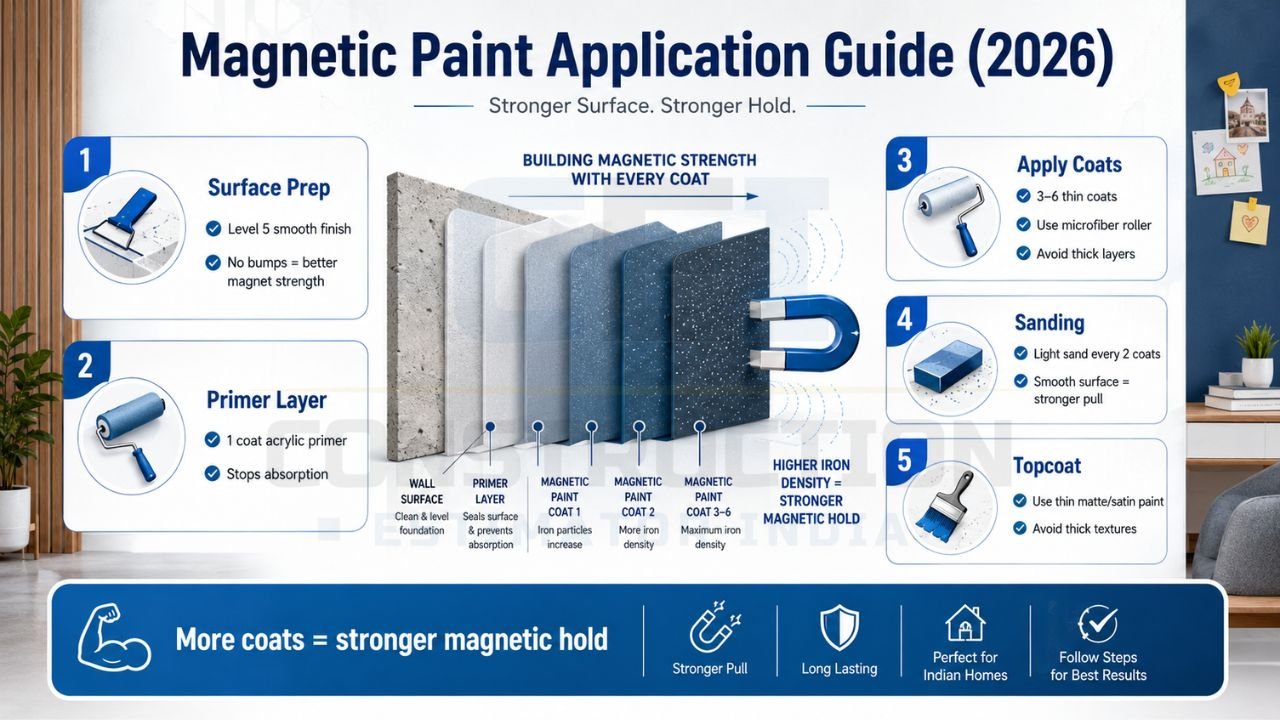
- Preparation: Sand the wall to a Level 5 finish. Any bump will create a gap that breaks the magnetic seal.
- Priming: Use a high-quality acrylic primer. This prevents the magnetic paint from soaking into the wall.
- The Rolling Technique: Use a short-nap microfiber roller. Apply thin, even layers. Do not try to “shortcut” by applying one thick coat; it will sag and create an uneven magnetic field.
- Sanding Between Coats: After every 2 coats, lightly sand the surface with 400-grit sandpaper to keep it smooth. Magnetic paint is naturally textured due to the iron dust; sanding ensures your final topcoat looks like a normal wall.
- The Topcoat Strategy: Use the thinnest possible topcoat. A heavy “textured” paint or thick wallpaper over magnetic paint will act as an insulator, killing the magnetic pull. We recommend a flat or satin emulsion for the best results.
Check the official 2026 magnetic paint application trends in India for updated techniques regarding low-VOC and odorless formulations suitable for kids’ rooms.
Testing Your Wall: The 24-Hour Magnetic Strength Test
How do you know if you’ve applied enough coats? We advise our clients at Construction Estimator India to perform a “Slide Test”:
- Apply 3 coats. Wait 24 hours.
- Take a standard sheet of A4 paper and a medium-strength magnet.
- If the magnet holds the paper firmly without sliding, 3 coats are enough for basic use.
- If it slides even an inch, you need a 4th and 5th coat.
- Pro Tip: Always test with the actual topcoat color you plan to use, as the topcoat always reduces magnetic pull by 10-15%.
Vastu and Function: Where to Place Your Magnetic Wall
In the context of Indian home design, Vastu Shastra often dictates the placement of “Active Walls.”
- North & East Walls: These are ideal for magnetic walls in study rooms or home offices. They represent growth and communication. A magnetic wall here can hold vision boards or academic schedules, aligning with the energy of the space.
- Avoid the South-West: This corner is for stability. Placing a “busy” magnetic wall with rotating tasks and papers here can sometimes conflict with the grounded nature of this zone.
Conclusion: Expert Final Advice
Mastering how many coats of magnetic paint are needed is the difference between a high-tech functional workspace and a failed DIY project. In the 2026 Indian construction landscape, accuracy is your best friend. Whether you are a homeowner in Meerut looking to organize a kitchen or a contractor in Delhi building a modern co-working space, remember the rule of thumb: 3 for show, 6 for pro.
Don’t leave your specialty paint project to guesswork. Every extra coat impacts your timeline, your labor costs, and your material budget. By ensuring your BOQ is calculated with precision, you protect your investment and ensure your walls perform exactly as promised.
For accurate painting cost estimation or BOQ for your magnetic paint project in India, WhatsApp or call us today at +91 8630676890.
Frequently Asked Questions (FAQ)
- Can I use magnetic paint under wallpaper?
Yes, but you must increase the number of coats. Wallpaper is much thicker than paint. If you are using wallpaper, we recommend a minimum of 6–8 coats of magnetic paint to ensure the pull is strong enough to reach through the paper. - Is magnetic paint safe for children and electronics?
Absolutely. Magnetic paint does not emit a magnetic field; it only attracts magnets. It is as safe as a standard piece of steel. Most modern 2026 brands are low-VOC and lead-free, making them perfect for nurseries. - Does the color of the magnetic paint matter?
Most magnetic paint is dark grey or black due to the iron content. However, you can paint over it with any color of your choice. Just remember: the darker the topcoat, the fewer coats of topcoat you need, which helps keep the magnetism strong. - Can I skip the primer to save money?
Never. Skipping primer on a new wall will cause the wall to absorb the iron particles unevenly, resulting in “dead spots” where magnets won’t stick. Primer is the cheapest part of your BOQ—don’t skip it. - How much magnetic paint do I need for a 10×10 wall?
Magnetic paint coverage is lower than standard paint because it is thicker. For a 100 sq ft wall with 4 coats, you will typically need about 8–10 liters of paint. This is why a precise BOQ is essential. - Does humidity in India affect the magnetism?
Humidity doesn’t affect the magnetism, but it affects the drying time. If you apply the next coat before the previous one is 100% dry, the iron particles won’t settle correctly, leading to a “mushy” finish that lacks strength. - Why is my magnetic wall not working after the topcoat?
You likely used a topcoat that was too thick, or you didn’t apply enough coats of the magnetic base. Every millimeter of paint between the magnet and the iron particles reduces the pull significantly. - Is there a difference between magnetic paint and magnetic plaster?
Yes. Magnetic plaster is much thicker and can be applied in one go to provide extreme strength. However, it is much harder to apply and requires professional masonry skills. Magnetic paint is DIY-friendly but requires multiple coats.