Imagine spending lakhs on premium “Moonlit Silk” luxury emulsion for your new home in Meerut or a high-rise in Gurgaon, only to see the color look patchy or start peeling after the first monsoon season. This nightmare is a reality for many Indian homeowners who skip one critical, invisible step: Priming.
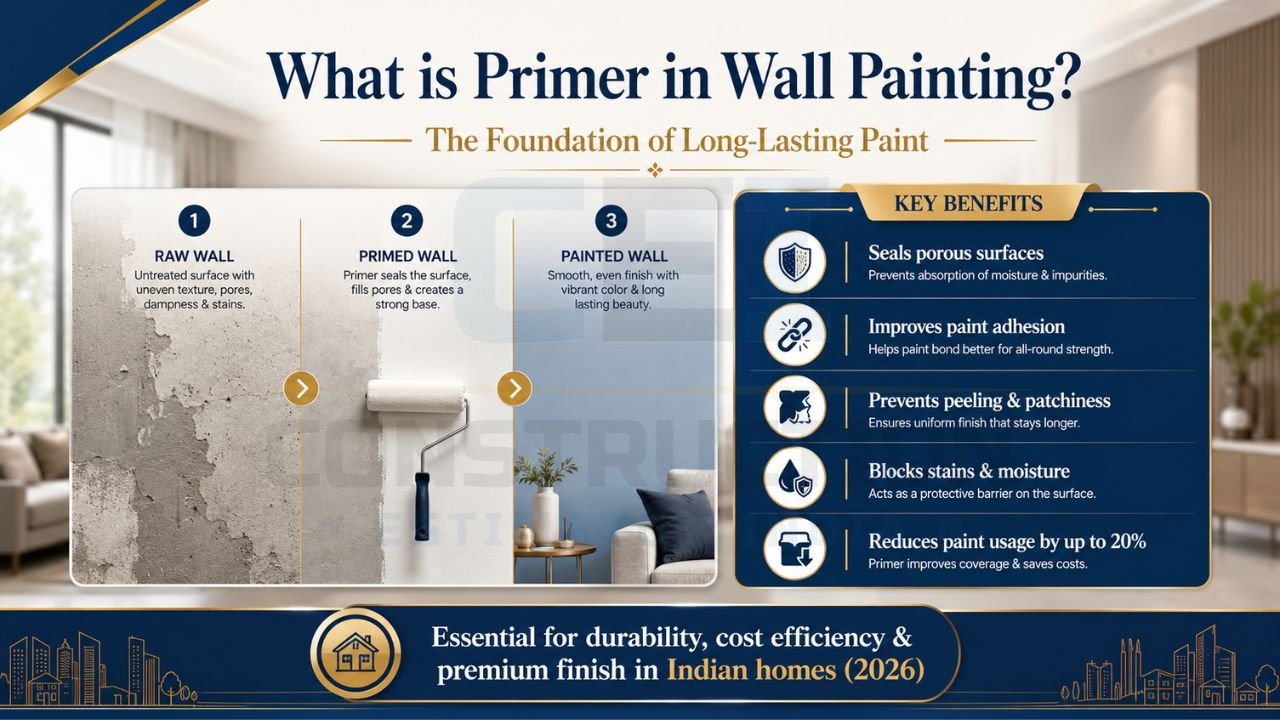
The direct answer to what is primer in painting walls is that it is a specialized preparatory coating applied to a surface before the actual paint. Think of it as the “glue” that binds the raw wall to your expensive topcoat. It seals porous masonry, provides a uniform surface for the paint to grip, and blocks stains from bleeding through.
At Construction Estimator India, with our 10+ years of construction estimating expertise, we’ve seen that correctly estimating and applying primer isn’t just about aesthetics—it’s about financial engineering. Using the right primer can reduce paint consumption by up to 20%, directly impacting your final Bill of Quantities (BOQ).
2026 Primer Essentials
- Definition: A preparatory layer that ensures adhesion, seals surfaces, and enhances paint durability.
- Key Benefits: Prevents peeling, improves “hiding power,” and saves money on expensive topcoats.
- 2026 Cost Impact: Prep work, including priming, accounts for a significant portion of the interior painting cost per sq ft in India 2026.
- Best For: New drywall, dark-to-light color changes, and walls with moisture issues.
For accurate painting cost estimation or BOQ for your home interior project in India (including primer), WhatsApp or call us today at +91 8630676890.
1. Understanding What is Primer in Painting Walls
In the technical world of house construction cost estimation services, primer is classified as a “binder-rich” coating. Unlike paint, which is designed for color and finish, primer is designed for functional performance.
In India, where masonry walls (bricks and cement) are standard, the “alkalinity” of fresh plaster can chemically attack paint. A high-quality primer acts as a barrier, neutralizing these salts and preventing “efflorescence”—those white chalky patches you see on poorly finished walls.
For a professional result, we at Construction Estimator India always include primer as a mandatory line item in our professional interior painting estimation services. Whether you are painting a villa in Meerut or a commercial space in Delhi, primer is the foundation of your wall’s durability.
2. The 5 Critical Reasons Why Primer is Essential in 2026
As we move through 2026, paint technology has advanced, but the laws of physics remain. Here is why the official 2026 primer importance in Indian homes is higher than ever:

A. Superior Adhesion
Paint doesn’t like sticking to dust or raw cement. Primer contains higher concentrations of resins that “bite” into the surface, creating a “tooth” for the paint to grab onto.
B. Blocking Porosity
Raw plaster is like a sponge. If you apply paint directly, the wall will “drink” the expensive liquid, leading to uneven drying and a dull finish. Primer seals these pores, ensuring your paint stays on the surface where it belongs.
C. Stain and Odor Blocking
Whether it’s water stains from a leaky AC or grease in an Indian kitchen, the right primer stops these marks from “bleeding” through your fresh topcoat.
D. True Color Representation
Switching from a dark “Deep Forest Green” to a trendy “Moonlit Silk”? Without a primer, you’ll need 4–5 coats of paint to hide the old color. A primer provides a neutral base, allowing you to achieve the true shade in just 2 coats.
E. Moisture Resistance
In humid regions of India, moisture trapped in walls is the #1 cause of paint failure. Specialized “damp-block” primers prevent moisture from pushing the paint film off the wall.
3. Types of Wall Primer: Choosing the Right Shield for Indian Homes
Choosing the wrong primer is as bad as using none. Here is a breakdown of the latest 2026 wall primer recommendations by Berger and Nerolac:
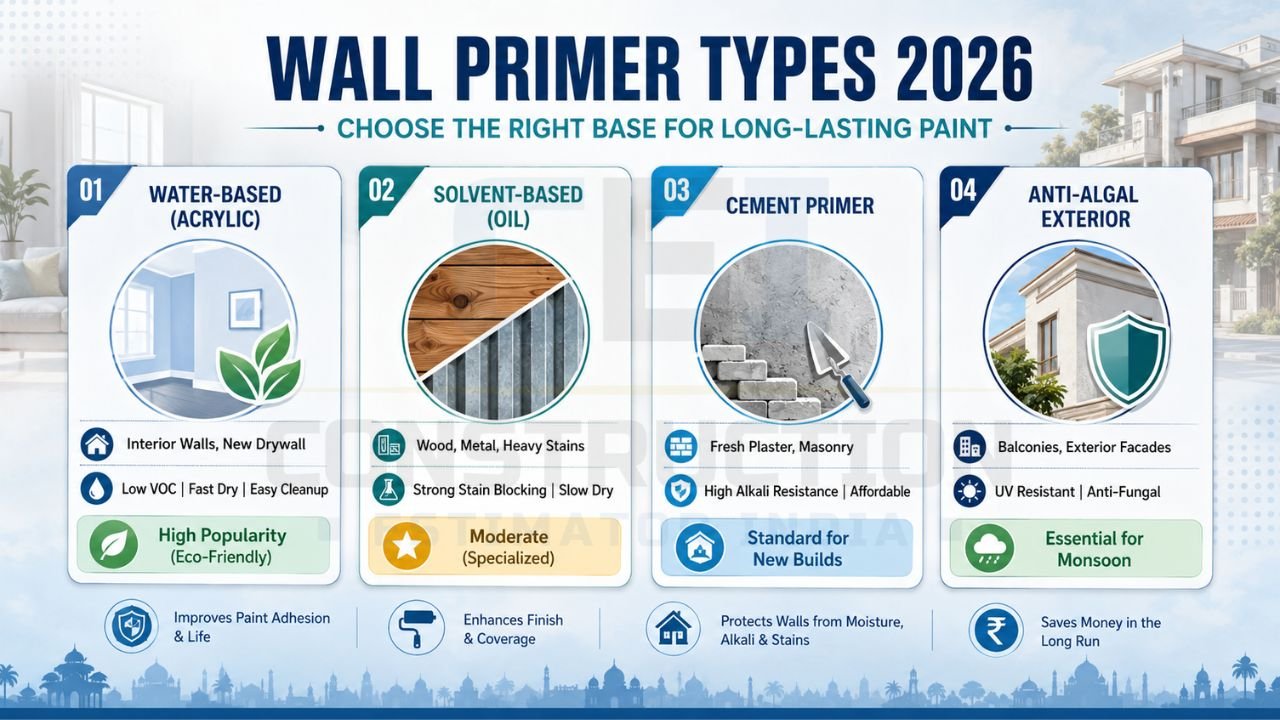
| Primer Type | Best Used For | Characteristics | 2026 Popularity |
|---|---|---|---|
| Water-Based (Acrylic) | Interior walls, new drywall | Low VOC, fast drying, easy cleanup | High (Eco-friendly) |
| Solvent-Based (Oil) | Wood, metal, heavy stains | Excellent stain blocking, slow dry | Moderate (Specialized) |
| Cement Primer | Freshly plastered masonry | High alkali resistance, affordable | Standard for new builds |
| Anti-Algal Exterior | Balconies, exterior facades | UV resistance, prevents fungus | Essential for Monsoon |
For a detailed technical comparison, refer to the Asian Paints official primer guide 2026.
4. Primer vs. Paint: The Chemistry of Adhesion
Many homeowners ask: “Can I just use a thin coat of white paint as a primer?”
The answer from our team of 10+ year experts is a resounding No.
- Paint is high in pigment (for color) and low in binder (to keep costs down). It is designed to look good and be washable.
- Primer is low in pigment and high in binder. It is designed to penetrate the surface and create a structural bond.
Using paint as a primer is a recipe for “delamination,” where the entire paint layer peels off like a sticker. In our interior painting cost per sq ft in India 2026 analysis, we found that skipping primer increases long-term maintenance costs by nearly 40%.
5. Step-by-Step Guide: How to Apply Primer on Walls Like a Pro
Even the best primer fails if the application is rushed. Follow these steps based on CPWD guidelines for interior painting and primer application:
- Surface Preparation: Scrape off old loose paint. Use a wire brush to remove dust.
- Repair and Patch: Use high-quality wall putty to fill cracks. Sand the putty until it’s perfectly smooth.
- Cleaning: Wipe the wall with a damp cloth to remove sanding dust.
- Dilution: Follow the manufacturer’s instructions. Usually, water-based primers require 10-20% dilution.
- Application: Use a high-quality roller for large areas and a brush for corners. Apply in even, vertical strokes.
- Drying Time: In India’s humidity, wait at least 4–6 hours for water-based primers and 24 hours for oil-based ones before painting.
6. The Estimator’s Secret: How Primer Impacts Your Painting BOQ
This is where Construction Estimator India saves you lakhs. In a standard Bill of Quantities (BOQ), primer is a “multiplier.”
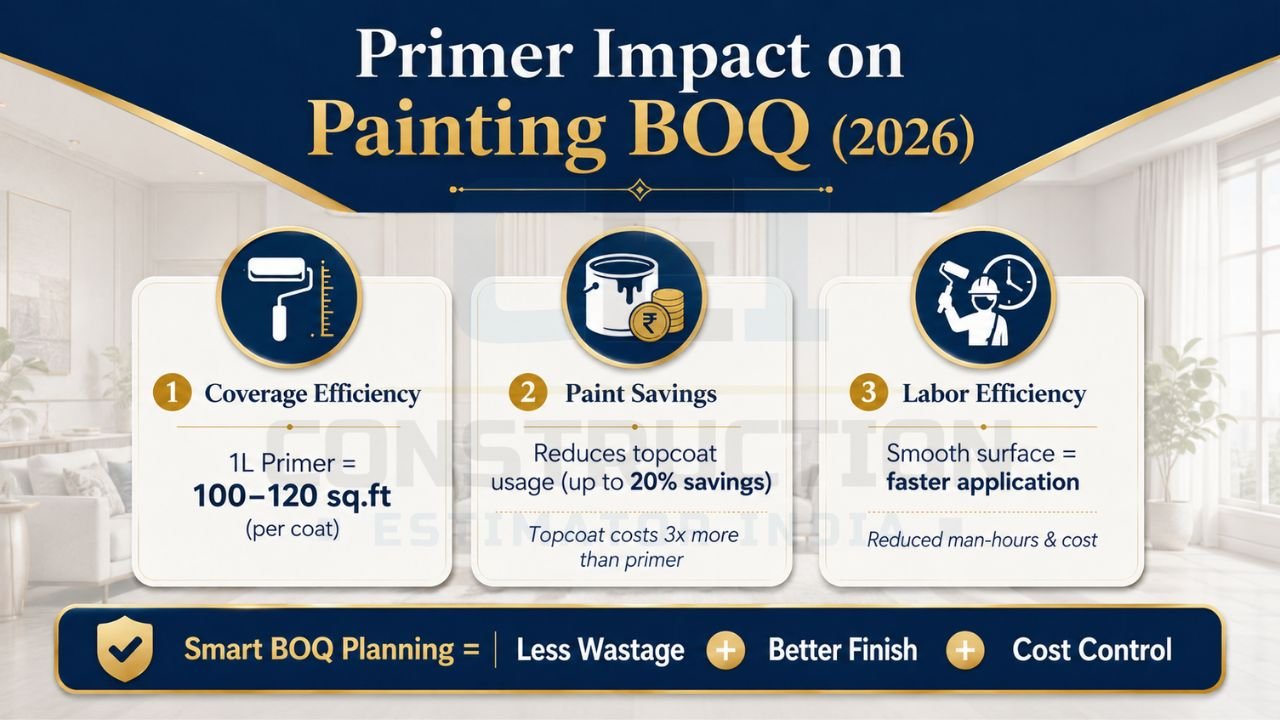
- Coverage Efficiency: 1 liter of premium primer covers approximately 100–120 sq. ft. per coat.
- Paint Savings: By sealing the wall, primer ensures your topcoat (which costs 3x more per liter) goes much further.
- Labor Efficiency: A primed wall is easier to paint, reducing the total man-hours required for the project.
When we provide house construction cost estimation services, we calculate the exact volume of primer needed to prevent mid-project shortages and wastage.
7. Common Priming Mistakes That Ruin Indian Interiors
- Priming Over Damp Walls: Never prime if the wall’s moisture content is above 12%. It will lead to bubbling.
- Using Interior Primer Outdoors: Interior primers lack UV stabilizers and will degrade in the sun within months.
- Applying Paint Too Soon: If the primer isn’t dry, the paint won’t bond, leading to a “gummy” finish.
- Skipping the Second Coat: On highly porous or dark walls, two coats of primer are often necessary for a professional finish.
8. Vastu Shastra and Wall Preparation
While Vastu focuses on colors, the purity of the surface is also vital. A clean, well-primed wall symbolizes a strong foundation and clarity. For North-East facing rooms, ensuring a white, even-primed surface before applying light blues or whites is said to enhance the flow of “Prana” or positive energy.
Conclusion and Expert Advice
Understanding what is primer in painting walls is the first step toward a successful home transformation. It is the silent hero that ensures your beautiful 2026 color palette stays vibrant, durable, and cost-effective.
At Construction Estimator India, we believe that precision in the “hidden layers” defines the quality of the final build. Don’t leave your painting project to guesswork. Ensure your material quantities are exact and your investment is protected.
For accurate painting cost estimation or BOQ for your home interior project in India (including primer), WhatsApp or call us today at +91 8630676890.
Frequently Asked Questions (FAQ)
- Is primer really necessary if my walls are in good condition?
Yes. Even good walls have microscopic pores. Primer ensures a uniform sheen and prevents the paint from looking “blotchy”. - Can I use a 2-in-1 paint and primer?
These are popular in 2026 for DIY projects. However, for new Indian masonry or heavy color changes, a dedicated separate primer is still the “Gold Standard” for durability. - How much does primer cost per sq ft in India?
The material cost for primer ranges from ₹2.50 to ₹4.50 per sq. ft. for a single coat, depending on the brand and quality. - How many coats of primer do I need?
One coat is usually enough for well-maintained walls. New plaster or dark-to-light transitions require two coats. - Does primer expire?
Yes. Most liquid primers have a shelf life of 1–2 years. Always check the manufacturing date before starting your project. - What happens if I don’t use primer?
Your paint will likely peel, flake, or look uneven. You will also use significantly more paint, which is more expensive than primer. - Can I use primer on a ceiling?
Absolutely. Ceilings are often very porous and benefit greatly from a sealing coat of primer.