Imagine standing in your newly built home in Meerut or Delhi, looking at pristine walls that represent years of hard work. As the final finishing stage approaches, you face a pivotal decision: do you choose the traditional, budget-friendly simplicity of distemper, or do you invest in the “Quiet Luxury” and high-performance sheen of a premium emulsion? In 2026, this choice is no longer just about the color on the card; it is a strategic financial decision that impacts your maintenance cycle, indoor air quality, and the long-term valuation of your property.
The direct answer to the question of the price difference between distemper and emulsion is that distemper is approximately 40–60% cheaper per liter than premium emulsion. In the 2026 Indian market, Oil Bound Distemper (OBD) costs roughly ₹12–₹18 per square foot, while high-quality emulsion ranges from ₹25–₹65 per square foot. However, when you factor in durability, washability, and the number of coats required, emulsion often proves to be the more cost-effective investment over a 10-year period.
For accurate painting cost estimation or BOQ for your home interior project in India (distemper or emulsion), WhatsApp or call us today at +91 8630676890.
2026 Paint Price & Performance Comparison
| Feature | Distemper Paint (Whitewash/OBD) | Emulsion Paint (Plastic Paint) |
|---|---|---|
| Average Cost (2026) | ₹12 – ₹18 per sq. ft. | ₹25 – ₹65 per sq. ft. |
| Durability / Life | 2–4 Years | 7–10 Years |
| Washability | Minimal (Cannot be scrubbed) | High (Stain resistant) |
| Coverage (2 Coats) | 100–120 sq. ft. per liter | 140–160 sq. ft. per liter |
| Finish Quality | Flat, Matte, Chalky | Matte, Silk, Satin, High-Sheen |
| Best Used For | Rental Units, Ceilings, Budget Projects | Luxury Homes, High-Traffic Areas |
| Maintenance Cost | High (Frequent repainting) | Low (Washable & Long-lasting) |
1. The 2026 Shift: Why Paint Choice Impacts Your ROI
The Indian home improvement market in 2026 is dominated by “Quiet Luxury” and health-conscious living. As experts at Construction Estimator India, drawing on our 10+ years of construction estimating expertise, we have observed that homeowners are increasingly moving away from basic distempers. The shift is driven by the need for biophilic health and surfaces that can withstand the intense North Indian heat and monsoon dust.
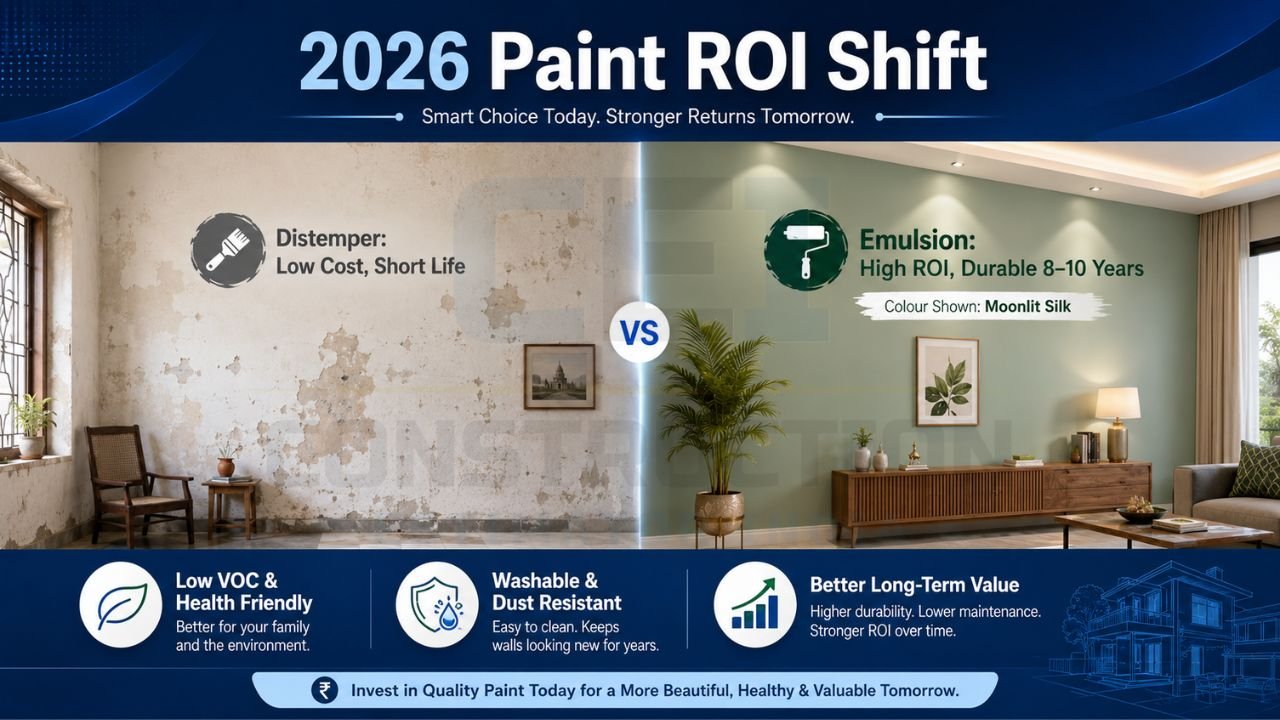
While distemper remains a viable option for temporary structures or budget rentals, the long-term return on investment (ROI) for emulsion has never been higher. Modern emulsions like “Moonlit Silk” not only look better but also feature anti-bacterial shields and Teflon surface protectors that were unavailable just a few years ago.
2. What is Distemper? The Budget-First Traditional Finish
Distemper, often referred to in India as “whitewash,” is a water-based paint consisting of chalk, lime, and a binder like glue. While it has been modernized into “Oil Bound Distemper” (OBD) for better strength, it remains a “breathable” but less durable option.
- Pros: Highly cost-effective, excellent for hiding minor wall imperfections, and easy to apply.
- Cons: Non-washable, prone to “chalking” (rubbing off on clothes), and fades within 3 years.
- Cost Insight: In 2026, distemper is the “Economy Class” of painting. It is perfect for those who need a fresh look on a strict budget, such as landlords in Noida or Meerut preparing a property for new tenants.
For official technical standards, you can refer to the CPWD guidelines for interior painting and finishing costs.
3. What is Emulsion? The Premium Standard for 2026
Emulsion paint is a water-based finish where the pigment is suspended in an acrylic or vinyl resin. In the Indian market, it is colloquially known as “plastic paint” because it forms a tough, plastic-like film on the wall once it dries.
- Pros: Highly washable (stains wipe off with a damp cloth), anti-fungal properties, and a lifespan of up to a decade.
- Cons: Higher upfront cost and requires “Level 5” surface preparation (putty and sanding) to look its best.
- 2026 Trends: Brands like Asian Paints Royale Glitz and Berger Silk Breathe Easy define this category, offering zero-VOC formulations that improve indoor air quality.
To compare specific product specs, check the Asian Paints 2026 distemper vs emulsion price list.
4. Technical Showdown: Price Difference Between Distemper and Emulsion
A. Material Cost per Liter vs. Finished Cost per Sq Ft
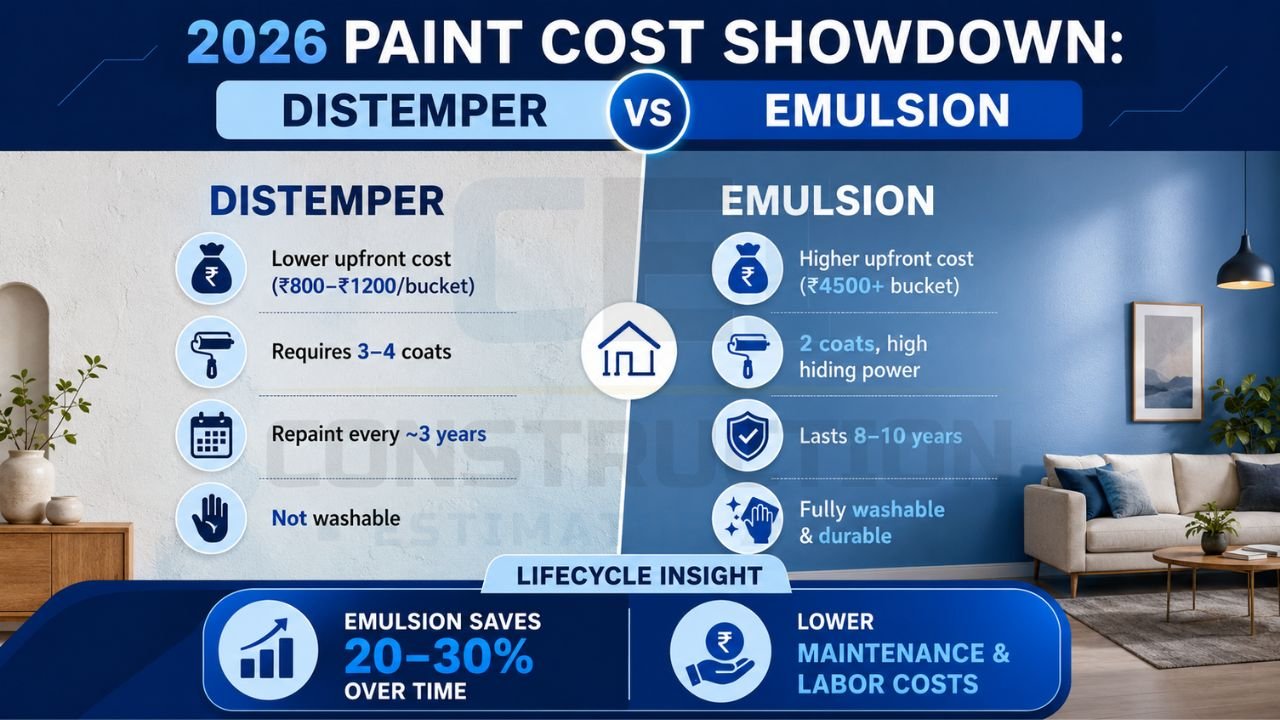
In 2026, a bucket of distemper might cost ₹800–₹1,200, while a premium emulsion bucket can exceed ₹4,500. However, at Construction Estimator India, we calculate the “Finished Cost.” Emulsion has superior “hiding power,” meaning it often covers a wall in just 2 coats, whereas distemper may require 3 or 4 coats to achieve the same opacity.
B. Durability and Lifecycle Savings
Distemper typically needs a refresh every 3 years. Over 9 years, you will paint your house three times with distemper. With a high-quality emulsion, you paint only once. When you factor in the labor cost—which is the most expensive part of any project—emulsion often saves you 20–30% in total lifecycle costs.
C. Washability and Maintenance
This is the biggest pain point for Indian families. Emulsion is truly washable; children’s crayon marks or kitchen grease can be cleaned without damaging the paint. Scrubbing distemper will lead to the paint thinning or peeling.
To see a detailed breakdown of these metrics, refer to the latest 2026 paint price comparison by Berger and Nerolac.
5. The Estimator’s Perspective: How Your Choice Affects the BOQ
This is where professional interior painting estimation services provide the most value. Most homeowners think paint is just a decorative layer, but from an estimator’s perspective, it is a significant line item in your Bill of Quantities (BOQ).
- Labor Rate Variance: Emulsion requires a smoother surface. This means you must invest more in “Level 5 Putty” and meticulous sanding. This can increase the interior painting cost per sq ft in India 2026 by ₹5–₹10 per sq ft just for preparation work.
- Quantity Takeoff Accuracy: Emulsion covers 140–160 sq. ft. per liter, while distemper covers roughly 100–120 sq. ft.. If your estimator doesn’t account for this, you will either over-buy expensive emulsion or under-buy distemper, leading to project delays.
- Pigment Costs: Deep, vibrant colors in 2026 use organic pigments that are more expensive. Selecting a dark “Royal Blue” in emulsion can increase material costs by 15-20% compared to a light “Off-White”.
For a detailed financial breakdown, check our house construction cost estimation services.
6. Climate Resilience: Handling Indian Heat and Monsoons
India’s climate is brutal on paint. In the 2026 market, we evaluate suitability based on two factors:
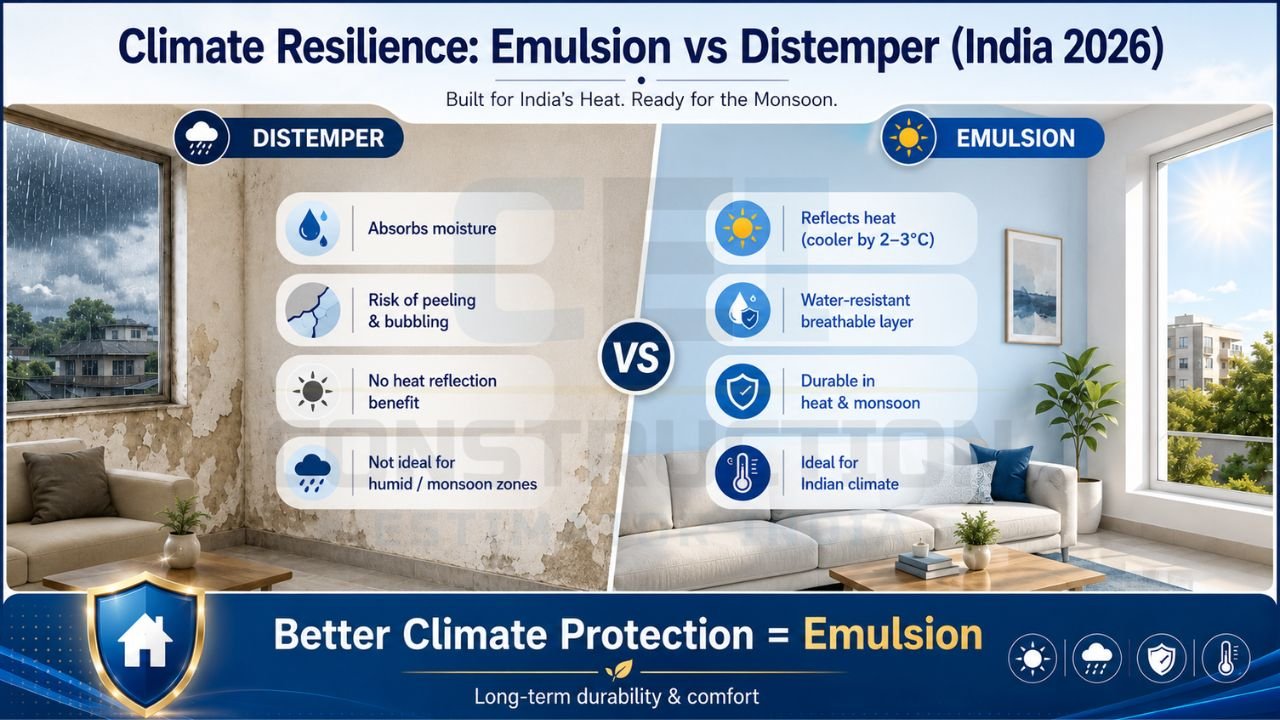
- Heat Reflection: High-quality white emulsions can reflect UV rays, keeping interiors cooler by 2–3°C. Distemper, being a thicker, chalk-based layer, does not offer these thermal benefits.
- Monsoon Resilience: Distemper tends to absorb moisture from the air, which can lead to peeling or bubbling if walls aren’t perfectly waterproofed. Emulsions form a breathable but water-resistant barrier that is much safer for homes in high-rainfall zones.
Refer to the official 2026 distemper and emulsion price trends in India for climate-specific recommendations.
7. Vastu Shastra and Finish Selection for Positive Energy
Vastu is essential for the 500+ happy clients we’ve served across India. The flow of energy (Prana) is influenced by your choice of finish and color.
- North-East (Water): Light Blue or White emulsion to promote clarity and peace.
- South-East (Fire): Pink or Orange shades in a satin emulsion finish to ignite prosperity.
- South-West (Earth): Yellow or Light Brown to provide family stability.
- North-West (Air): Cream or White to maintain social connections and mental calm.
8. Room-by-Room Recommendation Guide
| Room Type | Recommended Paint | Reason |
|---|---|---|
| Living Room | Premium Emulsion (Silk/Gloss) | High-touch, needs “Quiet Luxury” look and durability. |
| Master Bedroom | Emulsion (Matte/Silk) | Needs low VOC for better sleep and air quality. |
| Kitchen/Kids’ Room | Washable Emulsion | Stains from cooking or crayons are inevitable here. |
| Ceilings | Distemper | Low contact area; distemper’s flat finish hides imperfections. |
| Guest Room | Economy Emulsion / OBD | Rarely used; a budget-friendly compromise. |
| Rental Properties | Distemper | Cost-effective for frequent tenant turnovers. |
For accurate painting cost estimation or BOQ for your home interior project in India (distemper or emulsion), WhatsApp or call us today at +91 8630676890.
Conclusion and Final Expert Advice
Choosing between distemper and emulsion is a balance of your immediate budget and your long-term lifestyle goals. If you are building your “forever home” in 2026, the investment in a high-quality, washable emulsion like “Moonlit Silk” will pay for itself through sheer durability and aesthetic joy. For budget-constrained projects, rental properties, or low-visibility areas like ceilings, distemper remains a valid and honorable choice.
Remember, the most expensive paint is the one you have to redo because of poor estimation or preparation. Avoid the guesswork and ensure your home transformation starts with a solid financial foundation.
For accurate painting cost estimation or BOQ for your home interior project in India (distemper or emulsion), WhatsApp or call us today at +91 8630676890.
Frequently Asked Questions (FAQ)
- Which is cheaper, distemper or emulsion paint in 2026?
Distemper is cheaper upfront (₹12–₹18 per sq. ft.), while emulsion is more expensive (₹25–₹65 per sq. ft.). However, emulsion is cheaper in the long run due to its 10-year lifespan. - Can I apply emulsion paint over old distemper?
Yes, but you must scrape off the old, chalky distemper and apply a high-quality primer first. If you don’t, the emulsion will peel off. - Does emulsion paint have a strong smell?
Modern low-VOC emulsions in 2026 have almost no smell. Some distempers can have a lingering “chalky” odor during application. - How much does professional painting estimation cost for a 2BHK?
At Construction Estimator India, our detailed BOQs typically save you 10–15% on wasted material. A precision report for a 2BHK interior project ensures you only pay for what you need. - Is distemper safe for health?
While generally safe, distemper can release fine chalk dust as it ages. Emulsions with air-purifying technology, like Berger Silk Breathe Easy, are the healthier choice for those with respiratory issues. - What is “plastic paint”?
This is a common Indian term for high-end acrylic emulsions that form a protective plastic-like film on the wall. - How many coats are needed for a new wall?
Generally, one coat of primer followed by two coats of emulsion. Distemper may require three coats for full opacity.