The Indian construction industry is moving fast. Between ballooning project costs, complex multi-vendor supply chains, and government push for infrastructure spending under schemes like PM Gati Shakti and the National Infrastructure Pipeline, builders and developers who still rely on spreadsheets and siloed software are leaving serious money on the table. In 2026, the question is no longer whether your construction business needs an ERP — it’s which ERP is the right fit.
👉 Need Help Choosing the Right Construction ERP? 📞 Call/WhatsApp: +91 86306 76890
At Construction Estimator India, we’ve spent years working hands-on with builders, contractors, and real estate developers to help them navigate the crowded ERP landscape. We’ve seen what works on a ₹50 crore residential project and what falls apart when a mid-sized contractor tries to scale. This guide brings all of that experience into a single, honest ranking — so you can stop wasting time on demos that go nowhere and start making a confident decision.
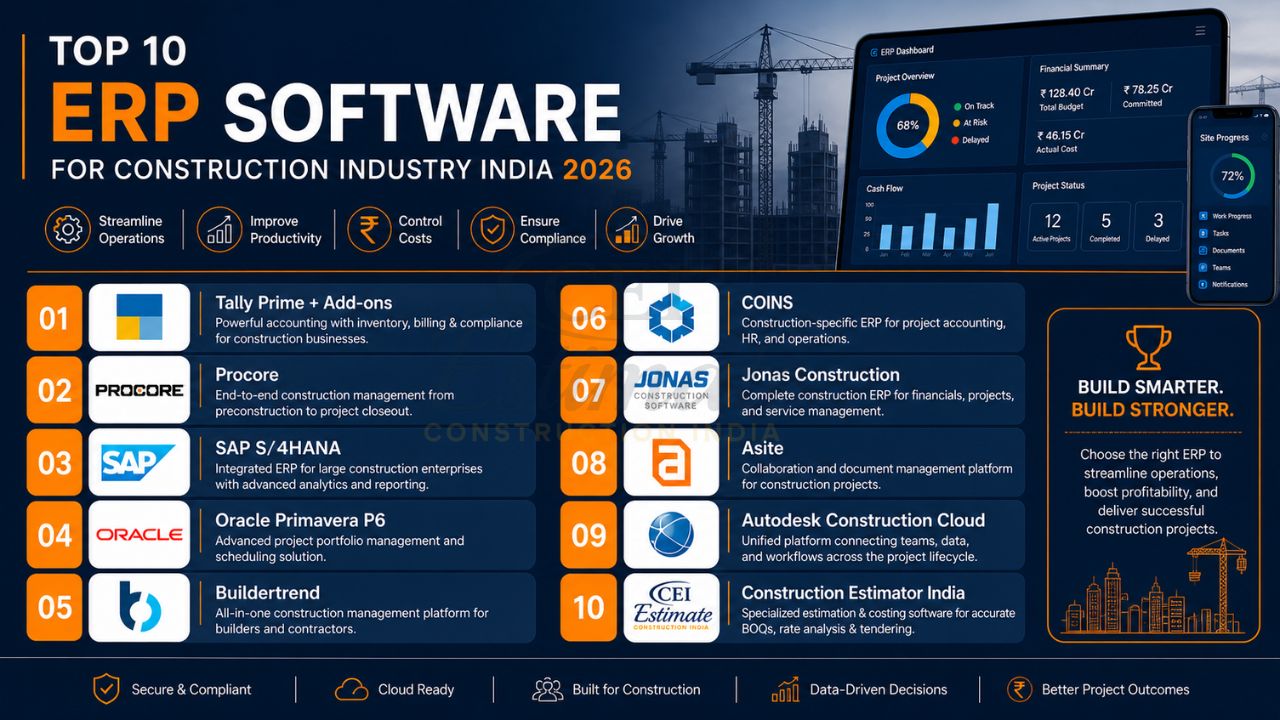
Top 10 ERP Software for Builders & Construction Industry in India (2026)
1. Tally Prime with Construction Add-ons
Tally Prime doesn’t need much of an introduction in India — it’s the backbone of accounting for millions of SMEs. But when paired with construction-specific add-ons (several reputable third-party developers now offer these), it becomes a genuinely capable tool for small to mid-sized builders managing projects up to ₹25–50 crore.
Key Features for Builders: GST-compliant billing and subcontractor payments, material issue tracking against BOM, petty cash management for site offices, vendor payment scheduling, work order management, and labour attendance integration through add-ons.
Best Suited For: Small contractors, individual builders, and developers with straightforward project structures who need solid accounts management more than complex project scheduling.
Pricing Overview: Tally Prime Silver (single user) starts around ₹18,000/year; Gold (multi-user) around ₹54,000/year. Add-on costs vary between ₹10,000–₹40,000.
Pros: Extremely familiar to Indian accountants and CA firms; excellent GST handling; affordable entry point; wide availability of local support partners.
Cons: Construction add-ons aren’t uniform in quality — vet third-party developers carefully. Not ideal for complex multi-project tracking or procurement workflows.
Real-User Insight: A residential builder in Lucknow we work with uses Tally Prime for all financial operations but integrates it with a separate estimation tool for BOQ-level project tracking. It works well because they’ve accepted the limitation upfront.
2. Procore
Procore is arguably the most well-known construction-specific project management and ERP platform globally, and its India presence has grown considerably in 2026. It’s cloud-native, mobile-first, and built entirely around the construction workflow.
Key Features for Builders: Real-time project dashboards, RFI and submittal management, drawing and document control, subcontractor management, daily logs, budget tracking, and a powerful mobile app. The Procore Financials module handles contracts, change orders, and cost forecasting in depth.
Best Suited For: Mid-to-large construction companies, EPC contractors, and developers managing multiple concurrent projects. Particularly strong for companies doing large-scale infrastructure work.
Pricing Overview: Annual costs typically start around USD 7,000–10,000 (₹6–8 lakh) for smaller plans and scale up significantly. Custom enterprise pricing for large portfolios.
Pros: Best-in-class document and drawing management; excellent mobile experience; large global ecosystem of integrations; dedicated construction workflow built into every module.
Cons: Premium pricing out of reach for many Indian SME contractors; some modules feel over-engineered for straightforward residential projects; USD pricing exposes you to exchange rate risk.
Real-User Insight: Larger Indian EPC contractors and international project teams love Procore’s field-to-office sync. But we’ve seen SME builders struggle with the pricing and the learning curve.
3. SAP S/4HANA for Construction
SAP S/4HANA is the gold standard for enterprise-grade ERP worldwide, and its Project System (PS) module has been used by major Indian infrastructure and real estate conglomerates for over a decade. The cloud-native S/4HANA Public Cloud has made SAP more accessible in 2026, though it’s still firmly an enterprise product.
Key Features for Builders: Integrated procurement, material management, plant maintenance, financial accounting with project cost centres, real estate-specific features for developer companies, workforce management, and advanced analytics via SAP Analytics Cloud.
Best Suited For: Large construction conglomerates, publicly listed real estate developers, and EPC companies with turnover above ₹200 crore.
Pricing Overview: SAP RISE (cloud migration bundle) starts around ₹30–50 lakh/year for medium-large enterprises. Implementation costs can easily double or triple this figure.
Pros: Unmatched depth of features; robust compliance for listed companies; excellent long-term vendor support; handles multi-entity, multi-currency scenarios.
Cons: Massive implementation effort (typically 12–24 months); very high total cost of ownership; heavy dependence on SAP implementation partners; overkill for most Indian builders.
👉 Get the Best ERP Software for Builders & Construction – 📲 WhatsApp / Call: +91 86306 76890
4. Oracle Primavera P6 + Oracle ERP Cloud
Primavera P6 remains the industry benchmark for complex construction project scheduling, and when paired with Oracle ERP Cloud’s financials and procurement modules, it creates a comprehensive ecosystem for large infrastructure projects.
Key Features for Builders: WBS-level scheduling with thousands of activities, resource and cost loading, earned value management (EVM), risk analysis, and tight integration with Oracle’s procurement and finance suite for end-to-end project control.
Best Suited For: Government infrastructure contractors, highway and metro rail project companies, large-scale industrial construction, and project management consultancies (PMCs).
Pricing Overview: Primavera P6 Professional starts around USD 2,500/user (perpetual) or ~USD 200–400/user/month subscription. Oracle ERP Cloud adds substantial additional cost.
Pros: Industry standard for large project scheduling; proven in complex multi-discipline projects; strong reporting and analytics capabilities.
Cons: Scheduling-heavy — does not naturally cover site material management; complex to configure and maintain; best results require dedicated project controls staff.
5. Buildertrend
Buildertrend is purpose-built for residential and commercial builders, remodellers, and specialty contractors, and it’s become increasingly popular among Indian mid-tier developers building gated communities and villa projects.
Key Features for Builders: Customer portal for client-facing project communication, construction scheduling with Gantt charts, online document signing, purchase order management, photo and video documentation from the field, lead management CRM, and a solid mobile app.
Best Suited For: Residential builders, boutique villa developers, interior-focused contractors, and companies that want to improve client communication and project delivery simultaneously.
Pricing Overview: Starts around USD 499/month (~₹42,000/month) for the Core plan; higher tiers run USD 799–1,099/month.
Pros: Excellent client-facing experience; intuitive UI that field teams actually use; strong document management; good for managing punch lists and warranty items.
Cons: USD pricing and US-centric compliance features mean Indian users need workarounds for GST; not ideal for contractors managing complex subcontractor chains.
6. COINS (Construction Industry Solutions)
COINS is a dedicated construction ERP gaining traction with Indian mid-to-large builders who need more than project management — they need an end-to-end business platform covering finance, HR, plant, and procurement with construction-specific logic baked in.
Key Features for Builders: Integrated job costing, subcontractor management with retention and variation tracking, plant and equipment management, payroll with labour analytics, procurement with three-way matching, and CRM for developer-side sales.
Best Suited For: Mid-to-large contractors and developers with turnover above ₹50 crore who have outgrown simpler tools and need deep construction-specific financial control.
Pricing Overview: Subscription-based, typically ₹8–20 lakh/year depending on modules and user count. Implementation costs additional.
Pros: Deep construction-specific logic; strong financial controls; covers both contracting and development sides; good compliance features for Indian regulatory requirements.
Cons: Steeper learning curve; UI feels dated compared to newer SaaS tools; implementation support in India is more limited than global markets.
7. Jonas Construction Software
Jonas has carved a strong niche in the contractor space — particularly mechanical, electrical, plumbing (MEP), and service contractors. Its ERP combines job costing, service management, and accounting in a tightly integrated platform.
Key Features for Builders: Job cost tracking at phase and cost code level, service dispatch and work order management, equipment management, subcontract management, payroll, and document management.
Best Suited For: MEP and specialty contractors, service-based construction companies, and mid-sized contractors who need strong job costing without enterprise ERP complexity.
Pricing Overview: Typically in the range of USD 15,000–30,000/year for the core platform with implementation costs on top.
Pros: Excellent job costing granularity; strong MEP-specific workflows; well-respected in the contractor community; solid accounting integration.
Cons: Less suited for large real estate developers; limited India-specific tax compliance features; requires customization for Indian construction norms.
8. Asite
Asite is a UK-origin construction collaboration platform that has seen strong adoption in India through large infrastructure programs and government-funded projects. It’s primarily focused on the Common Data Environment (CDE) concept — centralizing all project documents, drawings, and communications.
Key Features for Builders: Drawing and document management, procurement tendering and bid management, RFI workflows, site inspection and snag management, BIM integration, and robust audit trails.
Best Suited For: Large government infrastructure contractors, smart city project companies, developers embracing BIM-led project delivery, and multi-party project consortiums.
Pricing Overview: Subscription-based pricing typically starting around ₹5–12 lakh/year; enterprise pricing for large programs.
Pros: Strong document control and audit compliance; great for multi-organization projects; growing BIM integration; well-regarded in the government infrastructure space.
Cons: More CDE/document management tool than full ERP; separate finance/accounting solutions needed alongside it.
👉 Upgrade Your Construction Business Today – 📲 Contact: +91 86306 76890
9. Autodesk Construction Cloud (PlanGrid)
Autodesk’s acquisition of PlanGrid and its rollup into Autodesk Construction Cloud (ACC) has created one of the most capable field-to-office connected platforms available. In 2026, ACC is a serious consideration for Indian builders embracing digital construction.
Key Features for Builders: Sheet and drawing management, field issue tracking, daily reports, submittals, RFIs, cost management, BuildingConnected for bid management, and seamless integration with Autodesk’s design tools (Revit, AutoCAD).
Best Suited For: Contractors already in the Autodesk design ecosystem, companies doing complex infrastructure where design changes are frequent, and organizations looking for strong field-to-office digital workflows.
Pricing Overview: ACC plans typically range from USD 500–1,500/user/year depending on modules selected.
Pros: Best design-to-construction workflow in the industry; excellent drawing version control; strong mobile app; growing India presence with local support.
Cons: Cost adds up quickly when licensing multiple modules; full value requires Autodesk design tools; some cost management features still maturing.
10. Construction Estimator India’s Custom ERP & Estimating Solutions
We’ve deliberately saved this spot for what we believe is the most underserved need in the Indian construction ERP market: a solution that combines accurate construction estimating with project ERP, tailored specifically to Indian conditions.
At Construction Estimator India, our platform and advisory services bridge the gap between international ERP platforms and the ground realities of Indian construction — from DSR-based estimating and GST billing to labour contracting compliance and multi-tier subcontractor management. For detailed information on how Indian-specific construction ERP compares across vendors, explore our comprehensive guide to top construction ERP software in India and our in-depth review of the best construction ERP software in India.
Key Services: BOQ-level construction estimating, ERP selection consulting, software configuration for Indian compliance, training and change management, and integration between estimating tools and ERP systems.
Best Suited For: Any Indian builder, developer, or contractor who wants honest, unbiased guidance on ERP selection backed by deep construction domain knowledge.
👉 Manage Projects, Costs & Teams in One System – 📞 Call Now: +91 86306 76890
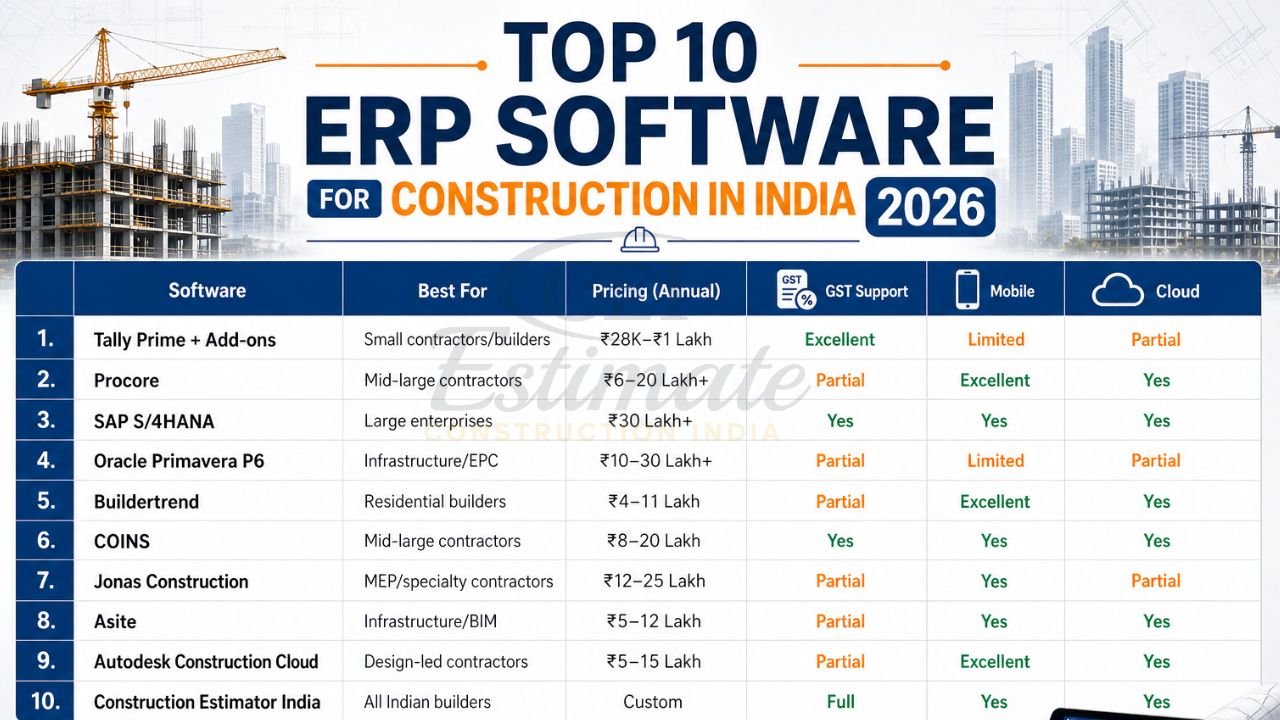
Comparison Table: Top 10 ERP Software for Construction in India 2026
Use this at-a-glance reference to quickly compare how each platform stacks up across the factors that matter most to Indian builders.
| # | Software | Best For | Pricing (Annual) | GST Support | Mobile | Cloud |
| 1 | Tally Prime + Add-ons | Small contractors/builders | ₹28K–₹1 Lakh | ✅ Excellent | Limited | Partial |
| 2 | Procore | Mid-large contractors | ₹6–20 Lakh+ | Partial | ✅ Excellent | ✅ Yes |
| 3 | SAP S/4HANA | Large enterprises | ₹30 Lakh+ | ✅ Yes | ✅ Yes | ✅ Yes |
| 4 | Oracle Primavera P6 | Infrastructure/EPC | ₹10–30 Lakh+ | Partial | Limited | Partial |
| 5 | Buildertrend | Residential builders | ₹4–11 Lakh | Partial | ✅ Excellent | ✅ Yes |
| 6 | COINS | Mid-large contractors | ₹8–20 Lakh | ✅ Yes | ✅ Yes | ✅ Yes |
| 7 | Jonas Construction | MEP/specialty contractors | ₹12–25 Lakh | Partial | ✅ Yes | Partial |
| 8 | Asite | Infrastructure/BIM | ₹5–12 Lakh | Partial | ✅ Yes | ✅ Yes |
| 9 | Autodesk Construction Cloud | Design-led contractors | ₹5–15 Lakh | Partial | ✅ Excellent | ✅ Yes |
| 10 | Constr. Estimator India | All Indian builders | Custom | ✅ Full | ✅ Yes | ✅ Yes |
Key Trends in Construction ERP for India in 2026
AI-Powered Cost Estimation
AI-powered cost estimation is no longer a future concept — it’s being deployed today. Leading platforms are using machine learning to predict cost overruns based on historical project data, flag procurement anomalies before they become budget crises, and auto-generate preliminary estimates from drawings.
Mobile-First Field Operations
Mobile-first field operations have become non-negotiable. Any ERP that site engineers won’t use on their smartphones is effectively dead on arrival. The industry has moved past desktop-only workflows, especially for daily reports, material GRN, and quality checklists.
BIM Integration
BIM integration is rapidly becoming a differentiator. Builders doing ₹100 crore+ projects are increasingly expecting their ERP to connect directly with BIM models so that quantity takeoffs, material scheduling, and progress tracking all flow from the digital twin.
GST and TDS Compliance Automation
GST and TDS compliance automation continues to be a critical requirement in India specifically. With GST rules around construction services, reverse charge mechanisms, and contractor TDS deductions changing periodically, ERP platforms with robust Indian compliance engines have a distinct advantage. You can read more about the evolving landscape in our detailed resource on construction management software in India.
Accelerating Cloud Adoption
Even traditionally conservative Indian construction companies are moving to cloud ERP, driven by the need for real-time visibility across multiple project sites. Multi-site access, automatic backups, and remote collaboration are now expected features rather than premium add-ons.
👉 Replace Excel with Smart Construction ERP – 📲 WhatsApp: +91 86306 76890
How to Choose the Right ERP System for Your Construction Business
Choosing an ERP is one of the most significant technology investments your construction business will make. We’ve seen companies get it spectacularly right — and painfully wrong. Here’s the framework we use at Construction Estimator India when advising clients.
Start with your biggest pain point, not the longest feature list.
If cash flow visibility is killing your business, start with an ERP that has exceptional financial controls. If project delays are your problem, prioritize scheduling and field management. The perfect all-in-one solution that nobody uses is worth nothing.
Assess your team’s technical readiness honestly.
A powerful ERP is only valuable if your site engineers, quantity surveyors, and accounts staff actually adopt it. We’ve seen ₹25 lakh SAP implementations gather dust because the training plan was an afterthought.
Verify Indian compliance depth specifically.
Not just GST — also TDS on contractor payments (Section 194C), labour welfare fund compliance, RERA-related financial reporting for developers, and e-way bill integration for material transport. These are non-negotiable for Indian operations.
Plan for integration, not just standalone use.
Your ERP should connect to your estimation software, your accounting system, your bank, and ideally your HR/payroll platform. The more siloed your software stack, the more manual re-entry, and the more errors.
Demand a construction-specific reference in India.
Any vendor should be able to point you to an Indian construction company of similar size and project type using their platform successfully. For a deeper dive into what to look for, our guide on the best construction software in India covers this in comprehensive detail.
👉 Automate Your Builder Business Today – 📞 Contact: +91 86306 76890
Why Construction Estimator India’s Solutions Stand Out?
What makes us different isn’t just software knowledge — it’s construction knowledge. Our team has worked with developers building integrated townships in Noida, contractors executing road packages in Rajasthan, and specialty MEP contractors in Bangalore. We understand the real challenges: labour availability fluctuations, monsoon-driven schedule delays, material price volatility, and the complex relationship between main contractors and subcontractors in India.
When we recommend or configure an ERP solution, we bring that domain expertise into every decision. We also specialise in the estimating side of the equation — because an ERP without accurate initial estimates is like a car without a GPS. If you’re looking for the right tools to improve your estimation accuracy before going live on a full ERP, explore our resource on top-rated construction estimating software in India.
Our approach is always client-first: we’ll tell you if a ₹5 lakh solution will serve you better than a ₹25 lakh one. That kind of honest advisory is rare in the technology consulting space, and it’s why builders across India trust us with their technology decisions. For a broader overview of leading platforms, review our analysis on top ERP software for construction companies in India.
Frequently Asked Questions (FAQs)
What is construction ERP software, and why do Indian builders need it in 2026?
Construction ERP (Enterprise Resource Planning) software integrates all core business processes — project management, procurement, finance, HR, and compliance — into a single connected system. For Indian builders in 2026, it’s no longer a luxury. With GST complexity, RERA compliance requirements, rising material costs, and increasing competition, ERP gives you real-time visibility and control that spreadsheets simply cannot provide. Whether you’re managing one project or fifty, ERP eliminates data silos, reduces manual errors, and helps you make faster, better-informed decisions.
Which ERP software is best for small builders and contractors in India?
For small builders and contractors with turnovers up to ₹20–30 crore, Tally Prime with a good construction add-on is often the most practical starting point — it leverages familiar accounting workflows and has affordable pricing. Buildertrend is a strong option if client communication and project documentation are priorities. At Construction Estimator India, we help small builders identify the right entry-level solution based on their specific business model and growth trajectory.
How much does construction ERP software cost in India?
Costs vary enormously by vendor and scale. Entry-level solutions start as low as ₹25,000–50,000/year for basic tools. Mid-range construction ERP platforms suitable for contractors with ₹50–200 crore revenue typically cost ₹5–20 lakh/year including implementation. Enterprise platforms like SAP can exceed ₹50 lakh/year in licensing alone, with implementation often costing significantly more. Always factor in implementation, training, and ongoing support costs — not just the licence fee.
Does construction ERP software support GST compliance in India?
Good Indian-focused construction ERP solutions do, but you need to verify this carefully. GST in construction covers a range of scenarios — 18% on works contracts, 5% on affordable housing, reverse charge on certain services, and subcontractor billing — all of which need to be handled correctly. Generic global ERP platforms often require customization for Indian GST. We strongly recommend checking GST compliance capabilities in depth during your evaluation process.
Can ERP software improve construction project profitability?
Absolutely, and we see this directly with clients. The most common profitability leaks in construction — material wastage, untracked subcontractor variations, delayed billing, and unplanned overtime — are all far more visible and manageable with a proper ERP in place. Builders typically see meaningful reductions in procurement cost through better vendor comparison and material tracking, and better cash flow through faster billing cycles enabled by real-time project progress data.
What is the difference between construction ERP and construction project management software?
Project management software (like Procore or MS Project) focuses primarily on scheduling, site workflows, and collaboration. Construction ERP goes broader — it also covers financial accounting, procurement, HR/payroll, and compliance in an integrated system. Many construction companies use both: a project management tool for field operations and an ERP for business-wide financial and resource management. Some platforms like Procore are expanding into ERP territory by adding financial modules.
How long does ERP implementation take for a construction company?
It depends heavily on company size and solution complexity. A small builder deploying Tally Prime with add-ons can be up and running in a few weeks. A mid-sized contractor implementing COINS or Jonas typically takes 3–6 months for a proper implementation including data migration, configuration, and staff training. Large enterprises deploying SAP S/4HANA should plan for 12–24 months minimum. Rushing implementation is one of the most common reasons ERP projects fail — proper change management and training are as important as the software itself.
Is cloud-based construction ERP better than on-premise for Indian builders?
For most Indian builders in 2026, cloud-based ERP offers clear advantages: no server hardware investment, automatic updates, access from any site or location, and lower upfront cost. The main concerns in India — internet connectivity at remote project sites — are increasingly addressed through offline modes and mobile-first design in modern cloud ERPs. On-premise solutions may still make sense for very large enterprises with specific data security requirements or in regions with unreliable connectivity.
How do I ensure my site engineers actually use the ERP system?
This is the most underrated challenge in any ERP implementation, and it’s one we focus on heavily at Construction Estimator India. The key factors are: choosing a system with a genuinely usable mobile app, involving site staff in the selection and testing process (don’t just impose a boardroom decision), providing context-specific training rather than generic software demos, and having management visibly champion the system from day one. If senior leadership still uses WhatsApp groups and spreadsheets for project updates, the rest of the team won’t take the ERP seriously either.
Can Construction Estimator India help me choose and implement the right ERP?
Yes, absolutely — this is a core part of what we do. Whether you need an unbiased ERP selection study, help configuring an existing system for Indian construction requirements, integration between your estimating tools and your ERP, or end-to-end implementation support, our team brings hands-on construction domain expertise to every engagement. We work with builders of all sizes, from individual contractors to large developers.
Conclusion
Choosing the right ERP is not about picking the most famous software or the most expensive one — it’s about finding the right fit for your business size, project types, team capabilities, and budget. The top 10 platforms we’ve covered above represent the best options available to Indian builders and contractors in 2026, each with genuine strengths and real limitations.
At Construction Estimator India, we’ve guided hundreds of builders through this decision. Our honest, no-obligation advice has helped companies avoid costly mistakes and find solutions that genuinely transform how they operate. If you’re evaluating ERP options for your construction business, we’d love to be part of that conversation.
Get in touch with us today — free consultation, no obligation.
📱 WhatsApp: +91 86306 76890 📧 Email: info@constructionestimatorindia.com
Whether you need a quick recommendation or a detailed ERP selection study, we’re here to help you build smarter.