
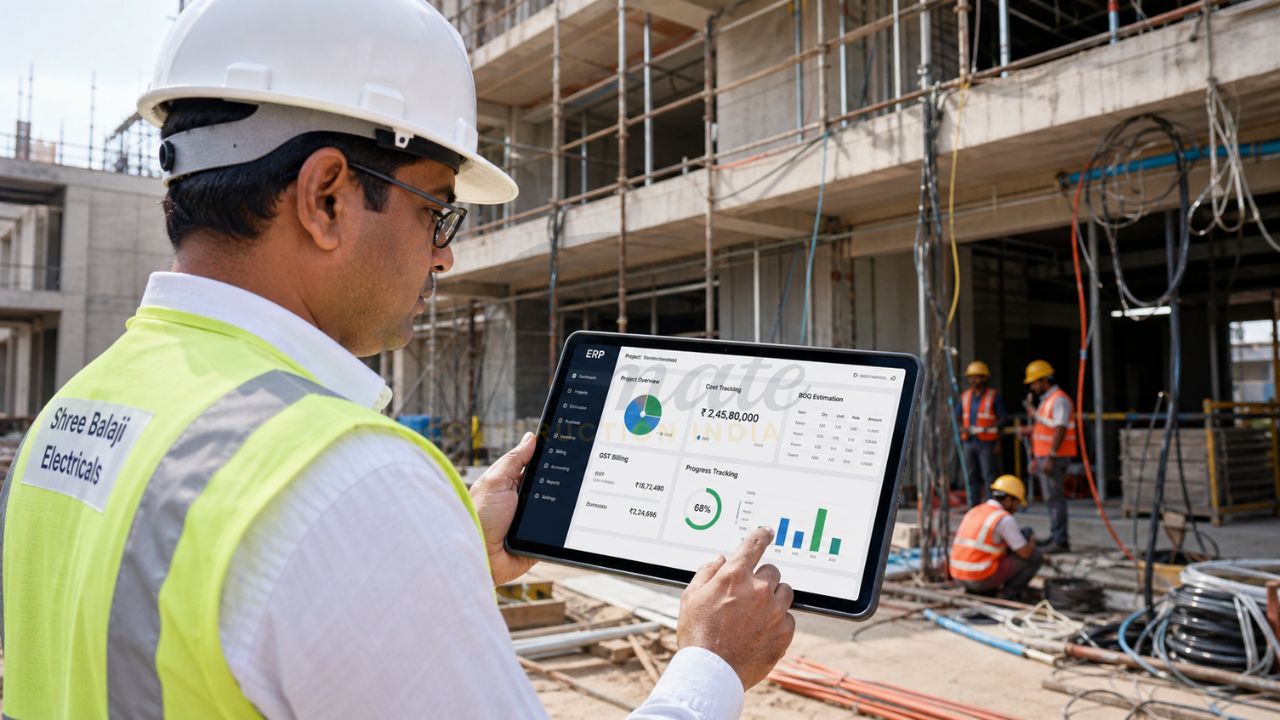
Running an electrical contracting business in India has never been more demanding. Between managing multiple project sites simultaneously, tracking material costs against tight budgets, coordinating field teams across cities, and staying compliant with GST and other regulations — the operational complexity can quickly overwhelm even experienced contractors. Spreadsheets and paper-based systems that worked ten years ago simply cannot keep pace with the scale and speed of today’s projects.
That’s where ERP systems step in and genuinely change the game. Enterprise Resource Planning (ERP) software brings all your business operations — estimating, procurement, project management, payroll, invoicing, and compliance — into a single, connected platform. At Construction Estimator India, we’ve worked closely with electrical contractors across the country for many years, and we’ve seen first-hand how the right ERP solution can transform a struggling, disorganised firm into a profitable, well-run business. In 2026, as India’s infrastructure and real estate boom continues to accelerate, adopting ERP isn’t just an advantage — it’s a necessity.
👉 Get ERP Software for Electrical Contractors – 📲 WhatsApp / Call: +91 86306 76890
Top Benefits of ERP Systems for Electrical Contractors
1. Accurate Job Costing and Real-Time Profitability Tracking
One of the most persistent pain points for electrical contractors is not knowing whether a project is actually making money until it’s too late. Material costs creep up, labour hours balloon, and by the time the final bill is drawn up, the margin has already evaporated.
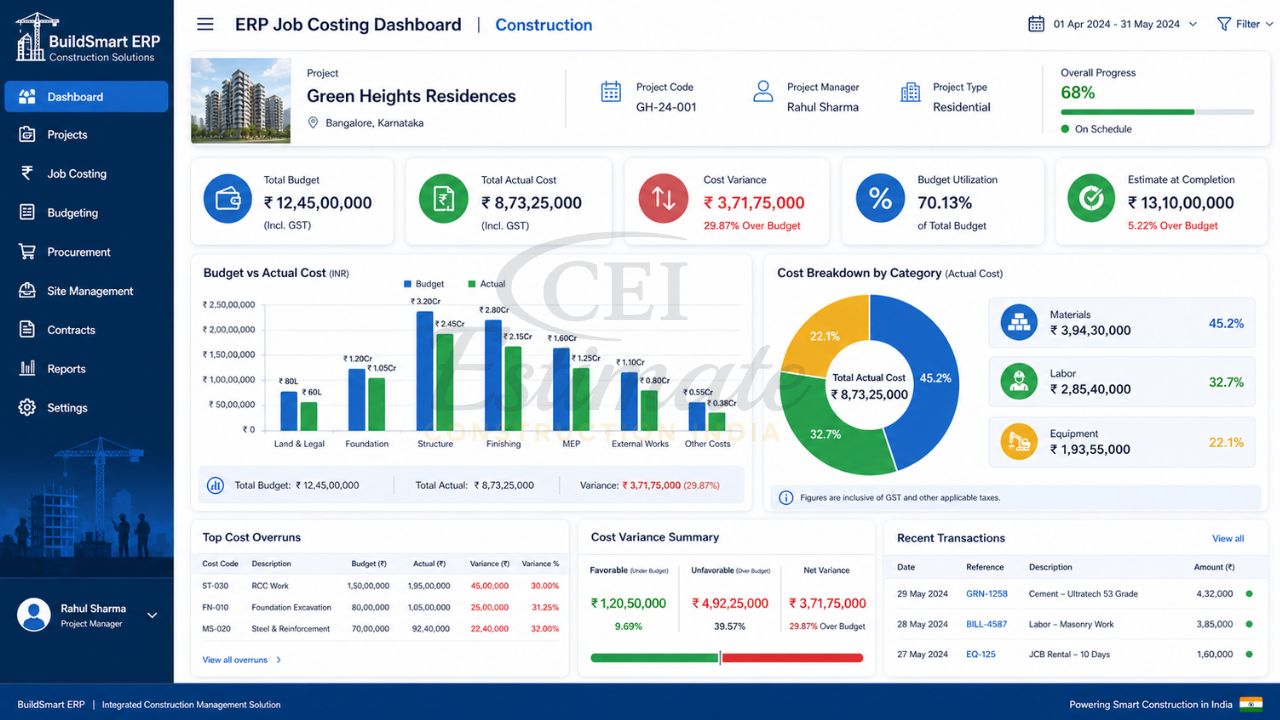
A purpose-built ERP software for electrical contractors eliminates this guesswork entirely. Every cost — cables, switchgear, labour, subcontractors, site overheads — is tracked in real time against the original estimate. Project managers can log into the system at any point and see exactly how much has been spent, how much remains in the budget, and whether the project is on track to deliver the expected margin. When a project starts drifting over budget, the ERP flags it immediately, giving contractors the chance to course-correct before losses compound.
For a typical mid-size electrical contractor handling five to ten projects simultaneously, this kind of visibility can make the difference between a profitable year and a painful one.
2. Streamlined Estimation and Tendering
Winning contracts in India’s competitive electrical sector requires fast, accurate, and professional estimates. Preparing tender documents manually is time-consuming and error-prone — a misplaced decimal or an outdated material rate can cost you the contract or worse, a project that loses money.
Modern ERP systems come with built-in estimation modules that pull live material rates, store historical pricing data, and auto-calculate quantities based on your project scope. What used to take two days of spreadsheet work can now be completed in a few hours, with far greater consistency. This speed advantage means your team can chase more opportunities without burning out — and submit more competitive bids with confidence.
3. Inventory and Material Management That Actually Works
Electrical contracting involves an enormous variety of materials — from low-value consumables like conduit pipes and junction boxes to high-value items like transformers, panel boards, and armoured cables. Mismanaging inventory leads directly to two costly problems: over-purchasing (tying up working capital in excess stock) and stock-outs (halting site progress while waiting for materials).
With an ERP system, your warehouse and procurement team operate from a shared, real-time inventory database. When site supervisors request materials through the system, the procurement team immediately sees current stock levels across all locations. Auto-reorder thresholds ensure critical items are replenished before they run out, while vendor management modules track supplier performance, pricing history, and delivery timelines. The result: leaner inventory, fewer delays, and significantly better cash flow management.
4. Efficient Project Scheduling and Workforce Management
Co-ordinating electricians, supervisors, and subcontractors across multiple sites — each with different timelines, skill requirements, and shift patterns — is a logistical challenge that can derail even the best-planned projects. Relying on phone calls and WhatsApp groups to manage workforce deployment is inefficient and creates accountability gaps.
An ERP platform gives project managers a visual Gantt chart of every project, with individual task assignments, completion targets, and real-time progress updates from the field. Electricians can mark tasks as complete through a mobile app, supervisors get instant alerts if milestones slip, and management can see the entire workforce deployment at a glance. Overtime, attendance, and productivity can all be monitored without a single phone call.
5. GST-Compliant Invoicing and Financial Management
For electrical contractors operating across multiple states, GST compliance is a constant administrative burden. Generating invoices, managing input tax credits, filing returns, and reconciling accounts across dozens of projects every month demands hours of effort that would be far better spent on the actual business.
A well-implemented ERP system handles all of this automatically. GST-compliant invoices are generated directly from the project billing module, with the correct CGST/SGST/IGST calculations applied based on the client’s location. TDS deductions, retention money tracking, and payment milestones are all built into the invoicing workflow. At month-end, financial reports and tax summaries are generated at the click of a button — dramatically reducing the workload on your accounts team and lowering the risk of costly compliance errors.
6. Centralized Document and Drawing Management
Electrical projects involve a mountain of documentation — approved drawings, specifications, inspection certificates, subcontractor agreements, warranty documents, and client correspondence. When these are scattered across email inboxes, USB drives, and filing cabinets, retrieving the right document at the right time becomes a frustrating, time-wasting exercise.
ERP platforms include centralised document management repositories where every project document is stored, version-controlled, and accessible to authorised team members from any device. Site engineers can pull up the latest single-line diagram on their tablet, auditors can access inspection records instantly, and project managers can retrieve contracts without rummaging through files. This single capability alone saves hours of administrative time every week.
👉 Need Help Choosing the Right ERP System? 📞 Call/WhatsApp: +91 86306 76890
7. Subcontractor Management and Payment Tracking
Most electrical contractors rely heavily on subcontractors for specialised work — earthing systems, fire alarm wiring, HVAC electrical connections, and so on. Managing multiple subcontractors across different projects, tracking their progress, and processing payments in line with completion milestones is genuinely complex.
ERP systems bring subcontractor management into the same platform as everything else. Work orders are issued digitally, progress is tracked against agreed milestones, and payment processing is triggered automatically upon verification — completely eliminating the payment disputes and delays that so often sour subcontractor relationships.
8. Equipment and Asset Tracking
Tools and equipment — cable drum jacks, wire strippers, multimeters, test kits, scaffolding — represent a significant investment for any electrical contractor. Without a proper tracking system, equipment goes missing, deteriorates without timely maintenance, and ends up being replaced unnecessarily.
ERP asset management modules assign each piece of equipment a unique identifier, track its location across sites, schedule preventive maintenance alerts, and record repair history. This not only extends the life of your equipment but also ensures your teams always have the right tools available when and where they need them.
9. Powerful Reporting and Management Dashboards
Business decisions should be driven by data, not gut feel. Yet most electrical contractors we speak to at Construction Estimator India are making critical decisions — which projects to bid for, how to price work, when to hire, where to invest — based on incomplete or outdated information.
ERP systems consolidate data from every corner of your business and present it through intuitive dashboards and customisable reports. Project profitability by client, outstanding receivables, equipment utilisation rates, material wastage trends — all of this is visible in real time. Senior management can spot problems early, identify high-performing project managers, and allocate resources where they’ll generate the best returns.
10. Scalability Without the Corresponding Chaos
One of the most common concerns we hear from growing electrical contractors is that scaling up means proportionally scaling up their administrative headcount. ERP removes this constraint. Because the system automates so many routine processes — purchase orders, invoicing, payroll, compliance filings — your business can take on significantly more projects without a corresponding increase in back-office staff. You can grow your revenue without growing your overhead, which is the real definition of operational efficiency.
👉 Upgrade Your Electrical Operations Today – 📲 Contact: +91 86306 76890
How ERP Specifically Helps Electrical Contractors Tackle Day-to-Day Challenges?
The generic benefits of ERP are well-documented, but electrical contracting has its own specific operational characteristics that make a sector-specific approach essential. The best construction ERP software in India for electrical contractors must handle the variable nature of electrical project scoping, where scope changes mid-project are the norm rather than the exception. It must accommodate complex BOQ (Bill of Quantities) structures, support site-level mobile access for field teams with limited connectivity, and integrate with the electrical testing and inspection workflows mandated by regulatory bodies.
It also needs to handle the contractual nuances common in Indian electrical contracts — retention money clauses, mobilisation advances, bank guarantee tracking, and milestone-linked payment terms. A generic ERP built for a manufacturing company simply won’t cut it for an electrical contracting firm.
Real-World Success Stories from Indian Electrical Contractors
A mid-size electrical contractor based in Pune, handling industrial and commercial projects across Maharashtra and Gujarat, implemented ERP software eighteen months ago. Before the system was in place, their accounts team was spending nearly forty percent of their time on manual invoicing and GST reconciliation. Post-implementation, that workload dropped to under ten percent, freeing up the team to focus on collections and financial planning. Project profitability visibility improved dramatically — within the first year, they identified two long-running projects that were quietly bleeding money and took corrective action in time to protect their margins.
A Delhi-based electrical contractor specialising in residential townships scaled from managing eight simultaneous projects to twenty-two — without adding a single person to their project management team. The ERP’s scheduling and subcontractor management modules gave them the oversight they needed to manage complexity at that scale. They also reported a significant improvement in client satisfaction, because they could provide accurate, real-time progress updates rather than vague estimates.
👉 Get ERP Demo + Pricing + Features Instantly – 📲 WhatsApp +91 86306 76890
Common Myths About ERP for Electrical Contractors — and the Truth
“ERP is only for large companies.” This is probably the most widespread misconception we encounter. ERP solutions today are scalable, modular, and available at price points that make them accessible even for contractors with a team of fifteen to twenty people. The return on investment — in time saved, errors avoided, and projects managed more profitably — typically far exceeds the cost within the first year.
“ERP takes years to implement and disrupts everything.” Modern cloud-based ERP solutions for electrical contractors can be deployed and running within a few weeks. Training is far more intuitive than it used to be, and the disruption during implementation is far less than the disruption of continuing to operate with fragmented, manual systems.
“Our current software does the same thing.” A combination of Tally for accounting, Excel for estimation, and WhatsApp for team coordination does not constitute an ERP. The real value of ERP lies in integration — when your estimates feed directly into procurement, which feeds into inventory, which feeds into invoicing, with no manual re-entry at any stage.
How to Choose and Implement the Right ERP System?
When evaluating ERP options, electrical contractors should look for systems that offer native support for construction and project-based accounting (not just generic accounting modules), mobile accessibility for field teams, strong BOQ and estimation capabilities, and GST-compliant financial management. The ability to customise workflows to match your specific business processes — rather than forcing your business to conform to rigid software logic — is also crucial.
Before going live, invest time in thorough data migration — your historical project data, vendor records, and client details need to be accurately transferred into the new system. Train your team not just on how to use the software, but on why the process changes being introduced will make their jobs easier. Change management is often the make-or-break factor in ERP implementations. You can also explore the top ERP software for construction companies in India to benchmark your options before making a final decision.
Why Construction Estimator India’s ERP Solutions Deliver the Best Results for Electrical Contractors?
At Construction Estimator India, we don’t just sell software — we bring years of hands-on experience working with electrical contractors across India to every implementation we undertake. We understand the specific challenges of the sector: the volatility of cable and switchgear prices, the complexity of multi-site deployment, the regulatory landscape, and the cash flow pressures that are unique to project-based businesses.
Our ERP solutions are designed specifically for the construction and electrical contracting sector, not adapted from generic manufacturing platforms. We’ve helped contractors across residential, commercial, industrial, and infrastructure segments implement systems that deliver real, measurable results. From initial needs assessment and system configuration through training, go-live support, and ongoing optimisation, our team is with you at every step.
Whether you’re looking to streamline your estimating process, get control of your inventory, or build the financial visibility you need to grow confidently, Construction Estimator India has the expertise and the solutions to make it happen. Explore our construction management software in India and our comprehensive overview of top 10 construction ERP software in India to see how our approach compares.
👉 Replace Excel with Smart ERP Software Today – 📲 WhatsApp: +91 86306 76890
Frequently Asked Questions (FAQs)
- What exactly is an ERP system, and how does it work for electrical contractors? An ERP (Enterprise Resource Planning) system is an integrated software platform that connects all the core functions of your business — estimating, procurement, inventory, project management, payroll, invoicing, and financial reporting — into a single database. For electrical contractors, this means your estimate automatically generates a material procurement list, your purchase orders update inventory in real time, and your completed milestones trigger invoices, all without anyone re-entering data between steps.
- How much does ERP software for electrical contractors typically cost in India? The cost varies significantly depending on the scope, number of users, and whether you opt for a cloud-based subscription or an on-premise deployment. Entry-level cloud subscriptions can start from around ₹15,000–₹30,000 per month for small teams, while comprehensive enterprise solutions for larger contractors may involve a higher investment. The important thing to evaluate is ROI — most contractors recoup their ERP investment within the first twelve to eighteen months through improved efficiency and better project profitability.
- Can ERP software handle GST and TDS compliance for electrical contractors? Yes — a well-designed ERP for the Indian market will handle GST invoice generation (with correct CGST/SGST/IGST splits based on delivery location), TDS deduction tracking, input tax credit management, and generate reports that simplify your monthly and quarterly return filings significantly.
- How long does it take to implement ERP software for an electrical contracting business? A cloud-based ERP for a small to mid-size electrical contractor can typically be configured and deployed within four to eight weeks. Larger businesses with more complex requirements may take three to six months for a full implementation. The key factor is the quality of your data migration and the thoroughness of your team’s training.
- Is ERP suitable for small electrical contractors with fewer than twenty employees? Absolutely. In fact, smaller contractors often see proportionally larger benefits because ERP eliminates the manual processes that consume a disproportionate share of time in small teams. Many ERP vendors offer modular solutions where you start with the functions you need most — say, estimation and invoicing — and add modules as your business grows.
- Can field electricians and site supervisors access ERP on mobile devices? Yes — modern ERP systems come with mobile apps that allow field staff to update task completion, request materials, log attendance, and access project drawings from their smartphones. This real-time field connectivity is one of the most impactful features for electrical contractors who have teams spread across multiple sites.
- How does ERP help with material procurement and vendor management? ERP systems maintain a centralised vendor database with pricing history, delivery performance ratings, and credit terms. When materials fall below reorder levels, the system can automatically generate purchase requests, which are then routed through an approval workflow before becoming purchase orders. This removes the ad-hoc, phone-call-based procurement that leads to over-purchasing and missed discounts.
- Will we lose our data if we switch ERP providers in the future? Reputable ERP providers allow you to export your data in standard formats. Before signing any ERP contract, confirm the data export policy and ensure you have contractual access to all your historical project, financial, and operational data.
- How does ERP improve cash flow management for electrical contractors? ERP improves cash flow in multiple ways: it tracks payment milestones and sends automated reminders for overdue invoices, gives real-time visibility into outstanding receivables and payables, helps manage retention money release schedules, and provides accurate cash flow forecasting based on project timelines and payment terms. These features collectively reduce the debtor days that are one of the biggest cash flow challenges in the sector.
- What should I look for when choosing ERP software specifically for electrical contracting? Look for construction-specific functionality (not generic business software adapted for contractors), strong BOQ and estimation capabilities, GST and TDS compliance, mobile field access, subcontractor management, and a vendor with genuine experience in the construction and electrical contracting sector. Implementation support and post-go-live training are just as important as the software features themselves.
Conclusion
The benefits of ERP systems for electrical contractors are clear, measurable, and transformative — from accurate job costing and streamlined procurement to GST compliance and scalable growth. In 2026, as competition intensifies and project complexity increases, the electrical contractors who invest in the right technology will be the ones who win the best contracts, protect their margins, and build sustainable businesses.
At Construction Estimator India, we’ve made it our mission to help electrical contractors across India make that transition successfully. If you’re ready to explore what an ERP solution designed specifically for your business could look like, we’d love to have that conversation.
📞 Call or WhatsApp us: +91 86306 76890 📧 Email us: info@constructionestimatorindia.com
Our team is available to walk you through a personalised demo, answer your questions, and help you choose the right path forward — no pressure, no jargon, just honest expertise from people who understand your business.