
Running an electrical contracting business in India today is a whole different ball game compared to even five years ago. Clients expect detailed quotes within hours, GST compliance is non-negotiable, field teams need real-time instructions, and project margins are thinner than ever. If you’re still managing estimates in Excel sheets and tracking labour on paper registers, you’re already losing ground to competitors who’ve made the switch to dedicated software.
At Construction Estimator India, we work closely with electrical contractors across the country — from small two-person teams handling residential rewiring to large EPC firms managing multi-crore industrial projects. One question we hear almost every week is: “Which software should we actually be using?” This guide is our honest, experience-backed answer.
👉 Need Help Choosing the Right Software? 📞 Call/WhatsApp: +91 86306 76890
We’ve evaluated dozens of platforms based on real-world usability, India-specific compliance features, pricing, and how well they actually serve on-the-ground electrical contracting operations. Here are the 10 best electrical contractor software in India for 2026.
Top 10 Best Electrical Contractor Software in India (2026 Rankings)
1. Construction Estimator India — ERP for Electrical Contractors
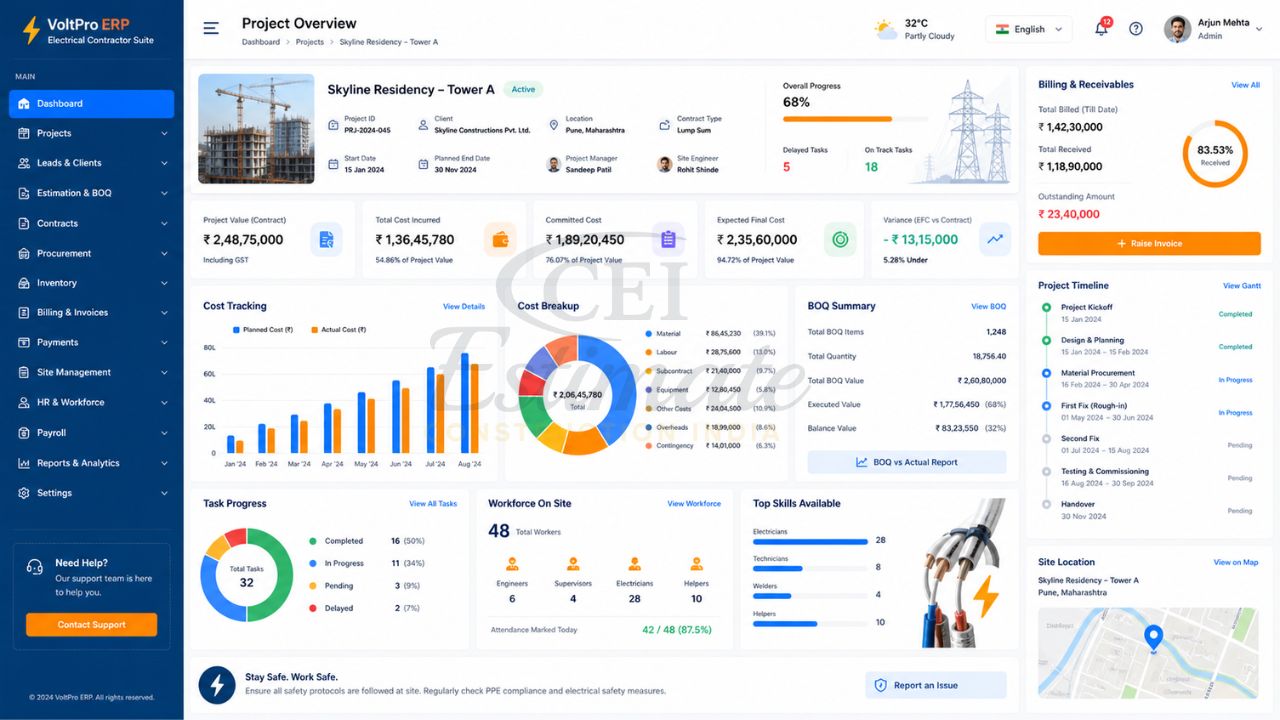
If you’re looking for software built specifically around the realities of Indian electrical contracting — BOQ-based estimation, GST-compliant billing, subcontractor management, and labour tracking — our own ERP software for electrical contractors is designed from the ground up for this market.
Key Features:
- Detailed electrical BOQ preparation with material take-off
- GST-ready invoicing with TDS and retention management
- Project-wise P&L tracking and job costing
- Labour attendance and productivity tracking
- Vendor rate comparison and purchase order management
- Multi-project dashboard with real-time progress reporting
- Integration with Tally for accounting
Best Suited For: Small to mid-sized electrical contractors, MEP subcontractors, and EPC project teams across India who need end-to-end project control without the complexity of an enterprise system.
Pricing Overview: Custom pricing based on business size and module requirements. Free demo available — contact us at info@constructionestimatorindia.com or WhatsApp +91 86306 76890.
Pros:
- Purpose-built for the Indian construction and electrical contracting market
- GST, TDS, and compliance features built in from day one
- Strong BOQ and estimation engine tailored to electrical work
- Dedicated onboarding and local support in India
Cons:
- Best suited for Indian market; may not suit international projects
- Requires initial setup and data migration from existing systems
Real-User Insight: Contractors using our platform consistently report a 30–40% reduction in estimation time and significantly better control over project cash flows once the system is fully set up.
2. Procore
Procore is one of the most widely recognised construction management platforms globally, and it has a growing footprint in India among larger EPC and infrastructure contractors.
Key Features:
- Project management, drawings, and RFI tracking
- Financial management with budget tracking and change orders
- Field productivity tools with mobile app support
- Document management and version control
- Integration with major accounting and ERP systems
Best Suited For: Large electrical contracting firms handling commercial, infrastructure, or industrial projects with complex documentation requirements.
Pricing Overview: Subscription-based; pricing is on request and can be significant for smaller teams. Indian offices of Procore can provide local quotes.
Pros:
- Extremely powerful for large, complex projects
- Excellent mobile app for field teams
- Strong integration ecosystem
Cons:
- Expensive for small or medium contractors
- Not optimised for Indian GST and compliance workflows out of the box
- Learning curve is steep for teams new to software
Real-User Insight: Procore works best when your team is tech-savvy and your projects are large enough to justify the investment. For pure electrical contracting needs in India, it often requires custom configuration.
3. Zoho Projects + Zoho Books (Zoho Ecosystem)
Zoho has built an impressive suite of business tools with strong India-specific features, including GST compliance and local payment integrations. Combining Zoho Projects with Zoho Books gives electrical contractors a fairly complete operational picture.
Key Features:
- Task and milestone management with Gantt charts
- GST-compliant invoicing through Zoho Books
- Time tracking and resource allocation
- Mobile app with offline capability
- Customisable project templates
Best Suited For: Small to medium electrical contractors who are already using Zoho CRM or Zoho Books and want to bring project management into the same ecosystem.
Pricing Overview: Zoho Projects starts at ₹4,300/month for up to 50 users; Zoho Books is available from ₹899/month. Bundled pricing is available.
Pros:
- Excellent GST compliance through Zoho Books
- Affordable compared to international construction-specific platforms
- Clean interface; relatively easy to learn
- Strong local support and data centres in India
Cons:
- Not purpose-built for construction or electrical contracting
- BOQ and estimation features are limited
- Requires manual workarounds for construction-specific workflows
Real-User Insight: Zoho works very well as a lightweight project tracker paired with accounting but needs significant customisation to handle electrical BOQ and material management properly.
4. Buildertrend
Originally built for residential construction, Buildertrend has evolved into a capable platform for specialty contractors including electrical teams working in the residential and commercial segments.
Key Features:
- Lead and sales management with proposal tools
- Scheduling and subcontractor coordination
- Client communication portal
- Purchase orders and bill tracking
- Daily logs and photo documentation
Best Suited For: Electrical contractors focused on residential projects, renovations, and smaller commercial fit-outs who need strong client-facing features.
Pricing Overview: Starts at USD 199/month (~₹16,500/month); can be expensive for smaller Indian teams.
Pros:
- Very strong client communication and portal features
- Good mobile experience for field teams
- Scheduling and coordination tools are intuitive
Cons:
- USD pricing makes it expensive for Indian businesses
- No native GST support; requires workarounds for Indian compliance
- Better suited for residential than industrial electrical work
Real-User Insight: Buildertrend is a strong choice if you handle premium residential interiors or smart home electrical installations and want to offer clients a professional experience.
5. ServiceMax (Field Service Management)
For electrical contractors whose business model revolves heavily around service contracts, AMC (annual maintenance contracts), and field service calls, ServiceMax offers a specialised solution.
Key Features:
- Field service scheduling and dispatch
- Work order management with mobile execution
- Asset tracking and preventive maintenance scheduling
- Customer service history and SLA tracking
- Integration with Salesforce CRM
Best Suited For: Electrical contractors with significant AMC portfolios, panel maintenance contracts, and facilities management work.
Pricing Overview: Enterprise pricing; typically requires a Salesforce subscription as the base. Contact for India-specific pricing.
Pros:
- Best-in-class for field service and maintenance operations
- Strong asset lifecycle management
- Excellent scheduling and dispatch optimisation
Cons:
- Primarily a service tool; weak on project estimation and BOQ
- Very expensive for mid-market contractors
- Requires Salesforce, adding to cost and complexity
Real-User Insight: If more than 60% of your revenue comes from service and maintenance work rather than new installation projects, ServiceMax is worth a serious look.
👉 Get Expert Advice for Electrical Estimating & ERP – 📞 WhatsApp: +91 86306 76890
6. Jobber
Jobber has gained strong traction among small electrical contracting businesses in India, particularly those handling residential and small commercial service jobs. It balances simplicity with just enough power for growing teams.
Key Features:
- Job quoting and invoicing with online payment options
- Client hub for self-service communication
- Scheduling and route optimisation
- Automatic follow-ups and reminder messages
- Mobile app for field technicians
Best Suited For: Small electrical service companies with 2–20 technicians handling routine installations, repairs, and service calls.
Pricing Overview: Plans start at approximately USD 49/month (~₹4,100/month); mid-tier plans around USD 149/month (~₹12,400/month).
Pros:
- Very easy to use; minimal training required
- Strong quoting-to-invoice workflow
- Good client communication automation
Cons:
- No Indian GST compliance built in
- Limited project management depth
- Not suitable for large project estimation or BOQ preparation
Real-User Insight: For an electrical contractor running a service-first operation with a relatively small team, Jobber reduces administrative overhead dramatically.
7. Asite
Asite is a cloud-based construction collaboration platform with a growing presence in Indian infrastructure and government projects. It’s particularly strong in document management and procurement for large-scale projects.
Key Features:
- Drawing and document management with version control
- Procurement and tendering workflows
- Field observation and defect management
- Quality and safety management modules
- Integration with BIM tools
Best Suited For: Electrical contractors working as subcontractors on large infrastructure, government, or EPC projects where document control and compliance are critical.
Pricing Overview: Subscription-based; priced per project or user; contact for India-specific quotes.
Pros:
- Excellent for projects with complex documentation requirements
- Strong procurement and tendering management
- Used by major Indian infrastructure players
Cons:
- Not designed for estimation or financial management
- Overkill for smaller projects
- Interface can feel complex for new users
Real-User Insight: Asite makes most sense when your client or main contractor mandates its use, or when you’re managing several concurrent large-scale projects with heavy documentation.
8. FieldEZ
FieldEZ is one of the more established Indian-made field service management platforms, with a solid reputation among utilities, facilities, and electrical service companies operating domestically.
Key Features:
- Field workforce management and live tracking
- Job scheduling with skills-based assignment
- Service report generation with digital signature
- Inventory and spare parts management
- Customer feedback and SLA compliance reporting
Best Suited For: Electrical contractors with large field teams managing service calls, audits, and maintenance work across multiple locations.
Pricing Overview: Indian pricing available; typically in the range of ₹500–₹1,500 per user per month depending on modules selected.
Pros:
- Made for Indian conditions with good local support
- Affordable entry-level pricing
- Strong field force tracking and productivity tools
Cons:
- Weaker on financial management and invoicing
- Limited project estimation capabilities
- Interface design lags behind newer international platforms
Real-User Insight: FieldEZ has a loyal user base among Indian electrical service companies. It does what it promises for field operations, though you’ll need to pair it with an accounting tool for complete financial management.
9. Tally Prime (with Construction Add-ons)
Tally Prime remains the backbone of Indian business accounting, and with the right construction-focused add-ons, it can serve as a reasonably capable management tool for smaller electrical contractors.
Key Features:
- GST-compliant billing and accounting (best-in-class)
- Purchase and sales management
- Payroll and employee management
- Project-wise cost tracking with add-ons
- Bank reconciliation and cash flow reports
Best Suited For: Small electrical contractors who are deeply embedded in Tally for their accounting and want to extend it for basic project tracking without switching platforms.
Pricing Overview: Tally Prime starts at approximately ₹18,000 per year for a single-user licence; multi-user and Silver/Gold plans available.
Pros:
- Unmatched GST and Indian compliance capability
- Widely understood by accountants and bookkeepers in India
- Huge ecosystem of add-ons and customisation options
- Very affordable
Cons:
- Not a project management or estimation tool in its native form
- BOQ, scheduling, and field management require third-party add-ons
- User experience is dated compared to modern SaaS platforms
Real-User Insight: Many electrical contractors use Tally for their back-office accounting and pair it with a specialist construction ERP like ours for estimation and project management — a combination that works well in the Indian context.
10. PlanSwift (Estimating & Takeoff Tool)
PlanSwift is a dedicated estimation and digital takeoff software that has become popular among MEP contractors, including electrical teams who need fast, accurate material quantity calculations from drawings.
Key Features:
- Digital plan takeoff from PDF drawings
- Electrical material quantity calculation
- Cost database with customisable assemblies
- Integration with Excel and accounting tools
- Template-based estimating for recurring project types
Best Suited For: Electrical estimators and contractors who handle frequent tendering and need to accelerate the takeoff and estimation process.
Pricing Overview: Starts at approximately USD 1,595 as a one-time licence (~₹1.3 lakh); subscription options also available.
Pros:
- Significantly faster than manual takeoff from drawings
- Excellent for accurate electrical material estimation
- Good template and assembly libraries
Cons:
- Estimation-only; no project management, billing, or compliance features
- Upfront cost is considerable
- Best paired with another platform for full project management
Real-User Insight: If your team does a high volume of tendering and estimate preparation, PlanSwift’s speed advantage pays for itself quickly.
👉 Find the Right Software for Your Electrical Business – 📲 Contact: +91 86306 76890
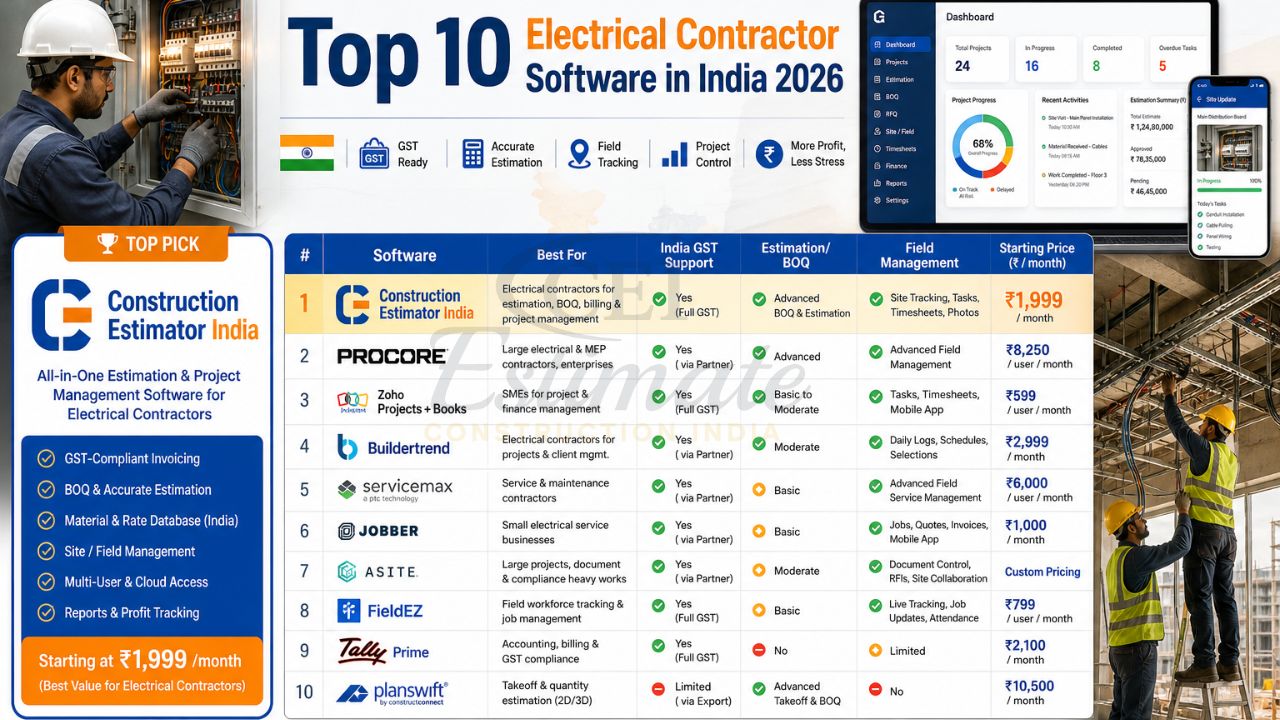
Comparison Table: Top 10 Electrical Contractor Software in India 2026
| Software | Best For | India GST Support | Estimation/BOQ | Field Management | Approx. Starting Price |
| Construction Estimator India | Indian electrical contractors (all sizes) | ✅ Yes | ✅ Strong | ✅ Yes | Custom / Demo available |
| Procore | Large EPC and infrastructure projects | ⚠️ Partial | ⚠️ Moderate | ✅ Yes | High (on request) |
| Zoho Projects + Books | SMEs already using Zoho | ✅ Yes | ❌ Limited | ⚠️ Moderate | ₹899/month onwards |
| Buildertrend | Residential & commercial fit-outs | ❌ No | ⚠️ Basic | ✅ Yes | ~₹16,500/month |
| ServiceMax | AMC & maintenance-heavy businesses | ❌ No | ❌ No | ✅ Excellent | Enterprise pricing |
| Jobber | Small service-first businesses | ❌ No | ⚠️ Basic | ✅ Good | ~₹4,100/month |
| Asite | Large infra & government projects | ⚠️ Partial | ❌ No | ⚠️ Moderate | On request |
| FieldEZ | Indian field service teams | ✅ Partial | ❌ No | ✅ Strong | ₹500–₹1,500/user/month |
| Tally Prime | Accounting-first small contractors | ✅ Excellent | ❌ No | ❌ No | ₹18,000/year |
| PlanSwift | Estimators & tendering teams | ❌ No | ✅ Excellent | ❌ No | ~₹1.3 lakh (one-time) |
Key Trends in Electrical Contractor Software in India for 2026
The software landscape for electrical contractors in India is evolving fast, and it’s worth understanding what’s driving these changes before making your choice.
- AI-Powered Estimation is no longer a future promise — it’s arriving in mainstream tools. Some platforms now use historical project data to suggest pricing and flag when a quote looks out of line with past similar jobs. This is particularly useful for Indian contractors managing dozens of concurrent smaller projects.
- Mobile-First Field Operations have become the expectation rather than the exception. In 2026, any software that doesn’t have a genuinely capable mobile app — one that works on basic Android devices and even in patchy network conditions — is falling behind. Field electricians are no longer willing to wait until they’re back at the office to submit site reports or log material usage.
- GST and Compliance Automation remains a top priority for Indian businesses. With e-invoicing mandates extending to smaller turnover thresholds, electrical contractors need software that handles GST returns, TDS deduction, and e-way bill generation without manual intervention.
- Integration with BIM and CAD Tools is becoming relevant for contractors working on large commercial projects. The ability to pull quantities directly from design models reduces estimation errors significantly.
- Subscription-Based Pricing is replacing large upfront licence fees, making better software accessible to contractors who were previously priced out. This is particularly relevant for the large number of small and medium electrical contractors across Tier 2 and Tier 3 cities in India.
How to Choose the Right Electrical Contractor Software for Your Business?
With so many options available, the right choice depends on understanding your own operation before evaluating any tool. Here’s the thinking framework we share with contractors who come to us for guidance.
- Start with your biggest pain point. Are you losing money on under-estimated projects? Is your invoicing delayed because bills are being prepared manually? Are your field teams working without real-time instructions? The answer to this question should point you toward the module you need most urgently — whether that’s estimation, billing, or field management.
- Be realistic about your team’s tech readiness. The most powerful software is useless if your site supervisors refuse to use it. For teams new to software, start with something intuitive and build up from there.
- Always verify Indian compliance capability. GST, TDS, labour laws, and e-invoicing requirements are non-negotiable for Indian businesses. A platform that looks impressive on a demo but can’t produce a compliant GST invoice will create more problems than it solves.
- Think beyond the demo. Ask for references from other Indian electrical contractors using the software, ideally in your own project-size range. A platform that works brilliantly for a ₹500-crore EPC firm may be unnecessarily complex and expensive for a ₹5-crore MEP subcontractor.
- Plan for integration, not isolation. Your software should talk to your accounting system, whether that’s Tally, Zoho Books, or something else. Isolated software creates duplicate data entry and errors.
For a broader perspective on choosing the right platform, our guide on construction management software in India covers the key evaluation criteria that apply across construction verticals, including electrical contracting.
👉 Get Software List + Pricing + Demo Details Instantly – 📲 WhatsApp +91 86306 76890
Why Construction Estimator India’s Solutions Stand Out for Electrical Contractors?
We’ve spent years working specifically with the construction sector in India, and that focus shows in every feature of our platform. Unlike international software that requires expensive customisation to handle Indian compliance, or generic business tools that don’t understand construction-specific workflows, our ERP solution for electrical contractors is built with the Indian electrical market as its primary design objective.
Here’s what that means in practice. When you prepare an electrical BOQ in our system, you’re working with a material database that reflects Indian market pricing and standard specifications — not US or European standards. When you raise a bill, GST calculation, TDS deduction, and retention tracking are handled automatically. When your project manager wants to see how a particular site is performing financially, the job costing report shows them margin by phase in real time, not at month-end after the accountant has closed the books.
We also understand that most Indian electrical contractors are running three, five, or sometimes fifteen projects simultaneously, often across different cities. Our multi-project dashboards are designed for exactly that kind of operation — giving business owners a single view across everything without having to log in and out of different project files.
Our solutions are part of a broader ecosystem of construction ERP software designed to serve the full spectrum of construction businesses in India, from specialised electrical contractors to civil contractors and real estate developers. You can also explore our comprehensive rankings of the top ERP software for construction companies in India and the top 10 construction ERP software in India to see where our solutions sit in the broader landscape.
The support we provide doesn’t stop at software. Our team includes people who have worked in construction management, understood project billing disputes, and seen the pain of a poorly estimated job. When you call us, you’re talking to someone who understands your world.
Frequently Asked Questions (FAQs)
What is the best electrical contractor software in India for 2026?
The best software depends on your business size, project type, and the specific challenges you’re facing. For Indian electrical contractors who need end-to-end project management with GST compliance, job costing, and BOQ preparation, Construction Estimator India’s ERP is the most purpose-built option. For large EPC firms, Procore offers powerful project management features. For service-heavy businesses, platforms like Jobber or FieldEZ may be more relevant. There is no single answer — the best software is the one that solves your most pressing operational problems efficiently.
Does electrical contractor software in India support GST compliance?
Not all of them do, and this is a critical point to verify before committing to any platform. Tally Prime and Zoho Books have the strongest GST compliance capabilities among general platforms. Construction Estimator India’s ERP is specifically built with Indian GST, TDS, and e-invoicing requirements in mind. International platforms like Procore or Buildertrend typically require additional configuration or workarounds for Indian compliance. Always test the invoicing and tax module carefully during your trial or demo.
Can small electrical contractors afford specialised software?
Absolutely. The market has matured significantly, and there are strong options at every price point. Jobber starts below ₹5,000 per month. FieldEZ offers per-user pricing that scales with your team size. Zoho’s ecosystem is among the most affordable for small businesses with Indian compliance needs. Construction Estimator India also structures pricing to be accessible for smaller contracting businesses — reach out to us for a conversation about what makes sense for your scale.
Is there electrical contractor software that works well for AMC and maintenance businesses?
Yes. If the core of your revenue model is annual maintenance contracts, breakdown callouts, and preventive maintenance rather than new installation projects, you should be looking at field service management platforms specifically. ServiceMax is the enterprise-grade option for large AMC operations. FieldEZ is a strong India-made alternative. Jobber also works well for smaller maintenance operations. The key features to look for are service scheduling, asset tracking, SLA monitoring, and automated reminder workflows.
How important is mobile app capability for electrical contractor software?
Critically important, and increasingly non-negotiable. Your site supervisors, field technicians, and project engineers are not sitting at desks — they’re on-site, often in places with unreliable internet connections. Any software you consider should have a mobile app that works on standard Android devices, supports offline functionality for at least basic data entry, and syncs reliably when connectivity is restored. Platforms that are desktop-only or have poor mobile apps will see low adoption from field staff, which defeats the purpose entirely.
What’s the difference between electrical contractor software and general construction management software?
General construction management software handles a broad range of activities across civil, structural, and finishing work. Electrical contractor software — or a construction ERP configured for electrical work — goes deeper on areas specific to MEP operations: electrical BOQ preparation, cable schedule tracking, panel schedule management, electrical material takeoff from drawings, and integration with standard electrical specifications. If you’re using general construction software for your electrical business, you’re likely filling gaps with spreadsheets. Purpose-built tools eliminate those gaps.
Can construction ERP software help electrical contractors win more tenders?
Yes, in several important ways. Faster, more accurate estimating means you can respond to more tenders without stretching your estimating team. Better job costing data from past projects means your pricing becomes more precise over time — you stop leaving money on the table or submitting bids that erode margins. Professional BOQ presentations and detailed cost breakdowns also improve your credibility with sophisticated clients. The best construction ERP software in India makes your tendering process a genuine competitive advantage.
How long does it take to implement electrical contractor software?
This varies significantly by platform and business complexity. A simple tool like Jobber can be up and running in a day or two. A comprehensive ERP solution typically requires two to eight weeks for full implementation, including data migration, team training, and configuration of project templates and rate libraries. At Construction Estimator India, we provide structured onboarding support to get your team productive as quickly as possible, with dedicated implementation assistance for the first weeks after go-live.
Should I choose a cloud-based or on-premise electrical contractor software?
For most Indian electrical contractors in 2026, cloud-based software is the better choice. Cloud platforms eliminate the need for server infrastructure, IT maintenance, and manual software updates. They also make collaboration easier across multiple project sites and enable mobile access for field teams. On-premise solutions may make sense in rare cases where data security policies or internet connectivity issues at your office make cloud deployment impractical, but these cases are increasingly uncommon. All modern leading platforms in this list are cloud-first.
Can I integrate electrical contractor software with Tally or other accounting software?
Yes, and this integration is actually very important for Indian businesses where Tally is deeply embedded in the accounting workflow. Construction Estimator India’s ERP offers Tally integration, allowing financial data to flow from project management into your accounts without double entry. Many other platforms also support CSV/Excel exports or direct API integrations with Tally. When evaluating any software, confirm the specific integration method and test it during your trial to ensure it works reliably with your version of Tally.
Conclusion: Make Your Software Decision Count in 2026
The right software won’t just make your office more organised — it will directly improve your project margins, reduce the risk of estimation errors, and give you the clarity to scale your business with confidence. In a competitive market like Indian electrical contracting, the contractors who invest in smart systems today are the ones winning better projects tomorrow.
At Construction Estimator India, we’re committed to helping electrical contractors across India find and implement the right technology for their specific operation. Whether you’re evaluating our own ERP platform or simply need guidance on what to look for in a solution, we’re here to help with no pressure and genuine expertise.
Get in touch with our team today:
📱 WhatsApp/Call: +91 86306 76890 📧 Email: info@constructionestimatorindia.com
Request a free demo of our electrical contractor ERP and see firsthand how it handles estimation, billing, project tracking, and compliance in one integrated platform — built specifically for the Indian construction market.