Choosing the right ERP system for your construction company is one of the most important technology decisions you will ever make. Get it right, and you can dramatically improve project profitability, speed up billing cycles, eliminate cost overruns, and gain real-time visibility across every site you manage. Get it wrong, and you could waste lakhs of rupees, lose months of productivity, and end up with a frustrated team that still reaches for spreadsheets.
In 2026, the Indian construction industry is in the middle of a massive digital transformation. With government infrastructure projects scaling up, private developers handling larger portfolios, and contractors managing multi-city operations, the pressure to digitise and streamline is immense. ERP solutions built specifically for construction are no longer a luxury — they are a competitive necessity.
But with dozens of vendors in the market, each promising the world, how do you separate the genuinely useful platforms from the ones that will gather digital dust after a few months? That is exactly what this guide is designed to help you figure out.
At Construction Estimator India, we have spent years helping construction companies across India — from mid-sized builders to large EPC contractors — identify, evaluate, and successfully implement ERP systems. This guide distils everything we have learned into a practical, no-nonsense buying framework.
👉 Choosing the right ERP can transform your construction business—📲 WhatsApp Now: +91 86306 76890
Step-by-Step: How to Choose the Right ERP System for Your Construction Company
Step 1 — Define Your Pain Points Before You Even Look at Software
Before you open a single brochure or attend a demo, sit down with your core team and make a list of the top 10 operational problems you face today. Are projects consistently going over budget? Is your billing team chasing payment certificates manually? Are your purchase orders still being approved via WhatsApp? Do you lack visibility into material stock across multiple sites?
This pain-point audit is non-negotiable. It tells you exactly what you need the ERP to solve — and prevents you from getting dazzled by features you will never use.
Step 2 — Map Your Business Processes
Every construction company operates differently. A Tier-2 residential developer in Pune has different workflows than a highway contractor running projects across Rajasthan and Maharashtra. Before shortlisting software, map out your current processes across estimating, procurement, execution, billing, and finance. This process map becomes your benchmark for evaluating whether any given ERP actually fits how your business runs.
Step 3 — Set a Realistic Budget
ERP investment in construction typically covers three cost heads: software licensing (or subscription), implementation and customisation, and training. Many companies budget only for the software and are then surprised by the total cost of ownership. A good rule of thumb for Indian mid-sized construction firms is to plan for 1.5x to 2x the software license cost to account for the full implementation.
Step 4 — Build Your Evaluation Team
ERP selection should never be a one-person decision. Include stakeholders from estimating, site execution, finance, procurement, and IT. Each department will surface requirements the others would miss, and broader buy-in at selection stage dramatically improves adoption once the system goes live.
Step 5 — Request Demos Focused on Your Industry
Generic ERP demos are nearly useless. Always ask vendors to show you workflows specific to construction — a BOQ-based estimate flowing into a purchase order, or a running account bill being generated from progress measurements. If the vendor cannot demo construction-specific scenarios with confidence, that tells you everything you need to know about how well their platform will serve you.
Key Factors to Consider Before Buying a Construction ERP
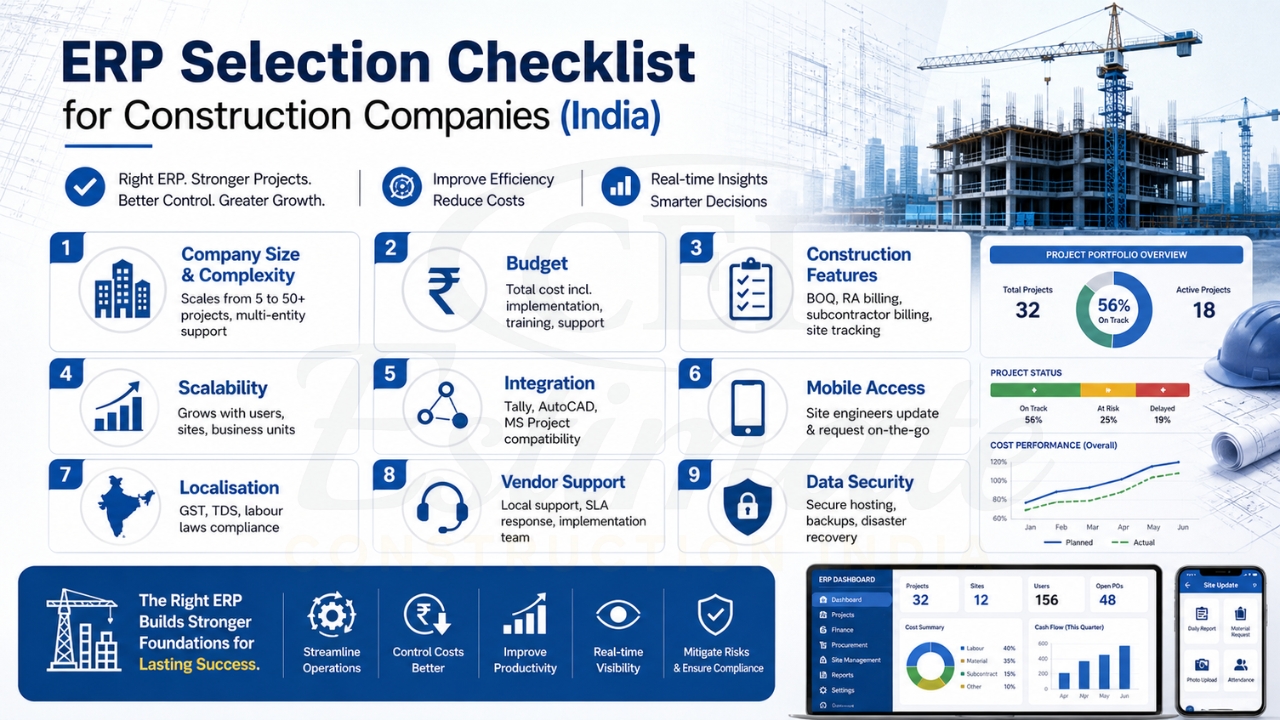
When we work with clients at Construction Estimator India, we walk them through a structured evaluation across these critical dimensions:
| Factor | What to Evaluate |
| Company Size & Complexity | Does the ERP scale from 5 projects to 50? Can it handle multiple entities? |
| Budget | Total cost of ownership including implementation, training, and annual support |
| Construction-Specific Features | BOQ management, RA billing, subcontractor billing, site progress tracking |
| Scalability | Can it grow with you as you add users, sites, and business units? |
| Integration | Does it connect with Tally, AutoCAD, MS Project, or other tools you already use? |
| Mobile Access | Can site engineers update progress and raise material requests from their phones? |
| Localisation | GST-compliant billing, TDS, labour laws, Indian accounting standards |
| Vendor Support | Is support available in your language? Response time SLAs? Local implementation team? |
| Data Security | Where is your data hosted? What backup and disaster recovery mechanisms exist? |
Must-Have Features in a Construction ERP for Indian Companies
Not all ERP platforms marketed to construction companies are genuinely built for the industry. Here are the features that any serious construction ERP must deliver:
1. Estimation and BOQ Management
The ability to create detailed Bill of Quantities from scratch or import them from Excel/AutoCAD, apply item rates, and link estimates directly to project budgets is foundational. Without this, you are just running a generic accounting system.
2. Running Account (RA) Billing
RA billing is the lifeblood of contractor cash flow in India. Your ERP must handle RA bill preparation, deviation tracking, client approvals, and reconciliation with contract values seamlessly. Any system that requires manual workarounds for RA billing is not construction-ready.
3. Project Management and Progress Tracking
Site-level progress entry linked to physical completion percentages, which then drive financial forecasting — this is what separates a construction ERP from a basic accounting package. Look for milestone tracking, S-curve reporting, and earned value analysis.
4. Procurement and Inventory Management
Material planning from BOQ, automated purchase requisitions, multi-level approval workflows, goods receipt against PO, and stock tracking across multiple sites and yards. Many Indian contractors lose 3-5% of their project value to poor material management — the right ERP eliminates this.
5. Subcontractor Management
Managing subcontractor work orders, back-to-back billing, deduction of security deposits and retention amounts, and reconciling advances — all of this should be built-in, not bolted on.
6. Finance and Accounts
Full integration of project accounts with company books, GST returns, TDS management, cost centre-wise P&L, and bank reconciliation. Bonus if the system can handle multi-company and multi-project P&L in a single view.
7. HR and Payroll
Labour management at construction sites is complex — daily muster rolls, skill categories, PF/ESI compliance, contractor labour billing. An ERP built for Indian construction should handle this natively.
8. Mobile and Field Access
In 2026, a construction ERP without a mobile app is behind the times. Site engineers should be able to submit DPRs, raise material requests, record labour attendance, and check BOQ balances from any smartphone.
For a detailed comparison of platforms that check all these boxes, you can explore our guide on the
best construction ERP software in India.
Common Mistakes Construction Companies Make While Choosing ERP (And How to Avoid Them)
Mistake 1: Choosing Based on Price Alone
The cheapest ERP almost always ends up being the most expensive in the long run. Low upfront cost often means limited features, poor support, or heavy customisation charges down the line. Evaluate total cost of ownership, not just the sticker price.
Mistake 2: Letting IT Decide Alone
ERP selection is a business decision, not a technology decision. We have seen companies where the IT team picked software that was technically excellent but operationally irrelevant because no one from estimating or site execution was involved in the evaluation.
Mistake 3: Ignoring Implementation Capability
A brilliant software product in the hands of a weak implementation partner is a recipe for disaster. Always evaluate the vendor’s implementation methodology, the experience of their team with Indian construction companies, and client references specifically from your segment of the industry.
Mistake 4: Going Live Without Adequate Training
ERP adoption fails at the training stage more often than at the technology stage. Plan for role-based training, not just generic system walkthroughs. Site engineers need different training from finance managers. Insist on a structured training plan before signing any contract.
Mistake 5: Skipping a Pilot or Phased Rollout
Trying to go live across your entire company on day one is extremely high risk. Always start with a pilot project or a single business unit, iron out the wrinkles, build internal champions, and then roll out more broadly.
Mistake 6: Not Evaluating GST and Statutory Compliance Depth
India’s tax and compliance environment is unique. Ensure the ERP handles e-invoicing, GSTR-1/3B, TDS on contractor payments, labour contractor compliance, and MSME payment regulations. A system built for a different market and retrofitted for India will cause compliance headaches.
👉 Find the perfect ERP solution tailored to your project needs—📲 WhatsApp: +91 86306 76890
Cloud vs On-Premise ERP: What Makes Sense for Indian Construction Companies?
This is one of the most common questions we get at Construction Estimator India, and the honest answer is: it depends on your specific situation. Here is a practical breakdown:
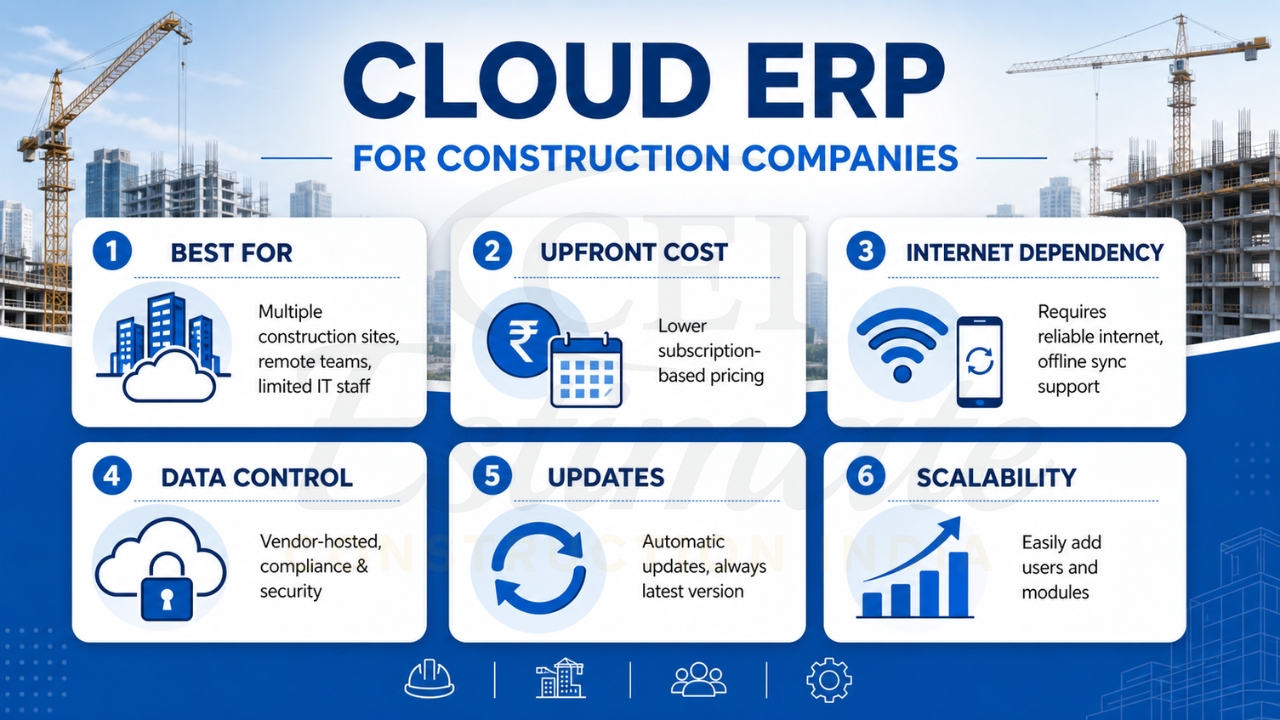
| Cloud ERP | |
| Best For | Companies with multiple sites, limited IT staff, or remote teams |
| Upfront Cost | Lower — subscription model spreads cost over time |
| Internet Dependency | Needs reliable connectivity; mobile apps can work offline with sync |
| Data Control | Hosted with vendor; check data residency and compliance |
| Updates | Automatic; always on latest version |
| Scalability | Easily add users and modules as you grow |
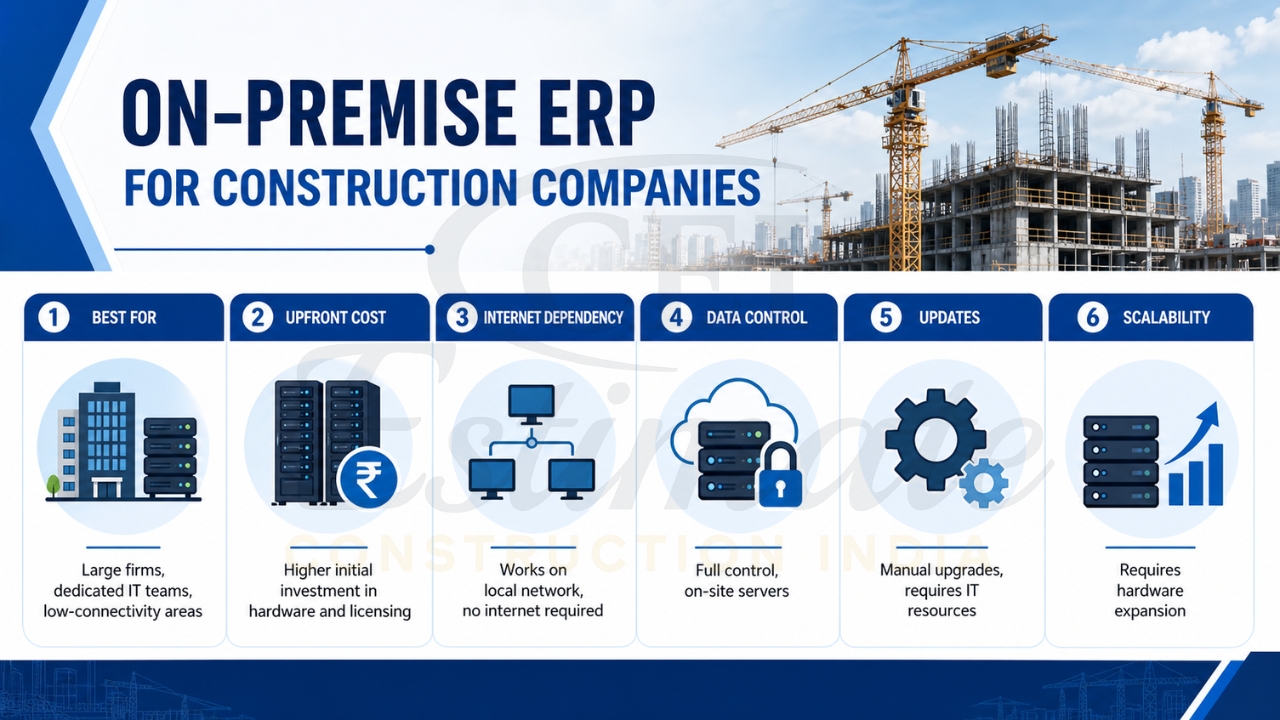
| On-Premise ERP | |
| Best For | Large firms with dedicated IT teams or projects in low-connectivity areas |
| Upfront Cost | Higher initial investment in hardware and licensing |
| Internet Dependency | Works on local network; no internet required |
| Data Control | Full control — data stays on your servers |
| Updates | Manual; requires IT resources for upgrades |
| Scalability | Scaling requires hardware investment |
For most mid-sized Indian construction companies today, cloud-based ERP is the more practical and cost-effective choice. The total cost of maintaining on-premise infrastructure — servers, IT staff, backup systems — frequently exceeds what a cloud subscription would cost. That said, larger organisations with stringent data security policies or those operating in remote geographies with poor connectivity may still have a valid case for on-premise deployment.
You can read more about specific platforms across both models in our comparison of the
top 10 construction ERP software in India.
👉 Make smarter ERP decisions with industry experts—📲 Connect Now: +91 86306 76890
How to Evaluate and Shortlist ERP Vendors?
Once you have defined your requirements and decided on deployment model, here is how to run a structured vendor evaluation:
- Create a Request for Proposal (RFP) — document your must-have and nice-to-have features in writing and send it to 4-6 vendors.
- Score vendors on a weighted scorecard — assign weights to features based on your business priorities, not just a flat checklist.
- Demand construction-specific demos — provide vendors with a sample project and ask them to demonstrate your specific workflows live.
- Check client references — specifically ask for references from companies similar to yours in size, project type, and geography.
- Evaluate support responsiveness — send a test support query before signing and measure how quickly and helpfully they respond.
- Assess data migration capability — ask how they will migrate your existing data from Tally, Excel, or your previous system.
- Review contract terms carefully — pay attention to data ownership, exit clauses, customisation ownership, and support SLAs.
Our detailed resource on
top ERP software for construction companies in India provides a pre-researched shortlist to help you begin this process.
ERP Implementation Roadmap and Timeline
A realistic ERP implementation for a mid-sized Indian construction company typically follows this timeline:
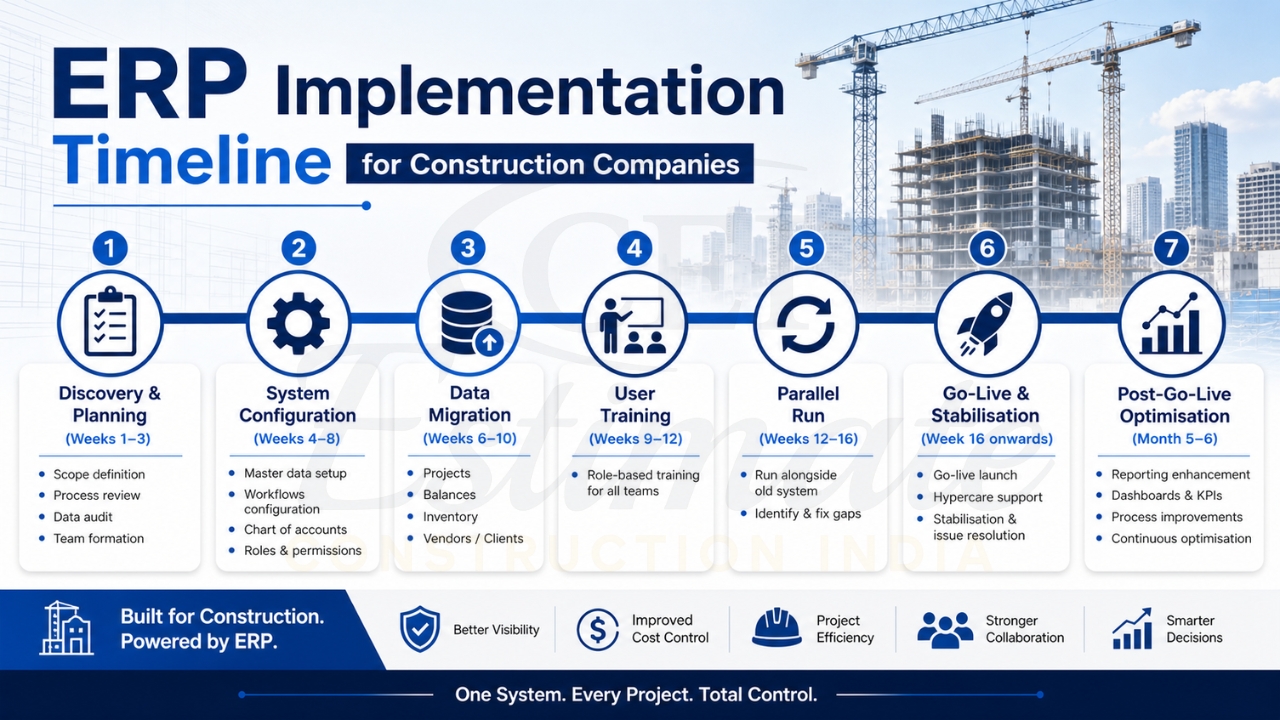
| Phase | Activities & Duration |
| Discovery & Planning (Weeks 1–3) | Finalise scope, business process review, data audit, project team formation |
| System Configuration (Weeks 4–8) | Master data setup, workflow configuration, chart of accounts, user roles |
| Data Migration (Weeks 6–10) | Migrate open projects, outstanding balances, inventory, vendor/client masters |
| User Training (Weeks 9–12) | Role-based training for finance, procurement, site, HR, and management teams |
| Parallel Run (Weeks 12–16) | Run new system alongside existing processes; identify gaps and fix issues |
| Go-Live & Stabilisation (Week 16 onwards) | Cutover to live system; hypercare support for first 4–8 weeks |
| Post-Go-Live Optimisation (Month 5–6) | Advanced reporting, dashboards, process refinements based on actual usage |
Be cautious of vendors who promise to go live in two weeks. A rushed implementation nearly always results in poor data quality, low user adoption, and a system that does not actually reflect how your business operates.
👉 Improve project control, budgeting & efficiency with the right ERP—📲 WhatsApp: +91 86306 76890
ROI Calculation: How Long Does It Take to Recover Your ERP Investment?
This is the question every MD and Director of Finance wants answered before approving an ERP budget. Based on our experience working with Indian construction firms, here are the primary areas where ERP delivers measurable financial return:
- Reduction in material wastage and theft: 2–4% saving on total material cost through better procurement controls and inventory tracking
- Faster billing cycles: RA bill preparation that used to take 5–7 days can be completed in 1–2 days, accelerating cash inflow
- Reduced rework due to estimation errors: Integration between estimates and execution data eliminates costly scope mismatches
- Labour cost accuracy: Digital muster rolls and payroll automation reduce overpayment and compliance penalties
- Lower finance costs: Improved working capital management through better visibility reduces reliance on overdraft facilities
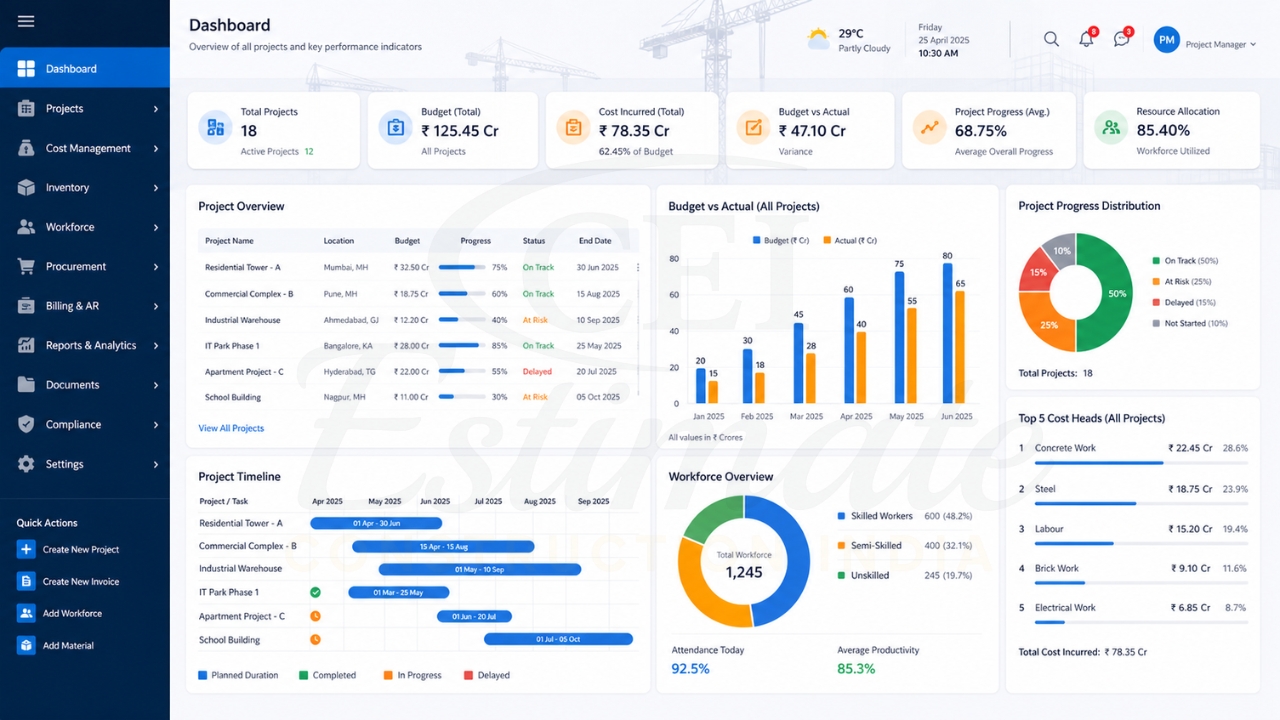
- Management decision speed: Real-time dashboards replace monthly reporting cycles, enabling faster course corrections
For a construction company with annual turnover of ₹50 crore, conservative estimates suggest ERP can deliver ₹1.5–3 crore in annual cost savings and revenue improvements. At a typical ERP investment of ₹15–25 lakh for implementation and first-year licensing, the payback period is typically 6–18 months.
For reference on how different software platforms are priced, our guide to
construction management software in India includes cost benchmarks across different categories.
Why Construction Estimator India Is the Right Partner for Your ERP Journey?
We are not just a software reseller. Construction Estimator India has deep roots in the Indian construction industry — our team has worked on real projects, dealt with real BOQs, and understands the chaos of a site office at month-end billing time. That on-the-ground perspective shapes everything we do, from the way we evaluate software to the way we implement it.
Here is what working with us looks like in practice:
- Vendor-agnostic advisory: We work with multiple leading ERP platforms and recommend the one that genuinely fits your business — not the one that pays us the highest commission.
- Construction-domain expertise: Our implementation consultants come from construction and real estate backgrounds, not just IT.
- Structured methodology: We follow a proven implementation framework that has been refined across dozens of successful deployments.
- Post-go-live support: We stay with you through the stabilisation phase and beyond — we are not done when the go-live email goes out.
- Transparent pricing: No hidden fees, no scope creep surprises. What we quote is what you pay.
You can explore more of our thinking and resources on
best construction software in India to get a sense of how we approach this space.
👉 Start your ERP selection process today—📲 WhatsApp Now: +91 86306 76890
Frequently Asked Questions (FAQs)
1. How do I know if my construction company is ready for an ERP system?
If you are managing more than 3–4 simultaneous projects and finding it difficult to track real-time costs, billing status, or material consumption without manually consolidating spreadsheets — you are ready. Other strong indicators include delayed billing cycles, frequent cash flow surprises, and difficulty producing project-level P&L reports quickly. Most companies wait too long; earlier implementation means less data chaos to sort out.
2. What is the average cost of an ERP system for a mid-sized construction company in India?
Costs vary significantly based on the number of users, modules required, and deployment model. As a rough guide, cloud-based construction ERP for a company with 20–50 users typically ranges from ₹5–15 lakh annually for licensing. Add implementation costs of ₹8–20 lakh depending on complexity. On-premise solutions have higher upfront costs — ₹20–50 lakh or more — but lower ongoing fees. Always evaluate total cost of ownership over 3 years rather than just year-one pricing.
3. Can a construction ERP handle both contracting and real estate development?
Yes, the best platforms handle both. Contracting workflows revolve around client billing, subcontractor management, and project cost control. Real estate development adds flat/unit tracking, CRM for buyer management, construction-linked payment plans, and RERA compliance. If your company operates in both segments, make sure you evaluate both capability areas in the demo — many systems are strong in one and weak in the other.
4. How long does an ERP implementation take for a construction company?
A realistic timeline for a mid-sized construction company is 4–6 months from kick-off to stable go-live. Smaller companies with simpler operations can sometimes achieve go-live in 10–12 weeks, while large multi-entity organisations may take 8–12 months. Be very wary of vendors who promise go-live in 4–6 weeks — rushed implementations almost always result in poor data quality and low adoption rates.
5. What is the difference between construction ERP and construction management software?
Construction management software typically focuses on project planning, scheduling, site management, and task tracking. ERP is broader — it integrates those project operations with financial management, procurement, HR, and accounting into a single unified system. For a growing construction business, ERP provides significantly more value than standalone construction management software because it eliminates the data silos between site and finance teams.
6. Do construction ERP systems work for small contractors with 1–2 projects?
A full-scale ERP might be overkill for a very small contractor — the implementation cost and complexity may not be justified. For companies at that scale, a construction-specific project management and billing tool may be more appropriate. However, if you have ambitions to grow and are already struggling with cost tracking or billing even on a small scale, investing in ERP early prevents painful data migration later when you are managing 10 projects and cannot afford the disruption of a system change.
7. How important is GST compliance in choosing a construction ERP?
Extremely important. Construction in India involves complex GST scenarios — works contracts, mixed supply, reverse charge on labour contractor services, input tax credit restrictions, and e-invoicing obligations above certain turnover thresholds. Any ERP you select must handle these natively and be kept updated as GST regulations evolve. Always ask vendors specifically about GST handling for works contracts and subcontractor billing during your evaluation.
8. Can we integrate our existing Tally accounting with a new construction ERP?
Many construction companies continue using Tally for statutory accounting while using a construction ERP for operational project management. Most modern construction ERPs offer Tally integration — journal entries, invoices, and payments can be synced between systems. However, the cleaner long-term solution is to move fully to an ERP that handles both operational and financial accounting, eliminating the integration overhead and reconciliation work. Discuss this trade-off openly with any vendor you are evaluating.
9. What happens to our data if we decide to change ERP vendors in the future?
This is a critically important question that most buyers forget to ask. Before signing any ERP contract, clarify: what data formats can be exported, can you export all historical transactions in a structured format, and are there any contractual restrictions on data portability. Cloud-based vendors should provide clear data export provisions. Always include a data exit clause in your contract. At Construction Estimator India, we help clients negotiate these terms as part of the vendor evaluation process.
10. How do we ensure high user adoption after ERP go-live?
User adoption is the single biggest risk in any ERP implementation, and it is almost entirely a people and process challenge, not a technology one. The most effective strategies we have seen work are: involving end-users in the selection process so they feel ownership, conducting role-specific training rather than generic system tours, identifying “champions” in each department who become the go-to resource for their colleagues, and ensuring senior management visibly uses and endorses the system. A system that management bypasses with spreadsheets will never be adopted by the teams below them.
Conclusion: Make the Right Choice the First Time
Choosing an ERP system is not a decision you want to make twice. The disruption of a failed implementation — both financially and in terms of team morale — can set a construction business back significantly. But with the right approach, the right evaluation framework, and the right implementation partner, ERP can genuinely transform how your construction business operates.
At Construction Estimator India, we have seen this transformation happen across companies of all sizes and project types — from residential builders managing 500 apartments to EPC contractors running highway projects across multiple states. The common thread in every successful implementation? The decision-makers took the time to do it properly, involved the right people, and chose a partner who understood construction.
If you are beginning your ERP evaluation journey — or if you are stuck midway through a selection process and need an expert second opinion — we would love to talk. Our team can help you assess your requirements, shortlist the right platforms, and build a business case that gets sign-off from your leadership.
📞 Call / WhatsApp: +91 86306 76890
📧 Email: info@constructionestimatorindia.com
Let’s build something better — together.