India’s infrastructure and property sectors are experiencing explosive growth in 2026. Many civil engineers, contractors, and entrepreneurs often get confused between Real Estate vs Construction Business India. One involves developing and selling properties, while the other focuses on executing projects for clients. Understanding the difference between real estate developer and contractor is crucial before investing your time and money.
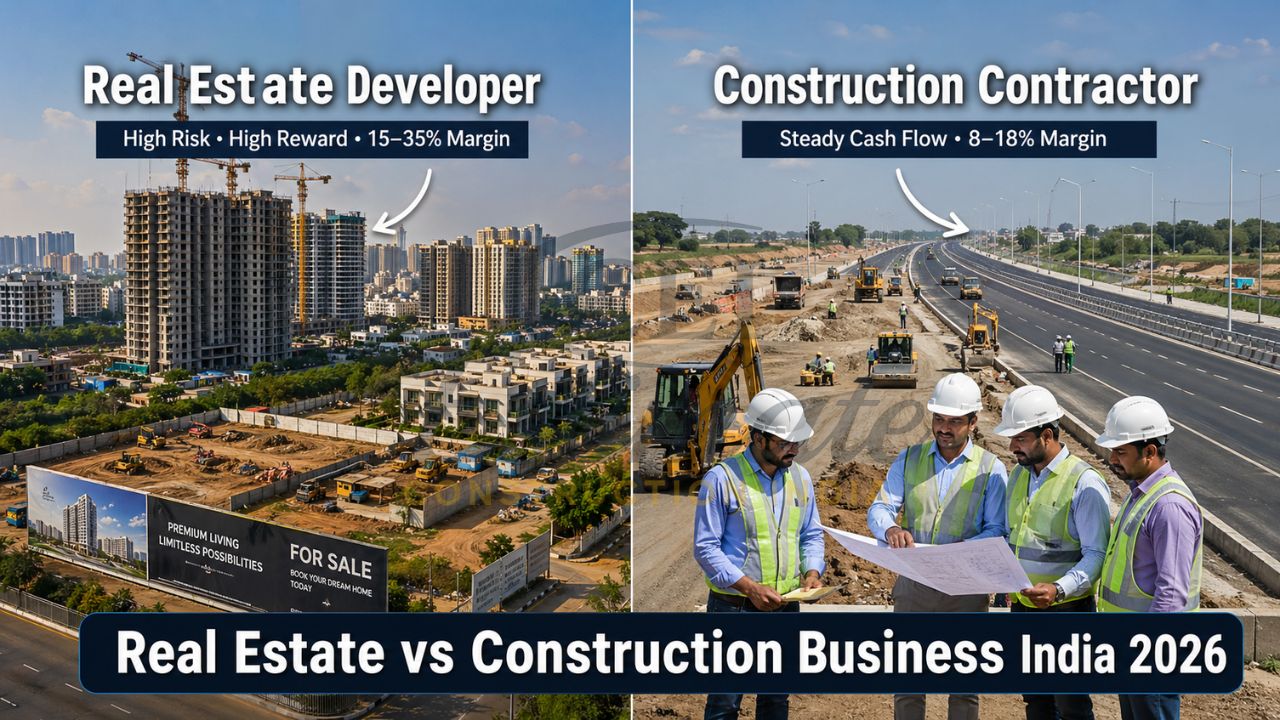
This detailed guide compares real estate business vs construction company India, covering investment, risks, profit margins, legal requirements, and practical insights. Whether you want to know which is better real estate or construction business or how to start either, this article provides clear answers tailored for Indian professionals in 2026.
What is Real Estate Business in India?
Real estate business primarily involves acquiring land, obtaining approvals, developing residential or commercial projects, and selling or leasing them for profit. In 2026, the Indian real estate market is valued at approximately USD 585 billion and is projected to reach USD 926 billion by 2031, growing at a CAGR of 9.63%.
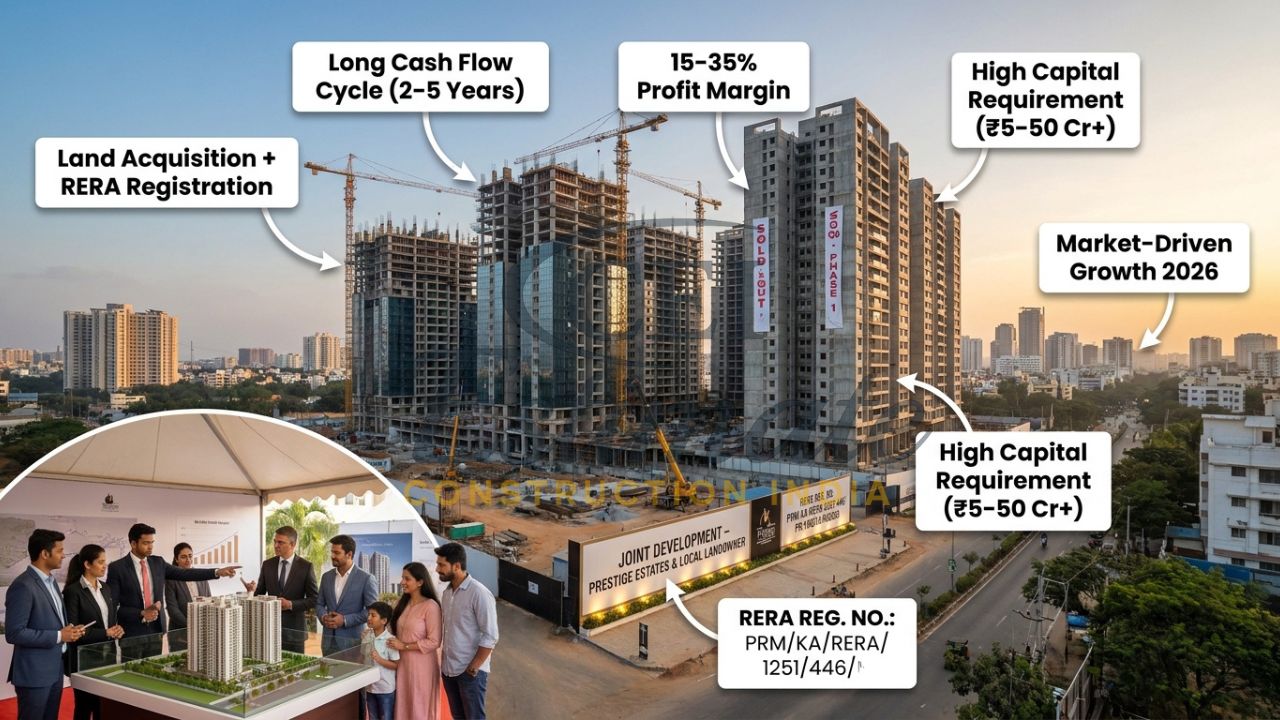
Key Activities:
- Land acquisition and joint development agreements (JDA)
- Project planning, design, and RERA registration
- Construction oversight (often outsourced)
- Marketing, sales, and post-sale services
- REITs and fractional ownership models gaining popularity
Real estate developers act as promoters. They take the highest risk but also enjoy the highest rewards through appreciation in property value.
What is Construction Business in India?
Construction business focuses on executing civil, infrastructure, or specialized projects for clients — government or private. The sector is expected to reach USD 0.79 trillion in 2026, growing steadily at around 6.87% CAGR.
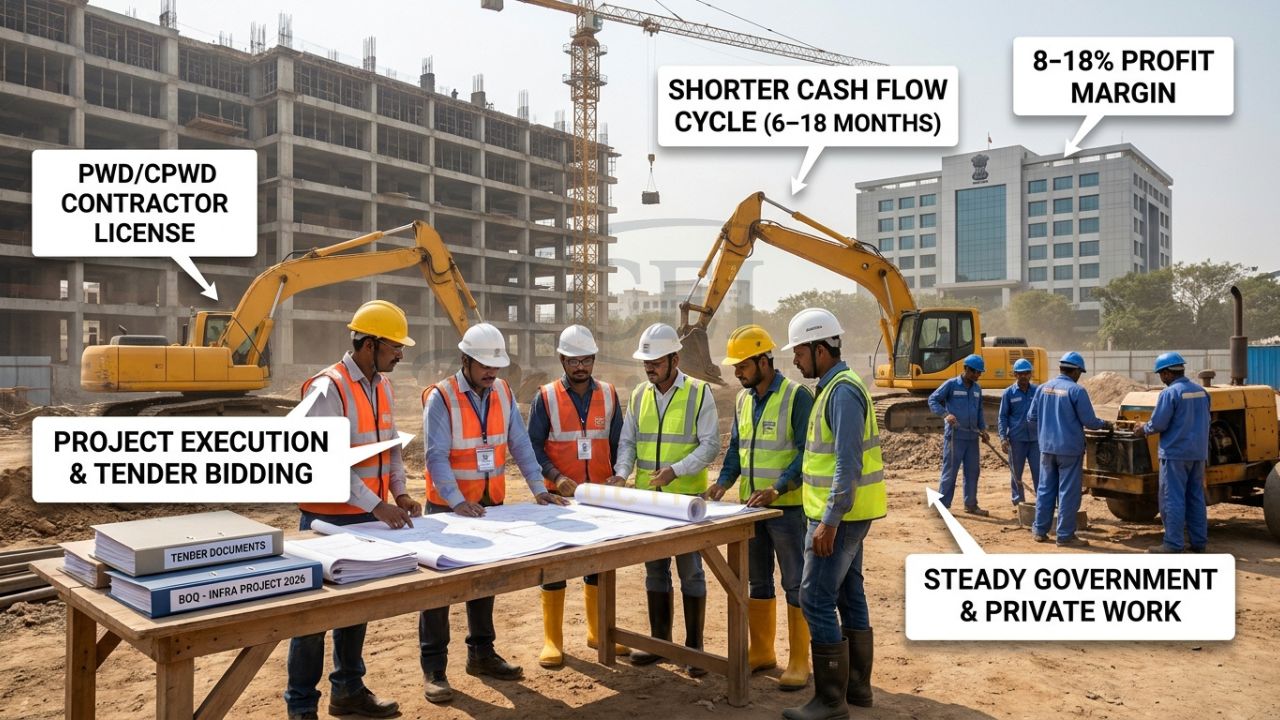
Key Activities:
- Bidding on tenders (government PWD, CPWD, highways, railways)
- Project execution as main contractor or sub-contractor
- Labour management, material procurement, and quality control
- Specialized verticals: electrical, plumbing, MEP, interior fit-outs, or labour contracting
Contractors earn through agreed margins on project value rather than land appreciation.
Real Estate vs Construction Business India: Head-to-Head Comparison
| Parameter | Real Estate Developer | Construction Contractor |
| Core Focus | Land + Development + Sales | Project Execution & Delivery |
| Investment Required | Very High (₹5–50 Cr+ per project) | Medium (₹10 Lakh – ₹5 Cr depending on scale) |
| Profit Margin | 15–35% (on total project) | 8–18% (on construction cost) |
| Risk Level | High (market, regulatory, delay) | Medium (execution, payment delay) |
| Cash Flow Cycle | Long (2–5 years per project) | Shorter (6–18 months per project) |
| Scalability | High in booming markets | Steady with government orders |
| Capital Lock-in | Very High | Moderate |
| Regulatory Focus | RERA, land laws, environment clearance | Contractor license, GST, labour laws |
| 2026 Market Growth | 9.6%+ (Residential & Commercial) | 6.4–7% (Infrastructure push) |
Key Differences Between Real Estate Developer and Contractor
- Risk & Reward: Developers bear land price fluctuation and buyer demand risks but gain from appreciation. Contractors have predictable revenue if they manage costs well.
- Capital Intensity: Real estate needs massive upfront capital for land. Construction requires working capital for machinery, labour, and materials.
- Skill Set: Developers need strong marketing, finance, and networking skills. Contractors excel in project management, engineering, and execution efficiency.
- Income Nature: Developers earn windfall profits on successful projects. Contractors enjoy recurring revenue from multiple ongoing works.
- Dependency: Real estate is highly sensitive to interest rates and buyer sentiment. Construction benefits from steady government spending on infrastructure.
Investment Required & Profit Margins (Real Estate vs Construction)
Real Estate:
- Small project (10–20 units): ₹5–15 crore
- Mid-size project: ₹20–100 crore+
- Profit: Net margins typically 15–25% after costs, but top developers achieve 25–35% in good locations.
Construction:
- Starting small firm: ₹10–50 lakh (machinery, licenses, working capital)
- Medium EPC firm: ₹2–10 crore
- Profit: 8–15% on project value for general contracting; higher (12–18%) in specialized works.
In 2026, real estate offers higher upside in Tier-1 and emerging Tier-2 cities, while construction provides more stable, lower-risk returns through government-backed projects.
Risks and Challenges in Both Businesses
Real Estate Risks:
- Regulatory delays and RERA penalties
- High interest costs on bank loans
- Market slowdowns affecting sales
- Land title disputes
Construction Risks:
- Payment delays from clients
- Rising material costs (steel, cement)
- Labour shortages and skill gaps
- Intense competition in tender bidding
Common Challenge: Both face working capital pressure, but real estate carries higher financial leverage risk.
Legal Requirements and Licenses
For Real Estate Developers:
- RERA registration (mandatory for projects >500 sqm or 8 units)
- GST registration
- Company incorporation
- Environment clearances, building plan approvals
- Updated RERA 2.0 rules in 2026 emphasize stricter escrow accounts and timely completion.
For Construction Business:
- Contractor License (PWD/CPWD classes A to E)
- GST, EPF, ESIC
- Labour contractor license if employing 20+ workers
- ISO certifications for bigger projects
Knowing what is a tender in construction becomes essential for contractors to win government work.
Which is Better for You? Factors to Consider
Choose Real Estate if you have:
- High risk appetite and access to large capital
- Strong networking and marketing skills
- Long-term vision for wealth creation through asset appreciation
Choose Construction if you have:
- Engineering background and execution expertise
- Moderate capital and preference for steady cash flow
- Interest in government projects and tender processes
Many successful professionals start with construction business to build capital and experience, then gradually move into real estate development.
Market Trends & Opportunities in 2026
- Residential and premium housing driving real estate growth
- Infrastructure (roads, railways, airports, data centers) boosting construction
- Sustainability and green buildings becoming mandatory
- PropTech and digital tools transforming both sectors
- Tier-2/3 cities offering higher growth potential with lower entry barriers
Success Tips for Real Estate Developers and Construction Contractors
- Maintain strong financial discipline and banking relationships.
- Invest in digital tools for project tracking and estimation.
- Build a reliable team of professionals.
- For contractors: Master how to fill tender documents step by step in India to win more bids.
- Use standardized construction contract agreement format India to protect your interests.
- Understand detailed estimate vs abstract estimate in construction for accurate bidding and cost control.
- Explore free vs premium templates to streamline your documentation and save time.
Conclusion
The decision between Real Estate vs Construction Business in India depends on your capital, risk appetite, and long-term vision. Both sectors offer excellent opportunities in 2026, but success comes to those who understand the differences and plan accordingly.
The best construction management app is the one that fits your workflow, your project scale, and your business goals. In 2026, Indian contractors and builders need tools that improve site tracking, labour attendance, material management, billing accuracy, and documentation while keeping operations simple and efficient.
If you want expert help choosing the right software and connecting it with accurate estimation and BOQ services, contact Construction Estimator India today on WhatsApp +91 8630676890. A better digital workflow can help you reduce delays, improve cost control, and build a more profitable construction business.
FAQs
- Which business has higher profit margin – real estate or construction?
Real estate generally offers higher margins (15–35%) but with greater risk and longer cycles compared to construction (8–18%).
- How much investment is needed to start real estate business in India?
Minimum ₹5 crore+ for a small project; brokerage can start smaller (₹50,000–2 lakh).
- Is construction business safer than real estate?
Yes, due to shorter cycles and government-backed payments, though competition is high.
- Can a contractor become a real estate developer?
Absolutely. Many successful developers began as contractors and used their execution experience to launch projects.
- What is the role of RERA in real estate?
It protects buyers and enforces timely delivery and transparency on developers.
- Which sector grows faster in 2026?
Real estate is growing faster at ~9.6% CAGR, while construction benefits from steady infrastructure push.
- Do I need a contractor license for real estate development?
Not always, if you outsource construction, but many developers maintain in-house capabilities.
- Which is better for beginners with limited capital?
Construction business is more accessible for beginners.