
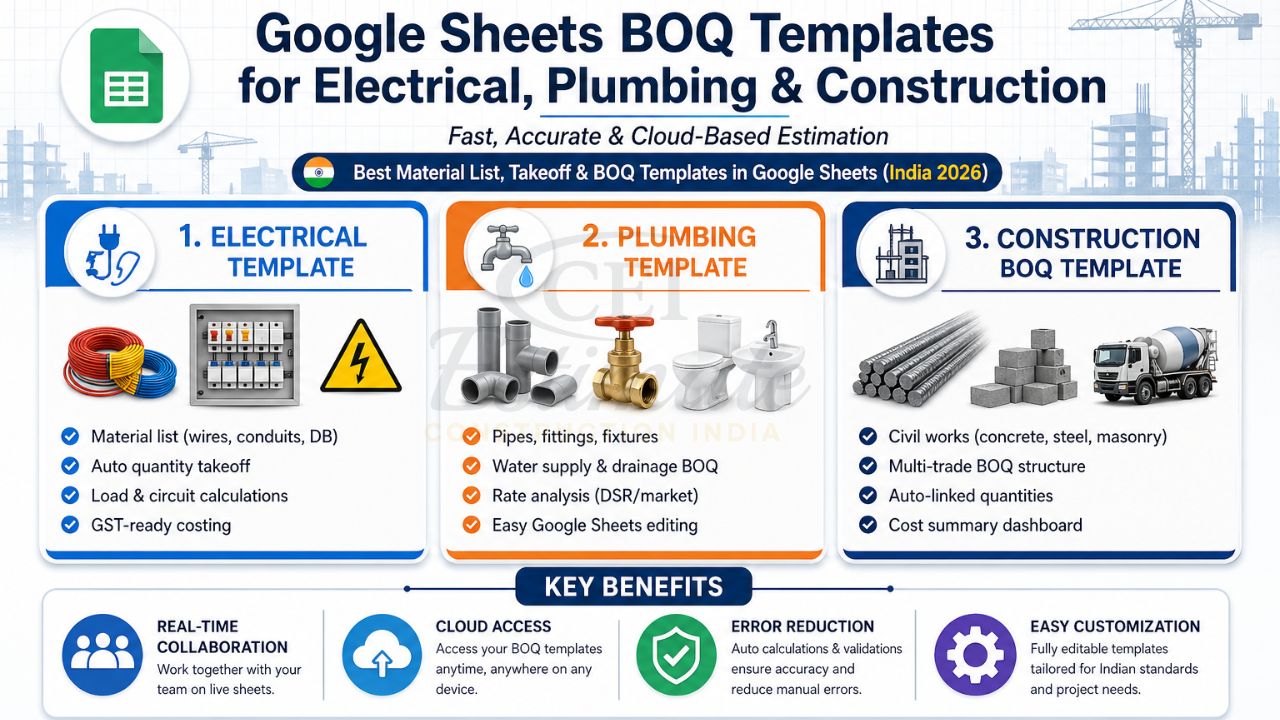
For an Indian contractor, the difference between a profitable project and a financial disaster often boils down to a single spreadsheet. We have all been there: a site supervisor calls at 4:00 PM saying they are short on 2.5sqmm wire, or a plumbing team realizes they ordered the wrong size of CPVC elbows for a high-rise project in Noida. These “minor” errors lead to urgent market trips, labor standing idle, and mounting overheads that eat into your margins.
In the fast-paced Indian construction market, manual estimation is no longer a viable option. Whether you are handling a residential bungalow in Gurugram or a commercial office fit-out in Bangalore, precision is your best friend. Using the best material list takeoff and bill of quantities templates in Excel is not just about staying organized; it is about protecting your profit and presenting a professional image to your clients. This guide will walk you through the essential tools every modern contractor needs to streamline their workflow, from initial drawings to final billing.
Why Professional Material List, Takeoff & BOQ Templates Are Essential?
The Indian construction industry is unique. We deal with volatile material prices, complex GST regulations (typically 18%), and a labor force that requires clear, itemized instructions. Professional templates provide a structured system that manual notes or basic lists simply cannot match.
- Elimination of Human Error: Automated formulas ensure that if you change a quantity in your takeoff sheet, the total cost and GST in your summary update instantly.
- Time Savings: Contractors report saving between 15 to 30 hours per project by switching from manual entry to template-based estimation.
- Procurement Precision: A proper material list prevents over-ordering (which locks up capital) and under-ordering (which halts site progress).
- Tender Professionalism: A well-formatted BOQ with your company logo and clear specifications gives you a competitive edge during the bidding process.
- GST Compliance: Pre-built templates handle CGST, SGST, and IGST calculations automatically, ensuring your quotes are legally sound and ready for invoicing.
Best Electrical Material List Template
Electrical work is perhaps the most detail-oriented trade in construction. A single residential project can involve hundreds of items, from various gauges of FRLS wires to modular switch plates and distribution boards. Without a comprehensive electrical material list template, it is easy to miss small but critical accessories like conduit bends, fan hooks, or specialized screws.
An expert-grade electrical list should be categorized by project stages. For instance, the Concealing Stage focuses on heavy-duty PVC conduits and metal boxes. The Wiring Stage covers copper wires of different capacities (1.0sqmm for lighting, 2.5sqmm for power points, etc.) and communication cables. Finally, the Finishing Stage includes modular switches, sockets, and light fixtures.
Your Excel template should include dedicated columns for:
- Item Code/Reference: For tracking specific parts.
- Brand Preference: Common Indian brands like Polycab, Finolex, Havells, or Anchor.
- Unit of Measurement (UOM): Mtr for wire, Nos for switches, or Rmt for conduits.
- Wastage Allowance: Typically 5–10% to account for site cutting and scrap.
By using a standardized format, you ensure that your procurement team knows exactly what to buy, reducing the risk of site delays caused by material mismatches.
Plumbing Material List Template for Contractors
Plumbing estimation has evolved significantly with the introduction of various piping technologies like CPVC, uPVC, and PPR. For a contractor, managing a plumbing material list template for contractors means more than just counting pipes; it involves tracking a massive variety of fittings, valves, and sanitary fixtures.
A professional plumbing list is usually split into two main systems: Water Supply and Drainage/Sewerage. For a project in Delhi NCR or Mumbai, you might be dealing with premium brands like Astral, Supreme, or Prince for piping, and Jaquar, Kohler, or Hindware for sanitaryware.
Key features to look for in a plumbing material list:
- Automated Pipe Sizing: Templates that allow you to enter the number of bathrooms and automatically suggest pipe quantities based on standard layouts.
- Fittings Multiplier: A smart Excel feature that estimates the number of elbows, tees, and couplers based on the total pipe length.
- Sanitaryware Checklist: A dedicated section for “Internal” items (cisterns, angle valves) and “External” items (wash basins, WCs, shower heads).
Using these templates prevents the common “last-minute run” to the local hardware store for a missing ₹50 coupler that ends up costing ₹500 in lost labor time.
Electrical Take Off Template
The “Takeoff” is the bridge between a blueprint and a bill of materials. It is the process of measuring lengths and counting points directly from the electrical drawings. An electrical take off template transforms this tedious task into a systematic workflow.
Instead of using a scale and a notebook, an Excel-based takeoff sheet allows you to enter measurements for different circuits. For example, if you are measuring the conduit for a master bedroom, you simply enter the room dimensions and the number of light points. The template then uses pre-set formulas to calculate:
- Horizontal Runs: Conduit length across the ceiling or slab.
- Vertical Drops: Conduit length running down the walls to switch boxes.
- Total Wire Length: Multiplied by the number of wires in each conduit.
This level of detail is crucial for large-scale Indian projects where conduit lengths can run into thousands of meters. It provides a “Technical Takeoff” that you can defend if a client questions your quantities during an audit.
Bill of Quantities Excel Template
While a material list is for your internal team, the Bill of Quantities (BOQ) is your official handshake with the client. It is the primary document used for tendering and contract signing. A professional bill of quantities excel template organizes your entire project cost into a clean, client-facing format.
In India, a standard BOQ is divided into sections such as Civil Works, Plumbing, Electrical, and Interior Fit-outs. Each line item includes a detailed description of the work, the quantity, the unit rate, and the total amount.
Pro Tip: Your BOQ should always clearly separate Material Costs and Labor Costs. This transparency builds trust with clients and makes it easier to handle “labor-only” or “material-supply” contracts. Furthermore, ensuring your template is GST-ready is non-negotiable in 2026. It should automatically calculate CGST and SGST at 9% each for intra-state projects, or IGST at 18% for inter-state work.
Bill of Materials Template Excel
Often confused with a BOQ, the Bill of Materials (BOM) is actually your procurement “shopping list.” While the BOQ tells the client what they are paying for, the bill of materials template excel tells your storekeeper exactly what to order from suppliers.
A BOM is highly granular. While a BOQ might have a single line for “Installation of a 25L Geyser,” the BOM will list every nut, bolt, flexible hose, and angle valve required to complete that installation.
Key components of a professional BOM:
- Technical Specifications: Not just “PVC Pipe,” but “110mm 6kg/sqcm PVC SWR Pipe”.
- Vendor Pricing: A column to track quotes from different suppliers like Ashirvad or Prince.
- Lead Times: Crucial for planning site delivery schedules.
- Stock Tracking: Columns to mark what has been ordered, received, and consumed on site.
Having a dedicated BOM ensures that you don’t just win the tender, but you actually build the project within the budget you promised.
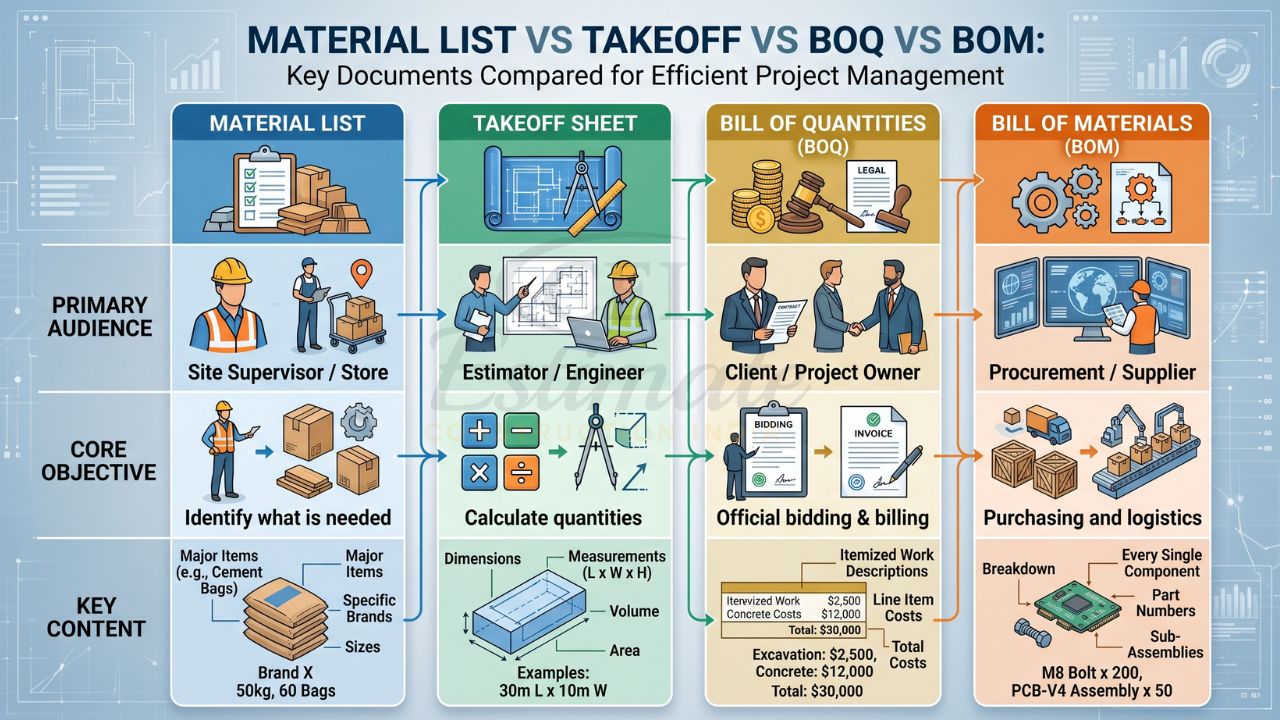
Comparison Table: Material List vs Takeoff vs BOQ vs BOM
Understanding the distinct roles of these documents is vital for efficient project management. Below is a comparison to help you use the right tool at the right time.
| Document Type | Primary Audience | Core Objective | Key Content |
|---|---|---|---|
| Material List | Site Supervisor / Store | Identify what is needed | Brands, sizes, and quantities of major items |
| Takeoff Sheet | Estimator / Engineer | Calculate quantities | Measurements from drawings (L x W x H) |
| BOQ | Client / Project Owner | Official bidding & billing | Itemized work descriptions and total costs |
| BOM | Procurement / Supplier | Purchasing and logistics | Every single component needed for assembly |
How to Use and Customize These Templates Effectively?
A template is only as good as the data you put into it. To get the most out of your Excel tools, follow these best practices:
- Update Your Rates Quarterly: Market prices for copper and PVC fluctuate. Ensure your Rate Analysis sheet reflects current market prices in your specific region (e.g., Delhi vs. Bangalore).
- Customize for Your Brand: Always replace placeholders with your Company Logo, GSTIN, and contact details. This simple step significantly increases your professional credibility.
- Use the Labor Calculator: Don’t just guess labor costs. Use templates that include a Labor Burden calculator, accounting for EPF, ESI, and local daily wages for skilled and unskilled workers.
- Set Up “Good-Better-Best” Tiers: Especially for residential projects, offer clients different pricing tiers (e.g., Standard vs. Premium fixtures) to help them stay within budget while you maximize your upsell opportunities.
Frequently Asked Questions (FAQs)
- Can I use these templates in Google Sheets?
Yes, most professional Excel templates are fully compatible with Google Sheets, allowing you to update quantities directly from your mobile phone while standing on the construction site. - Is GST included in the BOQ templates?
Most Indian-specific templates include automated GST calculation fields, typically set at the standard 18% rate, which can be modified if needed. - How much time can these templates save me?
On average, contractors save between 20 to 30 hours of manual calculation and formatting per project by using pre-built systems. - Are these templates suitable for small residential renovations?
Absolutely. There are specialized versions designed specifically for bathroom remodels and house wiring that simplify the process for smaller contractors. - Do I need advanced Excel skills to use them?
No. Most templates are designed for ease of use, where you only need to enter data in “yellow-highlighted” cells while the formulas handle all the math. - Can I add my own items to the pre-filled lists?
Yes, these templates are fully editable. You can insert rows to add specialized materials or unique site requirements. - How do I handle wastage in my estimation?
Look for templates that have a built-in Wastage Factor (usually 5% to 10%). This ensures you order enough material to cover cutting, breakage, and site scrap. - Is there support available if I get stuck?
Most template providers offer support via email or WhatsApp to help you customize the sheets for your specific project needs.
Conclusion
Success in the Indian construction industry is not just about hard work; it is about working smart. By moving away from manual, error-prone spreadsheets and adopting the best material list takeoff and bill of quantities templates in Excel, you are investing in the long-term health of your business. These tools allow you to bid with confidence, procure with precision, and bill with transparency.
Whether you are an electrical contractor, a plumbing expert, or a general builder, having a standardized set of documents is your first step toward scaling your operations and winning larger, more profitable tenders. Don’t wait for the next “missing material” crisis to modernize your workflow—start using professional templates today and see the difference in your bottom line.For more expert resources and customized templates, explore the full range of tools at Construction Estimator India, designed specifically for the unique challenges of the Indian market.