 Find the Perfect Construction ERP – Manage Site Work, Expenses & Teams in One Platform!
The Indian construction landscape in 2026 is witnessing an unprecedented evolution. With massive infrastructure projects surging and the real estate sector rebounding across Tier-1, Tier-2, and Tier-3 cities, the complexity of managing multi-site operations has reached a critical threshold. For builders, EPC firms, and specialized contractors—ranging from plumbing and electrical to painting and flooring—the traditional “Excel and paper” era has officially come to an end. Managing modern projects requires a robust digital backbone that can handle everything from high-speed execution to razor-thin profit margins.
The shift from siloed accounting systems, such as basic Tally setups, to integrated cloud ERP for construction India is no longer a luxury but a survival mechanism. A dedicated ERP software for construction companies in India provides the necessary framework for maintaining profitability amidst material price volatility and rigorous regulatory mandates like GST and RERA. In 2026, transparency and scalability are the primary drivers of success. For developers and contractors alike, adopting the best construction ERP software India 2026 means gaining real-time control over every rupee spent and every brick laid. This guide serves as a comprehensive roadmap for industry professionals to select the ideal construction management ERP India that fits their unique operational needs.
Why Construction Companies in India Need ERP Software in 2026?
The Indian construction industry faces a brutal combination of challenges that manual tracking simply cannot solve. Firms often experience cost overruns of 10-30% and productivity losses of 20-25% due to manual billing and material waste. Furthermore, the regulatory environment with RERA and GST has become too tight for spreadsheets, requiring high levels of precision and audit readiness to avoid heavy penalties.
Major Challenges Facing the Industry:
- Cost Overruns & Material Volatility: Rapid spikes in cement and steel prices can evaporate profit margins overnight if not tracked in real-time.
- Regulatory Compliance: Mandatory RERA timelines and strict GST/TDS reporting demand automated documentation.
- Fragmented Data: Multi-site projects often lead to communication gaps between the site and the head office, resulting in “ghost labor” costs and material theft.
- Cash Flow Management: Delays in Running Account (RA) billing can freeze working capital, stalling critical project phases.
Key Benefits of ERP Integration:
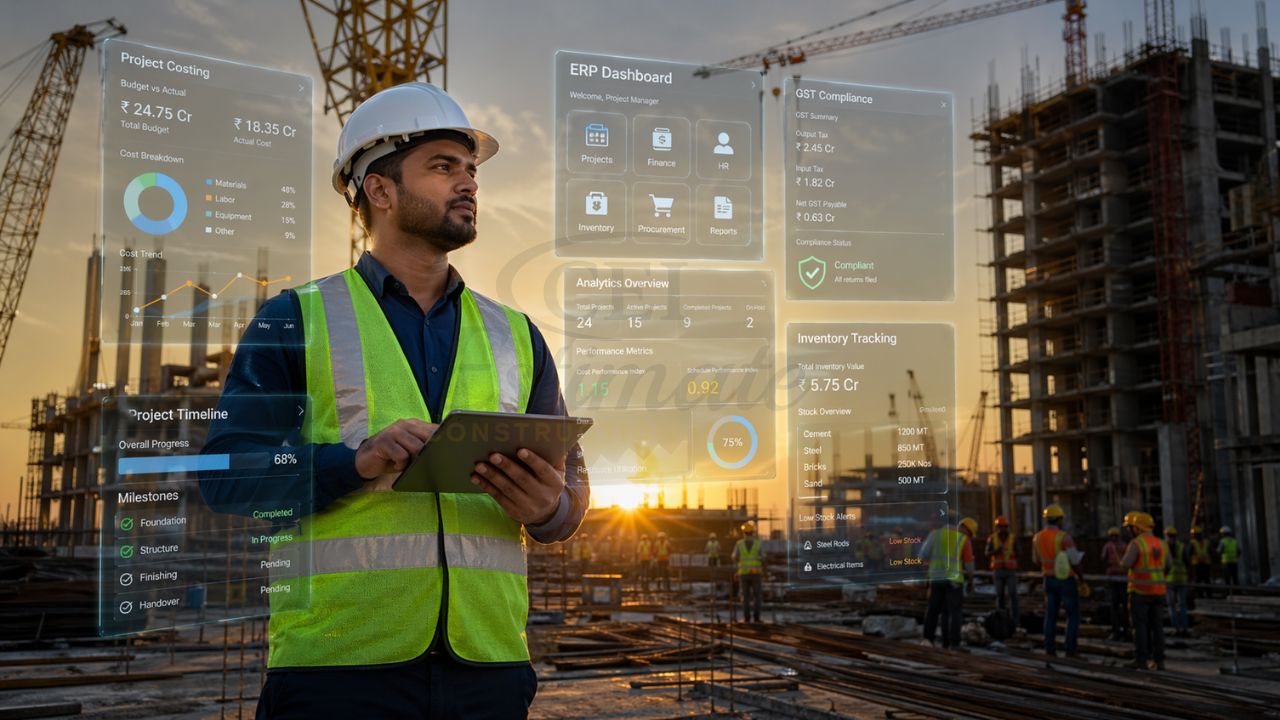
- Real-Time Visibility: Integrated dashboards allow stakeholders to see daily progress versus the Bill of Quantities (BOQ).
- Automated Workflows: From automated BOQ generation to GST-ready invoicing, ERP systems reduce manual entry errors significantly.
- Inventory Control: Advanced tracking prevents material leakage and ensures optimal stock levels across various sites.
- Enhanced Decision-Making: AI-driven analytics provide predictive alerts for potential risks, helping firms adjust strategies before delays occur.
Choose the Best ERP for Builders & Contractors – Control Projects, Costs & Operations Easily!
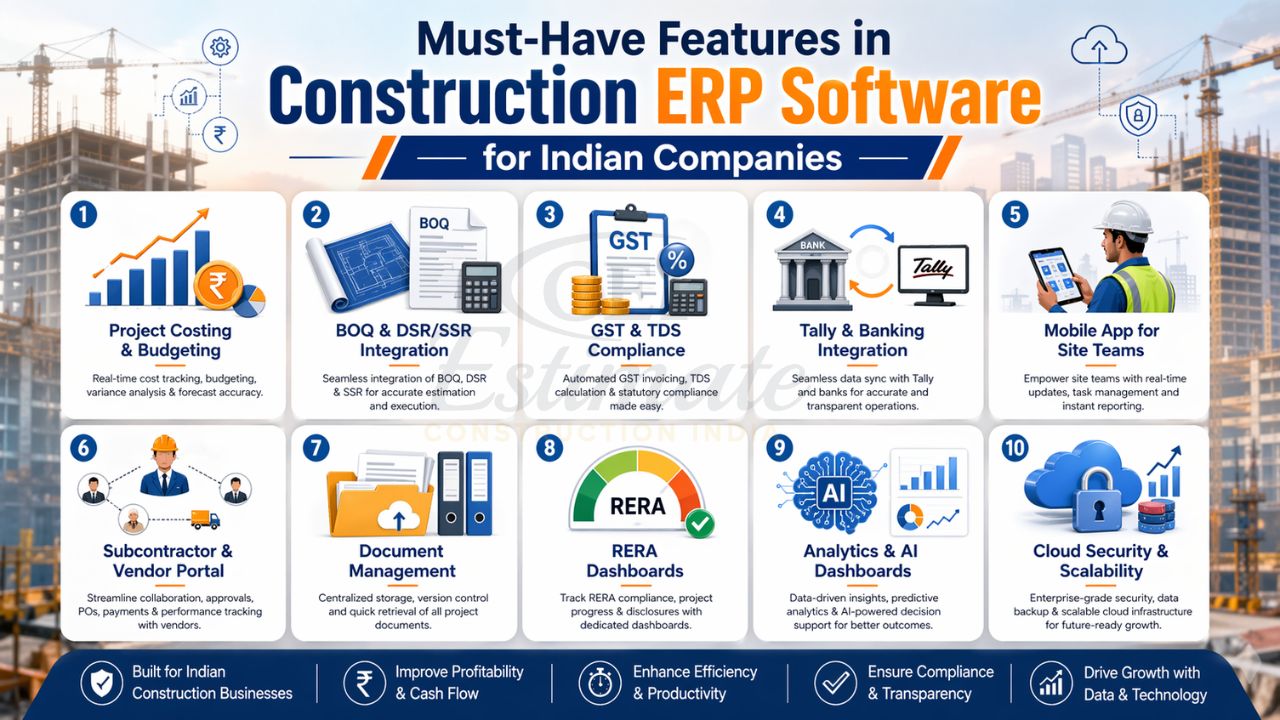
Must-Have Features in Construction ERP Software for Indian Companies
When evaluating an EPC ERP solution India, it is vital to look for features specifically localized for the Indian market:
- Project Costing & Budgeting: Deep integration between estimation data and procurement to track real-time variance.
- BOQ and DSR/SSR Integration: The ability to import CPWD or State SSR rates and automatically generate BOQs for government tenders.
- GST & TDS Compliance: Native support for GSTR-1/3B filing, GST on works contracts, and automated labor TDS deductions.
- Tally & Banking Integration: Seamless data flow into financial systems to avoid double data entry for accountants.
- Mobile App for Site Teams: Essential for site engineers to log Daily Progress Reports (DPRs) even with low connectivity.
- Subcontractor & Vendor Portal: Dedicated modules for managing subcontractor attendance, billing, and retention handling.
- Document Management: Centralized storage for drawings, RFIs, and contracts with version control.
- RERA Dashboards: Maintaining accurate records of escrow fund utilization to satisfy legal audits.
- Analytics & AI Dashboards: Visual representations of S-curves and project health to identify bottlenecks early.
- Cloud Security & Scalability: Robust encryption on secure servers to ensure data is safer than physical site records.
Get the Right Construction ERP Solution – Track Projects, Budgets & Workflows Seamlessly!
Top 10 ERP Software for Construction Companies in India 2026
1. Ramco ERP for Construction
Ramco ERP is a global heavy hitter of Indian origin, widely recognized for its AI-driven risk prediction and labor management capabilities. It competes globally while remaining deeply rooted in Indian compliance standards.
- Key Features: Facial recognition for labor attendance, AI-driven risk alerts, and end-to-end supply chain automation.
- Pros:
- Best-in-class labor tracking to reduce “ghost labor” costs.
- Strong focus on Indian GST and statutory compliance.
- Cons:
- Implementation can be long and resource-intensive.
- Higher entry cost compared to mid-market SaaS tools.
- Approximate Pricing: Custom enterprise quotes; typically starts from ₹5 Lakhs to ₹15 Lakhs+.
- Best Suited For: Large construction conglomerates and infrastructure companies.
- Official Website: Ramco ERP
2. BuildNext
BuildNext is highly recommended for residential builders and developers, focusing on bridging the gap between design, estimation, and site execution.
- Key Features: VR planning integration, built-in material libraries, and auto-BOQ generation from designs.
- Pros:
- Excellent for managing customer experience and transparency.
- Strong estimation-to-execution mapping.
- Cons:
- Can feel restrictive for heavy civil or large-scale infrastructure projects.
- Approximate Pricing: Approximately ₹2L–₹5L setup plus annual subscription fees.
- Best Suited For: Mid-sized residential builders handling 5–30 projects per year.
- Official Website: BuildNext
3. biCanvas
biCanvas is considered a gold standard for large-scale EPC and infrastructure firms in India. It specializes in transforming raw site data into actionable Business Intelligence.
- Key Features: Advanced Work Breakdown Structure (WBS) tracking, IIOT integration for fleet management, and multi-currency support.
- Pros:
- Incredible data visualization for complex project portfolios.
- Handles massive data volumes without performance lag.
- Cons:
- Steeper learning curve; requires a dedicated IT champion.
- Approximate Pricing: Enterprise pricing starting from ₹10 Lakhs to ₹40 Lakhs+ per year.
- Best Suited For: Large enterprise EPC firms and multi-state developers.
- Official Website: biCanvas
Select the Perfect ERP System for Your Projects
4. In4Suite (In4Velocity)
In4Suite is specifically engineered for the real estate developer lifecycle, from lead management to facilities handover.
- Key Features: Localized RERA compliance dashboards, CRM integration, and milestone-based billing.
- Pros:
- Native RERA compliance tracking for escrow accounts.
- Modular “pay-as-you-grow” model for growing developers.
- Cons:
- Less specialized for heavy EPC or industrial plant construction.
- Approximate Pricing: Setup typically ranges from ₹10L to ₹30L.
- Best Suited For: Real estate developers and commercial builders.
- Official Website: In4Velocity
5. FirstBit ERP
FirstBit ERP is an emerging specialist in the Indian market, particularly for small to mid-sized contractors looking for comprehensive project tracking.
- Key Features: Project-based accounting, precise material tracking, and automated RA billing.
- Pros:
- Deeply specialized for construction workflows rather than generic ERP adaptation.
- Strong local support for Indian tax structures.
- Cons:
- Smaller user ecosystem compared to global giants like SAP.
- Approximate Pricing: Starts from approximately ₹3 Lakhs depending on users.
- Best Suited For: Mid-sized civil contractors and specialized trade contractors.
- Official Website: FirstBit ERP
6. SAP S/4HANA for Construction
For firms planning an IPO or seeking institutional funding, SAP remains the premier choice for global auditing standards.
- Key Features: Robust financial consolidation, deep audit trails, and multi-company management.
- Pros:
- Impeccable data security and reliability for multi-entity reporting.
- Scalable for the largest conglomerates.
- Cons:
- Requires highly disciplined data entry and expensive implementation.
- Approximate Pricing: Starting from ₹20 Lakhs to ₹75 Lakhs+.
- Best Suited For: Very large developers with significant turnover and complex financial structures.
- Official Website: SAP Construction
7. Oracle Construction Cloud
Oracle provides high-performance cloud infrastructure designed to handle data-intensive projects.
- Key Features: Advanced resource scheduling, job costing, and BIM integration.
- Pros:
- Highly scalable for mega infrastructure and industrial projects.
- Integrates with Oracle’s broader enterprise ecosystem.
- Cons:
- Can be complex for smaller teams to navigate without external consultants.
- Approximate Pricing: Custom enterprise quotes; typically mid-to-high range.
- Best Suited For: Industrial, metro, and energy-sector EPC firms.
- Official Website: Oracle Construction
8. ERPNext (Construction Module)
ERPNext is an Indian-born open-source giant, ideal for firms wanting total control over their source code without recurring licensing fees.
- Key Features: Native Indian GST support, open API for custom integrations, and robust project accounting.
- Pros:
- Zero licensing fees for self-hosted versions.
- Highly customizable for local material units and workflows.
- Cons:
- Requires internal IT capabilities or a partner for maintenance.
- Approximate Pricing: Implementation typically ranges from ₹1 Lakh to ₹4 Lakhs.
- Best Suited For: Tech-savvy contractors and firms with internal IT teams.
- Official Website: ERPNext
Find the Best ERP Software for Your Construction Company
9. CMiC
CMiC is a deep-functional ERP designed specifically for heavy construction and capital project industries.
- Key Features: Single-database architecture for field-to-office communication and labor forecasting.
- Pros:
- Eliminates data silos by housing all project data in one place.
- Strong focus on job costing and risk mitigation.
- Cons:
- Implementation requires significant organizational change management.
- Approximate Pricing: Enterprise-level custom pricing; typically ₹15 Lakhs+.
- Best Suited For: Large general contractors and heavy civil firms.
- Official Website: CMiC
10. Microsoft Dynamics 365 for Construction
Dynamics 365 is the choice for firms already integrated into the Microsoft ecosystem, offering high scalability and familiarity.
- Key Features: Resource planning, detailed job costing, and integration with Power BI.
- Pros:
- Seamless integration with Office 365 and MS Project.
- Highly scalable through a vast partner network.
- Cons:
- Often requires third-party add-ons to meet specific Indian needs.
- Approximate Pricing: Starting from ₹4L to ₹15L setup plus user fees.
- Best Suited For: Growing firms and developers seeking a modern, scalable UI.
- Official Website: Microsoft Dynamics 365
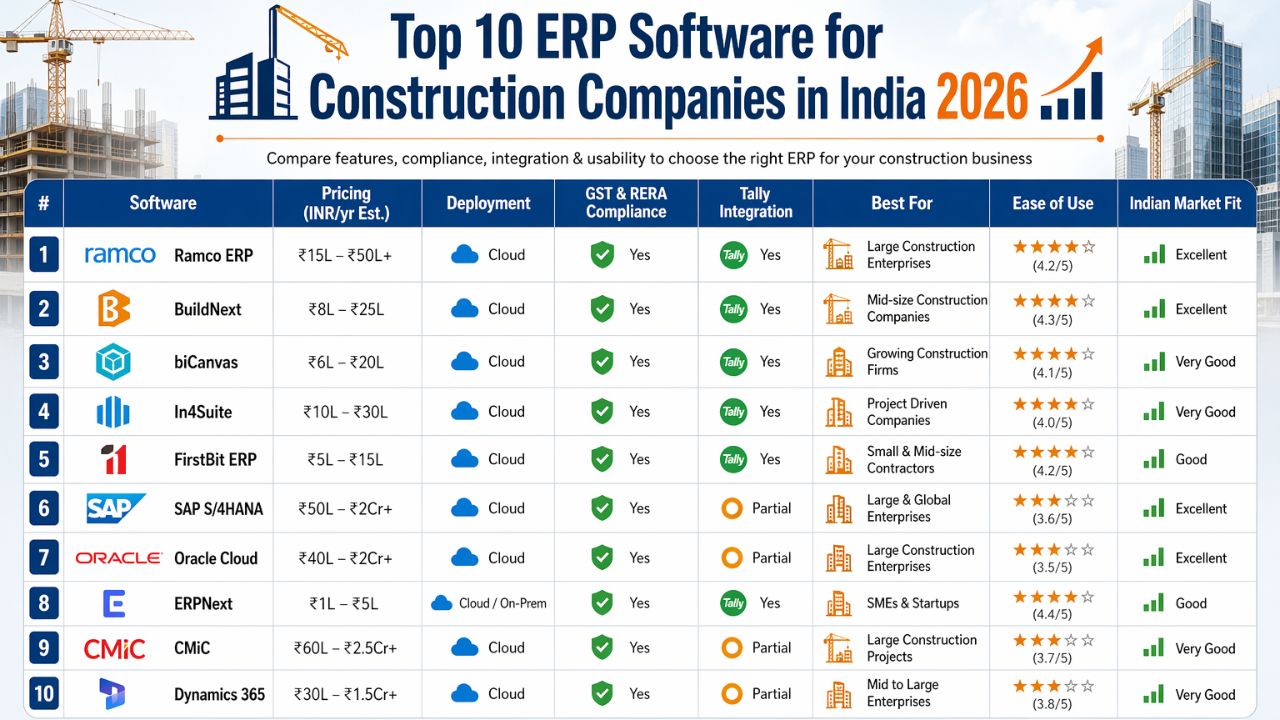
Detailed Comparison Table
| Software | Pricing (INR/yr Est.) | Deployment | GST & RERA Compliance | Tally Integration | Best For | Ease of Use | Indian Market Fit |
|---|---|---|---|---|---|---|---|
| Ramco ERP | ₹5L – ₹15L+ | Hybrid | Native | Native | Large Conglomerates | Moderate | High |
| BuildNext | ₹2L – ₹5L+ | Cloud | Native | Yes | Mid Residential | High | High |
| biCanvas | ₹10L – ₹40L+ | Cloud | Native | Yes | Large EPC / Infra | Moderate | High |
| In4Suite | ₹10L – ₹30L | Cloud | Native | Yes | Real Estate Developers | Medium | High |
| FirstBit ERP | ₹3L – ₹10L | Cloud | Native | Yes | Mid-Sized Contractors | High | High |
| SAP S/4HANA | ₹20L – ₹75L+ | Hybrid | Native | Native | Multi-State / IPO Ready | Low | High |
| Oracle Cloud | Enterprise | Cloud | Configurable | Yes | Industrial / Metro EPC | Medium | Moderate |
| ERPNext | ₹1L – ₹4L | Cloud/On-Prem | Native | Yes | Tech-Savvy SMBs | Moderate | Very High |
| CMiC | ₹15L+ | Cloud | Configurable | Yes | Heavy Civil / GC | Medium | Moderate |
| Dynamics 365 | ₹4L – ₹15L | Cloud | Localized | Yes | Growing MS Users | High | High |
Get the Right Construction ERP Solution – Track Projects, Budgets & Workflows Seamlessly!
How to Choose the Right ERP for Your Construction Business?
Selecting an ERP is like buying a crane—if it is too small, it won’t do the job; if it is too big, you will waste a fortune on maintenance. Consider these three steps:
- Company Size & Budget: Small firms (<₹20 Cr turnover) should prioritize speed and mobile ease, such as ERPNext or Odoo. Mid-sized builders (₹20-100 Cr) need strong BOQ and multi-site dashboards, like BuildNext or Ramco.
- Project Types: Residential builders need CRM and RERA features, whereas industrial EPCs require heavy resource scheduling and IIOT. Specialized trades like electrical or plumbing should look for tools that handle specific load calculations or material waste tracking.
- Team Readiness: If site engineers are not tech-savvy, a complex implementation like SAP might fail due to low adoption. Start with mobile-first tools to build digital habits.
When Off-the-Shelf ERP Is Not Enough – Custom ERP Solutions?
While ready-made ERPs offer many benefits, they often struggle with the unique, messy workflows of an Indian construction site. Many off-the-shelf tools are built on Western project models and may not fully capture the nuances of CPWD billing, complex multi-state labor shifts, or specific local vendor dynamics. For specialized trades like plumbing, electrical, and painting, generic software often lacks the granular tracking needed for specific material “leakage” or specialized subcontractor payments.
This is where Construction Estimator India provides a decisive advantage. We offer Custom ERP Solutions for Construction Companies that are tailored to your exact processes, budget, and scale. We provide personalized solutions for all types of construction companies, including plumbing, electrical, general construction, painting, flooring, and other specialized trades. We design and implement tailored ERP systems that perfectly match your unique business processes and scale with your growth. Unlike generic software, our solutions are designed by industry experts who understand the gap between an estimate and ground reality.
Conclusion
The Indian construction industry in 2026 is at a tipping point. The gap between “digital-first” contractors and those stuck in manual processes is widening rapidly. Whether you are a small contractor or a large conglomerate, the goal is the same: transparency, control, and profitability. Don’t wait for a major project loss to trigger your digital transformation.
If you need Custom ERP Solutions for Construction Companies, expert consultation, or help implementing the right ERP system for your business—whether you are into plumbing, electrical, painting, flooring, or general construction—contact us via WhatsApp at 8630676890. Our team delivers personalized ERP solutions that fit your business perfectly.