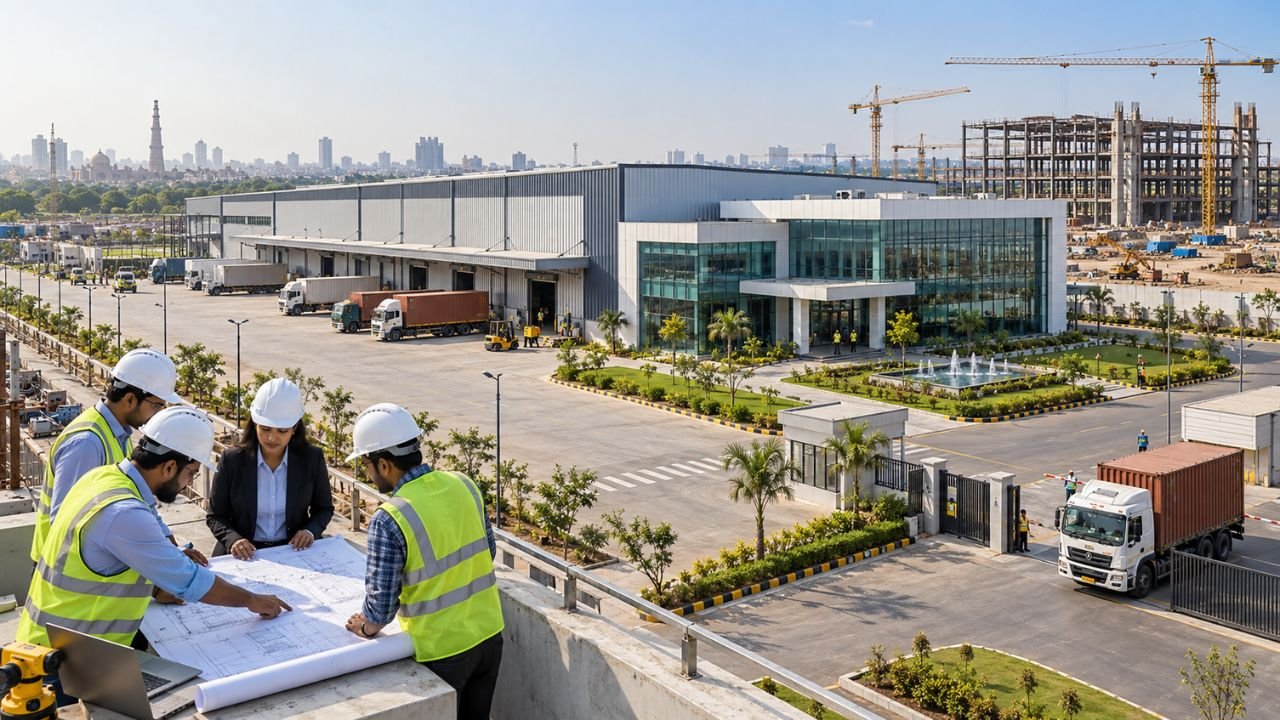
The Indian construction landscape in 2026 is undergoing a seismic shift. As the nation targets a $5 trillion economy, the infrastructure and real estate sectors are witnessing unprecedented growth, with government initiatives like PM Gati Shakti fueling a ₹20 lakh crore infra spend. For builders and contractors from Delhi NCR to Mumbai and Bengaluru, this boom brings both massive opportunity and significant peril. In an environment where material prices fluctuate daily and labor shortages are reaching 30% in states like Uttar Pradesh, the margin for error has effectively vanished.
Effective cost management is no longer just a financial preference; it is a survival mandate. Poor cost control—often stemming from reliance on scattered Excel sheets and manual PDF tracking—routinely leads to profit erosion of 10-25% and catastrophic project delays. Contractors are finding that traditional methods fail to capture the complexities of cost management software for construction India needs in 2026.
👉 Choose Cost Management Software with the Right Features – Start Controlling Your Project Costs Today!
Modern, real-time cost management tools are the digital backbone required to navigate this chaos. By providing a “single source of truth,” these systems empower builders to maintain profitability through data-driven decisions rather than guesswork. Whether you are a general contractor, an EPC firm, or a specialized plumbing or electrical subcontractor, adopting high-performance best cost control software construction 2026 standards is the only way to protect your bottom line against the rising tide of operational volatility.
Why Strong Cost Management is Critical for Construction Companies in India 2026?
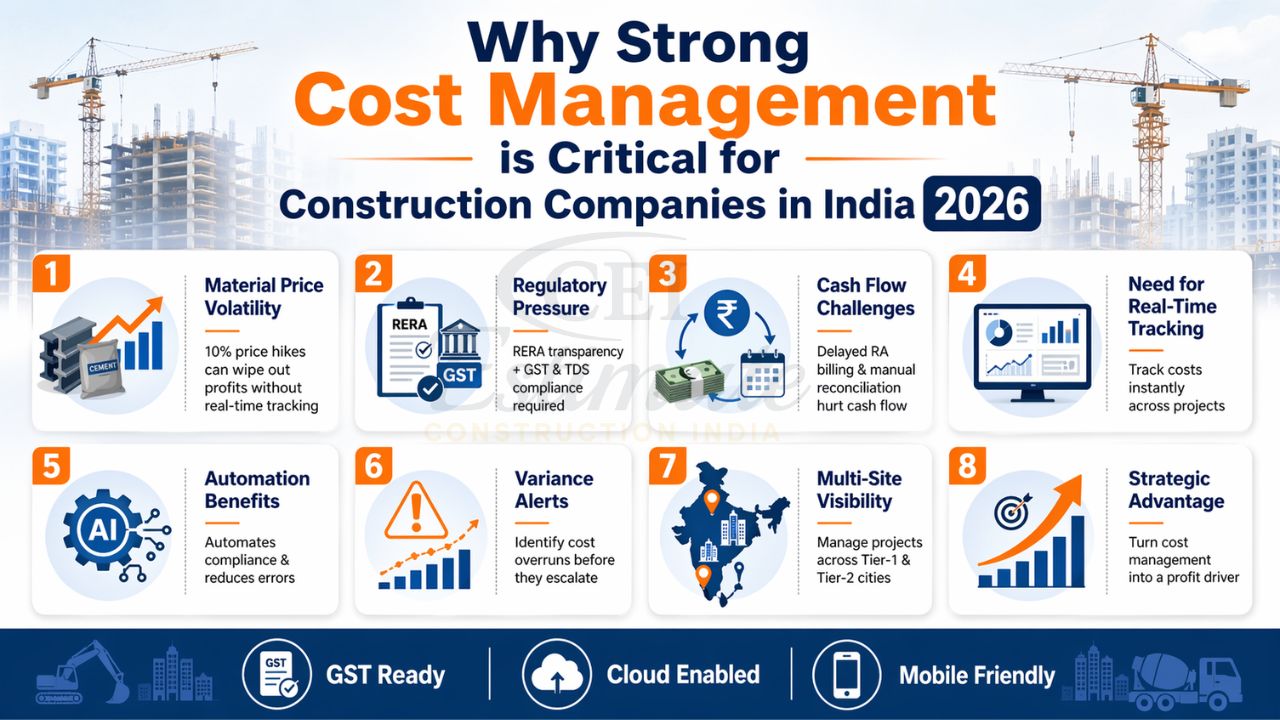
Indian builders face a unique set of challenges that make robust construction budgeting software India essential. In 2026, material price volatility for core commodities like steel and cement remains a primary driver of cost overruns. Without real-time tracking, a sudden 10% hike in rebar prices can wipe out an entire project’s profit before the office even realizes the purchase has been made.
Beyond materials, the regulatory burden has reached new heights. Strict RERA mandates require absolute transparency in project fund utilization, while GST compliance on works contracts demands precise invoicing and TDS management to avoid heavy penalties. Cash flow bottlenecks—often caused by delayed RA billing and manual reconciliation—remain a silent killer of small-to-mid-size firms.
Implementing dedicated project cost tracking software India offers immediate relief. It automates compliance, flags variances before they become crises, and provides the visibility needed to manage multi-site operations across Tier-1 and Tier-2 cities. For firms aiming to scale, these tools transform cost management from a reactive “accounting chore” into a proactive strategic advantage.
👉 Ready to Reduce Cost Overruns? Get the Right Software Today!
Top 10 Must-Have Features in Cost Management Software for Construction in 2026
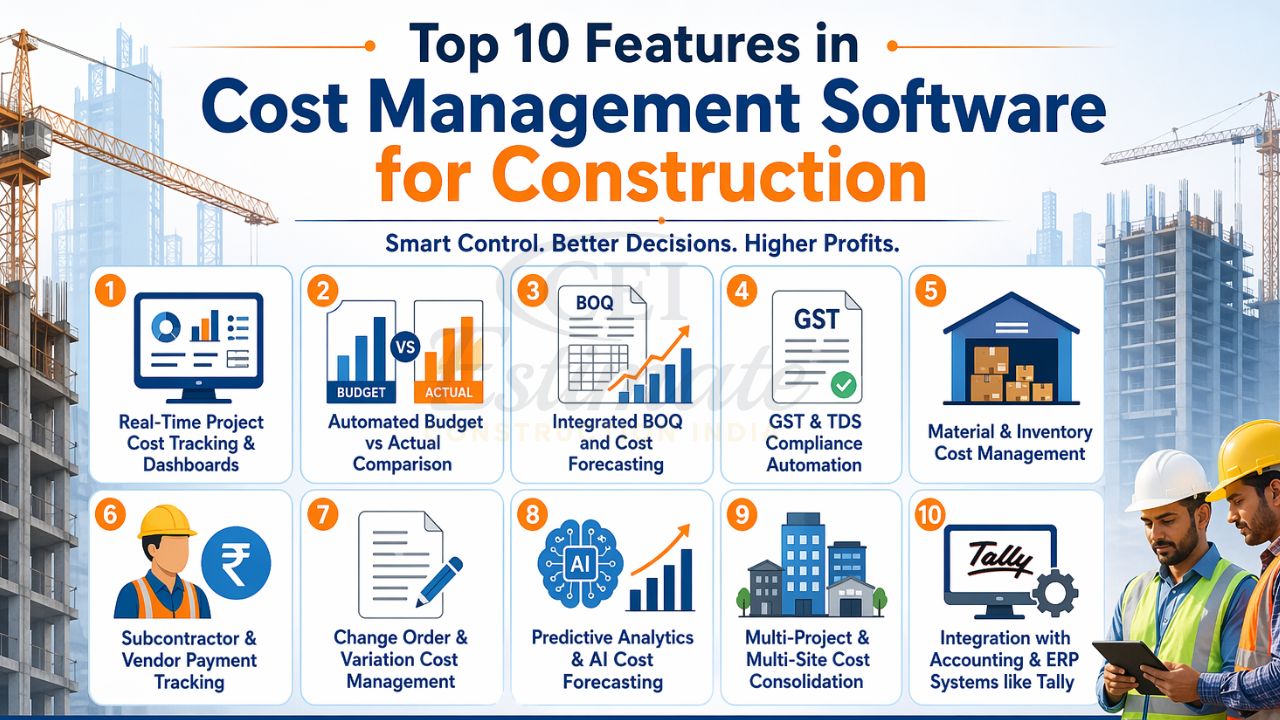
To achieve true ROI, contractors must look beyond basic accounting. The following 10 construction cost management features are non-negotiable for the Indian market in 2026.
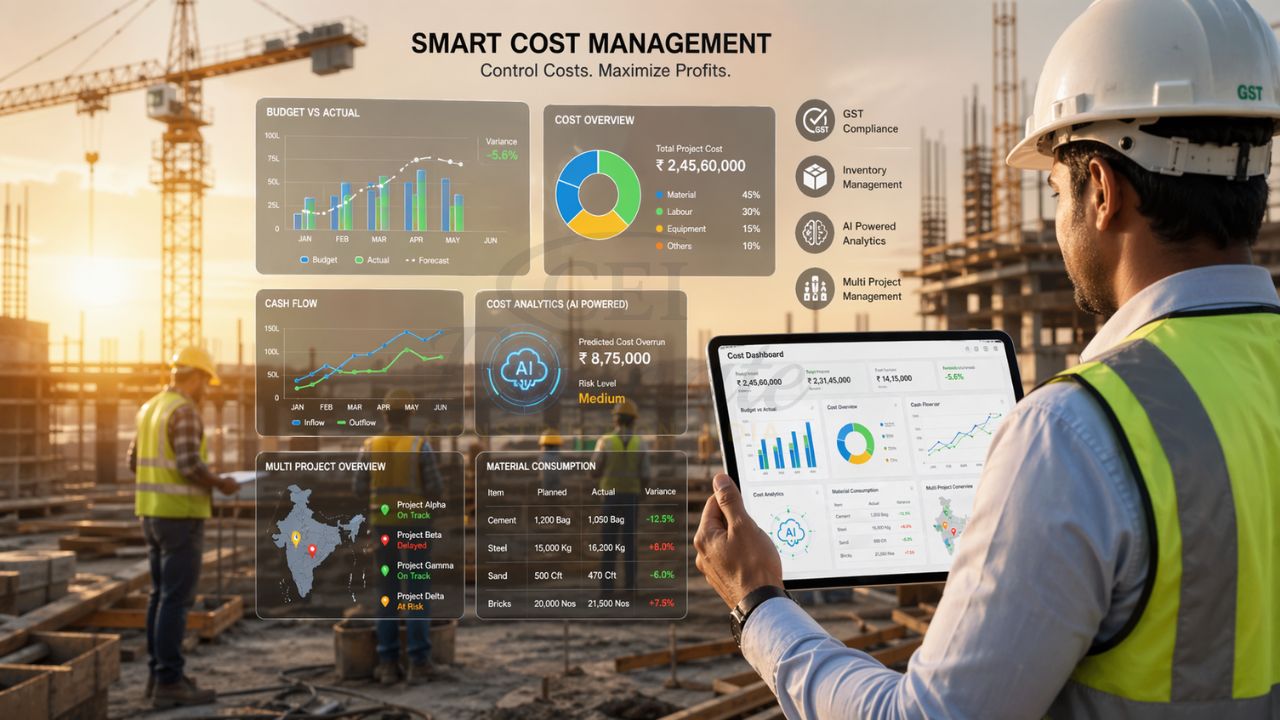
1. Real-Time Project Cost Tracking & Dashboards
In the fast-paced Indian site environment, “last week’s data” is already obsolete. Real-time tracking involves a direct sync between site activities and the central office dashboard.
- What it does: It captures every expense—from a pallet of bricks to a daily labor wage—the moment it is authorized on-site via mobile apps.
- Why it matters in India: Site engineers in remote areas or busy metros like Gurgaon can upload photos and digital vouchers instantly, ending the “phone-tag” between the field and the finance team.
- Common Pain Point Solved: Eliminates the 15-20% delay in reporting that typically hides cost overruns until it is too late to fix them.
2. Automated Budget vs Actual Comparison
Consistency is key to profitability. This feature compares your initial project budget against real-world spending in real-time.
- What it does: It provides a “Variance Report” that highlights exactly where spending is exceeding the planned budget at a line-item level.
- Why it matters in India: With CPWD and DSR rates frequently changing, knowing that your labor costs on a specific floor are 12% over budget allows for immediate corrective action.
- Common Pain Point Solved: Prevents “budget creep” where small overages across multiple sites aggregate into a massive loss at the end of the fiscal year.
3. Integrated BOQ and Cost Forecasting
A Bill of Quantities (BOQ) should not be a static document. In 2026, it must be a living roadmap for the project’s financial health.
- What it does: It maps every item in the BOQ to a cost code, allowing the software to forecast future spending based on current consumption rates.
- Why it matters in India: For large-scale residential projects in Maharashtra or Uttar Pradesh, this helps contractors predict when they will hit their cash flow limits based on the remaining work.
- Common Pain Point Solved: Reduces the risk of running out of funds mid-project due to poor visibility into remaining procurement needs.
4. GST & TDS Compliance Automation
The complexity of Indian taxation is a significant hurdle for builders. Automated compliance is no longer a luxury but a necessity.
- What it does: It automatically calculates GST on works contracts, generates E-way bills, and manages TDS deductions for subcontractors.
- Why it matters in India: Errors in GST reporting can lead to the suspension of RERA registrations or heavy fines.
- Common Pain Point Solved: Automates the “manual nightmare” of month-end tax filing and ensures every RA bill is GST-compliant from the start.
5. Material & Inventory Cost Management
Material theft and waste account for nearly 5-10% of profit loss in Indian construction.
- What it does: Tracks material from the PO stage to the gate pass and finally to consumption on-site.
- Why it matters in India: For electrical and plumbing contractors, tracking high-value items like copper wire or premium fixtures is critical to preventing “leakage”.
- Common Pain Point Solved: Stops unauthorized material “disappearance” and prevents over-ordering that ties up precious capital in dead stock.
6. Subcontractor & Vendor Payment Tracking
Managing a diverse pool of vendors and specialized trades requires precise financial coordination.
- What it does: Manages the entire lifecycle of a subcontractor’s contract, including work orders, RA bill submissions, and retention money tracking.
- Why it matters in India: Ensures that “petty contractors” are paid accurately based on verified site progress, not just verbal claims.
- Common Pain Point Solved: Reduces disputes over payment amounts and ensures retention funds are properly held and tracked for the defect liability period.
7. Change Order & Variation Cost Management
“Scope creep” is inevitable in construction, but it shouldn’t be a profit killer.
- What it does: Formally documents every change requested by the client, calculates the immediate cost impact, and updates the project budget.
- Why it matters in India: Clients often request “minor changes” during site visits; without a formal cost tracking feature, these changes often go unbilled, eating into the contractor’s margin.
- Common Pain Point Solved: Ensures every variation is documented and approved, allowing for accurate final billing and transparent client communication.
8. Predictive Analytics & AI Cost Forecasting
The year 2026 marks the rise of “Agentic AI” in the construction sector, moving from reporting to predicting.
- What it does: Uses historical data and current site trends to predict potential budget overruns before they occur.
- Why it matters in India: AI can flag that a monsoon delay in Mumbai is likely to increase labor costs by 15% next month, allowing the firm to adjust its procurement strategy today.
- Common Pain Point Solved: Moves management from “reactive firefighting” to “proactive planning,” significantly reducing the impact of unforeseen site risks.
9. Multi-Project & Multi-Site Cost Consolidation
For growing firms, managing costs across different cities is a major logistical challenge.
- What it does: Consolidates financial data from multiple sites into a single executive view.
- Why it matters in India: A builder with projects in Noida, Lucknow, and Patna needs to see their total cash position and overall material exposure at a glance.
- Common Pain Point Solved: Prevents “siloed data” where one profitable site is unknowingly subsidizing a failing one.
10. Seamless Integration with Accounting & ERP Systems (Tally, etc.)
Your cost management software must speak the same language as your accounting team.
- What it does: Provides native APIs or direct export modules for popular Indian accounting tools like Tally and enterprise ERPs.
- Why it matters in India: Tally remains the gold standard for Indian accounting; seamless integration ensures that site expenses flow directly into the final balance sheet without manual data entry.
- Common Pain Point Solved: Eliminates human error during manual data migration and ensures that financial reports are always in sync with site reality.
👉 Get Real-Time Cost Tracking, Budget Control & Reporting in One System!
How These Features Deliver ROI for Indian Construction Businesses?
The return on investment (ROI) for best cost control software construction 2026 is quantifiable and swift. Firms that implement these integrated features typically report a 15-25% reduction in project cost overruns within the first 12 months.
| Benefit Category | Estimated Impact | Real-World Indian Example |
|---|---|---|
| Material Waste Reduction | 5% – 10% Savings | A Delhi builder saved ₹12L/year by implementing gate-pass tracking. |
| Billing Cycle Speed | 40% Faster | RA bills that took 10 days now take 48 hours, improving cash flow. |
| Labor Productivity | 10% Improvement | Geofenced attendance reduced “ghost labor” costs significantly. |
| Compliance Efficiency | 80% Time Saved | Auto-generated GST reports reduced CA consultancy hours by 15/mo. |
For a mid-size contractor handling ₹50 crores in annual projects, a mere 3% improvement in margin—easily achievable through better cost tracking—results in an additional ₹1.5 crores in pure profit.
How to Choose the Right Cost Management Software?
Choosing the right project cost tracking software India depends on your specific operational DNA. Key factors include:
- Company Size & Scale: Small firms need mobile-first simplicity; large EPCs require deep BI analytics.
- Specialization: Are you a general builder or a specialized trade (e.g., electrical)? Specialized trades need precise material consumption tracking.
- Connectivity: Does the software offer an “Offline Mode” for Tier-3 sites with poor internet?
- Local Support: Ensure the vendor understands Indian statutory requirements like TDS and RERA.
👉 Automate Cost Tracking, Billing & Financial Reports – Save Time Today!
When Ready-Made Software Falls Short – Custom Solutions?
While off-the-shelf tools are a great starting point, they often fall short when faced with the unique, “ground-level” workflows of the Indian construction site. Many generic tools are built for Western markets and struggle with the nuances of local labor practices, complex subcontractor retention rules, or the specific material tracking needs of specialized trades.
This is where Construction Estimator India steps in. We recognize that a plumbing contractor in Chennai has different cost management needs than a high-rise developer in Mumbai. We provide Custom ERP Solutions for all types of construction companies, including plumbing, electrical, general construction, painting, flooring, and other specialized trades.
Our expertise lies in designing and implementing tailored cost management modules that perfectly match your existing business processes. Instead of forcing your team to adapt to a rigid software, we build the software around your successful workflows, ensuring 90%+ adoption rates and true operational efficiency.
Conclusion
The future of the Indian construction industry belongs to those who prioritize data over intuition. By 2026, the integration of real-time cost management tools, AI-driven forecasting, and automated GST compliance will be the defining features of successful builders. From reducing material waste to accelerating the RA billing cycle, the benefits of modern software are clear and compelling.
Do not leave your project margins to chance in an increasingly volatile market. If you need Custom ERP Solutions for Construction Companies with powerful cost management features tailored specifically to your business, contact us via WhatsApp at +91 8630676890. Our team at Construction Estimator India delivers personalized ERP and cost control systems for plumbing, electrical, painting, flooring, and all types of construction companies across India. Let us help you build a more profitable, digitally-resilient future today.