Imagine standing in your newly renovated living room in Meerut or a high-rise in Gurgaon, watching the evening sun hit your walls. You spent weeks choosing the perfect “Moonlit Silk” or “Desert Terracotta” shade, but as the fans whirl and the plaster cures, horror sets in. The color looks three shades darker than the swatch, or worse, it has developed a patchy, uneven tint. This phenomenon is one of the most common frustrations for Indian homeowners and contractors alike. In 2026, where “Quiet Luxury” and “Biophilic Sanctuaries” define our home improvement trends, understanding the science behind color shifts is critical for your project’s success and your construction budget.
👉 Confused Why Your Paint Color Looks Different After Drying? – 📲 WhatsApp Us Today
The Direct Answer: Paint color changes after drying primarily because of light absorption and pigment concentration. Wet paint contains solvents (water or oil) that reflect light differently than a dry, solid film. Generally, water-based emulsions dry darker, while oil-based enamels may dry slightly lighter. In the Indian context, environmental factors like high humidity, improper mixing, and the “Metamerism” effect of local LED lighting further exaggerate these shifts.
Quick Guide to Paint Color Shifts in 2026
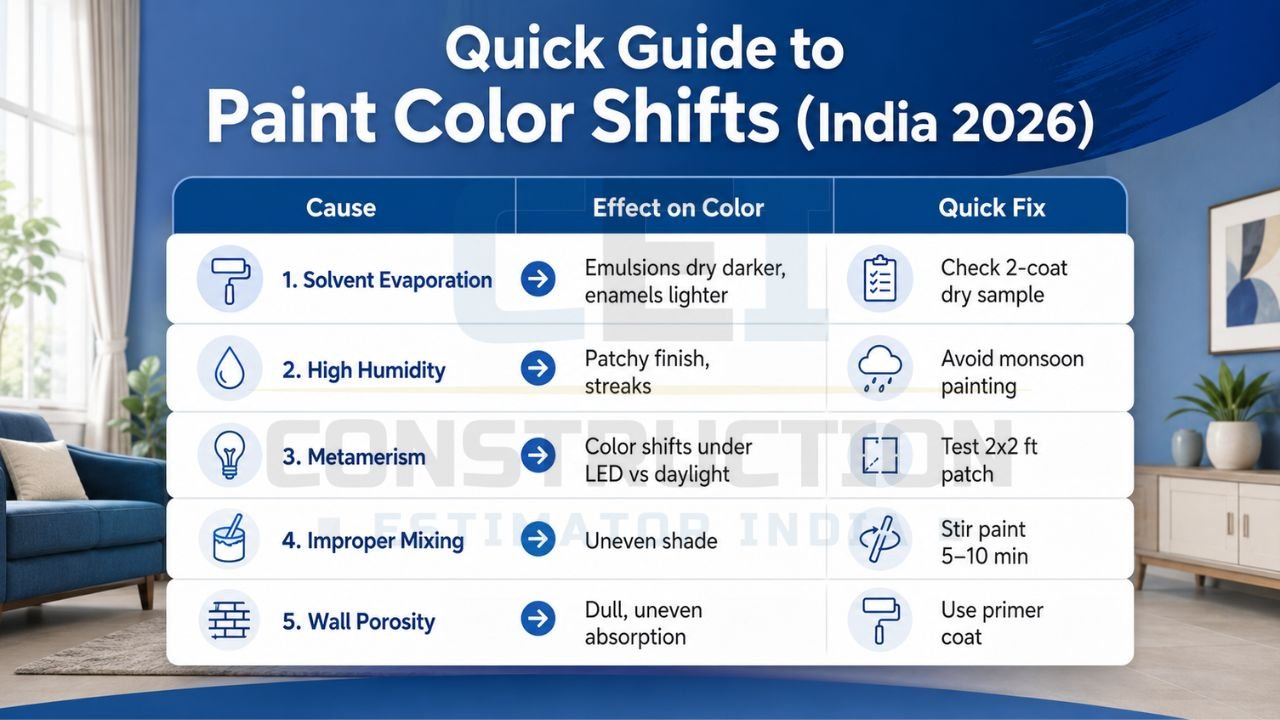
| Cause | Effect on Color | Quick Fix / Prevention |
|---|---|---|
| Solvent Evaporation | Emulsions dry darker; Enamels dry lighter | Always judge color by a 2-coat dry sample. |
| High Humidity | Patchiness and surfactant leaching | Avoid painting during North Indian monsoons. |
| Metamerism | Color shifts under LED vs. Natural light | Test 2ft x 2ft patches in the actual room. |
| Improper Mixing | Streaking and inconsistent shade | Use mechanical stirrers for 5-10 minutes. |
| Wall Porosity | Dullness and uneven absorption | Mandatory 1 coat of high-quality primer. |
For accurate paint colour selection, cost estimation or BOQ to avoid colour changes after drying in India, WhatsApp or call us today at +91 8630676890.
The Science: Why Paint Color Changes After Drying
In the professional world of our 10+ years of construction estimating expertise, we classify paint as a “dynamic liquid.” It isn’t just a bucket of color; it’s a complex chemical emulsion.
When paint is wet, the liquid particles (water or solvents) sit between the pigment particles. These liquids are highly reflective, making the paint appear brighter and often lighter in the bucket. As the paint dries, the water evaporates, and the binder (acrylic or vinyl) shrinks. This brings the pigment particles closer together, creating a denser film that absorbs more light. According to the Asian Paints official guide on why paint colour changes after drying, this “Dry-Down” effect is a standard characteristic of modern high-performance coatings.
Furthermore, the “Sheen Level” plays a massive role. A Matte finish absorbs light, making the color look deeper and more muted, whereas a High-Gloss finish reflects light, which can make the color appear more vibrant or even “washed out” under direct sunlight.
India-Specific Factors: Humidity, Monsoon, and Heat
India’s climate is brutal on paint chemistry. At Construction Estimator India, we calibrate our house construction cost estimation services based on your specific geography—be it the dry heat of Rajasthan or the humid air of Meerut.
The Humidity Factor
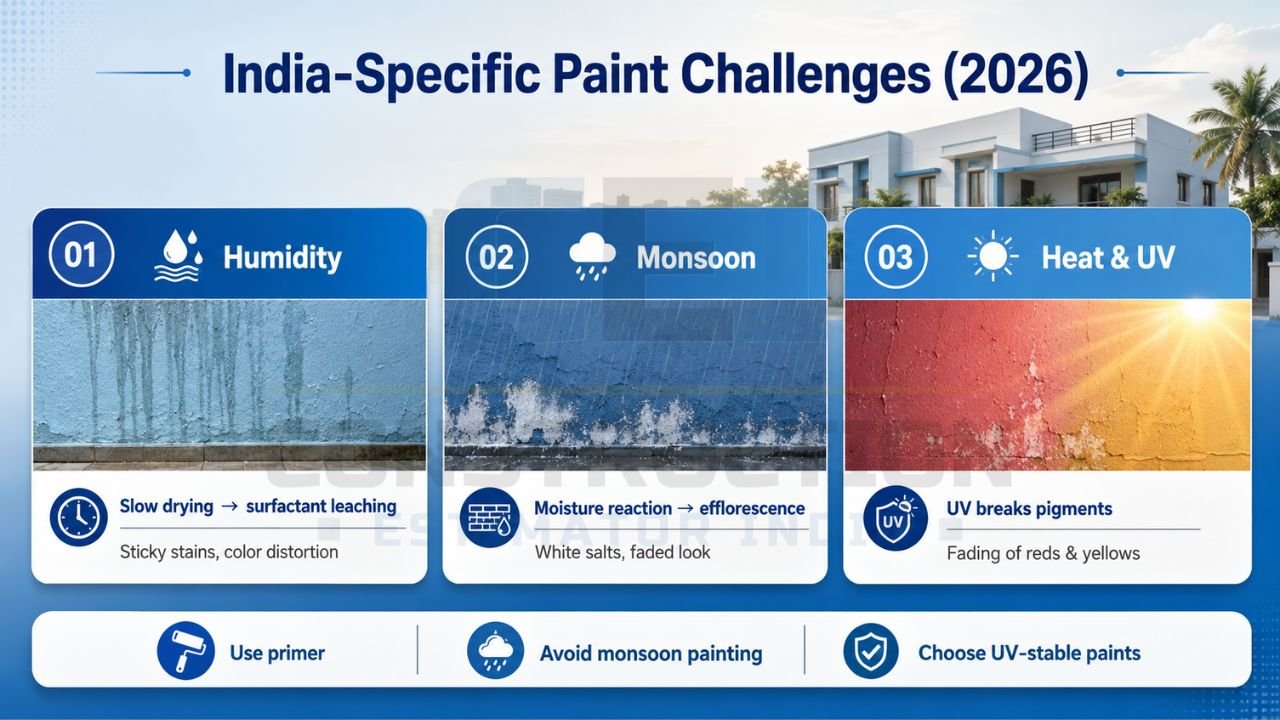
In high-humidity zones, paint takes longer to dry. This slow evaporation can cause “Surfactant Leaching,” where the ingredients in the paint rise to the surface, creating sticky, brownish streaks that permanently alter the perceived color. This is a major finding in the official 2026 paint colour change issues in Indian homes.
The Monsoon Effect
During the monsoon, moisture trapped behind the wall putty can react with the pigments. This often leads to “Efflorescence”—white salty patches that make your deep navy wall look like it’s fading into a dusty grey.
Intense UV Radiation
North Indian summers can reach 48°C. Intense UV rays can break down organic pigments (like bright reds and yellows) even as they are drying, leading to immediate fading. We always recommend UV-stable inorganic pigments for exterior projects to maintain color integrity.
The Lighting Trap: Metamerism in Modern Indian Homes
Have you ever noticed that a color looks perfect in the showroom but looks “muddy” in your bedroom? This is called Metamerism.
In 2026, Indian homes have shifted toward high-tech LED lighting. However, the Color Rendering Index (CRI) of your bulbs significantly impacts how you see the wall.
- Warm Yellow LEDs (2700K): Enhance reds and yellows but make blues look green.
- Cool White LEDs (5000K+): Make colors look crisp but can make warm beiges look “clinical” or grey.
- Natural Sunlight: Changes throughout the day. A North-facing room in Delhi receives cool light, while a South-facing room gets harsh, warm light.
We at Construction Estimator India advise our clients to observe their 2ft x 2ft samples at 10 AM, 4 PM, and 8 PM before finalizing the BOQ.
Common Application Mistakes That Alter Shade
Even the most expensive paint will fail if the application is flawed. Drawing from our professional interior painting estimation services, we’ve identified these top culprits:
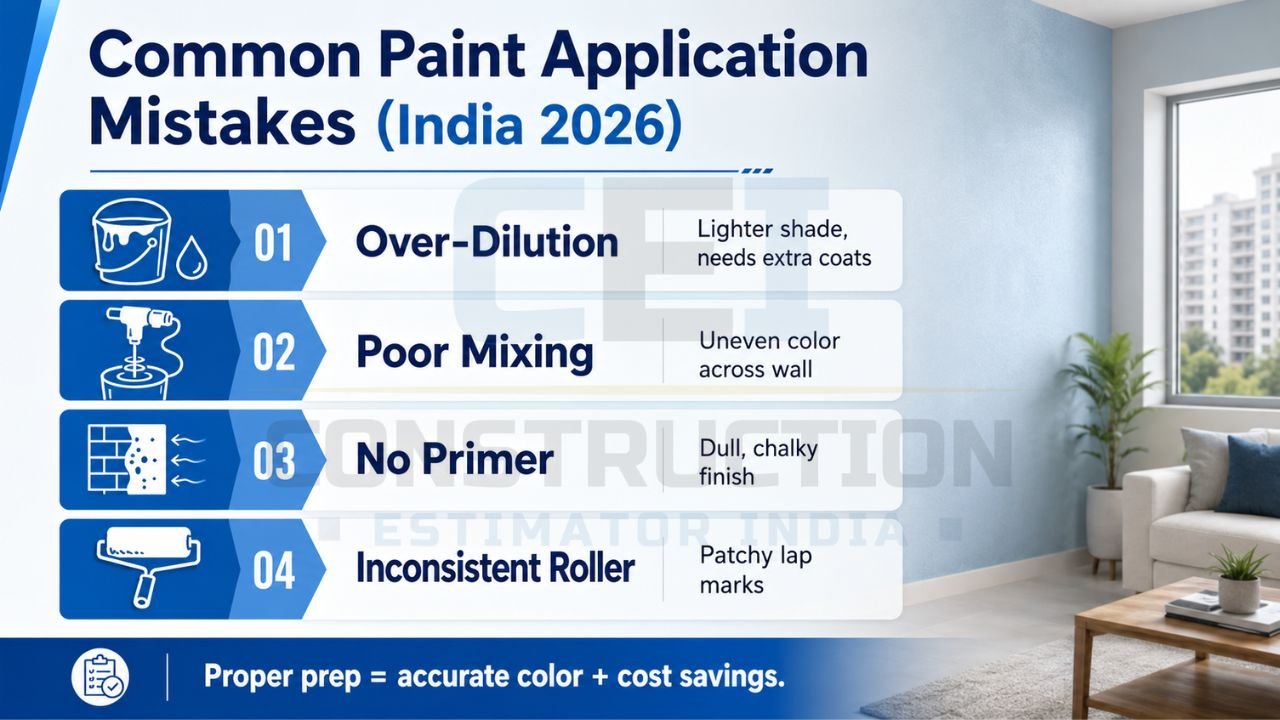
- Over-Dilution: Adding too much water to “increase coverage” is a common mistake in India. This thins the pigment density, leading to a lighter, translucent shade that requires more coats (increasing your cost).
- Poor Mixing: Pigments naturally settle at the bottom. If not mixed mechanically, the first half of the wall will be lighter than the second half.
- Skipping the Primer: Raw wall putty is highly absorbent. Without a primer, the wall “drinks” the resin, leaving the pigment “starved” on the surface. This creates a dull, chalky appearance.
- Inconsistent Roller Pressure: Variation in how the painter applies the roller can create “lap marks,” which look like different shades of the same color.
For accurate paint colour selection, cost estimation or BOQ to avoid colour changes after drying in India, WhatsApp or call us today at +91 8630676890.
Vastu and Pigment: Directional Color Shifts
Vastu Shastra is non-negotiable for many of our 500+ happy clients. However, Vastu colors must harmonize with directional light.
- North-East (Water): Light blues often dry darker here because the room lacks direct warm sunlight.
- South-West (Earth): Yellows and ochres can look overly intense or “burnt” due to the heavy afternoon sun.
- North-West (Air): Creams and whites can look slightly greyish if the paint has a cool undertone.
According to the latest 2026 paint colour change causes by Berger and Nerolac, selecting a “Vastu-compliant” shade requires adjusting the tint by 10-15% to account for these directional light shifts.
How to Diagnose and Prevent Color Changes?
Prevention is cheaper than repainting. Follow this 2026 framework used by our expert estimation team:
The “Dry-Patch” Test
Never trust the wet paint on a brush. Paint a small section and wait at least 4-6 hours (in Indian humidity) to see the true “Dry-Down” shade.
The 60-30-10 Rule Alignment
Ensure your furniture and flooring are present (or sampled) when checking the wall color. Reflections from a dark wooden floor can make a light wall look darker.
Level 5 Putty and Primer
For a stable color, the surface must be “inert.” Using Level 5 putty and a high-opacity primer ensures the paint bonds perfectly without being absorbed by the substrate. Refer to the CPWD guidelines for proper paint application and colour stability for professional finishing standards.
Cost Impact: How Color Shifts Ruin Your Painting BOQ?
This is where Construction Estimator India saves you lakhs. Most homeowners calculate their interior painting cost per sq ft in India 2026 based on 2 coats.
However, if the color changes drastically after drying and you aren’t happy:
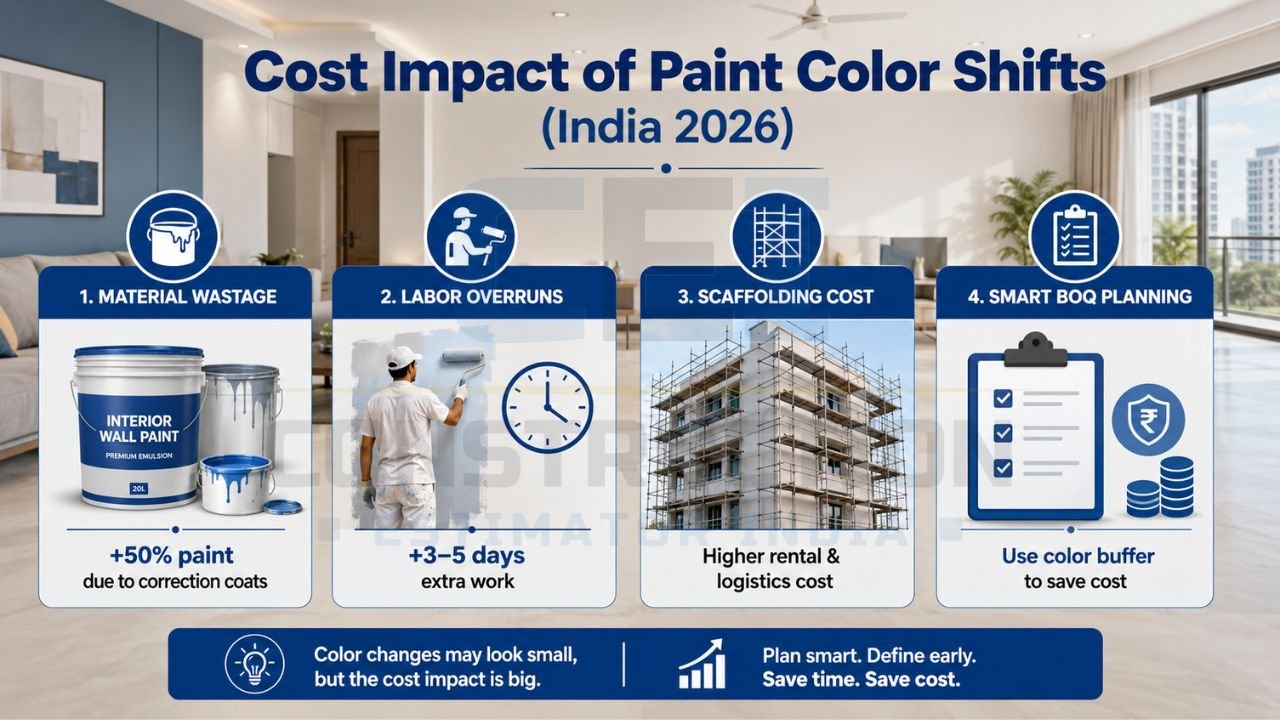
- Material Wastage: You may need an additional 1-2 coats to “correct” the shade, increasing material costs by 50%.
- Labor Overruns: Painters charge “per coat” or “per day.” A color correction can add 3-5 days to a standard 3BHK project.
- Scaffolding & Logistics: For exterior projects, every extra day of scaffolding adds to the rental cost.
Our precision BOQ services include a “Color Stability Buffer” to ensure you buy exactly what you need, even if a minor shade correction is required.
Best Paint Choices for 2026: Stability and Longevity
In 2026, the Indian market has shifted toward “Intelligent Coatings.” We recommend:
- Asian Paints Royale Glitz: Excellent color retention and “Teflon” surface protection.
- Berger Silk Breathe Easy: Zero-VOC and stable pigments that don’t shift with humidity.
- Nerolac Impressions Ideo: High hiding power, meaning the wet-to-dry shift is minimal.
Always check the manufacturer’s technical data sheet for the “Spreading Rate” and “Opacity Index.”
Conclusion and Expert Advice
Understanding why paint color changes after drying is the hallmark of a savvy homeowner. In 2026, you shouldn’t rely on luck. By accounting for humidity, lighting, and proper surface preparation, you can ensure your home matches your vision perfectly.
At Construction Estimator India, we believe that a beautiful home starts with a perfect estimate. A wrong color choice isn’t just an aesthetic failure; it’s a financial one. Don’t leave your “Forever Home” to chance.
For accurate paint colour selection, cost estimation or BOQ to avoid colour changes after drying in India, WhatsApp or call us today at +91 8630676890.
FAQ: Real User Questions on Paint Color Changes
Q1: Why does my grey paint look blue after drying?
This is due to “Undertones.” Most cool greys have a blue or violet base. Under typical Indian LED lights (cool white), these blue undertones become dominant. Always test a “Warm Grey” if you want to avoid the blue look.
Q2: Can I add white paint to a dark color if it dries too dark?
Technically yes, but we don’t recommend it for large areas. Manual tinting is inconsistent. It is better to buy a lighter shade from the same color family (the next one up on the swatch card).
Q3: Does the number of coats change the color?
Yes. The first coat is often influenced by the color of the primer or putty underneath. The second coat achieves the true intended shade. A third coat can make a color look slightly deeper and more saturated.
Q4: Why is my exterior paint fading so fast?
It’s likely due to UV exposure and North India’s “Dust Belt.” Dust particles act as abrasives, scratching the paint surface and making it look dull/faded. Use “Anti-Dust” emulsions for longevity.
Q5: Is it true that high-gloss paint dries lighter?
No, it usually appears more vibrant because it reflects more light. However, the perceived color can change drastically depending on the angle of the light source.
Q6: How long should I wait to see the final color?
In dry months (March-May), 4 hours is enough. During the monsoon, wait at least 24 hours to see the final cured color.