
Water seepage is one of the most common Indian household problems, affecting millions of homeowners across the country every year. In India, the combination of extreme monsoon seasons, high humidity levels, and traditional construction methods creates a perfect environment for moisture to penetrate building structures. This comprehensive guide, curated by the experts at Construction Estimator India, aims to educate you on how to identify, treat, and permanently prevent water seepage in your home.
👉 Facing seepage problems? Chat with our waterproofing experts on WhatsApp today.
Why Water Seepage is a Common Problem in Indian Homes?
The Indian subcontinent experiences a wide range of climatic conditions, but none are as challenging for buildings as the monsoon. During these months, heavy rainfall is relentless, and the air becomes saturated with moisture. When homes are not properly protected, this water finds its way into the most minuscule cracks in the terrace, walls, and foundation. Construction Estimator India has observed that many older structures—and even some newer ones—lack the necessary modern waterproofing membranes to withstand such intense hydraulic pressure.
Ignoring seepage is a dangerous gamble. Initially, it might appear as small blisters on walls or flakes of paint peeling off from walls/ceilings. However, these are merely the cosmetic “signs” of a much deeper structural issue. Mold or mildews on walls can be extremely harmful to our health, leading to chronic respiratory issues, allergies, and asthma. Furthermore, structural stability may be compromised if constant seepage within slabs, beams, and columns is allowed to persist. Perhaps most critically, water rusts steel inside RCC (Reinforced Cement Concrete), which makes the structure weak and can eventually lead to catastrophic failure.
You must remember: do not ignore seepage because it leads to large damage and high repair cost if left untreated. What starts as a ₹5,000 patch repair can escalate into a ₹5,00,000 structural renovation within a few years. Construction Estimator India offers professional waterproofing services designed to provide a permanent solution rather than a temporary cover-up. Our team of experts, with over 15 years of experience in Roorkee and the surrounding regions of Uttarakhand, utilizes advanced diagnostic tools to find the root cause of every leak.
Top 10 Causes of Water Seepage in Indian Houses
Understanding the “why” is the first step toward a permanent fix. Here are the most frequent culprits identified by Construction Estimator India during our 15+ years of site inspections in Roorkee and Haridwar.
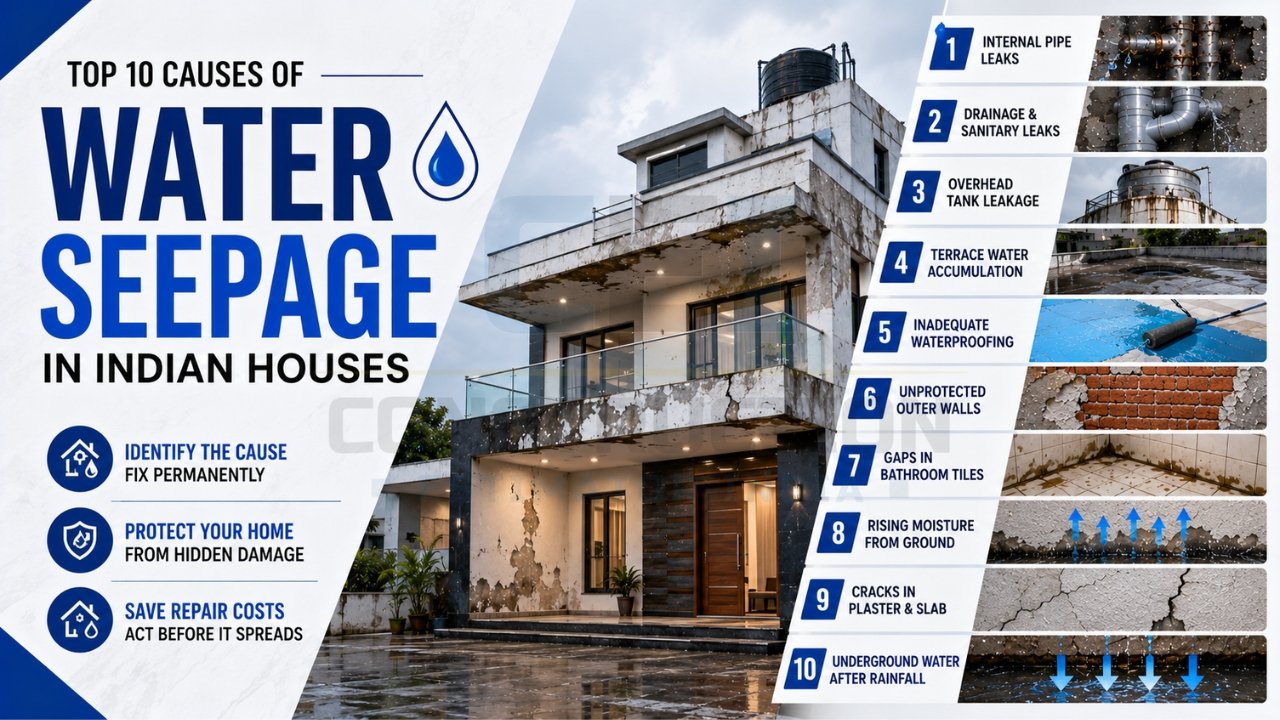
Faulty Internal Plumbing & Hidden Pipe Leaks
Internal plumbing leaks are the silent killers of Indian walls. Often, GI (Galvanized Iron) pipes used in older constructions begin to corrode from the inside. Even modern CPVC pipes can leak at the joints if the adhesive was applied incorrectly. Because these pipes are embedded deep within the masonry, a small pinhole leak can saturate a large area of the wall before any dampness appears on the surface.
👉 Get professional solutions for damp walls, leakage, and seepage issues.
Leaky Drainage Pipes & Sanitary Fitments
Waste pipes from toilets and kitchens are frequent sources of seepage. In many Indian homes, the vertical drainage stacks (PVC pipes) are mounted on the exterior or inside “ducts.” If these pipes develop cracks or if the “P-traps” under sinks and toilets are not properly sealed, wastewater can seep into the floor slabs and walls, causing foul-smelling dampness.
Water Tank Leakage (Overhead Tanks)
Overhead RCC water tanks are a staple of Indian architecture. Over time, the internal plaster of these tanks develops cracks due to the weight of the water and thermal expansion. This allows water to seep into the roof slab directly below, leading to damp ceilings in the topmost floor rooms. Constant overflowing of tanks also saturates the terrace, worsening the problem.
Water Accumulation on Terrace/Roof Due to Poor Drainage
If your terrace does not have a proper “slope” (typically 1:100), rainwater will pool in low spots. In India, dust and debris often clog the drainage outlets (khurras). When water stands on a concrete surface for hours, it exerts hydrostatic pressure, forcing moisture through the pores of the concrete. This is the primary reason for ceiling dampness.
Inadequate Waterproofing During Construction
Many builders, in an attempt to save costs, skip the “integral waterproofing” step. This involves mixing specialized liquid waterproofing compounds into the cement during the casting of slabs and the application of plaster. Without these additives, concrete acts like a sponge, soaking up moisture through capillary action.
Unplastered or Unprotected Outer Walls
External walls are the first line of defense. If the outer plaster is thin, cracked, or worse—if the wall remains unplastered (common in side-alleys)—rainwater hits the bricks directly. Indian bricks are highly porous and will absorb water, which then travels to the interior face of the wall, ruining your expensive interior paint.
Gaps Between Bathroom Tiles
The joints between tiles are often filled with simple white cement, which is brittle and prone to cracking. Once these gaps open up, water from daily bucket baths or showers enters the floor bed. This water has nowhere to go and eventually seeps into the walls of the adjacent rooms or the ceiling of the floor below.
Rising Moisture from Ground (Capillary Action)
Also known as “Rising Damp,” this occurs when the Damp Proof Course (DPC) at the plinth level is missing or damaged. Ground water is sucked up through the foundation and into the walls by capillary action, similar to how a sponge draws up water. This typically affects the bottom 2-4 feet of ground-floor walls.
Cracks in Plaster & Slab
Structural cracks due to building settlement or thermal expansion (due to India’s extreme temperature swings) provide an open highway for water. Even hairline cracks in the external plaster can let in enough moisture during a heavy monsoon to cause significant internal damage.
Natural Underground Water After Heavy Rainfall
In areas with high water tables, like the plains of Uttarakhand and Uttar Pradesh, heavy rainfall can cause the water table to rise significantly. This puts immense pressure on the basement floors and foundation, forcing water through the smallest floor cracks or construction joints.
Visible Signs of Seepage Problem in Your House
Identifying seepage early can save you lakhs in repair costs. Construction Estimator India recommends checking for these signs every year before the monsoon arrives.
Damp Walls & Dark Spots
The most immediate sign is a change in the color of your wall. Patches of the wall may appear darker than the surrounding area, indicating that the masonry is saturated with moisture. If the spot feels cool or clammy to the touch, you have an active seepage issue.
Paint Blisters, Bubbling, and Peeling
As moisture trapped behind the paint tries to evaporate, it pushes the paint film away from the wall. This results in unsightly bubbles or blisters. Eventually, the paint loses all adhesion and begins to flake off in large chunks, leaving the underlying plaster exposed.
White Powdery Efflorescence on Walls
Often mistaken for “white fungus,” efflorescence is actually a deposit of salts. When water travels through bricks and mortar, it dissolves mineral salts. When the water evaporates at the surface, it leaves behind a white, powdery, or crystalline substance that ruins the aesthetics and slowly degrades the plaster.
Mold, Fungus, and Mildew Growth
This is a critical health hazard. Mold appears as black, green, or fuzzy gray spots on damp surfaces. It thrives in humid, poorly ventilated areas of the house. Mold or mildews on walls can be extremely harmful to our health, releasing spores that trigger respiratory distress.
Yellow/Brown Stains on Walls/Ceilings
If the seepage is coming from a plumbing leak or a bathroom upstairs, the water often carries impurities or rust, leaving behind yellowish or brownish “tide marks” on your ceiling or walls. These stains are a clear indicator of a localized water source problem.
Swollen or Warped Wooden Furniture
Wood is highly hygroscopic. If a wooden wardrobe or kitchen cabinet is placed against a seeping wall, it will absorb the moisture. This causes the wood to swell, doors to jam, and laminates to peel off. In many cases, it also leads to termite infestations, as termites love damp wood.
Musty Odor in Rooms
Sometimes you can smell seepage before you see it. A persistent, damp, “earthy” or musty smell in a room usually indicates hidden mold growth or high moisture levels within the walls or under the flooring.
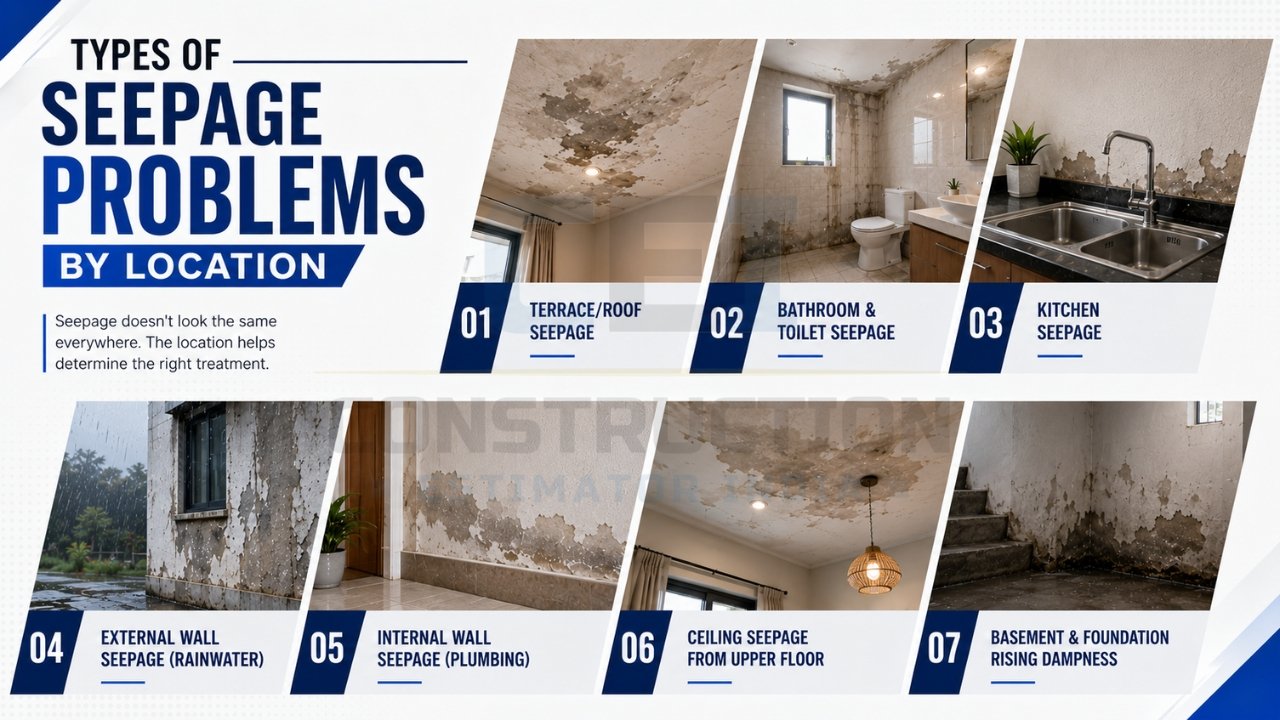
Types of Seepage Problems by Location
Seepage doesn’t look the same everywhere. Depending on where it occurs, the treatment method varies. Construction Estimator India categorizes seepage into several distinct types for accurate diagnosis.
👉 Protect your home from water damage with expert seepage solutions.
Terrace/Roof Seepage
This manifests as damp patches on the ceiling, often around fan hooks or along the corners where the wall meets the slab. It is usually caused by cracks in the terrace concrete or poor drainage. In heavy rains, these spots may even begin to drip water.
Bathroom & Toilet Seepage
Usually visible on the walls shared with the bathroom or on the ceiling directly below the toilet. It is almost always caused by tile gap issues, leaking “concealed” plumbing, or a failure of the sunken slab waterproofing.
Kitchen Seepage
Kitchens are high-moisture zones. Seepage here often occurs behind the sink area due to leaky waste pipes or around the countertop where the seal between the granite and the wall has failed, allowing water to trickle behind the cabinets.
External Wall Seepage (Rainwater)
This affects walls that are directly exposed to the wind and rain. You will notice that these walls become damp only during the monsoon. The moisture usually penetrates through cracks in the external plaster or via poorly sealed window frames.
Internal Wall Seepage (Plumbing)
If a wall in the middle of your house is damp and there’s no rain, the culprit is likely an internal plumbing line. These leaks are persistent and do not change with the seasons, indicating a constant supply of water from a pressurized pipe.
Ceiling Seepage from Upper Floor
If you live in an apartment or a multi-story house, dampness on your ceiling often originates from the floor above. This is a common source of disputes between neighbors but is usually caused by a leaking bathroom or a washed balcony on the upper level.
Basement & Foundation Rising Dampness
Visible at the base of the walls (the first 1-3 feet from the floor). This is caused by water traveling up from the soil. It is particularly common in older Indian houses where the DPC (Damp Proof Course) was either never installed or has deteriorated over time.
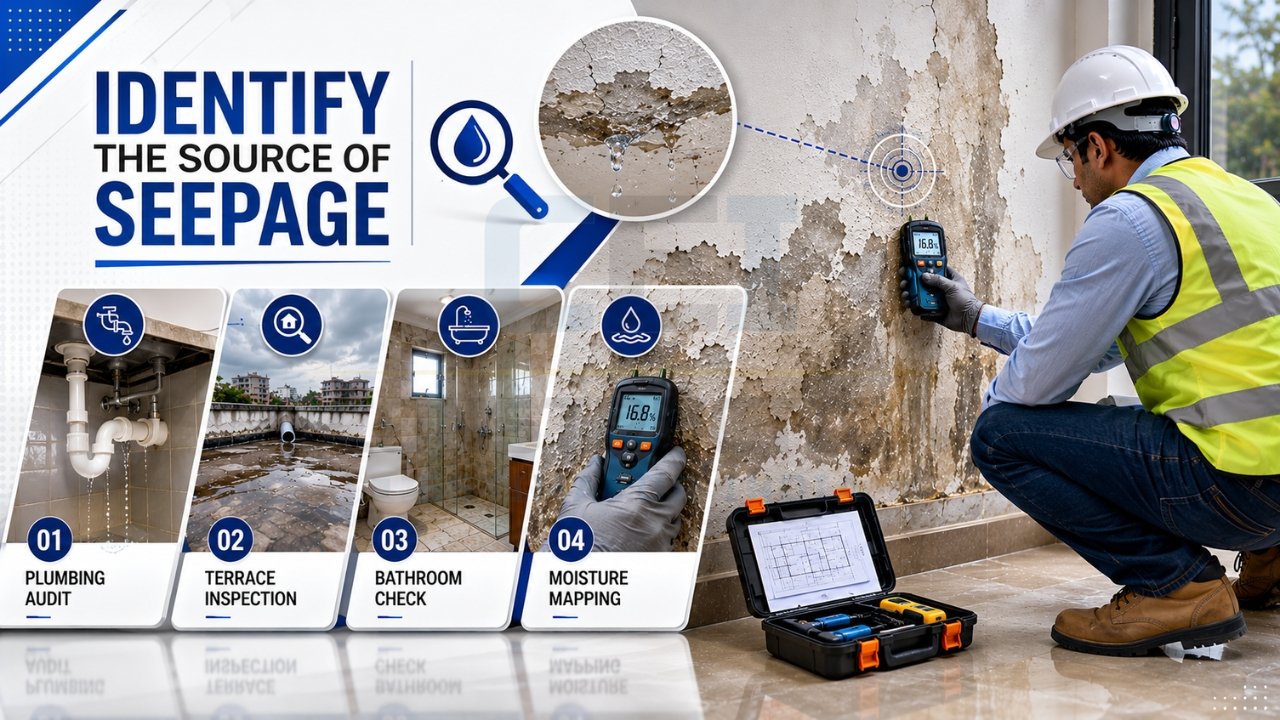
How to Identify the Source of Seepage?
Finding the source is the most important part of the repair. Never treat the wall before fixing the source—it will always come back. Follow this diagnostic process used by Construction Estimator India:
| Step | Action | What to Look For |
|---|---|---|
| 1 | Plumbing Audit | Turn off all taps and check if the water meter is still running. This indicates a hidden leak. |
| 2 | Terrace Inspection | Check for stagnant water and blocked drainage pipes. Inspect the parapet wall joints. |
| 3 | Bathroom Check | Pour water on the bathroom floor and see if the dampness in the adjacent room increases. |
| 4 | External Wall Scan | Use a ladder to check the outside of the building for cracks or unplastered patches. |
| 5 | Moisture Meter | Professionals use moisture meters to map the exact boundaries of the dampness. |
For a foolproof diagnosis, Contact Construction Estimator India at +91 8630676890 for a free site inspection. We use thermal imaging and moisture mapping to find leaks without breaking your walls unnecessarily.
👉 Need help with seepage problems? Speak with our experts on WhatsApp now.
Permanent Waterproofing Solutions for Each Seepage Type
At Construction Estimator India, we believe in using the right chemistry for the right problem. We recommend premium brands like Dr. Fixit, Asian Paints SmartCare, JK Maxx, Pidilite Dampguard, and Birla White for long-lasting results.
Terrace Waterproofing Solution
For terraces, a “membrane” approach is best. After cleaning the surface, we apply a primer followed by two coats of a fiber-reinforced elastomeric coating (like Dr. Fixit Newcoat or Asian Paints SmartCare Damp Proof). This creates a seamless, rubber-like layer that can bridge cracks and withstand standing water.
Bathroom Waterproofing Solution
The best time to waterproof a bathroom is during construction. For existing bathrooms, we recommend “epoxy grouting” for the tile joints. If the leak is severe, the tiles must be removed, and the “sunken” area must be treated with a bituminous or cementitious coating before relaying the tiles.
Wall Seepage Waterproofing
For interior walls, use a “crystalline” waterproofing compound like Dr. Fixit Dampguard. This penetrates the pores of the plaster and reacts with moisture to form crystals, blocking the water’s path. Never skip alkali-resistant primer on seepage walls—regular primer will fail due to the high salt content in damp walls.
External Wall Waterproofing
External walls require “high-build” coatings. Products like Asian Paints SmartCare Apex Ultima Protek provide a thick, flexible shield that protects the brickwork from driving rain while allowing the wall to “breathe.”
Foundation/Damp Proofing Solution
To tackle rising damp, we use “chemical injection.” We drill holes at the base of the wall and inject a silane-based water repellent that creates a new chemical DPC, stopping the upward movement of water.
Plumbing Leakage Repair
This involves replacing old GI pipes with high-quality CPVC or PEX pipes. We ensure all joints are sealed with high-grade solvent cement and pressure-tested for 24 hours before closing the wall.
Crack Sealing & Joint Sealant
Structural cracks should be V-grooved and filled with a non-shrink “crack filler” or polyurethane sealant. For moving joints, a flexible sealant is essential to prevent the crack from reopening during seasonal changes.
Step-by-Step Wall Seepage Repair Process
If you are planning to repair a damp wall, follow this professional sequence. Wait for full curing between every layer—rushing undoes everything.
- Step 1: Find and fix the source. As emphasized, identify the leak source (plumbing, terrace, etc.) and repair it first.
- Step 2: Scrape off old layers. Use a paint scraper or wire brush to remove all peeling paint, loose plaster, and efflorescence. You must reach the “sound” masonry.
- Step 3: Repair cracks. Use a crack-filler paste for minor cracks. For larger gaps, use a polymer-modified mortar.
- Step 4: Apply waterproofing layers. Apply two coats of a waterproofing compound (e.g., Dr. Fixit Dampguard). Allow 6-8 hours of drying between coats.
- Step 5: Apply alkali-resistant primer. This is a non-negotiable step. The primer prevents the salts in the wall from reacting with the new paint.
- Step 6: Apply wall putty. Use a water-resistant putty like Birla White or Asian Paints SmartCare to smoothen the surface.
- Step 7: Apply final paint. Use moisture-resistant or exterior-grade paint even for interior seepage walls—it’s worth the extra investment for the added durability.
Never hide seepage behind panels or furniture—it only gets worse. The lack of ventilation will accelerate mold growth and rot the panels from behind. For professional help with complete waterproofing, Call Construction Estimator India at +91 8630676890.
Prevention: How to Avoid Seepage Problems in New Construction
The cheapest time to fix a leak is before it starts. Construction Estimator India provides complete waterproofing consultation for new construction in Roorkee and Haridwar.
- Integral Waterproofing: Add liquid waterproofing (like Dr. Fixit LW+) to every bag of cement used in foundations, slabs, and plastering.
- Damp Proof Course (DPC): Ensure a 1-inch thick DPC layer is installed at the plinth level to block rising dampness.
- Terrace Slope: A slope of 1:100 is mandatory. Water should never “sit” on the roof.
- Quality Plumbing: Use branded pipes (Astral, Ashirvad, Prince) and avoid too many joints inside the walls.
- External Plastering: Use a “two-coat” plaster system for external walls and finish with a high-quality weather-proof paint.
- Tile Grouting: Use epoxy grout in bathrooms and kitchens from day one. It is 100% waterproof and stain-resistant.
Seepage Repair Cost in India 2026
The cost of repair depends heavily on the severity and the area. Based on recent projects by Construction Estimator India, here are the estimated rates:
- Small Patch Repair: ₹500 – ₹2,000 (localized treatment).
- Bathroom Waterproofing: ₹3,000 – ₹15,000 (depending on whether tiles are removed).
- Terrace Waterproofing: ₹5,000 – ₹25,000 (for standard 1000 sq.ft. roof area).
- External Wall Waterproofing: ₹10,000 – ₹50,000 (depending on height and scaffolding).
- Complete House Waterproofing: ₹30,000 – ₹1,50,000+.
Remember, late action leads to large damage and high repair cost. A small investment today can save you from a major financial burden later. Get a FREE project-specific estimate from Construction Estimator India by calling +91 8630676890.
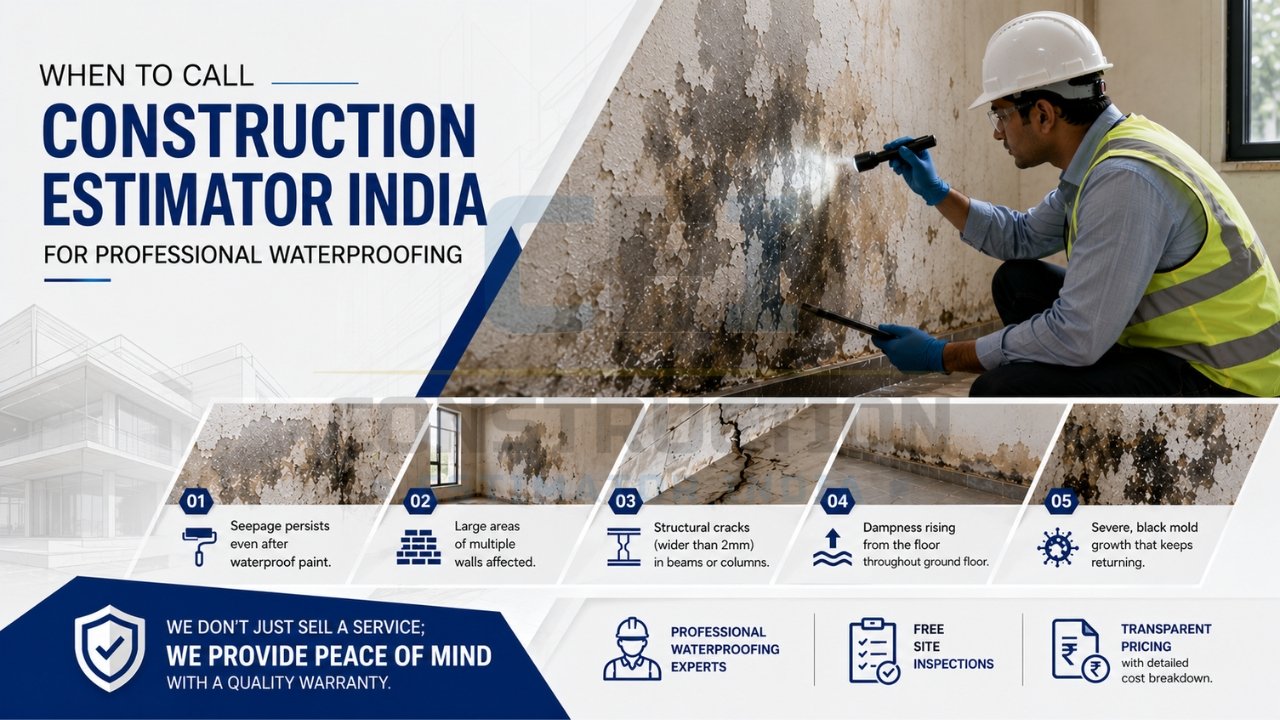
When to Call Construction Estimator India for Professional Waterproofing
While DIY kits exist for small patches, certain situations require the “big guns.” You should consult our experts if:
- Seepage persists even after you’ve tried “waterproof paint.”
- Large areas of multiple walls are affected.
- You see structural cracks (wider than 2mm) in beams or columns.
- Dampness is rising from the floor throughout the ground floor.
- There is severe, black mold growth that keeps returning.
Construction Estimator India offers professional waterproofing experts, free site inspections, and transparent pricing with a detailed cost breakdown. We don’t just sell a service; we provide peace of mind with a quality warranty.
👉 Get expert waterproofing advice and long-lasting seepage solutions.
Frequently Asked Questions (FAQs)
Q1: What is the most common cause of seepage in Indian homes?
The most common cause is water accumulation on terrace/roof due to poor drainage combined with inadequate waterproofing during construction. Heavy monsoon rainfall in India causes water to pool on terraces, penetrating through cracks and weak points. Without a proper slope, the concrete remains saturated for months, leading to deep structural seepage.
Q2: How do I know if my wall has a seepage problem?
Look for visible signs: damp walls with dark spots, paint blisters or bubbling, white powdery efflorescence, mold/fungus growth, yellow/brown stains, swollen wooden furniture, or a musty odor. If you notice any of these, especially after the rainy season, you likely have an active seepage issue that needs immediate attention.
Q3: Can I fix a seepage problem myself or do I need a professional?
Small patch seepage can be a DIY project using proper waterproofing compounds like Dr. Fixit or Asian Paints SmartCare. However, for large areas, structural cracks, foundation dampness, or hidden plumbing leaks, it is best to consult Construction Estimator India at +91 8630676890 for professional help. Improper DIY can often mask a problem while the structure continues to rot underneath.
Q4: Does a seepage problem affect health?
Yes, absolutely. Mold or mildews on walls can be extremely harmful to our health, causing respiratory issues, allergies, asthma, and skin problems. Damp environments also attract dust mites and bacteria, worsening indoor air quality significantly. For families with children or elderly members, fixing seepage is a health priority, not just a cosmetic one.
Q5: What is the best waterproofing compound for walls in India?
Top recommended products include Dr. Fixit Dampguard, Asian Paints SmartCare Damp-proof, Pidilite Dampguard, JK Maxx Waterproofing, and Birla White wall putty. For severe cases, we use acrylic-based or polymer-modified waterproofing coatings that provide better elasticity and bond strength than traditional cement-based solutions.
Q6: How long does waterproofing last?
Quality waterproofing typically lasts 5-10 years for terraces, 3-5 years for bathrooms, and 5-7 years for walls. The lifespan depends heavily on the material quality, application method, weather exposure, and regular maintenance (like cleaning terrace drains). Professional waterproofing from Construction Estimator India typically includes a warranty for added security.
Q7: Should I repaint after fixing seepage?
Yes, absolutely. After fixing the seepage source and applying waterproofing, you must repaint to restore the aesthetics and provide a final protective layer. Never skip alkali-resistant primer—regular primer will fail on treated walls. Use moisture-resistant or exterior-grade paint even for interior walls—it’s worth the investment for its anti-fungal properties.
Q8: Can seepage cause structural damage?
Yes, critically. Structural stability may be compromised if constant seepage within slabs, beams, and columns occurs. Water rusts steel inside RCC, which makes the structure weak. As the rebar expands due to rust, it causes the concrete to “spall” or crack, which can eventually lead to beam weakness and even building collapse in extreme cases.
Q9: How to prevent seepage during the monsoon rainy season?
Before the monsoon: clear terrace drainage outlets, inspect and repair cracks, apply a fresh waterproofing coat, check bathroom tile gaps, and ensure outer walls are plastered. During the monsoon: monitor for water accumulation on roofs, redirect rainwater away from the foundation, and keep plumbing checked for any new leaks triggered by high pressure.
Q10: What is rising dampness and how to fix it?
Rising dampness is moisture traveling upward from the ground through capillary action in walls and floors. It is identified by dampness at the base of the wall. Fix it by installing a Damp Proof Course (DPC) during construction, or in existing homes, by using chemical injection of water repellents into the brickwork and applying damp-proofing coats on the foundation.
Q11: Is efflorescence (white deposit on walls) a sign of seepage?
Yes, efflorescence is a major sign of seepage. It’s a white powdery deposit caused by salts in the plaster or mortar dissolving in water and crystallizing on the surface when the moisture evaporates. It indicates that water is actively penetrating your walls. To fix it, you must find the water source, scrape off the salts, apply a specialized waterproofing treatment, and repaint.
Q12: How do I contact Construction Estimator India for waterproofing services?
You can contact Construction Estimator India by calling or WhatsApping +91 8630676890. We offer a free consultation, free site inspection, and a free project-specific estimate with a detailed cost breakdown. Our services cover everything from terrace and bathroom waterproofing to foundation damp proofing across Roorkee, Haridwar, and Dehradun.