As India’s infrastructure landscape hits high gear in 2026, the complexity of government and PSU projects has reached an all-time high. From high-speed rail corridors to smart city housing in Agra and multi-level flyovers in Lucknow, the stakes are massive. To ensure that these mission-critical projects don’t fall into the hands of incompetent or financially unstable firms, the Indian government has made Prequalification in Construction Tender in India a mandatory gatekeeper for high-value contracts.
For a contractor or builder, Prequalification (PQ) is the “Elimination Round.” It is a specialized vetting process where the department—be it CPWD, NHAI, or a state-level PWD—evaluates your technical and financial muscle before they even look at your price bid. In the 2026 e-tendering era on CPPP (eProcure.gov.in) and GeM, this process is transparent, data-driven, and highly competitive. If your “PQ Bid” fails to meet the stringent turnover or experience benchmarks, your financial bid remains locked and encrypted, regardless of how low your rates are. To participate, you must first understand the fundamental tender in construction definition and how it differs from open bidding. This guide provides a 2026-centric roadmap to mastering the PQ stage and ensuring your firm stays in the race.
What is Prequalification in Construction Tenders in India?
Prequalification is a two-stage bidding process designed to shortlist only those contractors who possess the necessary financial standing and technical expertise to execute a specific work. We can also say that prequalification is a screening stage used in the e-tendering in construction ecosystem.

The Core Definition
Unlike an “Open Tender” where any registered contractor can bid, a tender with a PQ stage requires bidders to submit a “Technical/PQ Envelope” first. The evaluation committee checks if you meet the “Eligibility Criteria” defined in the Notice Inviting Tender (NIT). Only those who pass this “litmus test” are invited to the second stage: the Opening of the Financial Bid.
The Legal Framework in 2026
The PQ process is governed by:
- GFR 2017 (General Financial Rules): Setting the standard for public procurement.
- Manual for Procurement of Works: The updated 2026 guidelines for CPWD and PSUs.
- CVC (Central Vigilance Commission) Guidelines: Ensuring transparency and preventing “tailor-made” criteria to favor specific firms.
Choose Your Construction Services
Connect with verified experts for your project. We provide professional
General Contractors, Sub-contractors, Builders, and Material Suppliers.
Our network also includes specialized 3D Rendering Developers and Interior Experts.
When is Prequalification Required?
In 2026, Prequalification is not usually required for small, routine maintenance works. However, it is mandatory in the following scenarios:
- Large Value Projects: Typically for works exceeding ₹5 Crores to ₹10 Crores (varies by department).
- Complex Engineering: Bridges, tunnels, airports, or high-rise hospital buildings.
- Turnkey/EPC Projects: Where the contractor is responsible for both design and execution.
- International Competitive Bidding (ICB): Where global firms are invited to participate.
Key Prequalification Criteria in Indian Construction Tenders 2026
The following table outlines the “Standard Hurdles” a contractor in Agra, UP, or pan-India must clear to qualify.
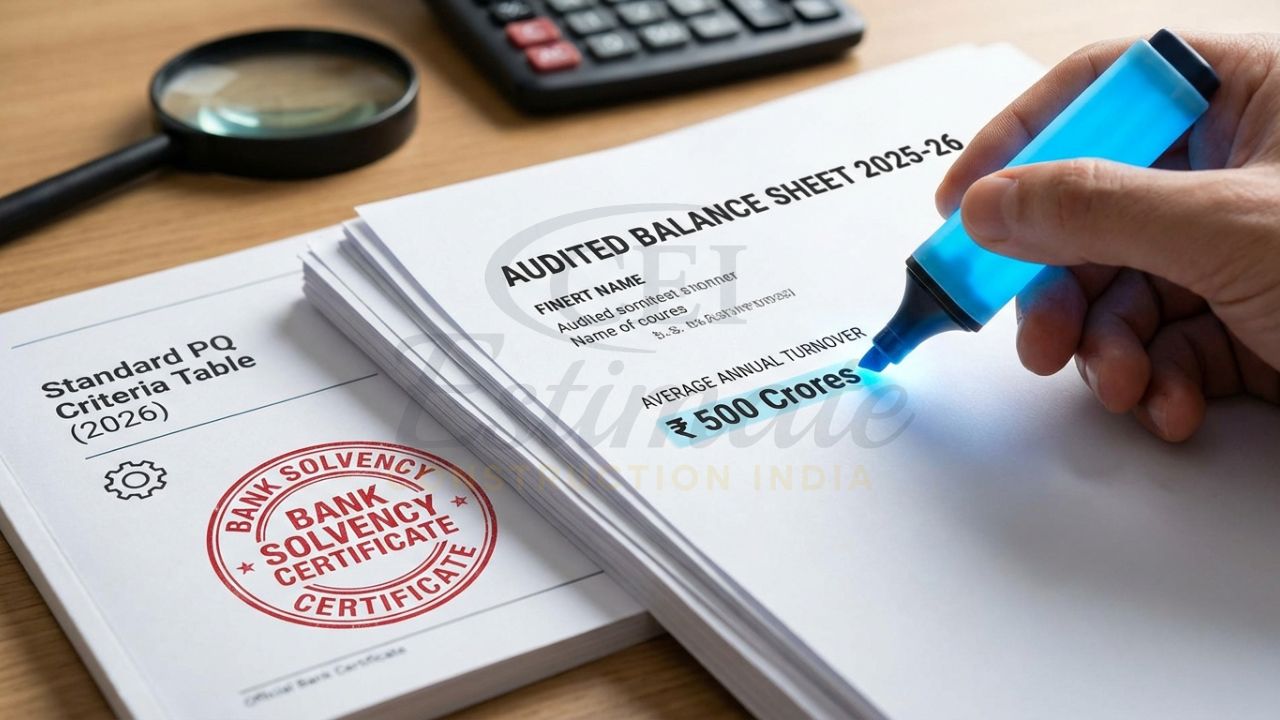
Standard PQ Criteria Table (2026)
| Category | Key Criteria | Typical Requirement (Example) |
| Financial | Avg. Annual Turnover | 100% to 300% of the estimated project cost over the last 3-5 years. |
| Financial | Net Worth | Must be positive; often required to be at least 10-20% of the project value. |
| Financial | Solvency Certificate | Issued by a scheduled bank, covering 40% of the project value. |
| Technical | Similar Work Experience | Completion of 1-3 similar works (50-80% value) in the last 7-10 years. |
| Human Resource | Key Personnel | List of B.E./B.Tech Engineers with 10+ years of specific project experience. |
| Machinery | Equipment List | Proof of ownership or lease for specific plants (e.g., Batching Plant, Paver). |
| Regulatory | Compliance | Valid GST, PAN, EPF, ESI, and non-blacklisting affidavit. |
MSE & Startup Relaxations 2026
Under the Make in India (PPP-MII) Order, many tenders now offer relaxations for registered Startups and MSEs:
- No Prior Turnover: Often waived if the firm meets technical standards.
- No Prior Experience: Waived for certain categories to encourage new players.
- EMD Exemption: Only a “Bid Security Declaration” is required instead of cash.
The Role of Financial Planning
The PQ stage relies heavily on your firm’s historical data. However, for the project at hand, your technical qualification is often linked to how well you understand the construction cost per sq ft in India to prove your bid’s viability.
Step-by-Step Prequalification Process in India 2026
If you are bidding on CPPP eProcure, the process follows this digital sequence:
- NIT Publication: The department uploads the PQ document along with the tender on the portal.
- PQ Bid Submission: You upload scanned copies of audited balance sheets, completion certificates, and CVs of your engineers.
- Technical Scrutiny: An Evaluation Committee (EC) reviews the documents. In 2026, many departments use AI-based cross-verification with the GSTN and Income Tax portals to verify turnover.
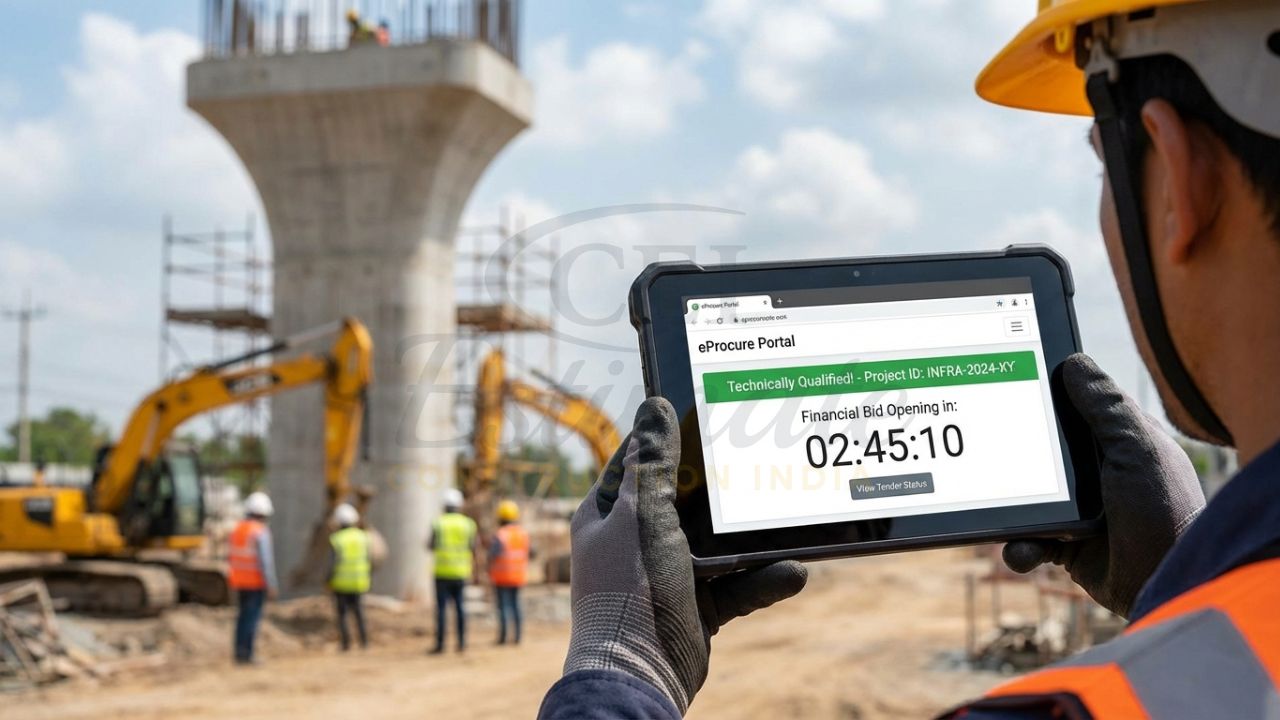
- Shortlisting: A list of “Technically Qualified Bidders” is published on the portal.
- Financial Opening: Only the price bids of the shortlisted firms are “unlocked” and evaluated to find the L1 (Lowest) bidder.
Documents Required for PQ Submission
Prepare this “Golden Folder” to ensure you never miss a PQ deadline:
- Financial Docs: Audited Balance Sheets and P&L Statements for the last 5 financial years.
- Experience Certificates: “Completion Certificates” signed by an officer not below the rank of Executive Engineer.
- Work Orders: Copies of letters of award for ongoing projects.
- Technical CVs: Signed resumes of your project managers and site engineers.
- Equipment Proof: RC copies for machinery or notarized lease agreements.
- Bank Solvency: A fresh certificate (not older than 6 months).

Benefits & Challenges of Prequalification
| Benefits | Challenges |
| Risk Mitigation: Only serious players with “skin in the game” participate. | Entry Barriers: Difficult for small contractors in Tier-2 cities like Agra to jump to larger tiers. |
| Faster Execution: Qualified firms are less likely to abandon projects midway. | Time Consuming: The PQ stage adds 30-45 days to the tender cycle. |
| Fair Price: Prevents “unrealistically low” bids from amateurs that lead to poor quality. | Documentation Heavy: One missing page in an 800-page PQ bid can lead to rejection. |
Tips for Contractors to Qualify in PQ 2026
- Maintain a Clean Financial Record: Ensure your GST filings and ITRs are consistent. Discrepancies lead to “Technical Disqualification.”
- Consortium/JV Advantage: If you lack the turnover for a massive Agra highway project, consider a Joint Venture (JV) with a larger firm to pool your experience.
- Get Specific Certificates: Don’t just get a “Work Done” letter. Ensure it specifies the “Similar” nature of the work (e.g., “Rigid Pavement” vs. “Bituminous Road”).
- Class 3 DSC: Ensure your Digital Signature Certificate is valid; you can’t upload PQ docs without it.
Why Professional Estimation Helps in PQ & Tender Success?
Many contractors fail the PQ stage not because they lack experience, but because they fail to document it correctly or they miscalculate their Net Worth according to the tender’s specific formula.
Professional estimation services help you:
- Gap Analysis: Reviewing the PQ criteria before you even buy the tender to see if you qualify.
- Experience Mapping: Formatting your past projects to align perfectly with the “Similar Work” definitions.
- BOQ Accuracy: Once you qualify, you need a highly precise Detailed Estimate to bid the L1 price without losing money.
Preparing for prequalification in your next construction tender in India 2026? Construction Estimator India provides expert support for PQ applications, detailed estimates, BOQ preparation, experience documentation, and competitive bid strategies starting just at ₹10,000 INR. Our team helps you meet turnover/experience criteria accurately, submit strong PQ docs for CPPP/eProcure or state portals, and improve your qualification chances—whether in Agra, UP or anywhere else.
Contact us today:
Phone/WhatsApp: +91 86306 76890
Email: info@constructionestimatorindia.com
Get your customized prequalification & tender estimation support in just 24 hours and qualify with confidence!
Frequently Asked Questions (FAQs)
What is prequalification in construction tender in India?
Prequalification is a screening process used in the e-tendering process in India 2026 to shortlist contractors based on their technical and financial capabilities. It ensures that only firms with the right experience (similar works) and financial health (turnover/solvency) are allowed to participate in the final price bidding. It is the first stage of a two-envelope or two-stage tender system.
What are the common prequalification criteria for govt construction tenders in India 2026?
Common PQ criteria construction tenders India 2026 include: An average annual turnover of at least 100% of the project value, completion of at least one similar project of 80% value (or two of 50%), a positive net worth, a bank solvency certificate, ownership of specific machinery, and having a team of qualified engineers on the payroll.
How to apply for prequalification in CPPP or eProcure tenders?
Contractors must log in to the CPPP eProcure portal using their DSC. When a tender is published with a “PQ” or “Technical” envelope, bidders must upload scanned, digitally signed copies of their financial audits, work completion certificates, and machinery lists. The department then evaluates these “Pre-Qualification Documents” online.
Are there relaxations in prequalification for startups or MSEs in India?
Yes, under the Startup India and Public Procurement Policy for MSEs, many 2026 tenders offer relaxations. Startups may be exempt from “prior turnover” and “prior experience” criteria, provided they can prove their technical capability. MSEs often get EMD exemptions and a 15% price preference in certain competitive scenarios.
Why do contractors fail in prequalification for construction tenders?
The top reasons for failure in government construction tender PQ India are: 1. Arithmetic errors in calculating average turnover, 2. Submitting “Completion Certificates” that don’t match the “Similar Work” definition, 3. Expired Solvency Certificates, 4. Blacklisting by another department not being disclosed, and 5. Incomplete documentation (missing pages in audited reports).